
What VA Benefits Are Available for Shrapnel Head Trauma?
Explains the dual-rating structure for shrapnel head trauma under VA diagnostic codes—separate pathways for soft-tissue injury and traumatic brain injury—and the legal-process risks that lead to underrating or denial.
- Jurisdiction
- US Federal
- Court
- Board of Veterans' Appeals
- AI tool named
- None
- Ruling date
- Jul 29, 2026
- Source document
- View primary court order ↗
- Last verified
- Jul 29, 2026
Lex Machina Review is an independent risk-tracking and reference resource. Nothing on this site is legal advice, and using it does not create an attorney-client relationship. Every record is reviewed against primary sources but may not reflect the most current status of a matter — always verify directly against the cited court order, rule text, or a licensed attorney before relying on it.
Companion explanation — secondary to the source document above
A veteran who files for “shrapnel wound to head” may be describing one event, but the VA rating system does not treat it as one undivided injury. The wound can leave scarred skin, damaged fascia, retained fragments, muscle loss, pain, and weakness. It can also leave cognitive, emotional, behavioral, or neurological residuals from traumatic brain injury. Those are not rated through the same legal doorway.
That distinction is where many legal claims and benefits issues involving veterans with shrapnel head trauma begin to go wrong. Soft-tissue damage is generally evaluated under the muscle injury schedule in 38 CFR §4.73, Diagnostic Codes 5301–5323. Brain-function impairment is evaluated under Diagnostic Code 8045 in 38 CFR §4.124a. A claim that preserves only one pathway can leave compensable residuals outside the rating decision, even when the service injury itself is not in serious dispute.[1][2][3]
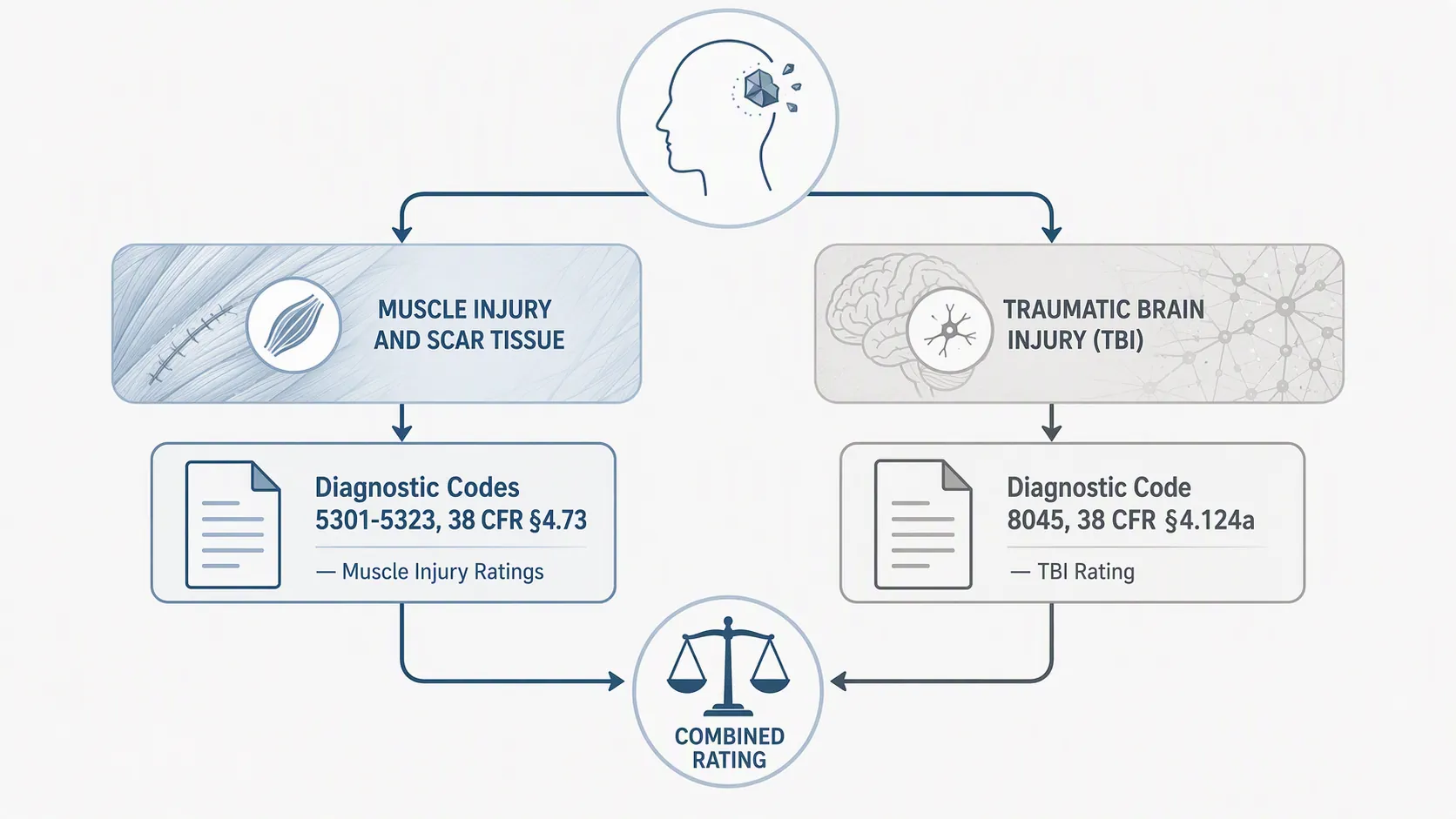
The point is not that every head wound automatically produces two compensable ratings. The point is that the record has to be developed as if two different rating questions may exist. A veteran may need evidence of the in-service shrapnel injury, current physical residuals, current TBI residuals, and medical findings detailed enough for each diagnostic code. Without that separation, the VA can merge symptoms too broadly, miss a residual entirely, or reject part of the claim as unsupported.
This is not limited to one conflict era. Much of the strongest published material on TBI and blast exposure focuses on post-9/11 service, including OEF/OIF/OND. But shrapnel head trauma appears across wars and deployments. The rating problem is not tied to a battlefield label; it is tied to how the current VA record connects an in-service injury to current residuals and then fits those residuals into the correct diagnostic codes.
The Two Rating Tracks Are Separate for a Reason
The muscle-injury side asks a relatively anatomical question: what tissue was injured, where, and how severe are the residuals? The TBI side asks a functional brain question: what impairment remains in memory, judgment, behavior, communication, consciousness, and related areas? Both questions may arise from the same shrapnel event, but they do not measure the same disability.
| Issue in the claim | Typical VA rating pathway | What the record needs to show |
|---|---|---|
| Scalp, face, neck, or nearby soft-tissue wound with muscle involvement | Muscle injury schedule under 38 CFR §4.73, Diagnostic Codes 5301–5323 | Anatomical region, affected muscle group, retained fragments if present, entrance/exit wound findings, loss of fascia or muscle substance, weakness, fatigue, pain, and severity tier |
| Cognitive, emotional, behavioral, or neurological residuals after head trauma | TBI residuals under 38 CFR §4.124a, Diagnostic Code 8045 | Qualifying TBI diagnosis, TBI-specific examination findings, and ratings across the functional facets |
| Scar from shrapnel wound | Potentially separate scar evaluation when supported by the record | Scar location, size, pain, instability, disfigurement, or functional limitation, without duplicating symptoms already rated elsewhere |
| Headaches, dizziness, mood changes, memory problems, or sleep-related complaints | May be considered under TBI facets or separately rated conditions depending on the medical and rating findings | Clear medical attribution and avoidance of pyramiding the same symptom under overlapping codes |
That last column matters because the VA does not compensate the story of the wound in the abstract. It compensates current disability that is service connected and matched to rating criteria. A file can contain a combat injury, a scar, headaches, irritability, and memory complaints, yet still produce a low rating if the examination does not answer the specific questions the rating schedule asks.
How the Muscle-Injury Side Is Usually Built
For shrapnel wounds, the muscle schedule looks at injury to defined muscle groups. Hill & Ponton describes the relevant shrapnel-wound framework as involving Diagnostic Codes 5301–5323, organized across five anatomical regions and four severity levels: slight, moderate, moderately severe, and severe.[1] A head wound may not fit neatly into the mental picture many people have of “muscle injury,” but shrapnel can affect the neck, face, scalp-adjacent tissues, shoulder girdle, or other nearby structures depending on the path of the fragment.
The administrative risk is underdevelopment. A rating decision may acknowledge a shrapnel wound and then move too quickly to a scar rating, without developing whether there is deeper tissue loss, painful retained fragments, weakness, fatigue, loss of muscle substance, or functional impairment in a relevant region. When that happens, the decision may look responsive because it grants something, while still omitting the more serious residual.
A useful record does more than state that the veteran has a shrapnel scar. It identifies the wound path if known, the tissue affected, the current limitation, and the symptoms that belong to the soft-tissue injury rather than the brain injury. If the veteran reports pain at the wound site, tenderness over retained fragments, weakness with use, or fatigue in a specific movement, those findings need to be captured in terms that the muscle schedule can actually use.
This is also where pyramiding confusion begins. The veteran should not be paid twice for the same manifestation under two labels. But avoiding pyramiding does not mean collapsing all residuals into one rating. A painful scar, muscle injury, and TBI-related memory impairment are different kinds of disability if the medical record separates them. The practical task is to separate symptoms honestly, not to make the claim smaller than the injury.
Diagnostic Code 8045 Works Differently
The TBI rating is not built by adding every symptom together. Under Diagnostic Code 8045, the VA evaluates residuals across 10 functional facets: memory and attention; judgment; social interaction; orientation; motor activity; visual-spatial orientation; subjective symptoms; neurobehavioral effects; communication; and consciousness.[2][3]
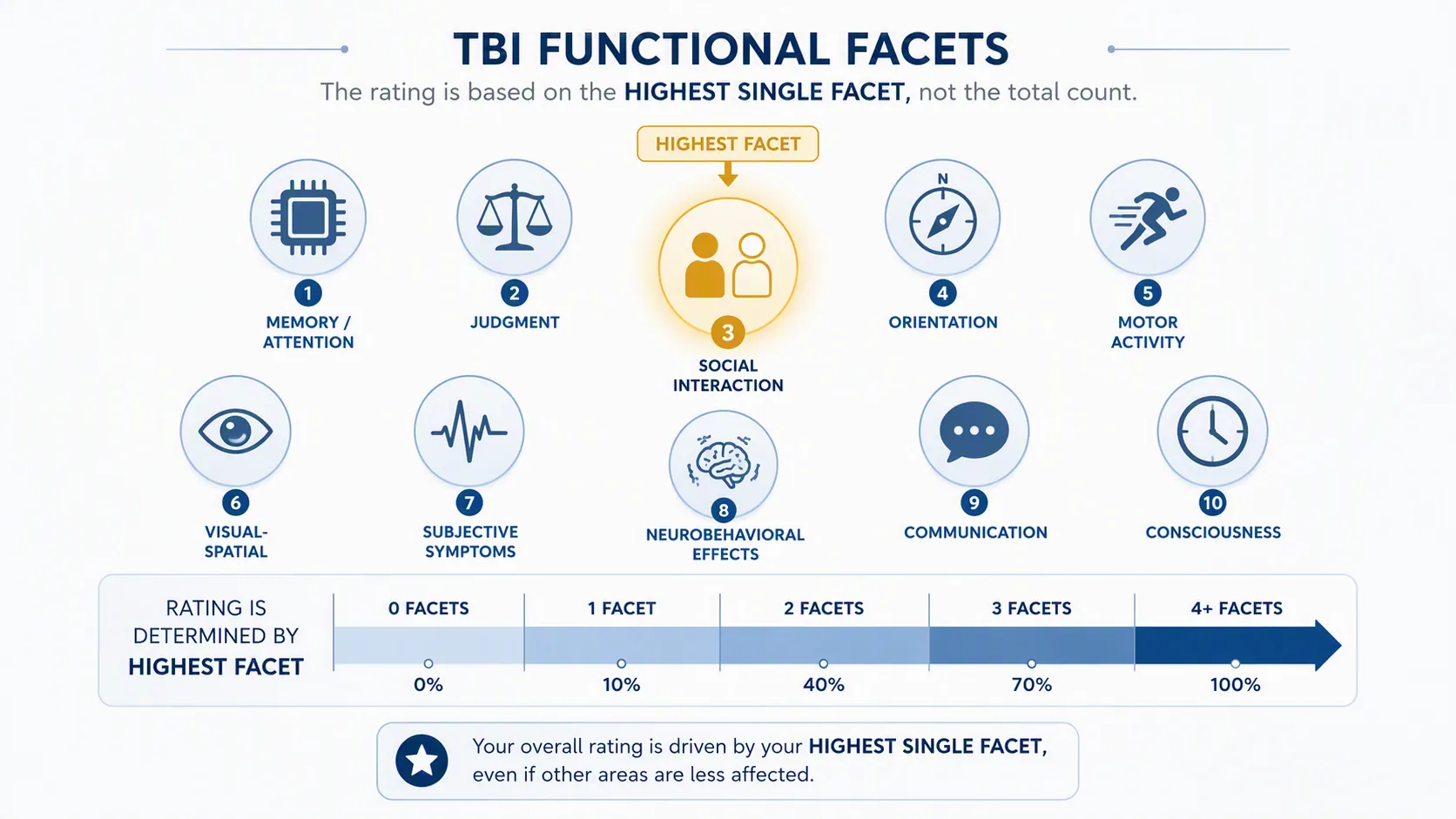
The overall TBI rating then follows the highest single facet level. If the highest facet is 0, the rating is 0 percent. If the highest facet is 1, the rating is 10 percent. If the highest facet is 2, the rating is 40 percent. If the highest facet is 3, the rating is 70 percent. If any facet is evaluated as total, the rating is 100 percent.[2][3]
That structure is counterintuitive for veterans who live with several moderate-seeming problems at once. The system does not simply add mild memory trouble, mild judgment problems, subjective symptoms, and neurobehavioral effects into a higher combined TBI level. The National Academies committee reviewing the disability determination process for veterans with TBI identified this highest-facet method as a concern because it can ignore the cumulative effect of multiple mild impairments.[4]
This is why a veteran can be credibly impaired and still feel underrated. The issue is not always disbelief. Sometimes the record contains several findings, each below the level that drives a higher TBI percentage. The claim then turns on whether the facets were accurately evaluated, whether separately diagnosable residuals should be rated outside the TBI table, and whether the examiner used the right framework in the first place.
The Diagnosis and Exam Cannot Be Casual
A TBI claim does not become viable merely because the veteran, spouse, or primary-care note uses the words “head injury.” The National Academies discussion of VA’s process states that the TBI diagnosis must come from a neurologist, psychiatrist, or neurosurgeon, and that compensation examinations use the TBI-specific Disability Benefits Questionnaire.[4]
That requirement creates a very practical failure point. If a veteran has headaches, irritability, dizziness, sleep disruption, memory lapses, or word-finding problems after a shrapnel head wound, a general medical note may be clinically important but still insufficient for the rating task. The VA needs an examination that walks through the TBI facets and a diagnosis from the required type of specialist. A non-qualifying diagnosis can leave the claim vulnerable even when the symptom history is consistent and sincere.
What the Claim Has to Prove
A well-developed shrapnel head trauma claim usually has to move through five evidentiary tasks. They do not all require the same amount of argument, but skipping one can distort the final rating.
- Establish the in-service injury: service treatment records, combat records, incident reports, line-of-duty material, award citations, photographs, lay statements, or other evidence tying the shrapnel wound to service.
- Document current physical residuals: scar findings, retained fragments, pain, muscle loss, weakness, fatigue, limitation of motion, and any functional loss tied to the wound site.
- Document current brain-function residuals: memory, attention, judgment, orientation, communication, subjective symptoms, neurobehavioral effects, and related problems that may fall under Diagnostic Code 8045.
- Obtain the proper TBI evidence: a diagnosis from a neurologist, psychiatrist, or neurosurgeon and a TBI-specific DBQ that addresses the functional facets.
- Separate overlapping symptoms: identify which symptoms belong to scar, muscle injury, TBI, headaches, psychiatric conditions, or other residuals so the VA does not deny or reduce the claim on pyramiding grounds.
The first task is often easier for veterans with documented combat wounds, but not always. Older records may be incomplete. A wound may have been treated in the field. The more time that has passed, the more important it becomes to connect the current residuals to the original injury with medical reasoning rather than assuming the VA will infer the relationship from the word “shrapnel.”
The second and third tasks are where the dual-track structure becomes concrete. A spouse’s statement that the veteran has become forgetful may help show functional change, but it will not describe muscle loss. A surgeon’s note about retained fragments may help prove physical residuals, but it will not score the memory or judgment facet. A record built for only one audience can fail the other rating pathway.
Where Valid Claims Become Low Ratings
The most common legal-process problem is not that the veteran has no injury. It is that the file lets the VA answer a narrower question than the veteran thought was being asked.
| Failure point | How it affects the rating |
|---|---|
| The claim is filed only as a shrapnel wound or scar | The VA may rate visible or localized residuals while never fully developing TBI facets. |
| The claim is filed only as TBI | The VA may evaluate cognitive and behavioral impairment while overlooking muscle injury, retained fragments, or scar residuals. |
| The TBI diagnosis comes from the wrong source | The file may contain symptoms but lack the required specialist diagnosis for VA’s TBI process. |
| The C&P exam does not use the TBI-specific DBQ | The rating decision may lack findings for the 10 facets that control Diagnostic Code 8045. |
| Several mild facets are treated as insignificant | The highest-facet method can produce a lower rating even when multiple mild impairments affect daily life. |
| The same symptom is claimed under overlapping theories | The VA may reject part of the claim as pyramiding instead of separating distinct residuals. |
The highest-facet issue deserves special attention because it can look like a math problem when it is really a legal-design problem. A veteran with several facet scores at the same lower level may experience real combined impairment. Yet the rating table is driven by the highest facet, not by the total number of affected facets. The National Academies concern about cumulative mild impairments is therefore not a complaint about one bad examiner; it is a warning about how the method itself can underrate some presentations of TBI.[4]
That does not mean every low TBI rating is wrong. It means the decision has to be read carefully. Did the examiner actually address each facet? Did the report explain why memory, judgment, social interaction, subjective symptoms, or neurobehavioral effects were placed at a particular level? Were headaches, psychiatric conditions, vestibular problems, or other diagnosable residuals considered separately where the rules allow? Or did the decision use a general description of “mild TBI” to avoid the facet-by-facet analysis?
Why Early Record Development Matters More Than the Average Timeline Suggests
Processing-time numbers can give a false sense of safety. Hill & Ponton reports an average VA disability claim processing time of 81.1 days as of November 2025.[1] That sounds like a manageable administrative window. It is not the right number to rely on if the initial decision misses the TBI pathway, underdevelops muscle injury, or rates several mild facets in a way that requires an appeal.
The National Academies report found that appeals averaged seven years from initiation to Board of Veterans’ Appeals resolution.[4] That figure changes the practical advice. The objective is not simply to file quickly. It is to file with enough diagnostic-code precision that the first decision has the right evidence in front of it.
For a shrapnel head trauma claim, that usually means naming the residuals rather than relying on the event alone. A filing can identify the shrapnel wound, the scar or muscle injury residuals, the suspected or diagnosed TBI residuals, headaches or other neurological complaints if present, and any psychiatric or behavioral changes that need medical evaluation. The filing should not ask the VA to pay twice for the same symptom, but it should make clear that the wound produced more than one category of residual.
The Evidence Should Match the Code Being Invoked
A useful way to review the file is to ask which rating official could use each piece of evidence. A photograph of a scar may support the existence and appearance of a wound residual. It does not score the judgment facet. A neuropsychological history may support cognitive impairment. It does not identify the affected muscle group. A spouse’s statement may describe changes in memory, irritability, sleep, and social function. It still needs to be connected to the proper medical and rating framework.
The TBI-specific DBQ matters because it forces the examination into the structure that Diagnostic Code 8045 uses. The specialist requirement matters because a TBI label from a non-qualifying source may not carry the claim through the VA’s rules. The muscle-injury findings matter because a scar-only exam may leave deeper residuals legally invisible.
Medical evidence also has to handle attribution carefully. If the veteran has headaches, depression, sleep disturbance, dizziness, memory problems, or irritability, the record should not casually assign every symptom to every condition. Some symptoms may be TBI residuals. Some may support a separate diagnosis. Some may overlap. When attribution is unclear, the VA may choose the narrower route, and the veteran may be left appealing an ambiguity that could have been addressed at the examination stage.
How to Read the Rating Decision
A grant is not the same as a complete rating. After a decision on shrapnel head trauma, the veteran or representative should read for what was actually service connected and what was only mentioned in passing.
- Does the decision identify a muscle injury code, a scar code, a TBI code, or some combination?
- If Diagnostic Code 8045 is used, does the decision discuss all 10 TBI facets and identify the highest facet level?
- If the wound was rated only as a scar, does the record show possible deeper muscle or retained-fragment residuals that were not developed?
- If symptoms were denied as unrelated, did the examiner explain why they are not residuals of the shrapnel head trauma?
- If the VA avoided a separate rating because of pyramiding, did it correctly identify the same manifestation, or did it collapse distinct impairments?
The answer to those questions determines the next move. A missing TBI DBQ may call for challenging the adequacy of the examination. A rating that ignores muscle findings may call for pointing to the correct Diagnostic Codes 5301–5323 analysis. A TBI rating driven by one low facet may require a close review of whether other facets were understated or whether separate residuals should have been evaluated outside the TBI table.
Context Without Overclaiming It
TBI is not a rare concern in the veteran population. VA Research states that nearly one in four U.S. veterans shows signs of probable TBI, and the Defense and Veterans Brain Injury Center reported nearly 414,000 TBIs among service members from 2000 to late 2019.[5][2] Those figures explain why the issue is not marginal. They do not prove that any individual shrapnel wound caused a compensable TBI, and they do not substitute for the specialist diagnosis and facet findings required in a particular claim.
The same caution applies to compensation amounts. Public benefit summaries may quote monthly payment levels for 10 percent through 100 percent ratings, and those amounts can be useful for planning. But VA compensation rates change with cost-of-living adjustments and should be checked against official VA rate tables before a veteran files, appeals, or makes a financial decision based on a projected rating.
The Practical Legal Judgment
VA benefits for shrapnel head trauma may include compensation for muscle injury, scars, TBI residuals, and separately diagnosable conditions when the medical and legal requirements are met. The strongest claim does not treat the wound as one tragic fact and hope the VA sorts it out. It separates the soft-tissue injury from the brain-function injury, documents each residual in the language of the relevant diagnostic code, and avoids claiming the same symptom twice under different labels.
The underrating risk is structural. The muscle schedule and Diagnostic Code 8045 ask different questions. The TBI table uses a highest-facet method that may fail to reflect the cumulative burden of several mild impairments. The claims process can then magnify the problem through the wrong examiner, a missing TBI-specific DBQ, an underdeveloped muscle record, or a rating decision that grants one residual while leaving another legally unaddressed.
This analysis is editorial risk analysis, not legal advice. Before filing or appealing, veterans and representatives should verify current VA rules, official compensation rates, and the evidence required for the specific diagnostic codes at issue.
References
- VA Disability for Shrapnel Wounds, Hill & Ponton
- Getting Up to 100% VA Rating for TBI, Hill & Ponton
- How Does VA Rate a Traumatic Brain Injury?, CCK Law
- Disability Determination Process for Veterans with TBI, NCBI/NASEM
- TBI, VA Research
Related records
Tool profile
Browse tool evaluations →Governing regulation
Browse the obligations tracker →Preventive workflow
Browse verification workflows →
Report a correction or tip
Spotted an outdated figure, a misstated fact, or a ruling this case record should reflect? Public comments are disabled for this content given the professional cost of a misreported case outcome, penalty amount, or rule text — use the structured correction channel instead.
Report a correction or tip for this record →