
How Virginia's Contributory Negligence Rule Affects Car Accident Claims
This article provides a structured framework for evaluating car accident claims under Virginia's pure contributory negligence rule, outlining three common-law exceptions and a causation-analysis path that can salvage otherwise meritorious claims.
- Jurisdiction
- Virginia
- Court
- Supreme Court of Virginia
- AI tool named
- General
- Ruling date
- Jul 30, 2026
- Source document
- View primary court order ↗
- Last verified
- Jul 30, 2026
Lex Machina Review is an independent risk-tracking and reference resource. Nothing on this site is legal advice, and using it does not create an attorney-client relationship. Every record is reviewed against primary sources but may not reflect the most current status of a matter — always verify directly against the cited court order, rule text, or a licensed attorney before relying on it.
Companion explanation — secondary to the source document above
This risk-digest article is an analytical framework, not legal advice. Virginia car-accident fault issues turn on pleadings, discovery, jury instructions, and case-specific facts; any filing, valuation, referral, or partner briefing should be checked against primary Virginia authority and handled by Virginia-licensed counsel.
The first consequence is binary. Virginia remains a pure contributory-negligence jurisdiction: if the defendant proves that the plaintiff was negligent and that the plaintiff’s negligence proximately contributed to the accident, the plaintiff can recover nothing, even when the defendant was also negligent.[1][2] That changes intake. It changes valuation. It changes whether a serious injury case is worth months of records, experts, depositions, and settlement work.
The useful question is not whether the plaintiff did something imperfect. Almost every crash file has an imperfect fact if one looks hard enough: a glance away, a late signal, a rolling approach, an uncertain speed estimate, a lane position that a defense expert can shade into carelessness. The working question is narrower and more dangerous for both sides: can the defense prove, by the greater weight of the evidence, that the plaintiff’s negligence was a legal cause of this collision?

Start with what the defense must prove
Virginia’s harsh rule does not relieve the defendant of proof. The defense has to establish plaintiff negligence and proximate causation. Va. Model Jury Instruction 6.040 is commonly summarized as placing that burden on the defendant by the greater weight of the evidence, and Lerwill v. Regent Van & Storage is described as requiring contributory negligence to be a substantial, “but for” cause of the accident.[1]
That burden is the difference between a bad fact and a case-killing fact. A plaintiff who failed to use ideal care has created a defense theme. A plaintiff whose failure legally helped cause the crash has created a contributory-negligence bar. The distance between those two propositions is where early case assessment belongs.
| Defense step | What counsel should test | Why it matters |
|---|---|---|
| Alleged plaintiff negligence | Identify the exact act or omission: speed, lookout, signal, following distance, lane position, intoxication, distraction, or some other conduct. | A vague claim that the plaintiff “should have been more careful” is not enough. |
| Proof of negligence | Ask what evidence supports the allegation: witness testimony, video, event data, phone records, scene measurements, medical evidence, or admissions. | The defense bears the burden; suspicion is not proof by the greater weight of the evidence. |
| Proximate cause | Separate carelessness from causation. Did the plaintiff’s act help bring about the collision, or was it merely present in the story? | The bar applies only if the plaintiff’s negligence was a legal cause of the accident. |
| Timing | Decide whether the plaintiff’s negligence was contemporaneous with the defendant’s negligence or only sequential/background conduct. | Under the causation-first path, a completed or non-causal plaintiff mistake may not defeat recovery. |
The causation-first path: Ponirakis and the timing problem
The most useful screen in a Virginia contributory negligence analysis is causation before blame. A 2026 secondary guide describes Ponirakis v. Choi as requiring the plaintiff’s negligence to be contemporaneous with the defendant’s negligence; sequential negligence, on that account, does not automatically supply the proximate cause needed for the bar.[3] Counsel relying on the case should verify the primary opinion before quoting it, but the analytical point is sound enough to structure intake: sequence matters.
A hypothetical shows the distinction without pretending to decide a real case. Suppose a plaintiff made an arguable lane-change error several seconds before impact, then fully established position in the lane before being struck by a speeding defendant. The lane change may still be useful impeachment. It may affect how a jury hears the plaintiff. But unless that lane change remained a proximate cause of the crash at the moment the defendant’s negligence operated, it is not automatically contributory negligence in the case-ending sense.
Change the facts and the risk changes. If the plaintiff drifted into the defendant’s lane at the same time the defendant was speeding, or began a turn without yielding while the defendant failed to keep a proper lookout, the defense has a cleaner contemporaneous-causation story. The plaintiff’s conduct is no longer background color; it is part of the collision mechanics.
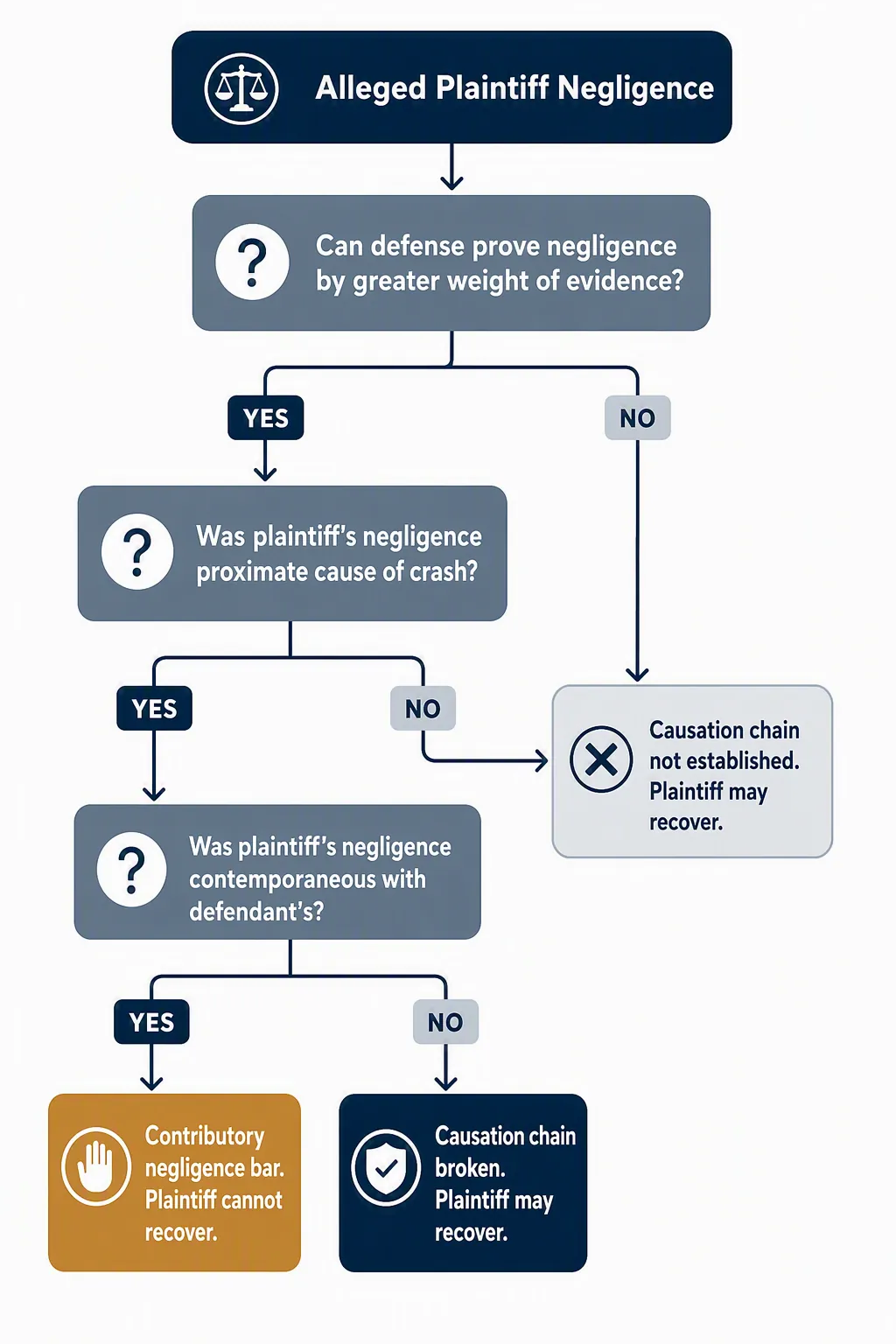
This is where a file often turns. The plaintiff’s intake story may be sympathetic and still not survive if the plaintiff’s negligent act was active in the causal chain. A file may also look poor at first glance and improve once the alleged plaintiff fault is pinned to a time, place, and mechanism. The defense has to prove more than “the plaintiff did something imperfect.” It has to prove that the imperfection mattered legally.
Records that make the timing issue concrete
The causation-first analysis should drive discovery choices. The file needs the evidence that locates conduct in time: dash or surveillance video, traffic-signal sequencing, event data, vehicle damage geometry, roadway measurements, skid or yaw evidence, sight-distance photographs, phone-use timing, police diagrams, body-camera statements, and early witness accounts. Some of that evidence may hurt. That is the point. A Virginia file with unresolved timing ambiguity is not merely underdeveloped; it may be carrying total-loss exposure.
Last clear chance has two branches, and confusing them is expensive
Last clear chance is the exception most likely to be invoked too casually. It does not mean the defendant had some earlier opportunity to drive better. It asks whether, after the plaintiff was in peril, the defendant had the final clear opportunity to avoid the injury. Coutlakis v. CSX is commonly described as confirming two branches: the helpless plaintiff and the inattentive plaintiff.[4][5]
| Branch | Plaintiff’s condition | Defendant knowledge requirement | Typical proof focus |
|---|---|---|---|
| Helpless plaintiff | The plaintiff is in peril and physically unable to escape. | The defendant saw or should have seen the plaintiff’s peril in time to avoid the injury. | Sight lines, stopping distance, reaction time, speed, lighting, roadway layout, and whether the plaintiff’s danger was objectively discoverable. |
| Inattentive plaintiff | The plaintiff is in peril but could physically escape if attentive. | The defendant actually saw and realized the plaintiff’s peril in time to avoid the injury. | Admissions, witness testimony, video, horn use, braking behavior, evasive steering, and any evidence that the defendant perceived the danger before impact. |
The distinction matters because “should have seen” does not carry the same load in both branches. A helpless plaintiff can use constructive knowledge. An inattentive plaintiff generally needs actual perception and realization of peril by the defendant. If the record only shows that a careful driver would have noticed the plaintiff sooner, that may be enough to argue ordinary negligence by the defendant; it may not be enough for last clear chance under the inattentive-plaintiff branch.
For intake, last clear chance should be treated as a proof question, not a rescue phrase. Who saw whom? When? From what distance? At what speed? With what available escape route? How long did the defendant have after the plaintiff’s peril became apparent or should have become apparent? A doctrine that depends on the last clear opportunity cannot be evaluated from sympathy, injury severity, or a one-sentence police narrative.
Willful and wanton negligence is a narrow exit, not a routine workaround
A defendant’s willful and wanton negligence can defeat a contributory-negligence defense, but the bar is materially higher than ordinary negligence. The secondary materials frame the Virginia standard around conscious disregard: conduct worse than a mere failure to use reasonable care.[3][6] That makes the category tempting in severe crashes and dangerous in marginal proof records.
The caution is not academic. A 2026 guide reports a December 2025 Fourth Circuit discussion, attributed to Virginia Lawyers Weekly, in which a conscious-disregard finding was reversed despite crash severity.[3] Because the primary appellate opinion was not available in the provided materials, that report should be verified by direct docket or opinion review before being used in a brief, demand package, or internal risk memo. The safer lesson at this stage is narrower: serious injury and bad driving do not automatically establish willful and wanton negligence.
Intoxication can supply an evidentiary hook, but it should not be overstated. The provided materials identify a BAC at or above 0.15% in connection with a statutory presumption under Va. Code § 18.2-266 and aggravated-misconduct analysis.[6] Even then, counsel should avoid the shortcut that intoxication automatically defeats contributory negligence. The file still needs the causal story: how the intoxication affected perception, speed, braking, lane control, reaction time, or decision-making, and how that conduct produced the crash.
Sudden emergency protects reaction, not poor setup
Sudden emergency is the third recurring exception. It can protect a plaintiff whose split-second reaction to an unexpected danger is later criticized as imperfect, so long as the plaintiff did not create the emergency through their own negligence. Virginia practice materials treat it as one of the recognized ways to answer a contributory-negligence defense, but it remains fact-sensitive.[1]
The doctrine is strongest when the record separates the plaintiff’s emergency response from the creation of the hazard. A driver who swerves because another vehicle abruptly crosses the centerline presents a different question from a driver who is already speeding, following too closely, or looking away and then claims emergency when traffic stops. The former may be about reasonable reaction under pressure. The latter gives the defense a way to argue that the emergency was self-created.
Why the Virginia rule matters beyond doctrine
The financial delta is easy to understand and hard to ignore. A plaintiff who is 1% at fault on a $100,000 claim would recover nothing in Virginia under pure contributory negligence, while the same plaintiff would recover $99,000 in a pure comparative-fault state.[7] That difference affects settlement leverage, referral judgment, reserve discussions, and any regional strategy involving Virginia-adjacent crashes.
The available crash context also explains why the issue is not rare. A 2026 secondary guide, attributing figures to Virginia DMV 2023 crash data and a VDOT survey, reports 127,597 Virginia crashes in 2023, one every 4.1 minutes, with 16.87% involving distracted driving and 66% of Virginians admitting to distracted driving.[3] Those figures should be checked against the underlying DMV and VDOT publications before publication-grade statistical reliance, but even as attributed context they show why small fault allegations arise constantly.
Regional counsel also need to be careful with assumptions imported from nearby jurisdictions. The provided materials describe Maryland and the District of Columbia as having enacted vulnerable-road-user exceptions in 2025, widening the regional gap with Virginia for certain pedestrian, cyclist, and other vulnerable-road-user claims.[3][6] The statutory text in those jurisdictions should be verified before making a cross-border comparison, but the practical point remains: a claim that looks viable under one local fault regime may become far more fragile when Virginia law controls.
As of mid-2026, the supplied secondary research identifies no enacted Virginia reform abolishing or modifying contributory negligence, and the 2026 Virginia Code update effective July 1, 2026 does not change that posture in the materials reviewed.[3] That should be stated as no enacted reform, not as a claim that no bill, proposal, or advocacy effort existed.
A practical go/no-go lens for a Virginia car accident file
A disciplined intake review should force the file through the defense’s proof path before the office becomes invested in injury severity. The order matters: negligence, proof, proximate cause, timing, then exceptions. Skipping straight to damages invites exactly the kind of late-stage collapse Virginia’s rule makes possible.
- Define the plaintiff-fault allegation with precision. “Distracted,” “speeding,” or “failed to keep a lookout” is a category, not proof.
- Ask what admissible evidence the defense can use to prove that allegation by the greater weight of the evidence.
- Separate negligence from causation. A plaintiff mistake that did not help cause the impact should not be treated as automatically fatal.
- Pin the alleged plaintiff negligence to the collision sequence. If it was sequential, completed, or merely background conduct, Ponirakis-style causation analysis becomes central.
- Test last clear chance under the correct branch. Helpless-plaintiff and inattentive-plaintiff cases do not carry the same defendant-knowledge requirement.
- Reserve willful and wanton negligence for records showing conscious disregard, not just severe consequences or ordinary driving errors.
- Use sudden emergency only where the plaintiff’s challenged conduct was a reaction to an unexpected peril the plaintiff did not negligently create.
- Verify primary authority before relying on secondary-source case descriptions, reform-status statements, regional statutory comparisons, or attributed crash statistics.
Virginia remains unforgiving, but the intake answer is not automatic rejection whenever a plaintiff has a bad fact. The proper screen is narrower and more exacting: can the defense prove plaintiff negligence, prove proximate cause, place that negligence in the operative collision sequence, and avoid a supported exception? If the answer is yes, the claim may be worth little despite serious damages. If the answer is no, the contributory-negligence defense may be loud without being dispositive.
References
- Contributory Negligence in Virginia: The Harsh Rule and Exceptions To Defeat It — MartinWren, P.C.
- How Contributory Negligence Works in Virginia — Marks & Harrison
- Navigating Contributory Negligence in Virginia: The 2026 Guide — Leaders in Law
- Revisiting the Last Clear Chance Doctrine — Allen & Allen
- The "Last Clear Chance" Exception — Kendall Law Firm
- What Happens to My Virginia Car Accident Case If I'm Even 1% At Fault? — Fishwick & Associates
- Virginia's Contributory Negligence Rule: Why It Can Destroy Your Car Accident Claim — Frei, Mims & Perushek
Related records
Tool profile
Browse tool evaluations →Governing regulation
Browse the obligations tracker →Preventive workflow
Browse verification workflows →
Report a correction or tip
Spotted an outdated figure, a misstated fact, or a ruling this case record should reflect? Public comments are disabled for this content given the professional cost of a misreported case outcome, penalty amount, or rule text — use the structured correction channel instead.
Report a correction or tip for this record →