
Virginia Felony Procedure: Elijah Bieniemy Case Timeline
A procedural-reference article using the live Elijah Bieniemy prosecution as a date-anchored illustration of Virginia's felony criminal process, mapping each step from arrest through preliminary hearing to Circuit Court trial timeline.
- Jurisdiction
- Virginia, United States
- Court
- Loudoun County General District Court
- AI tool named
- None
- Ruling date
- Aug 31, 2026
- Source document
- View primary court order ↗
- Last verified
- Jul 28, 2026
Lex Machina Review is an independent risk-tracking and reference resource. Nothing on this site is legal advice, and using it does not create an attorney-client relationship. Every record is reviewed against primary sources but may not reflect the most current status of a matter — always verify directly against the cited court order, rule text, or a licensed attorney before relying on it.
Companion explanation — secondary to the source document above
Current status as of July 28, 2026
This is a procedural reference record, not legal advice and not an AI-sanction or legal-tech incident. The live question for readers tracking legal updates in the shooting case involving Elijah Bieniemy and Mia Bieniemy is where the Virginia prosecution actually sits: arrest has occurred, arraignment has occurred, bond has been denied, and the next scheduled court event is a preliminary hearing in Loudoun County General District Court.
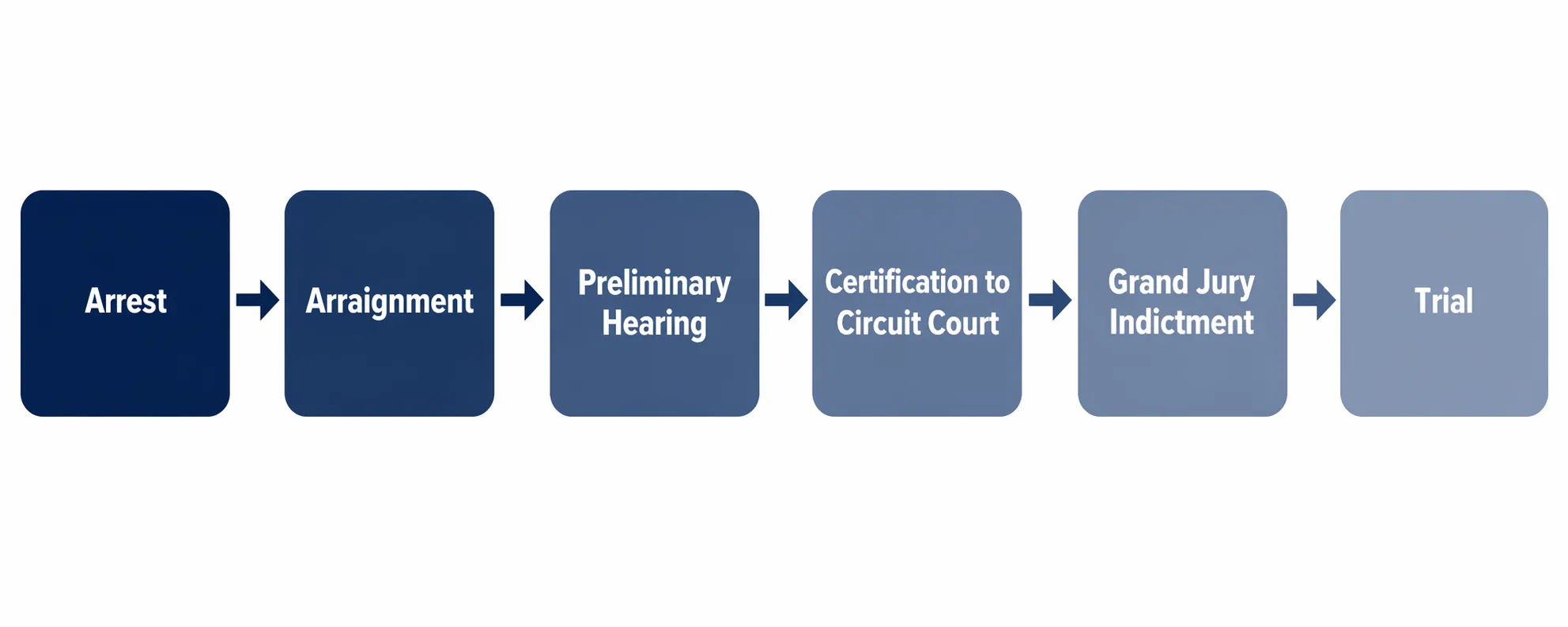
| Date | Court or actor | Event | Procedural meaning |
|---|---|---|---|
| July 26, 2026 | Loudoun County Sheriff’s Office / magistrate | Elijah Bieniemy arrested at an Ashburn residence after a reported shooting; same-day custody followed magistrate probable-cause review. [1][2] | The arrest and initial custody posture start the felony case; they do not decide guilt. |
| July 27, 2026 | Loudoun County General District Court | Arraignment; defendant ordered held without bond. [1] | The General District Court formally brings the defendant before the court and addresses initial custody conditions. |
| August 31, 2026, 1:00 p.m. | Loudoun County General District Court | Preliminary hearing scheduled. [1] | The Commonwealth must show probable cause, not prove the case beyond a reasonable doubt. |
| After August 31, if probable cause is found | General District Court to Circuit Court | Certification toward the Loudoun County Circuit Court grand jury. [3] | The case would move toward indictment and later Circuit Court scheduling. |
Readers looking for charge-by-charge penalties should use the companion sentencing analysis, Eric Bieniemy's son faces up to 35 years on Virginia felonies. This article stays with the docket path: what has happened, what the August 31 hearing is for, and what would follow if the case is certified.
What the first 48 hours did
The reported arrest was warrantless and occurred at the Ashburn residence on July 26, 2026. NBC4 reported criminal-complaint details that include a 911 call by Mia Bieniemy, recovery of a .22-caliber firearm, and two gunshot wounds to the upper body, with a projectile fragment lodged in the body. [1] The Loudoun County Sheriff’s Office release, by contrast, identified the person shot only as “an adult female,” so the victim’s name is better sourced to media reporting and the complaint details described there, not to the sheriff’s public release itself. [1][2]
That sourcing distinction matters because early felony records often arrive in layers. A sheriff’s release can confirm the law-enforcement response and broad allegations. A criminal complaint can add sworn factual allegations. A court docket can confirm settings, custody posture, and the next hearing. None of those sources is a trial record.
After arrest, the magistrate stage is the first legal checkpoint. The point is not to decide whether the Commonwealth can win at trial. It is to determine whether there is probable cause for criminal process and initial detention decisions. In the ordinary Virginia felony path, that happens before the case is developed into a Circuit Court prosecution. [3]
The July 27 arraignment then placed the case before the Loudoun County General District Court. NBC4 and NFL.com reported that Bieniemy was held without bond after that appearance. [1][4] A no-bond order is important for custody, but it should not be converted into a prediction about guilt, plea posture, or eventual sentence. It tells the reader the defendant remains detained unless that posture changes through later court action.
General District Court is not the trial court for these felonies
Virginia’s General District Court can handle the early felony machinery: warrants, advisement, bond, and preliminary hearing. It is not where a felony jury trial on these charges would occur. If the prosecution clears the preliminary-hearing threshold, the case is certified toward Circuit Court, where the grand jury and any later felony trial belong. [3]
That is why the August 31 setting is more useful than any early speculation about trial dates. There is no publicly identified defense attorney in the materials reviewed as of July 28, 2026, and no case-specific Circuit Court scheduling order to analyze. Until the preliminary hearing occurs, any confident claim about trial timing, motions practice, or defense strategy is ahead of the record.
The August 31 preliminary hearing is a probable-cause hearing
The preliminary hearing is scheduled for August 31, 2026, at 1:00 p.m. [1] Its function is narrow. The Commonwealth must show probable cause that a felony was committed and that the accused committed it. That is a low threshold compared with proof beyond a reasonable doubt, and it is not a decision on the final merits. [3]
At that hearing, the Commonwealth may use the evidence already described in public reporting to support probable cause: the reported 911 call, the recovered .22-caliber firearm, and forensic information about the two gunshot wounds. [1] The court’s task is not to resolve every inconsistency, weigh all credibility as a trial factfinder would, or impose punishment. The task is to decide whether the case should move out of General District Court and into the Circuit Court track.
A defense lawyer may test the Commonwealth’s showing through cross-examination and argument, but nothing in the available public record identifies counsel or establishes a particular defense theory. That restraint is not cosmetic. Early criminal complaints often tell only the Commonwealth’s opening version of events. The preliminary hearing may clarify facts, narrow issues, or simply certify the case without revealing much about the eventual defense.
The charges, kept in procedural proportion
The reported charges are three felony counts: malicious wounding under Virginia Code § 18.2-51, use of a firearm in the commission of a felony, and discharge of a firearm inside a dwelling under Virginia Code § 18.2-279. [1][5][6][7] Those statutes explain sentencing exposure and required elements, but they do not change the immediate procedural question. Before any Circuit Court trial setting matters, the General District Court must address probable cause.
The firearm-use count deserves one brief procedural note because it is sometimes misread in early coverage. Virginia’s firearm-use statute carries a mandatory consecutive term for a first offense, but that consequence matters only after conviction. [6] It should not be used to make the preliminary hearing sound like a sentencing event.
If probable cause is found
If the General District Court finds probable cause on August 31, the case is certified to the Loudoun County Circuit Court grand jury. [3] Certification is not a conviction, and it is not an indictment by itself. It is the procedural handoff that says the felony allegations have cleared the preliminary screen and may proceed toward the court that has felony trial jurisdiction.
The next major event would be grand jury review. If an indictment follows, Circuit Court arraignment, motions deadlines, discovery practice, plea discussions, and trial scheduling would move on that court’s calendar. The available sources support only a typical Loudoun County estimate: approximately 3–6 months from indictment to trial in ordinary practice, not a promise about this prosecution. [8]
That distinction is especially important here because the case is in its earliest stage. A trial estimate can be useful for planning, but it is not a docket entry. Continuances, motions, indictment timing, witness availability, forensic work, plea negotiations, and counsel scheduling can all affect the actual calendar once the case reaches Circuit Court.
If probable cause is not found
If the General District Court does not find probable cause, the charges before it are dismissed at that stage. [3] That is the other side of the August 31 fork, and it is why the hearing is more than a scheduling formality even though the Commonwealth’s burden is low.
The public record available now does not justify stronger predictions. It supports a narrower conclusion: the prosecution has entered the standard Virginia felony sequence, the defendant is currently held without bond, and the next meaningful test is probable cause in General District Court.
What the docket does not yet show
The docket posture does not show a defense strategy. It does not show a Circuit Court trial date. It does not show whether motions will challenge the complaint, custody status, forensic evidence, witness statements, or any other part of the case. It also does not turn the defendant’s custody status into proof of the allegations.
The family connection explains why the case drew national attention, but it does not change the Virginia procedure. The legally operative dates remain July 26 arrest, July 27 arraignment and no-bond order, and August 31 preliminary hearing. After that, the case either stops in General District Court for lack of probable cause or moves toward Circuit Court certification, grand jury review, and later trial scheduling.
References
- NBC4 Washington report on Elijah Bieniemy criminal complaint, NBC4 Washington, July 2026
- Loudoun County Sheriff’s Office press release AID=10789, Loudoun County Sheriff’s Office, July 2026
- Criminal Case Procedures, Virginia’s Judicial System
- NFL.com report on Elijah Bieniemy custody status, NFL.com, July 2026
- § 18.2-51. Shooting, stabbing, etc., with intent to maim, kill, etc., Code of Virginia
- § 18.2-53.1. Use or display of firearm in committing felony, Code of Virginia
- § 18.2-279. Discharging firearms or missiles within or at building or dwelling house, Code of Virginia
- Loudoun County General District Court local practices, Loudoun County General District Court
Related records
Tool profile
Browse tool evaluations →Governing regulation
Browse the obligations tracker →Preventive workflow
Browse verification workflows →
Report a correction or tip
Spotted an outdated figure, a misstated fact, or a ruling this case record should reflect? Public comments are disabled for this content given the professional cost of a misreported case outcome, penalty amount, or rule text — use the structured correction channel instead.
Report a correction or tip for this record →