
Walmart's Liability Exposure in the 2026 Cyclospora Lettuce Recall
An analysis of Walmart's product liability risk from the July 2026 Taylor Farms cyclospora outbreak, examining the retailer's exposure under strict liability exceptions, negligence claims based on Taylor Farms' prior contamination history, and the aggregate pressure from a massive outbreak involving Walmart's own Marketside brand.
- Jurisdiction
- US-Federal
- Court
- U.S. District Court for the Northern District of Ohio
- AI tool named
- None
- Ruling date
- Jul 17, 2026
- Source document
- View primary court order ↗
- Last verified
- Jul 26, 2026
Lex Machina Review is an independent risk-tracking and reference resource. Nothing on this site is legal advice, and using it does not create an attorney-client relationship. Every record is reviewed against primary sources but may not reflect the most current status of a matter — always verify directly against the cited court order, rule text, or a licensed attorney before relying on it.
Companion explanation — secondary to the source document above
Risk Digest Verification
| Item | Current Record |
|---|---|
| Last verified | July 26, 2026, using public CDC, FDA, recall-reporting, and litigation-reporting sources available by that date. |
| Outbreak status | CDC surveillance reported 4,173 confirmed domestic cyclosporiasis cases, 308 hospitalizations, and cases across 41 states as of July 24, 2026; at least 7,400 additional cases were under investigation. The outbreak-specific count tied to Taylor Farms/Taco Bell exposure was narrower: 1,947 cases across 9 states and 98 hospitalizations. [1][2] |
| Recall status | Taylor Farms voluntarily recalled all iceberg lettuce from central Mexico on July 17, 2026; Walmart removed four Marketside-brand products from stores in 27 states. [3] |
| Named defendants identified | First-wave litigation publicly identified Taco Bell franchise entities, Taylor Farms, and Taco Bell-related defendants, but no lawsuit naming Walmart as a direct defendant had been identified as of July 26, 2026. [4][5] |
| Scope of this note | Predictive product-liability exposure analysis, not legal advice and not reporting of a filed Walmart case. |
The immediate question is not whether Walmart caused the contamination. On the public record, Taylor Farms and Taco Bell are closer to the alleged point of contamination and service. The question for a complaint-drafting lawyer, or for an in-house lawyer trying to brief leadership before the caption changes, is narrower and more practical: why might plaintiffs name Walmart anyway?
Three facts make Walmart harder to leave in the background than an ordinary passive seller. The recalled products were sold under Walmart’s Marketside brand. They were pre-cut, bagged lettuce products, not untouched heads of produce. And the supplier, Taylor Farms, entered this outbreak with a recent public contamination record that a negligence plaintiff will almost certainly plead.
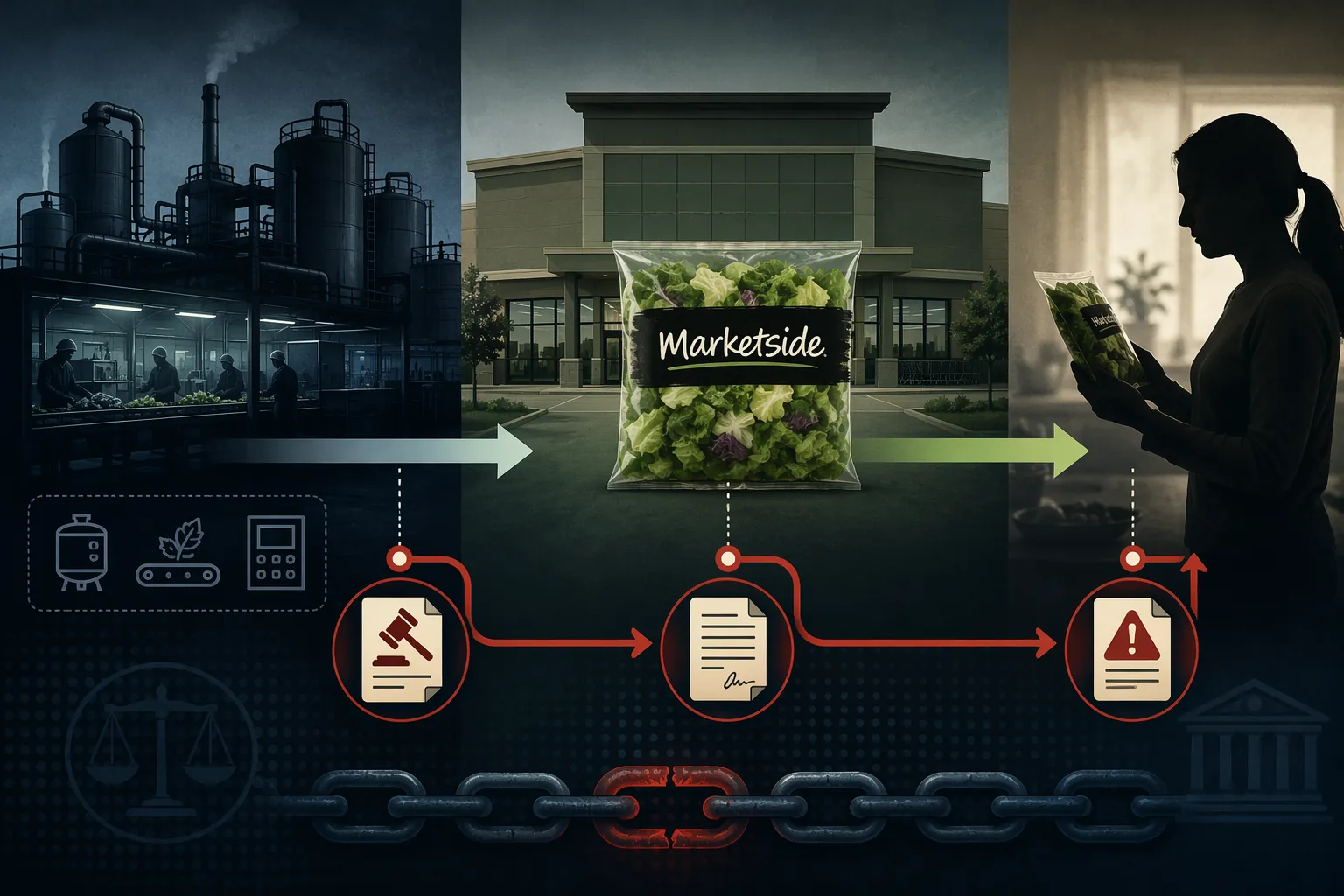
Why Walmart Is Not Just a Background Retailer
Most retailer exposure analysis starts with a useful but incomplete proposition: many states do not impose strict liability on a retailer that merely sold a product it did not manufacture. In those jurisdictions, a plaintiff usually needs a negligence theory against the seller, not just proof that the product was defective when it reached the consumer. Foodborne-illness practitioners regularly distinguish that seller exception from chain-of-distribution regimes, including states such as New Jersey and Pennsylvania that may impose strict liability on entities that handled the product before it reached the consumer. [6]
That distinction matters, but it does not end the Walmart analysis. The Marketside label changes the pleading surface. A plaintiff does not need to persuade a court that Walmart washed lettuce or ran a processing line in order to allege that Walmart placed its own consumer-facing brand on a bag of food and sold it as fit for consumption. The implied-warranty theory is cleaner when the retailer’s name or house brand is on the package than when the retailer merely stocks a third-party branded product on a shelf.
The bagged and pre-cut format also matters. Seller-exception statutes and doctrines are least protective when the retailer can plausibly be characterized as part of a commercial distribution system for a processed food product rather than a passive seller of raw, unaltered agricultural goods. That does not make Walmart the manufacturer as a matter of national law. Product-liability law is too state-specific for that shortcut. It does, however, give plaintiffs a better opening in jurisdictions that define manufacturer, processor, apparent manufacturer, or chain participant broadly.
A head of lettuce sold in a produce bin invites one set of arguments. A sealed bag of pre-cut Marketside salad invites another. The second product carries more retailer identity, more implied assurance, and more room for a plaintiff to argue that the consumer did not buy “Taylor Farms lettuce” in any meaningful retail sense.
The 2024 Taylor Farms Record Is the Negligence Hook
Strict liability may be the cleaner pleading vehicle against a manufacturer or processor. Negligence is where Walmart’s risk becomes more fact-dependent and more uncomfortable.
In 2024, an E. coli O157:H7 outbreak linked to slivered onions from Taylor Farms’ Colorado facility sickened 104 people across 14 states, hospitalized 38, and caused one death. FDA inspection findings later reported biofilm and food debris on equipment after cleaning, inadequate handwashing, failure to dry sanitized utensils, and missing sanitation records dating back to 2023. [7][8]
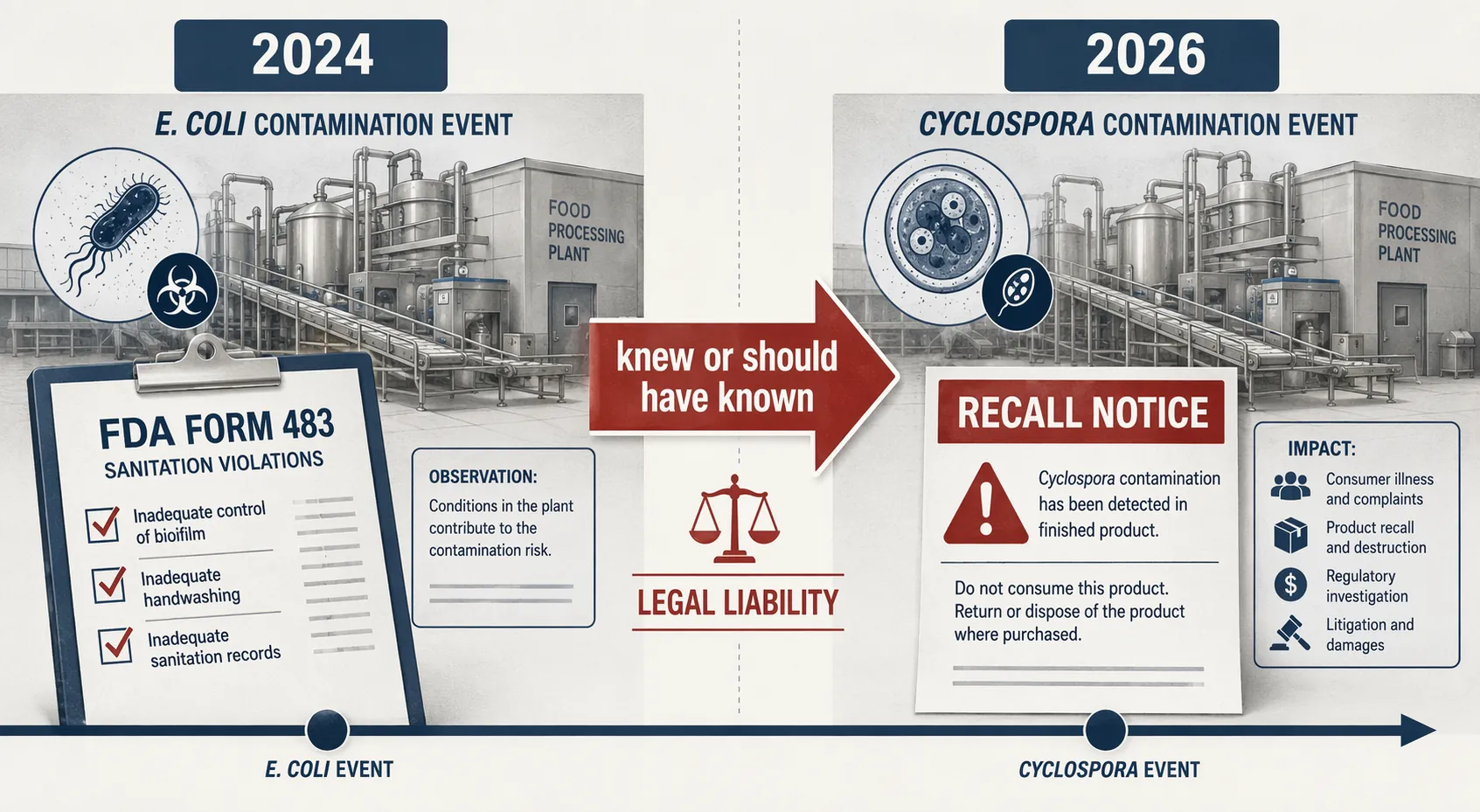
Those facts do not prove that Walmart knew of a cyclospora risk in July 2026. They also do not prove that the same facility, commodity, or sanitation failure caused the current outbreak. The legally useful point is narrower: a prior public contamination event involving the same supplier gives plaintiffs material for a “knew or should have known” allegation. That allegation may survive longer than a bare claim that a national retailer should independently inspect every field, wash line, or packaging step in its supply chain.
A plausible negligence complaint would likely ask what Walmart did after the 2024 Taylor Farms event. Did supplier review change? Were audits requested? Were corrective-action documents obtained? Were any facilities, commodities, or regions treated as higher risk? Were recall records, quality incidents, insurance certificates, and indemnity obligations reviewed before Walmart continued selling Taylor Farms-supplied Marketside products? Those questions may or may not produce damaging answers, but they are not reputational noise. They go directly to notice, reasonable supplier oversight, and causation.
This is also where “we have indemnity” is not a complete answer. Indemnity may be very important to Walmart’s eventual net loss. It does not prevent a plaintiff from naming Walmart, taking discovery into supplier governance, or pleading that the retailer continued to place its own brand on a product supplied by a company with a recent contamination record.
The Case Counts Are Not Interchangeable
The numbers need care because they measure different things. The CDC surveillance total is a broad domestic cyclosporiasis surveillance figure: 4,173 confirmed cases, 308 hospitalizations, 41 states, and at least 7,400 additional cases under investigation as of July 24, 2026. The outbreak-specific Taylor Farms/Taco Bell count is smaller: 1,947 cases across 9 states and 98 hospitalizations. [1][2]
Treating those figures as interchangeable would overstate the record. Ignoring the broader surveillance number would understate the litigation environment. Plaintiffs’ firms do not evaluate aggregate pressure only by the final allocation of fault. They look at the volume of diagnosed illness, the number of people still under investigation, the geographic footprint, the number of consumer touchpoints, and the ability to plead a common supply-chain story.
That is why the 27-state Walmart product removal matters even if the strongest current factual allegations sit closer to Taylor Farms and Taco Bell. A multi-state removal of four Marketside products gives plaintiffs a retail map. It also gives defense counsel a preservation map: purchase records, distribution lists, lot information, supplier notices, recall communications, consumer complaints, store-level removal confirmations, and internal escalation records. [3]
Scale does not make Walmart liable. It does make Walmart more likely to appear in complaints where plaintiffs want every solvent, recognizable chain participant in the caption. In outbreak litigation, that pressure arrives before the court sorts out which defendant controlled which risk.
What the First Filings Do and Do Not Show
The first reported lawsuit, Ayyad v. Pacific Bells, LLC, was filed July 16, 2026 in federal court in Ohio and alleged negligence, breach of warranty, and deceptive trade practices against Taco Bell franchise entities. By July 24, 2026, class-action reporting identified litigation naming Taylor Farms and Taco Bell entities. Walmart was not identified as a named defendant in that first wave. [4][5]
That absence should slow the analysis, not end it. A first complaint often follows the clearest meal history and the most direct alleged exposure. Retail defendants may be added later after product tracing, purchase records, class-definition work, or state-law venue analysis. The absence of a Walmart caption as of July 26, 2026 is therefore a real fact, but it is not a reliable safe-harbor signal.
The early Taco Bell pleadings also show the theories plaintiffs are already willing to test: negligence, breach of warranty, and consumer-facing misrepresentation or deceptive-practices theories. Those theories translate more easily to a house-brand grocery product than a pure strict-liability manufacturer theory would. For Walmart, the breach-of-warranty and retailer-notice lanes are the ones to watch first.
The FDA False-Positive Retraction Helps Defendants, But Only So Far
On July 19, 2026, FDA retracted a positive cyclospora sample finding as a false positive but maintained the recall based on “overwhelming epidemiological data.” [9]
That evidentiary wrinkle will be useful to defendants where plaintiffs overstate laboratory proof. It may support arguments about product identification, causation, and the limits of any specific lot-level theory. But it does not erase the recall, the epidemiology, the product removals, or the supplier-history allegations. In practical terms, it is a narrowing fact, not a dismissal fact.
Where State Law Could Move the Result
The legal answer will not be national. A Walmart claim that is weak in a jurisdiction with a robust innocent-seller defense may look different in a chain-of-distribution state, or in a state whose apparent-manufacturer or private-label doctrines give weight to the branding on the package. New Jersey and Pennsylvania are commonly discussed examples of chain-of-distribution strict-liability exposure, but they are illustrations, not a substitute for a state-by-state chart. [6]
The processed nature of the lettuce could matter in that chart. So could the precise defendant identity, the label language, the purchase state, the injury state, the consumer’s point of sale, and whether the plaintiff pleads Walmart as a seller, apparent manufacturer, warrantor, negligent supplier manager, or all of the above. Counsel deciding whether to reserve should resist the comforting one-line rule that “retailers are exempt.” Sometimes they are. Sometimes they are not. Often the exception depends on facts that are not yet public.
Supplier Indemnity Is a Back-End Issue
Walmart’s public supplier requirements state that suppliers must carry product-liability insurance and indemnify Walmart against claims arising from supplier products. [10]
That is an important risk-transfer framework, but it should be kept in the right column. It may reduce ultimate net loss if Taylor Farms is contractually obligated, adequately insured, and able to respond. It does not answer whether Walmart can be named, whether Walmart must preserve and produce records, whether Walmart faces warranty or negligence discovery, or whether Walmart must participate in early settlement architecture.
The public record does not disclose the Taylor Farms-specific indemnity language, additional-insured endorsements, policy limits, exclusions, self-insured retentions, tender history, or collectability position. A risk memo that treats Walmart’s general supplier policy as a complete defense is doing claims-handling work with a procurement summary.
Monitor or Reserve and Prepare?
As of July 26, 2026, Walmart’s exposure remains predictive rather than filed-case exposure. No public lawsuit naming Walmart as a direct defendant had been identified. Taylor Farms likely carries the more direct manufacturing and processing risk, and Taco Bell entities are already closer to the first reported pleadings. [4][5]
For Walmart, the material-risk facts are still present: Marketside branding, pre-cut bagged lettuce, a 27-state product removal, a supplier with a recent public contamination history, and a large outbreak environment with thousands of confirmed or investigated illnesses. Those facts are enough to move this out of a passive “monitor only” file.
The practical posture is reserve and prepare, while keeping front-end plaintiff exposure separate from back-end recovery. Preserve supplier approval records, audit materials, corrective-action communications, recall execution documents, lot and distribution records, consumer complaints, insurance certificates, tenders, and indemnity correspondence. Update the assessment daily as CDC and FDA counts change and as new pleadings identify which legal theories plaintiffs are actually pressing.
For the regulatory-enforcement track of food recalls, see the companion Risk Digest analysis on FDA enforcement actions after the PT Organics recall. This article is limited to product-liability exposure.
References
- Surveillance of Cyclosporiasis, CDC.
- Cyclospora Outbreak Investigation, CDC.
- Walmart recall: Iceberg lettuce pulled over cyclospora risk, USA Today, July 18, 2026.
- Taco Bell Hit With Federal Lawsuits Over Cyclosporiasis Infections, Forbes, July 17, 2026.
- Class Action Lawsuit Alleges Taylor Farms, Taco Bell Failed to Warn Consumers of Cyclospora Contamination, ClassAction.org, July 24, 2026.
- Strict Liability and Negligence and When They Apply and Chain of Distribution Liability, Marler Clark.
- FDA report: E. coli outbreak onions from Taylor Farms had biofilm, food debris and other problems, CBS News.
- FDA redacts information from report showing Taylor Farms inadequate food safety measures related to McDonald's E. coli outbreak, Food Safety News, January 2025.
- Investigation of 9-State Outbreak of Cyclospora Illnesses Linked to Iceberg Lettuce, July 2026, FDA, July 2026.
- Supplier Requirements, Walmart.
Related records
Tool profile
Browse tool evaluations →Governing regulation
Browse the obligations tracker →Preventive workflow
Browse verification workflows →
Report a correction or tip
Spotted an outdated figure, a misstated fact, or a ruling this case record should reflect? Public comments are disabled for this content given the professional cost of a misreported case outcome, penalty amount, or rule text — use the structured correction channel instead.
Report a correction or tip for this record →