
FDA, FTC, DOJ target wellness influencers over peptides
This Risk Digest entry documents how the FDA, FTC, and DOJ independently enforce against wellness influencers promoting unapproved peptides, and why the 'research use only' disclaimer no longer shields against liability. Includes primary-source links to warning letters, consent orders, and criminal cases.
- Jurisdiction
- US-Federal
- Court
- FDA
- AI tool named
- None
- Ruling date
- Mar 31, 2026
- Source document
- View primary court order ↗
- Last verified
- Jul 27, 2026
Lex Machina Review is an independent risk-tracking and reference resource. Nothing on this site is legal advice, and using it does not create an attorney-client relationship. Every record is reviewed against primary sources but may not reflect the most current status of a matter — always verify directly against the cited court order, rule text, or a licensed attorney before relying on it.
Companion explanation — secondary to the source document above
- Category: Risk Digest
- Last verified: July 27, 2026, 00:00 UTC
- Legal review note: General information only; not legal advice and not a substitute for jurisdiction-specific review of a product, campaign, prescription pathway, pharmacy relationship, or influencer contract.
- Current enforcement posture: FDA, FTC, and DOJ can reach peptide promotion through separate legal routes. A “research use only” label may still be relevant evidence, but it is not a firewall when the sales funnel, claims, bundled products, affiliate economics, or distribution conduct point toward human use.
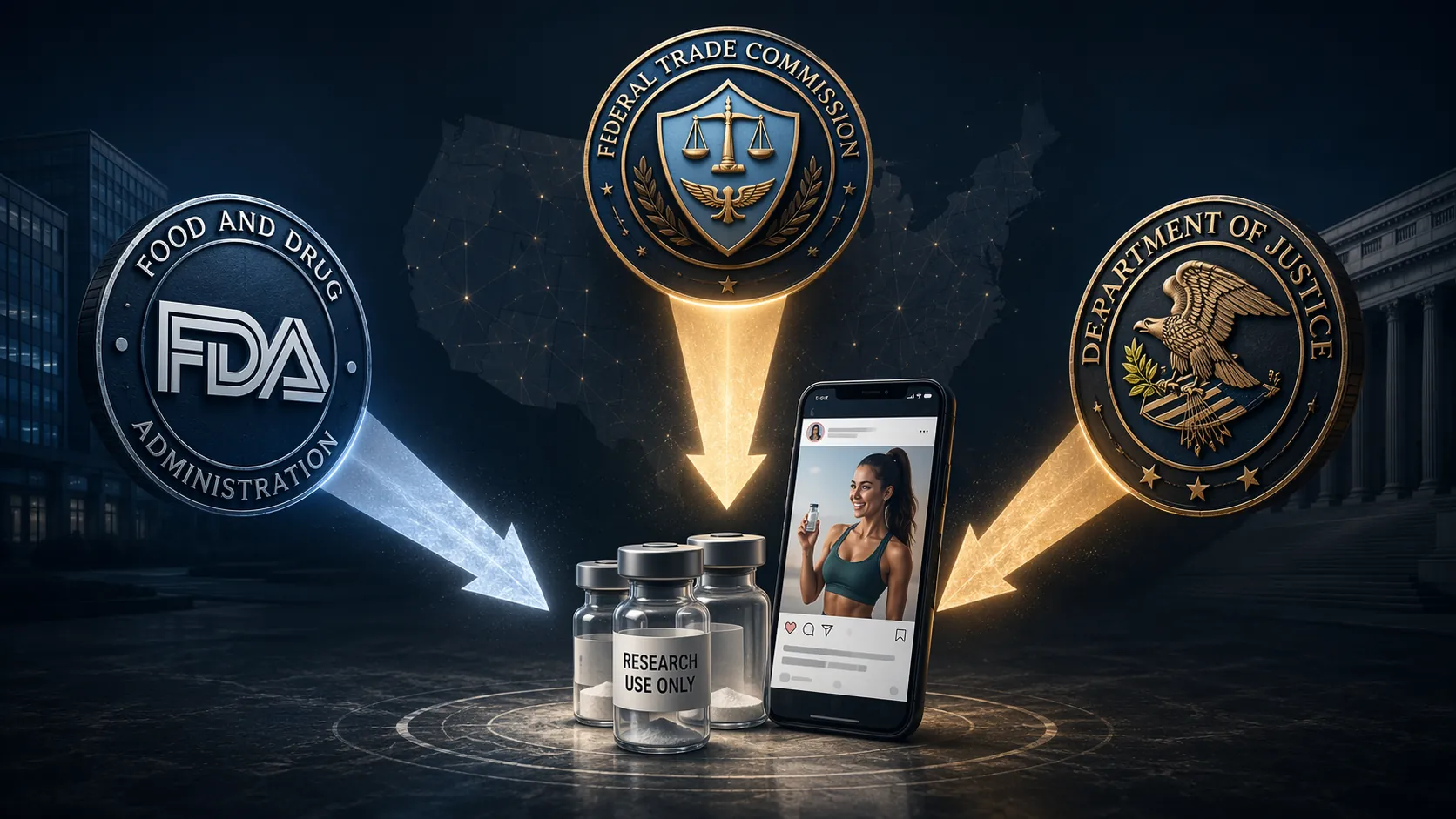
The Gram Peptides letter is the place to start
The cleanest federal document in the current peptide-influencer risk file is FDA’s March 31, 2026 warning letter to Gram Peptides. The letter matters because it does not treat “Research Use Only” as the end of the inquiry. FDA looked at the surrounding evidence, including the company’s marketing of peptide products and its co-marketing of bacteriostatic water for injection, and applied the objective-intent regulation at 21 CFR 201.128 to infer intended human use despite RUO positioning.[1]
That is the sentence doing the work, even if it is not the sentence a marketer wants to read. FDA’s theory is not that the three words “research use only” are always false. It is that intended use can be shown by objective evidence. A vial label is one piece of that record. So are dosing-adjacent instructions, product bundles, companion supplies, customer-facing claims, testimonials, site architecture, influencer captions, discount codes, and checkout flows.
For wellness influencers, the practical consequence is uncomfortable but straightforward: an RUO disclaimer in a caption or on a landing page does not neutralize the rest of the funnel. If the post sends consumers to a page that sells peptides next to bacteriostatic water, describes expected body-composition or metabolic outcomes, or gives the ordinary buyer a path to personal use, counsel should assume FDA may read the page as a whole.
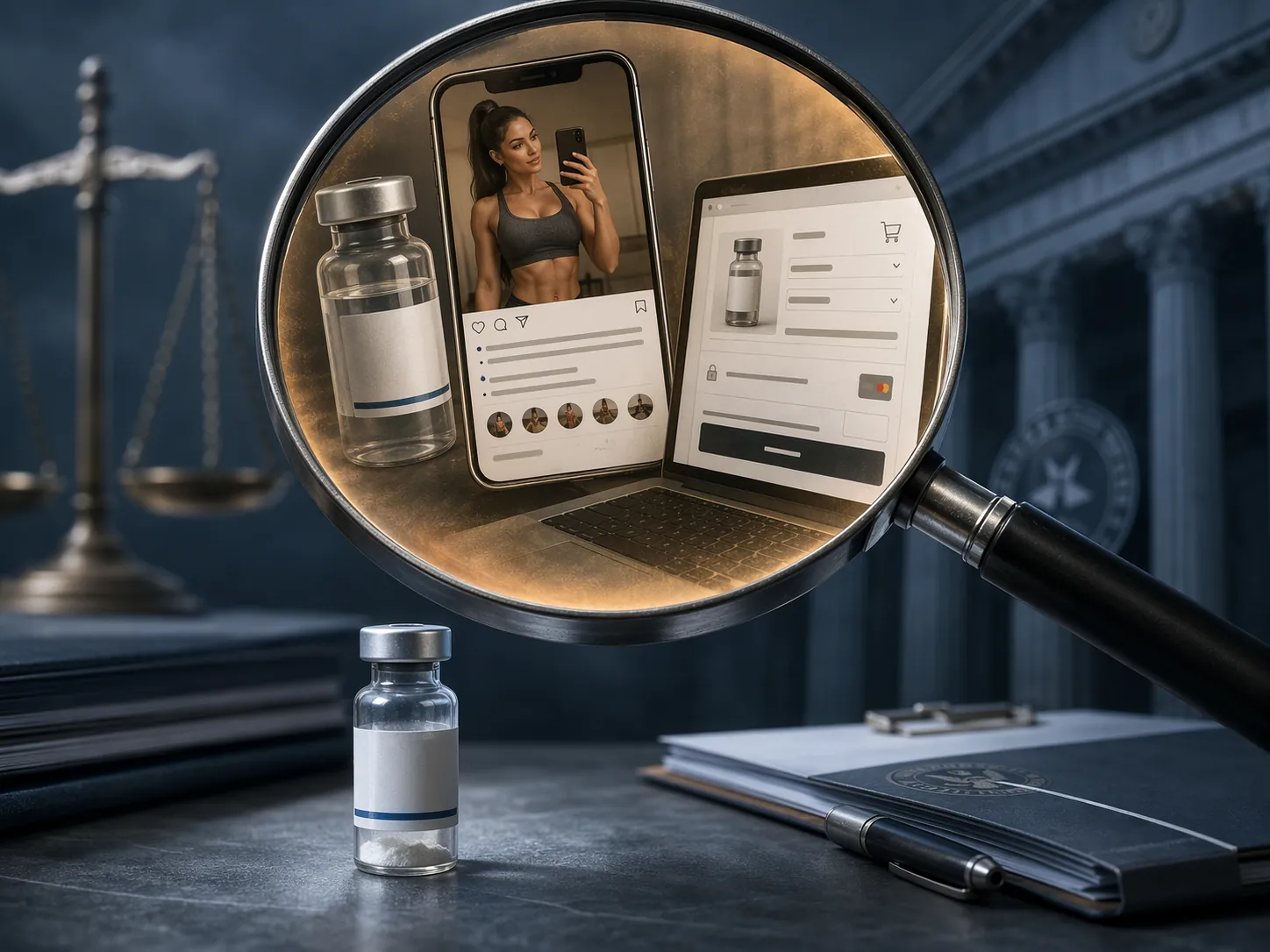
What FDA is actually collecting
The useful compliance question is not “Did we include the disclaimer?” It is “What evidence did we create around the disclaimer?” In the Gram Peptides posture, FDA’s intended-use analysis can absorb the same items an influencer campaign normally produces as a matter of course:
- A product page that identifies peptides in a way ordinary consumers associate with weight loss, recovery, anti-aging, body composition, libido, sleep, inflammation, or metabolic health.
- Companion products that make the “research” story harder to maintain, especially injection-adjacent supplies.
- Influencer captions, stories, or videos describing personal use, expected results, before-and-after experiences, or “protocols.”
- Affiliate links and discount codes that tie the influencer’s message to a purchase path.
- Customer support scripts or FAQs that answer human-use questions while leaving the vial label formally untouched.
The reported pattern is not limited to Gram Peptides. A 2026 peptide regulatory landscape summary identifies FDA warning letters involving Lovega, Prime Sciences, and USApeptide as additional examples of RUO peptide vendors facing similar objective-intent reasoning in the 2025–2026 period.[2] That source is a secondary legal summary rather than the primary FDA docket itself, so it should not be treated as a substitute for pulling the underlying letters. It is still useful as pattern evidence for triage: the Gram Peptides logic is not a one-off compliance curiosity.
FTC gets there through net impression, not intended use
The FTC problem is adjacent, but it is not the same problem. FDA asks whether the objective evidence shows intended use under the drug-law framework. FTC asks what the advertising likely communicates to consumers and whether the advertiser has adequate substantiation for that message. A tiny RUO disclaimer does not rescue a post whose net impression is that a peptide product produces health, weight-loss, or wellness results in humans.
The best concrete remedial template in the current record is the FTC’s final order against telehealth provider NextMed, approved in December 2025. The order followed allegations involving deceptive GLP-1-related advertising and included a $150,000 monetary judgment, restrictions on unsubstantiated claims, clear-and-conspicuous disclosure obligations, and recordkeeping requirements.[3]
NextMed is not an individual peptide-influencer case. It is still important because it shows what FTC remedies look like when health-adjacent digital marketing outruns substantiation and disclosure. The order is the kind of document counsel can put in front of a founder, growth lead, or talent manager and say: this is not merely a request to edit adjectives. It is a behavioral order with documentation duties.
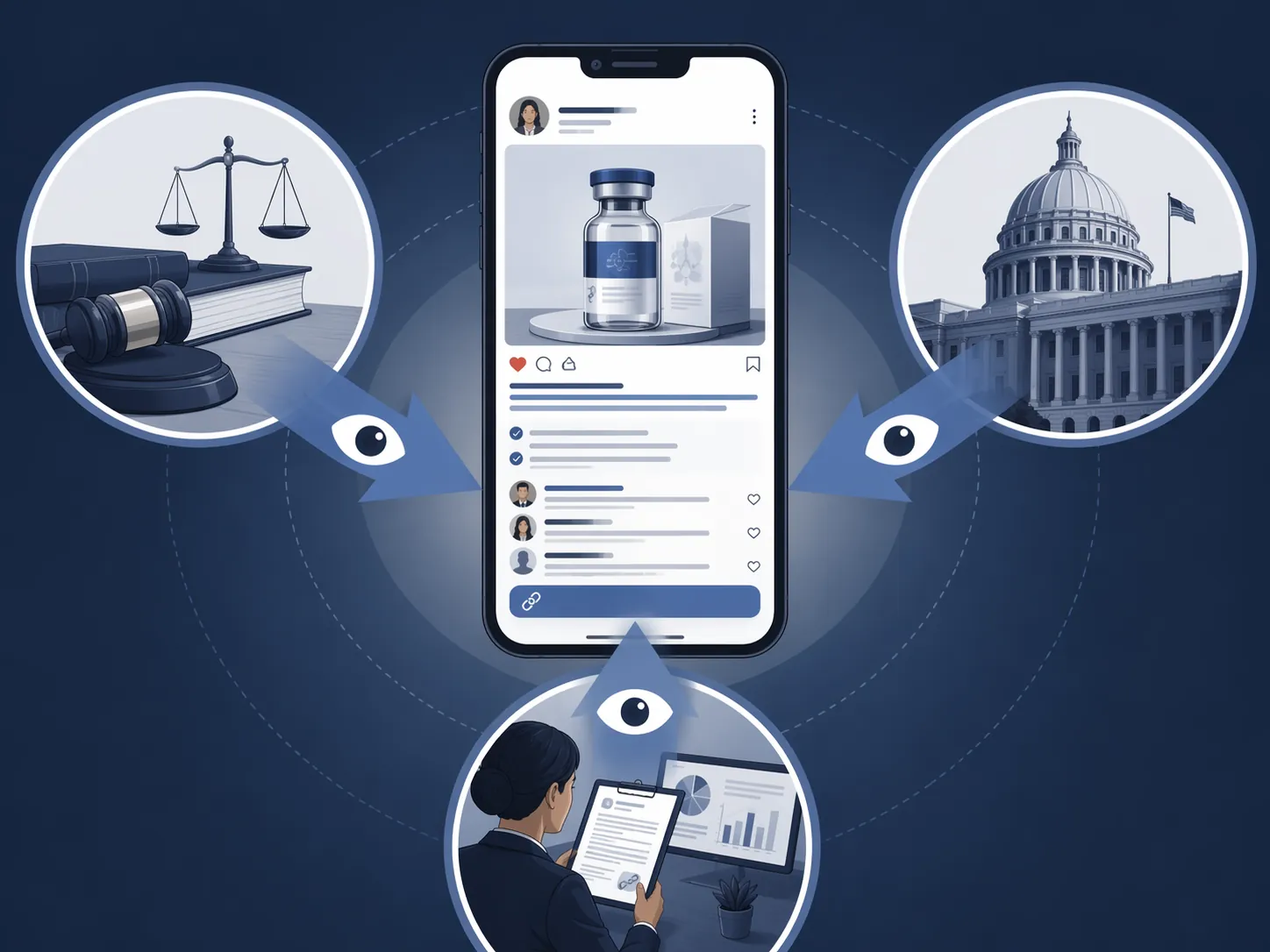
Individual influencer exposure is real, but the peptide-specific record is not there yet
FTC’s 2023 Endorsement Guides revisions supply the obvious pathway for individual influencer exposure: endorsements must reflect honest opinions and experiences, material connections must be disclosed clearly, and advertisers cannot use endorsers to make claims the advertiser could not substantiate directly. Secondary peptide-advertising analysis also notes that FTC has named individual endorsers in non-peptide matters.[4]
That is where the line should be drawn. As of the reviewed materials, no individual influencer has been identified as an FTC respondent specifically for peptide promotion.[4] The exposure pathway is not imaginary; the peptide-specific enforcement example is. A lawyer who blurs that distinction may win a meeting and lose credibility in the next one.
For campaign review, the FTC analysis should focus on the message the consumer receives, not the protective language the brand hoped would dominate. A caption that says “not medical advice” while describing personal peptide use, linking to a vendor, showing body-composition changes, and offering a code may still create an advertising impression about human health effects. If that impression lacks competent substantiation, the disclaimer is doing very little useful legal work.
DOJ is a different kind of risk
The DOJ material should be used carefully. United States v. BioPeptide Labs is described in the reviewed secondary source as a 2025 criminal prosecution involving conspiracy to commit wire fraud in peptide distribution.[5] That is serious. It is not, however, the same as saying DOJ has adopted FDA’s RUO disclaimer-collapse analysis as its own standalone doctrine.
Criminal exposure turns on conduct and proof that can include fraud, misrepresentations, conspiratorial agreement, payment flows, shipment practices, and communications. A disclaimer can be part of that factual environment, but the DOJ theory in the materials does not appear to rise or fall on whether “research use only” was overcome in the same way FDA overcame it in Gram Peptides.
The penalty frame is also different. The research materials identify wire-fraud exposure as carrying up to 20 years of imprisonment per count.[5] That figure is not useful as scare copy. It is useful because it changes who needs to be in the room: criminal counsel, not only advertising review; document preservation, not only caption revision; distribution records, not only claim substantiation.
Same peptide campaign, three different federal questions
| Regime | Question the regulator asks | Evidence that tends to matter | What the current materials support |
|---|---|---|---|
| FDA | Do the objective facts show the product is intended for human use as a drug? | Product pages, RUO labels, co-marketed injection supplies, claims, instructions, bundles, customer communications, influencer content, and purchase pathways. | Strong peptide-specific support. Gram Peptides applies objective-intent reasoning to RUO peptide sales and co-marketed bacteriostatic water.[1] |
| FTC | What net impression does the advertising create, and is that message substantiated and properly disclosed? | Captions, testimonials, before-and-after content, affiliate links, discount codes, material-connection disclosures, health claims, and claim substantiation files. | Concrete health-advertising remedial model from NextMed, plus a plausible influencer pathway under the 2023 Endorsement Guides; no reviewed peptide-specific individual-influencer respondent yet.[3][4] |
| DOJ | Do the facts support fraud, conspiracy, or related criminal distribution theories? | Representations to buyers, payment and shipping records, internal communications, coordination among sellers, and concealment or misrepresentation evidence. | Serious criminal-risk evidence from BioPeptide Labs, but the disclaimer issue is less central than it is in the FDA materials.[5] |
What counsel should preserve before fixing the campaign
The first instinct after a risky peptide post goes live is usually to edit the caption. That may be necessary, but it should not be the first compliance act if litigation or enforcement is plausible. Someone needs to preserve the record as it existed when consumers saw it.
- Capture the full post, stories, reels, comments, pinned replies, link-in-bio pages, landing pages, checkout screens, FAQs, and email or SMS follow-up.
- Identify every claim that implies human health, body-composition, metabolic, sexual-health, sleep, recovery, anti-aging, or disease-related benefit.
- Separate the influencer’s personal-experience statements from the brand’s supplied scripts, talking points, briefs, product sheets, and approval comments.
- Map the purchase path from the post to the product page, including bundled or suggested items such as bacteriostatic water or injection-adjacent supplies.
- Collect substantiation files before the marketing team rewrites the claims into something more defensible.
- Review affiliate contracts, discount-code reporting, payment records, and any indemnity language that allocates responsibility between brand and influencer.
- Suspend scheduled reposts, paid amplification, whitelisting, and lookalike ads until the same review has been applied to the derivative campaign assets.
The important point is sequencing. Preserve first, then remediate. If a regulator later asks what consumers saw, a cleaned-up page with a stronger disclaimer will not answer the question.
State-law pressure runs in parallel
The federal record is the center of gravity, but state enforcement should not be ignored. The reviewed 2026 landscape summary flags Minnesota HF 2779, California’s Consumers Legal Remedies Act, and New York General Business Law § 349 as additional vectors that may matter for peptide marketing, consumer deception, and state-level health-product enforcement theories.[2]
Those theories do not need to match FDA’s intended-use analysis perfectly. A state attorney general can care about a deceptive consumer-facing peptide promotion even where the federal drug-law question is still being briefed. For a brand or influencer with nationwide reach, that means the campaign should be reviewed as a multi-jurisdictional consumer-protection problem, not only as a federal warning-letter problem.
The July 2026 compounding development does not erase the present record
There is a moving compounding-policy backdrop. The reviewed materials flag July 2026 PCAC activity concerning certain peptides and a possible rulemaking interval that could affect the future 503A Bulks List landscape.[2] The materials reviewed here do not provide a final vote tally or a final rule.
That uncertainty is not a reason to treat current influencer campaigns as safe. The enforcement posture described above rests on documents already in the file: an FDA warning letter applying objective-intent reasoning to RUO peptide marketing, an FTC consent-order model for health-advertising remedies, and criminal materials showing that peptide distribution can move into DOJ territory. Future compounding developments may change what certain licensed actors can do under specific conditions. They do not retroactively make an influencer’s human-use peptide sales funnel disappear.
The narrow conclusion is the defensible one. RUO language is, at most, one fact in the evidentiary record. FDA’s peptide-specific support is the strongest. FTC influencer liability is concrete as a framework and partly extrapolated for peptide-specific individual respondents. DOJ exposure is serious, but less dependent on disclaimer analysis than the FDA route. That is enough to treat wellness influencer peptide legality as a live enforcement risk, not a copywriting problem.
References
- Gram Peptides - 721806 - 03/31/2026 — FDA, March 31, 2026.
- Navigating the 2026 Peptide Regulatory Landscape: Federal Compliance, State Enforcement, and the Legal Liabilities of Healthcare Providers — DJ Holt Law.
- FTC Approves Final Order Against Telehealth Provider NextMed over Charges It Used Deceptive — FTC, December 2025.
- FTC Crackdown: Peptide Advertising, Social Media & Influencer Compliance — PeptideLaws.com.
- Recent DOJ Actions Against Illegal Peptide Distributors — PeptideLaws.com.
Related records
Tool profile
Browse tool evaluations →Governing regulation
Browse the obligations tracker →Preventive workflow
Browse verification workflows →
Report a correction or tip
Spotted an outdated figure, a misstated fact, or a ruling this case record should reflect? Public comments are disabled for this content given the professional cost of a misreported case outcome, penalty amount, or rule text — use the structured correction channel instead.
Report a correction or tip for this record →