
What the Suffolk Verdict Means for Westchester ICE Liability
After the $112M Suffolk County verdict, Westchester County faces two distinct liability tracks from ICE cooperation: a detainer track shielded by the Immigrant Protection Act, and an unaddressed ALPR data-sharing track that the June 2026 class action may turn into a second catastrophic exposure. This article examines both risk paths and what county risk managers must audit now.
- Jurisdiction
- U.S. District Court, Southern District of New York
- Court
- U.S. District Court for the Southern District of New York
- AI tool named
- Rekor
- Ruling date
- Jun 17, 2026
- Source document
- View primary court order ↗
- Last verified
- Jul 30, 2026
Lex Machina Review is an independent risk-tracking and reference resource. Nothing on this site is legal advice, and using it does not create an attorney-client relationship. Every record is reviewed against primary sources but may not reflect the most current status of a matter — always verify directly against the cited court order, rule text, or a licensed attorney before relying on it.
Companion explanation — secondary to the source document above
A county risk meeting in Westchester now has to start with two documents on the table. One is the Suffolk County verdict: $112 million, divided into $75 million for Fourth Amendment damages and $37 million for due-process damages, for 674 class members detained between July 2014 and November 2018 after ICE detainers were lodged against them.[1] The other is not a verdict at all. It is the June 2026 challenge to Westchester’s automatic license plate reader system, where the unresolved question is whether a county that limited jail cooperation with ICE left a separate location-data channel open.
Those are not the same liability track. Detainer detention turns on whether a jail held a person after release authority expired based on a civil immigration request rather than a judicial warrant; the Suffolk litigation carried that theory past interlocutory review before trial when the Second Circuit let the class claims proceed.[2] Westchester’s Immigrant Protection Act was written to block that custodial scenario by barring county agencies from holding people on civil immigration detainers without judicial warrants and by prohibiting stops, interviews, or arrests based solely on civil immigration status.[3] ALPR sharing is different. It asks whether police-created vehicle-location data, retained and shared through a vendor platform, can become a warrantless mass-surveillance system accessible to immigration enforcement outside the jailhouse rules.
The Suffolk verdict is a benchmark, not a map of Westchester’s whole exposure
The Suffolk number matters because it attached a catastrophic dollar figure to a familiar jail practice. The verdict was not an abstract rebuke of immigration enforcement cooperation. It compensated a defined class, during a defined period, for being held on ICE detainers after they otherwise should have been released from Suffolk County custody.[1]
The operative point is the legal character of the detainer. ICE detainers are requests, not commands. In the Suffolk litigation, the underlying theory was that local officers could not convert a civil immigration request into a fresh seizure without a judicial warrant, and that doing so implicated both Fourth Amendment and New York constitutional limits.[2] That is why the damages line is so legible for other counties: if custody continued only because ICE asked for it, and no judge authorized the detention, the risk is no longer theoretical.
It is also why Suffolk should not be read as if every ICE-related practice carries the same already-adjudicated exposure. The verdict speaks most directly to custodial holds. It does not decide whether Westchester’s ALPR network is unconstitutional, whether ICE currently has access to that network, or what damages would follow if plaintiffs prevail in the 2026 case. Treating all of those questions as already answered would be sloppy in the exact way that creates bad municipal files.
Westchester’s Immigrant Protection Act addresses the jail-hold problem
Westchester did not wait for the Suffolk verdict to write a rule against civil-detainer custody. The county’s Immigrant Protection Act was signed on March 20, 2018. As described by county legislator Colin Smith, the enacted law bars county agencies from holding a person on a civil immigration detainer without a judicial warrant, and it restricts county participation in stops, interviews, investigations, and arrests based solely on civil immigration status.[3]
For the detainer track, that statute gives county counsel something Suffolk lacked during the class period: a written protective rule that matches the liability theory. If a person is otherwise entitled to release, the county agency should not extend custody merely because ICE issued a civil detainer. The audit question is concrete. Pull jail records, detainer logs, release timestamps, and warrant files, then test whether practice matched the statute.
That does not make the file self-proving. A board resolution and a signed county law do not establish that every booking officer, corrections supervisor, records clerk, transport officer, and outside-agency liaison followed the rule. But the IPA does draw a clear line for the custodial scenario that produced the Suffolk verdict. The harder question is what happens when the ICE cooperation allegation moves from the jail cell to the database.
The ALPR channel sits outside the IPA’s cleanest protection
Westchester’s ALPR system is not a small investigative tool used only after a plate has already been tied to a crime. Reporting and advocacy materials describe a countywide network of 575 cameras across 37 municipalities, generating 264 million recordings in 2024 alone, with approximately 1.6 billion recordings held under a two-year retention period.[4] The same materials describe sharing with at least 55 outside agencies through the Rekor platform.[4]
The ICE-access allegation turns on vendor permissions and platform reach, not a sheriff’s desk accepting a detainer. The Guardian’s March 2025 investigation reported that users with @ice.dhs.gov email addresses had access to the Rekor system used by Westchester, while also reporting that Westchester County did not confirm whether that access continued as of publication.[5] That distinction matters. The record supports saying ICE access was documented in that investigation. It does not support treating current access as admitted unless a current audit, production, stipulation, or platform record confirms it.
The June 2026 class action filed by the NYCLU, the Knight First Amendment Institute, and the NYU Policing Project tries to turn that data architecture into a constitutional and authority problem. Reporting on the complaint says the plaintiffs allege violations of the Fourth Amendment and Article I, Section 12 of the New York Constitution, along with an ultra vires theory that the county legislature never authorized the ALPR program.[6] The named plaintiff, Sarah Moore, alleges that ICE tracked and briefly detained her using ALPR data.[6] Those are allegations at this stage, not findings.
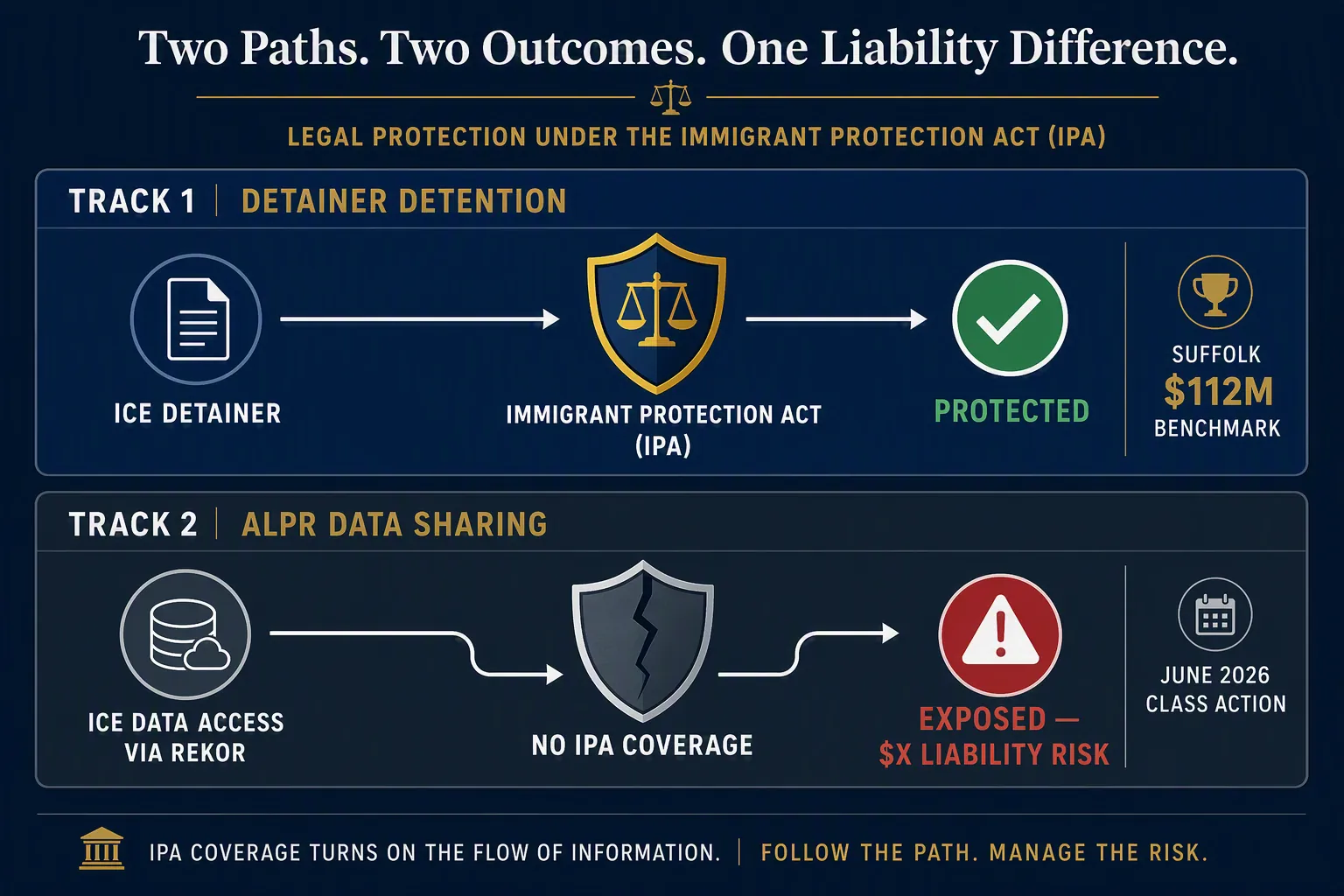
The two tracks require different proof
| Issue | Detainer detention | ALPR data sharing |
|---|---|---|
| Core act | A local jail holds a person after release authority expires because ICE issued a civil detainer. | A countywide camera network captures, retains, searches, and shares vehicle-location records through a vendor platform. |
| Main legal question | Whether a civil immigration request can justify continued custody without a judicial warrant. | Whether mass vehicle-location collection and outside-agency access amount to unconstitutional surveillance or exceed county authority. |
| Westchester’s written shield | The IPA bars county agencies from holding people on civil immigration detainers without judicial warrants.[3] | The IPA’s detainer rule does not, by itself, answer who may access retained ALPR data or under what authorization. |
| Current litigation status | Suffolk has a jury verdict with $112 million in damages across a defined class and detention period.[1] | Westchester faces a June 2026 class action; the complaint’s theories remain unadjudicated.[6] |
| Audit evidence | Detainer forms, warrants, release times, custody records, jail policies, training records. | Vendor permissions, agency-sharing lists, search logs, retention settings, memoranda of understanding, legislative authorization. |
Why the ALPR case could set the next ceiling
Suffolk supplies a damages benchmark because the court and jury were dealing with people who had already been seized and held. The ALPR case is harder to price because it concerns collection, retention, searchability, and alleged downstream use of location data. That uncertainty is not comforting. A jail-hold class is limited by custody records. A plate-reader database can involve millions of observations before any individual plaintiff ever learns that a search occurred.
The scale is the first pressure point. Westchester’s reported 264 million recordings in 2024 and 1.6 billion retained recordings are not just large numbers; they change the kind of file a risk manager must inspect.[4] The relevant question is not only whether a particular officer searched a particular plate. It is who could search, whether outside users were granted access by default or by invitation, how long records stayed searchable, what audit logs exist, whether ICE-affiliated users appeared in those logs, and whether any county official with authority approved those settings.
Retention is the second pressure point. The NYCLU commentary contrasts Westchester’s two-year retention period with much shorter statutory limits in several other states, including three minutes in New Hampshire, 60 days in Minnesota, and 30 days in Iowa.[4] Those comparisons do not decide the New York constitutional question. They do, however, give plaintiffs a simple way to describe Westchester’s system as something more durable than momentary roadside observation.
Authorization is the third pressure point, and it may be the one municipal defendants find least comfortable. A constitutional claim asks what government may do. An ultra vires claim asks who in county government had the power to do it. The June 2026 complaint, as reported, alleges that the county legislature never authorized the ALPR program.[6] If that theory survives motion practice, the defense file will need more than technology-policy explanations from police administrators. It will need the votes, delegations, contracts, procurement records, intermunicipal agreements, and vendor documents that show where authority entered the system.
This is also where the IPA becomes awkward for Westchester. A county can comply with the narrow detainer rule and still face the allegation that its data-sharing practices defeat the protective purpose of that rule. The county’s best custodial answer—no civil-detainer holds without judicial warrants—does not by itself explain why immigration authorities would or would not have access to a searchable county vehicle-location database.
Chapter 55 adds an enforcement layer outside the damages case
The 2026 state-law overlay should not be confused with the Suffolk verdict or the Westchester ALPR class action. Chapter 55 of the Laws of 2026 became effective in June 2026 and created a set of immigration-enforcement restrictions that includes limits on 287(g) arrangements, civilian-employee data sharing, school resource officer involvement, sensitive-location enforcement, and law-enforcement identification and face-covering practices.[7][8]
For county counsel, the most immediate operational item is the 287(g) provision. The New York Association of Chiefs of Police bulletin describes a ban on formal and informal 287(g) arrangements and a wind-down deadline of August 25, 2026, affecting 12 New York agencies.[7] Even a county with no Suffolk-style detainer problem and no Westchester-style ALPR system still has to confirm whether any formal, informal, deputized, task-force, data-access, or embedded arrangement falls within the statute’s reach.
Chapter 55 also changes who can come asking. The Office of Immigrant Trust is described as having subpoena, inspection, civil action, and compliance powers.[7] That matters because regulatory exposure does not wait for an individual damages plaintiff to prove a constitutional injury. It can begin with records, policies, access logs, training materials, or an inspection demand.
The public-facing guides to the new law emphasize immigrant protections in schools, sensitive locations, local-government information sharing, and interactions with law enforcement.[8] A risk file has to translate those protections into agency-specific controls: who may respond to ICE, who may disclose what data, what requires a judicial warrant, what must be refused, and which systems expose civilians or contractors to immigration-enforcement requests that the elected board may not have contemplated.
The audit should follow the operation, not the press release
The first question is whether Westchester’s current operations match the public legal posture. On the detainer side, that means sampling jail files for ICE detainers, judicial warrants, release timing, and any communication that delayed release. If the IPA is working, the file should show that a civil detainer alone did not extend custody. If the file cannot show that, the county has a proof problem even before it has a new plaintiff.
The second question is current ICE access to ALPR data. The Guardian investigation documented @ice.dhs.gov access as of its reporting, but current access has to be established from present records, not assumed from an old screenshot, a vendor assurance, or a public denial.[5] The county should be able to identify every agency, user domain, role, permission level, search capability, export capability, and date range tied to the Rekor platform or any successor system.
The third question is authorization. For each ALPR camera, database, sharing relationship, and retention setting, the file should show who approved it and under what authority. A police department procurement record may explain how equipment was purchased. It may not answer whether the county legislature authorized a countywide location-surveillance program or the sharing of that data with outside agencies.
The fourth question is retention. A two-year retention setting is not a background technical choice when the system holds more than a billion historical vehicle-location records.[4] It is a policy decision with constitutional, statutory, and litigation consequences. If no one can say why two years was chosen, who reviewed the choice, and when it was last reconsidered, the absence of an answer will be treated as part of the system.
The fifth question is whether the IPA and Chapter 55 have been mapped onto actual systems. A county may have a compliant detainer policy, a sanctuary-branded public position, and a noncompliant data-sharing environment at the same time. The only way to know is to compare the written rules against vendor permissions, interagency agreements, audit logs, training records, and real user behavior. The distinction between a policy that looks lawful and an operation that can prove compliance is now the liability question.
References
- Jury awards $112M to immigrants unlawfully detained by Suffolk County for ICE — RiverheadLOCAL, November 14, 2025.
- Appeals Court Lets Class Action Against Suffolk County’s Detention of Immigrants Proceed — NYCLU, November 14, 2018.
- Immigrant Protection Act still protects Westchester residents — Peekskill Herald.
- Westchester Police Are Tracking Millions of Drivers — NYCLU.
- Revealed: Ice tracked drivers in sanctuary cities using car data platform — The Guardian, March 11, 2025.
- Lawsuit Challenges Westchester Police’s Vast Vehicle Surveillance Network — Examiner News, June 17, 2026.
- Budget Legislation Affecting Interactions with Immigration Enforcement: Chapter 55 of the Laws of 2026 — New York State Association of Chiefs of Police.
- What You Need to Know About New York State’s New Immigration Protections — The Legal Aid Society.
Related records
Tool profile
Browse tool evaluations →Governing regulation
Browse the obligations tracker →Preventive workflow
Browse verification workflows →
Report a correction or tip
Spotted an outdated figure, a misstated fact, or a ruling this case record should reflect? Public comments are disabled for this content given the professional cost of a misreported case outcome, penalty amount, or rule text — use the structured correction channel instead.
Report a correction or tip for this record →