
Why Charges Against AG Liz Murrill Were Dropped
This article explains the three procedural defects that led to the dismissal of all 16 felony counts against Louisiana Attorney General Liz Murrill on July 22, 2026, and why the prosecution's collapse does not resolve the underlying statutory ambiguity.
- Jurisdiction
- Louisiana (Orleans Parish)
- Ruling date
- Jul 22, 2026
- Source document
- View primary court order ↗
Lex Machina Review is an independent risk-tracking and reference resource. Nothing on this site is legal advice, and using it does not create an attorney-client relationship. Every record is reviewed against primary sources but may not reflect the most current status of a matter — always verify directly against the cited court order, rule text, or a licensed attorney before relying on it.
Companion explanation — secondary to the source document above
All 16 felony charges against Louisiana Attorney General Liz Murrill were dropped on July 22, 2026, because the special prosecutor entered a nolle prosequi, the prosecutor’s voluntary dismissal of charges. That is the short explanation. The more careful one is that the case never reached an evidentiary ruling on whether Murrill committed public intimidation or malfeasance in office. No court acquitted her. No judge found the May 13 letters lawful. No binding precedent now says those letters could not support a criminal charge in another procedural posture. The prosecution ended before arraignment because its procedural footing had already cracked in several places.[1]
The charges themselves were serious: eight counts of public intimidation and eight counts of malfeasance in office, tied to eight alleged victims. Reports on the indictment described each count as carrying exposure of up to 10 years’ imprisonment and possible forfeiture of office.[2] But seriousness does not cure a defective return, a conflict problem, or a prosecutor’s decision that the named victims no longer want the case pursued. For readers trying to understand why the felony charges were dropped, the important distinction is this: the dismissal disposed of the indictment, not the legal question underneath it.
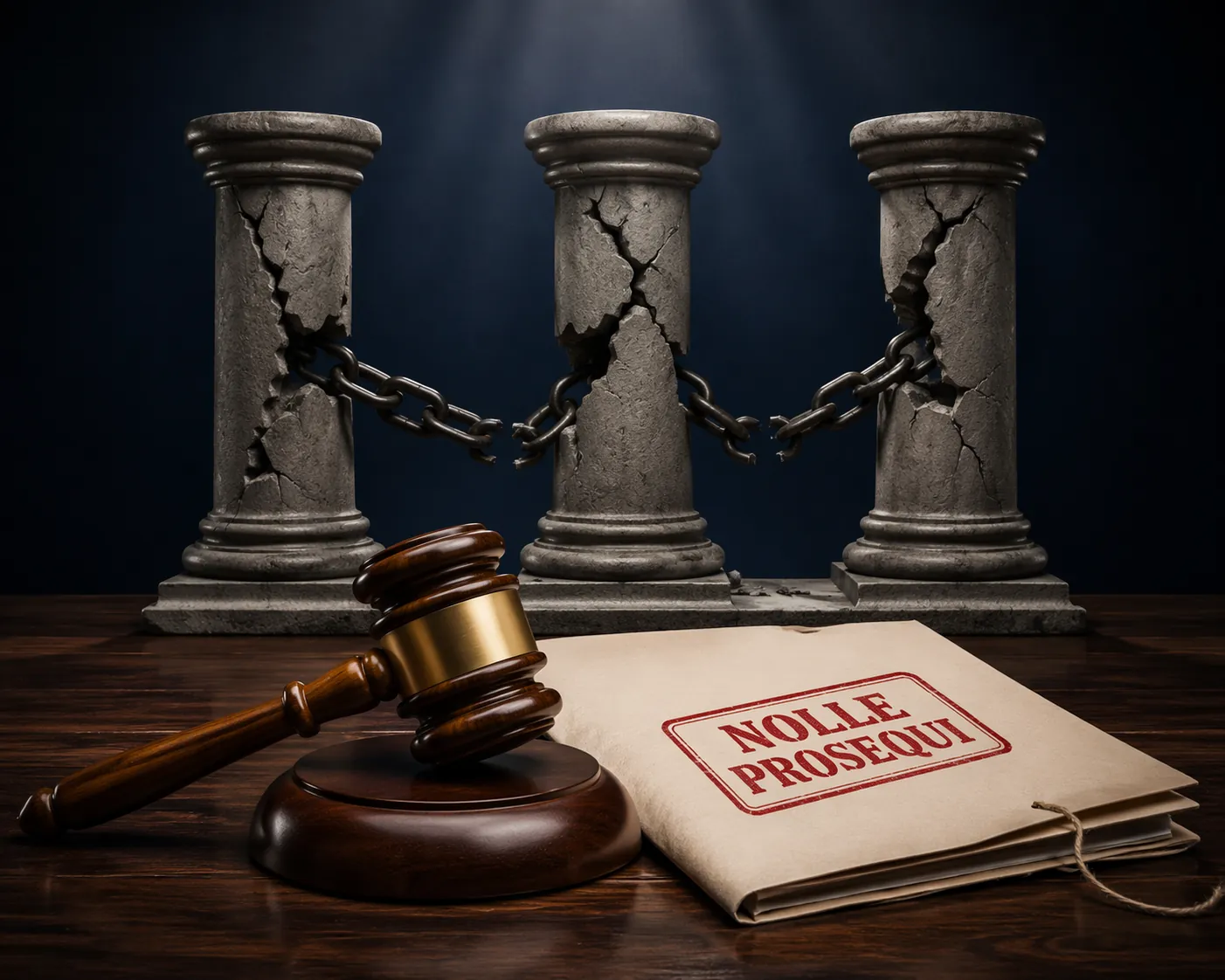
What Actually Ended the Case
The July 22 filing was a nolle prosequi by retired judge Laurie White, who had been appointed as special prosecutor. AP reported that White dropped the charges after all eight alleged victims asked her to do so.[1] That mechanism matters. A nolle prosequi is not a jury verdict, not a judicial declaration of innocence, and not a constitutional ruling on the scope of Louisiana’s public-intimidation statute.
It also does not erase the fact that a grand jury had returned an indictment on July 2. PBS reported that the indictment grew out of Murrill’s fight with New Orleans officials over changes to local courts and the clerk’s office.[2] The case then moved with unusual speed: the Louisiana Supreme Court halted proceedings within roughly 24 hours, before the matter could settle into the ordinary trial-court calendar.[1][3]
That speed is part of why the public record is easy to misread. A criminal case can collapse for reasons that say a great deal about the prosecution and very little about the facts alleged in the indictment. Here, three problems did the work: the sealed grand-jury return, the special-prosecutor conflict question, and the letters from all eight alleged victims asking that the charges be dismissed.
The Timeline Was Almost All Procedure
| Date | Event | Why It Mattered |
|---|---|---|
| May 13, 2026 | Murrill sent warning letters to New Orleans officials over the clerk dispute. | The letters relied on Louisiana’s usurper-statute framework, not the criminal statutes later used in the indictment. |
| July 2, 2026 | An Orleans Parish grand jury indicted Murrill on 16 felony counts. | The indictment charged public intimidation and malfeasance in office. |
| July 3, 2026 | The Louisiana Supreme Court stayed the prosecution. | The stay focused immediate attention on defects in how the indictment was returned. |
| July 21, 2026 | All eight alleged victims signed letters urging dismissal. | Those letters gave the special prosecutor the stated basis for ending the case. |
| July 22, 2026 | The special prosecutor entered a nolle prosequi. | The charges were dropped without a merits ruling. |
The short life of the case explains much of the confusion around it. The indictment arrived on July 2. The state high court intervened on July 3. The alleged victims’ dismissal letters came on July 21. The nolle prosequi followed on July 22.[1][3] In court-record terms, that is not a prosecution that matured and failed at proof. It is a prosecution that encountered threshold objections almost immediately.
A fuller timeline is available in the site’s related explainer, How Did Liz Murrill's Indictment Get Dismissed in 20 Days?. The point here is narrower: each critical event after the indictment made it harder to treat the charging document as a stable vehicle for testing the allegations.
The Sealed Return Was the First Visible Break
The clearest defect was not buried in a later evidentiary dispute. It appeared at the moment the indictment was returned. News outlets reported that the Louisiana Supreme Court’s stay order faulted the way the grand-jury return was handled, quoting the court as identifying “disturbing defects” and an apparent violation of Louisiana’s open-court requirement.[3] Because the order itself was in PDF form and was not independently reproduced in the source set available for this review, that exact wording should be checked against the original court document before any filing-grade reliance on the quote.
The problem was not merely aesthetic. A grand jury may deliberate in secrecy, but the return of an indictment is a different procedural act. When a charging document is presented in a closed or sealed courtroom, the court is no longer just managing sensitive information; it may be depriving the public record of the very act that gives the prosecution its public footing. That is why the defect mattered before anyone debated the strength of the intimidation theory.
The scene outside that sealed proceeding made the defect harder to dismiss as a technical footnote. The Guardian reported that two media representatives, WWL’s Danny Monteverde and attorney Elana Beiser, were handcuffed after protesting the sealing of the grand-jury return.[3] That episode did not decide whether Murrill’s letters were criminal. It did show how quickly a public prosecution can become procedurally suspect when the public-facing act of indictment is shielded from observation.
For lawyers trying to advise officials after the dismissal, this is the cleanest lesson from the case. The high court’s early intervention was not a late-stage merits correction. It was a docket-stabilizing move after the indictment’s return appeared to have violated a basic openness requirement. Once that happened, every later decision sat on top of an already damaged procedural record.
The Special Prosecutor Issue Added a Separate Recusal Problem
The second problem concerned White’s role as special prosecutor. AP reported that Murrill challenged White’s appointment because White had previously represented Calvin Duncan, one of the alleged victims connected to the dispute.[1] That fact did not, by itself, produce a final judicial ruling disqualifying White in the materials reviewed here. It did, however, create an immediate recusal question in a case already under emergency review.
Conflict questions do not need to prove bad motive to matter. A prosecutor’s authority is part of the case’s foundation. If the lawyer steering the indictment has a prior attorney-client relationship with a named victim, the defense does not have to wait for trial to ask whether the appointment is structurally sound. In an ordinary case, that issue might be briefed, heard, and resolved on a developed record. In this case, it arrived while the court was already looking at the sealed-return problem.
That is why the conflict point should be kept in proportion. It was not the only reason the charges disappeared, and the public materials do not support a sweeping claim about White’s intent. It was one more procedural vulnerability in a prosecution that had not yet cleared the first gate.
The Alleged Victims Asked the Prosecutor to Stop
The final act came from the people the indictment identified as victims. AP reported that all eight alleged victims asked White to dismiss the case, and that White cited those requests when she dropped the charges.[1] Fox 8 likewise reported that the charges were dismissed after the alleged victims urged the special prosecutor not to proceed.[4]
That group included New Orleans officials and public figures tied to the clerk dispute: Mayor Helena Moreno, District Attorney Jason Williams, five city council members, and retired judge Calvin Johnson, according to public summaries of the dismissal letters. The requests mattered because public-intimidation charges depend, practically if not always formally, on the posture of the officials allegedly targeted. A prosecutor can pursue charges without a victim’s enthusiasm in many criminal cases, but here the unanimous request to dismiss made continuation harder to justify after the Supreme Court stay and the recusal challenge.
The letters should not be overread. They do not amount to a judicial finding that the indictment was baseless. They also do not prove that the officials who signed them thought Murrill’s conduct was proper. They supplied the special prosecutor with a stated reason to end a case already compromised by earlier procedural defects.
The Statutory Dispute Underneath the Indictment
The underlying fight began before the indictment, with a dispute over Act 15 and the New Orleans court-clerk structure. On May 13, Murrill sent letters warning New Orleans officials that appointing an interim clerk and calling a special election for Calvin Duncan’s position could violate Louisiana’s usurper statutes, including La. R.S. 42:71, and could expose officials to consequences including forfeiture of office.[5]
The grand jury later treated those same warning letters as the basis for felony charges. The indictment charged public intimidation under La. R.S. 14:122 and malfeasance in office under La. R.S. 14:134.[2][6] Louisiana’s public-intimidation statute covers certain efforts to influence public officers, public employees, witnesses, jurors, voters, and others through threats or force, depending on the statutory subsection and circumstances.[7]
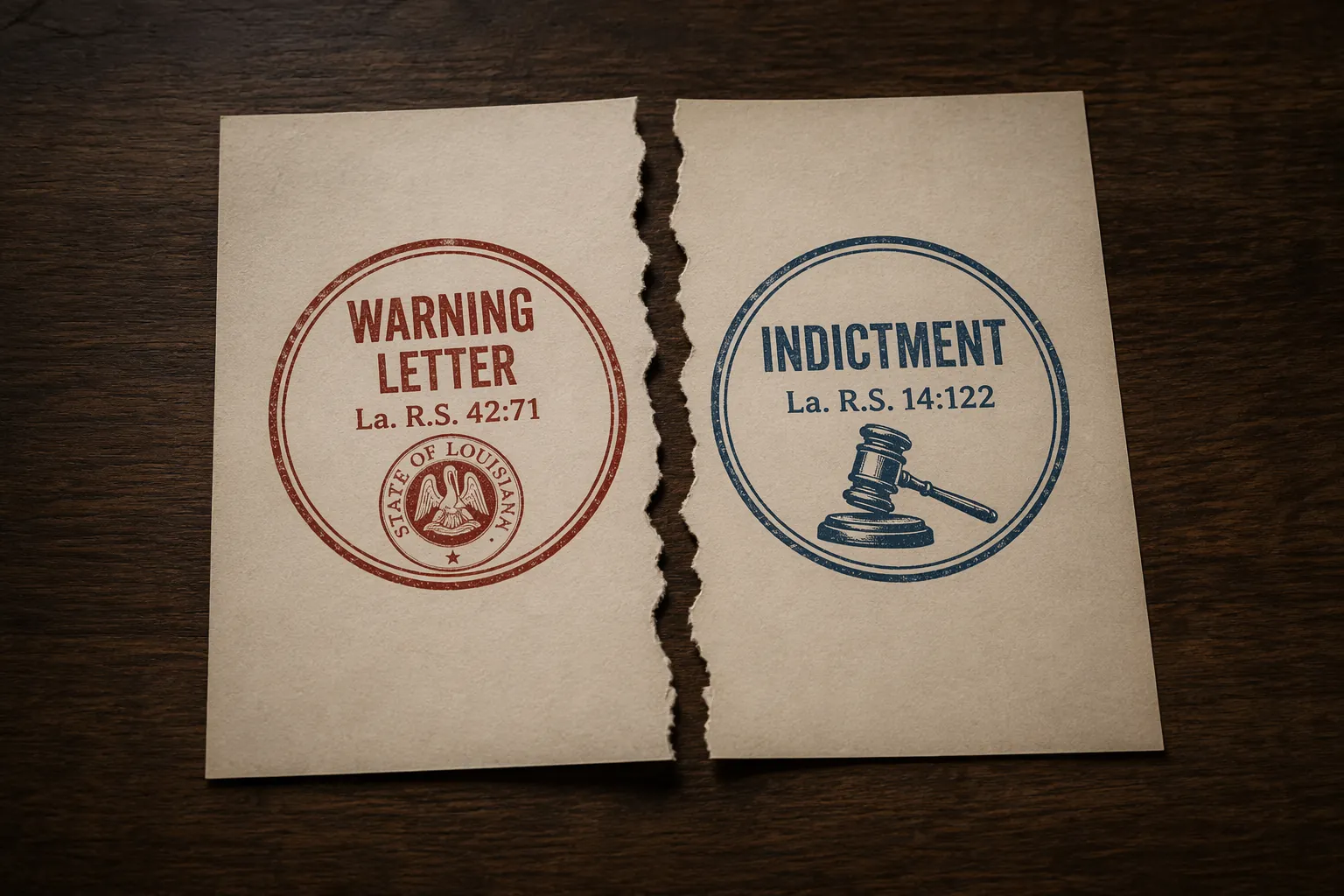
That is the unresolved legal seam. One description casts the May 13 letters as an attorney general warning local officials about the legal consequences of action she believed unlawful. The other casts the same letters as threats meant to influence officials in the performance of public duties. The dismissal did not tell future officials where the boundary lies between those two descriptions.
The distinction between La. R.S. 42:71 and La. R.S. 14:122 is not a citation exercise. It determines what kind of legal act is being evaluated. A warning under the usurper statutes invokes a civil or public-office consequence. A public-intimidation charge alleges criminal misuse of threats or pressure. A letter can be aggressive, political, mistaken, or legally contestable without automatically becoming criminal intimidation. Conversely, an official title does not immunize every threat sent on letterhead. The indictment put that boundary in play, then the nolle prosequi removed the case before a court could draw it.
That is why the dismissal leaves more practical uncertainty than the political reactions suggest. Public officials still need to know when a warning letter crosses from enforcement posture into intimidation. Prosecutors still need to know whether La. R.S. 14:122 can be applied to official legal threats without running into constitutional and statutory limits. Defense lawyers still need to know whether a malformed indictment can be repaired, refiled, or replaced in a cleaner proceeding. None of those questions was answered by the July 22 dismissal.
For a narrower treatment of that unresolved boundary, see Why the Liz Murrill Dismissal Leaves the Law Unsettled.
What the Dismissal Does Not Decide
The safest way to read the July 22 result is by subtraction. It ended the pending 16-count indictment. It removed the immediate threat of arraignment and prosecution under that charging document. It did not adjudicate the factual allegations. It did not resolve the legality of the May 13 letters. It did not decide whether a differently structured prosecution could survive threshold review.
Nor did it close every investigative lane. As of the July 24, 2026 review point for this article, available reports describe an ongoing state police investigation and an FBI inquiry that has been requested but not confirmed. Those facts should be treated as live and limited: an ongoing investigation is not a charge, and a requested federal inquiry is not the same thing as a confirmed federal investigation. The site’s separate piece on the federal investigation angle in the Murrill case addresses that uncertainty in more detail.
The political fallout is also separate from the criminal docket. Available reports note that Gov. Jeff Landry vetoed more than $33 million in Orleans Parish funding after the indictment episode, but that fact does not explain the legal basis for the nolle prosequi. It belongs to the broader institutional dispute, not to the narrow reason the charges were dropped.
So the answer is neither vindication in the courtroom sense nor escape through an irrelevant technicality. The prosecution collapsed procedurally: a sealed grand-jury return drew emergency scrutiny, the special prosecutor’s appointment carried a conflict question, and every alleged victim asked the prosecutor to stop. The felony counts are gone for now. The line between an attorney general’s enforcement warning and criminal intimidation remains where this case left it: disputed, fact-sensitive, and not settled by the dismissal.
References
- Prosecutor drops felony charges against Louisiana Attorney General Liz Murrill, AP News, July 22, 2026
- Grand jury indicts Louisiana’s attorney general in fight over changes to local courts, PBS News, July 2, 2026
- Louisiana court halts criminal indictment against attorney general Liz Murrill, The Guardian, July 3, 2026
- Criminal charges against Louisiana AG Liz Murrill dropped, Fox 8 WVUE, July 22, 2026
- Murrill threatens legal action against New Orleans leaders over court clerk dispute, Fox 8 WVUE, May 13, 2026
- Louisiana Attorney General Liz Murrill indicted by grand jury, WDSU, July 2, 2026
- Louisiana Revised Statutes § 14:122, Louisiana State Legislature
Related records
Tool profile
Browse tool evaluations →Governing regulation
Browse the obligations tracker →Preventive workflow
Browse verification workflows →
Report a correction or tip
Spotted an outdated figure, a misstated fact, or a ruling this case record should reflect? Public comments are disabled for this content given the professional cost of a misreported case outcome, penalty amount, or rule text — use the structured correction channel instead.
Report a correction or tip for this record →