
Why Trump's Smithsonian Order Lacks Legal Force
A legal analysis of President Trump's executive orders targeting the Smithsonian Institution, assessing the trust-instrumentality defense and the practical risks that remain even if the orders are unlikely to be enforced in court.
- Jurisdiction
- US Federal
- Court
- D.C. Circuit
- AI tool named
- None
- Ruling date
- Jun 29, 2026
- Source document
- View primary court order ↗
- Last verified
- Jul 25, 2026
Lex Machina Review is an independent risk-tracking and reference resource. Nothing on this site is legal advice, and using it does not create an attorney-client relationship. Every record is reviewed against primary sources but may not reflect the most current status of a matter — always verify directly against the cited court order, rule text, or a licensed attorney before relying on it.
Companion explanation — secondary to the source document above
As of July 25, 2026, the newest pressure point in the Smithsonian museum controversy is not a lawsuit, a subpoena, or a removal order. It is a sidewalk sign. The July 24 follow-on executive order, “Restoring Trust in the Smithsonian Institution,” directs the Interior Department to place temporary National Park Service signage outside Smithsonian museums warning visitors about allegedly inaccurate content inside. The order recommends the text: “Warning: the exhibits in this museum were prepared by people who don’t want you to love your country.”[1]
That is a useful entry point because it shows the legal problem in its operational form. The White House is not only criticizing museum content. It is trying to create a channel around the Smithsonian’s own governance structure: if the administration cannot directly rewrite exhibits, it can use adjacent federal property, appropriations pressure, personnel pressure, and appointment strategy to shape the institution’s choices.
This analysis is not legal advice. The short legal answer is that President Trump’s Smithsonian orders are unlikely to bind the Smithsonian directly. The better reading of the available authorities is that the Smithsonian is not an ordinary executive agency subject to presidential command over curation, leadership, or internal personnel. The practical answer is less comfortable: weak enforceability does not mean weak pressure. The orders can still change behavior before any court reaches the merits.
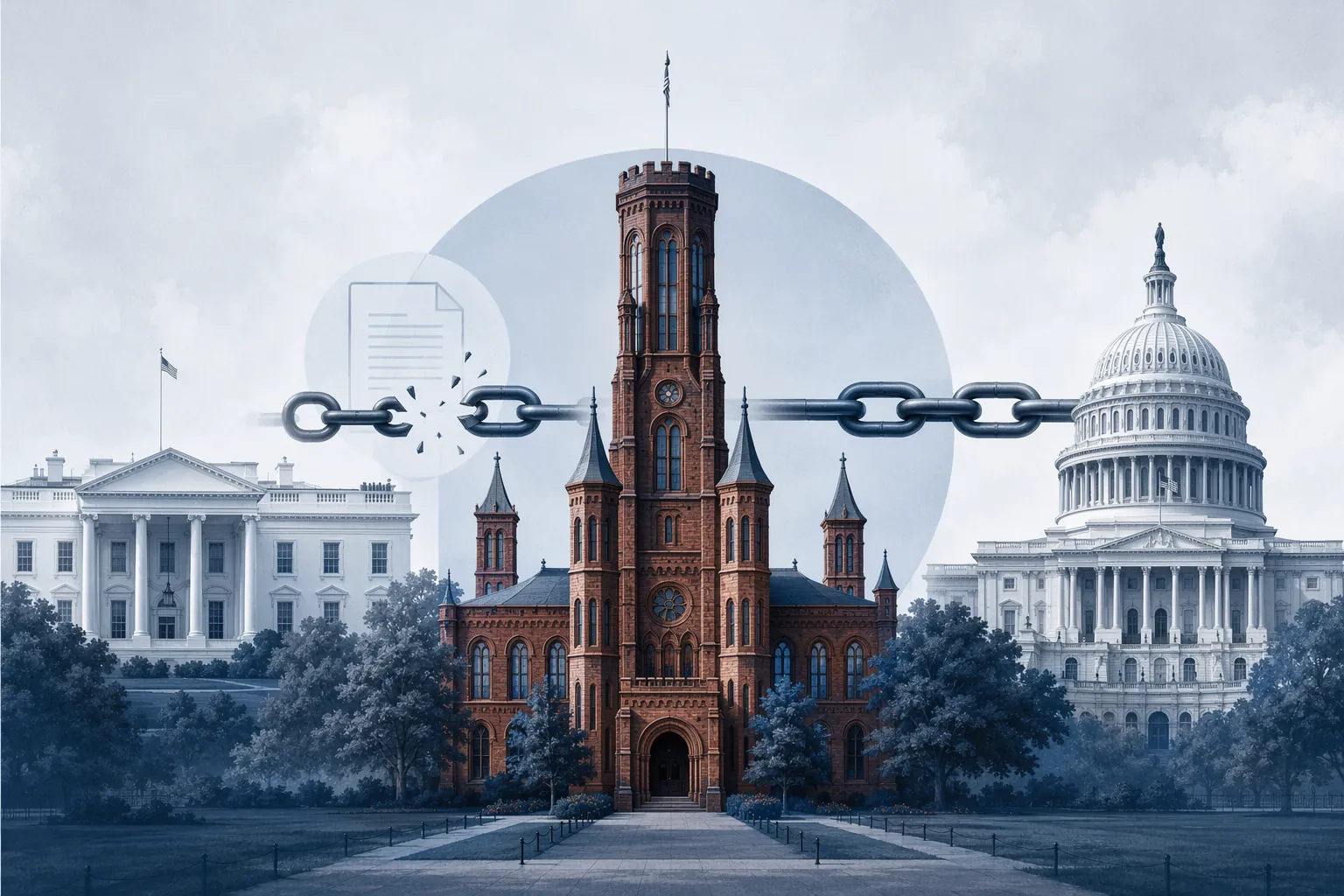
What the Orders Actually Try to Do
The March 27, 2025 order, “Restoring Truth and Sanity to American History,” is the foundation. It directs Vice President J.D. Vance, in his Smithsonian Board of Regents role, to work to “remove improper ideology” from Smithsonian properties, including museums, education and research centers, and the National Zoo. It also instructs agencies to condition future appropriations and grants on compliance with the order’s policy and directs the Vice President to seek citizen regents “committed to advancing the policy of this order.”[2]
The July 2026 order escalates the pressure but also exposes the weakness of the direct-control theory. Instead of ordering the Smithsonian itself to post the warning signs, it orders Interior to act on National Park Service-controlled sidewalks outside Smithsonian museums.[1] That drafting choice matters. It suggests the administration understands there is a legal distinction between commanding an executive department and commanding the Smithsonian’s own curatorial apparatus.
There is a government-speech frame available here, but it should not be allowed to swallow the harder question. Government entities can generally speak for the government, and museum exhibits maintained by public institutions often implicate that doctrine.[3] The central issue in this dispute, however, is not whether a public museum may communicate a message. It is who has lawful authority to decide the message inside this particular institution.
The Smithsonian Is Not Built Like an Executive Agency
The Smithsonian was created by Congress in 1846 to administer James Smithson’s bequest. Its legal status has never fit neatly into the usual boxes. Contemporary legal analysis describes it as the nation’s only “trust instrumentality,” and the Office of Legal Counsel has called it both “a very unusual entity” and “a historical and legal anomaly.”[4]
The decisive feature is governance. The Smithsonian is controlled by a 17-member Board of Regents: the Chief Justice of the United States serves as chancellor; the Vice President sits on the Board; six members of Congress serve as regents; and nine citizen regents fill the remaining seats, with citizen regents limited to a maximum of two six-year terms.[5] That is not an executive department chain of command. It is a deliberately mixed, multi-branch structure.
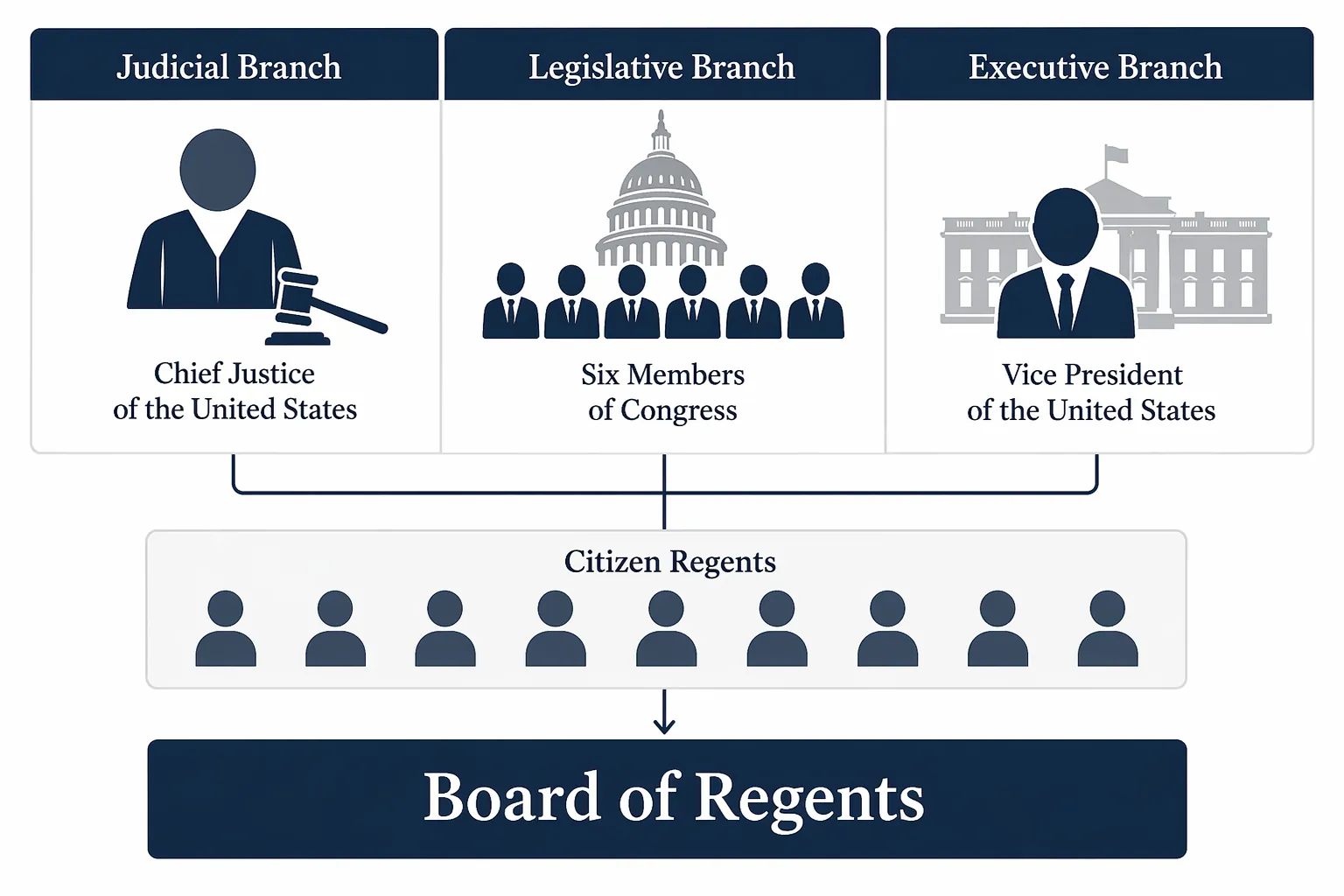
That structure is why the Congressional Research Service’s April 2025 report is so important. CRS concluded that curatorial revisions based on claims of improper ideology “would appear to be exclusively subject to the decisions of the entire Board of Regents pursuant to authorities granted to it by Congress.”[6] The word “entire” does work there. The Vice President is a regent, but not the Board. The President is not a regent at all.
The separation-of-powers problem is not academic. In Dong v. Smithsonian Institution, the D.C. Circuit rejected treatment of the Smithsonian as an executive agency under the Privacy Act in part because the Board includes officials from all three branches. Treating that entity as an executive agency would raise constitutional difficulties: the President would be asserted to control an institution whose governing body includes the Chief Justice and members of Congress. Legal scholarship on the current orders treats Dong as a central obstacle to direct presidential command.[4]
Expeditions Unlimited v. Smithsonian Institution points in the same direction, though through a different route. The D.C. Circuit treated the Smithsonian as an agency for purposes of the Federal Tort Claims Act, but not as an executive-branch entity for all purposes. That distinction is the statute-by-statute framework. A statutory label can solve one problem in one statute without transforming the Smithsonian into a cabinet department.
Why the Label “Agency” Does Not End the Question
This is the point most likely to be blurred in public argument. The Smithsonian can be treated as federal enough for some purposes and independent enough for others. Tort liability, records rules, appropriations practice, employment statutes, and constitutional command authority do not necessarily move together.
| Question | Why It Matters |
|---|---|
| Is the Smithsonian covered by a particular statute? | That depends on the statute’s text, purpose, and prior judicial treatment. |
| Is the Smithsonian part of the executive branch for presidential command purposes? | That raises a separate separation-of-powers question because of the Board’s multi-branch composition. |
| Can one regent direct curation? | CRS says ideological curatorial revisions appear to belong to the entire Board, not one officer. |
| Can political actors create pressure without legal command? | Yes. Funding, appointments, public criticism, and interagency cooperation can operate before adjudication. |
For counsel, that framework is more useful than asking whether the Smithsonian is “federal” in the abstract. The litigation question is narrower: what source of law gives the President authority to command Smithsonian curatorial decisions? On the present record, EO 14253 does not identify a statute that does that work. It instead directs executive-branch actors and attempts to influence Smithsonian governance through the Vice President’s regent seat, funding conditions, and future citizen-regent selection.[2]
Slaughter Helps the President, But Not Enough
The best counterargument is that the Supreme Court has become increasingly receptive to presidential control over entities exercising executive power. Trump v. Slaughter, decided June 29, 2026, is the obvious authority to cite. In a 6-3 decision, the Court expanded presidential removal power over entities exercising executive power.[7]
But Slaughter does not simply hand the White House the Smithsonian. The opinion confines its reasoning to entities “exercising executive power,” and commentary cited in the current record notes that Stanford Law professor Anne Joseph O’Connell described the Smithsonian as looking “nothing like the FTC.”[7] That distinction is not decorative. The FTC is a regulatory body exercising federal executive authority. The Smithsonian is a congressionally chartered trust instrumentality governed by a multi-branch Board and entrusted with museum, research, and cultural functions.
The carve-out matters, but so does the Court’s direction of travel. A court sympathetic to broader presidential control might read “executive power” aggressively if the dispute were framed around federal funding, federal property, or federally sponsored public messaging. That does not make the Smithsonian an executive agency. It does mean a litigation memo that stops at “Slaughter is distinguishable” is not finished.
The cleaner defense remains institutional: the President cannot use an executive order to override the Board structure Congress created. If the administration wants to change who controls Smithsonian curation, it needs a source of law outside the President’s general supervisory authority over the executive branch. The current orders do not appear to supply one.
The Real Risk Is Compliance Before Judgment
The Smithsonian does not need to lose in court to lose room to maneuver. That is the practical legal risk in this controversy. Institutions with appropriations exposure, board vacancies, and public-facing missions often respond to pressure long before anyone obtains a declaratory judgment.
The reported facts already point in that direction. The Smithsonian has closed its Office of Diversity, turned over partial records, and seen National Portrait Gallery director Kim Sajet resign under pressure, even while maintaining that it remains independent.[5] Those acts do not prove that the orders are legally binding. They show the familiar gray zone in which a legally contestable demand produces operational concessions.
Funding pressure is the most direct route. EO 14253 directs agencies to use appropriations and grant conditions to advance the order’s policy.[2] Even if a particular budget condition would later be challenged as unlawful, the timing favors the funder. Program planning, staffing, exhibit loans, research commitments, and donor communications all respond to uncertainty faster than courts can resolve institutional-status litigation.
Vacancies are the slower route. Citizen regents are not executive subordinates, but future appointments can alter Board behavior if enough seats turn over. Reporting in July 2026 focused on Board vacancies, Denise O’Leary’s term, and Chief Justice Roberts’s institutional role as chancellor, while noting that the exact count of filled seats remained a moving target in mid-July.[5] That uncertainty is itself part of the risk environment: control may be pursued incrementally, through ordinary governance mechanics rather than a single legally testable command.
The sidewalk-sign order adds a third route: selective cooperation by agencies that clearly are executive-branch entities. Interior can be ordered to act on National Park Service property in a way that affects the visitor experience at Smithsonian museums.[1] That does not rewrite an exhibit label inside the museum. It may still change how visitors encounter the museum and how Smithsonian leadership assesses the cost of resisting further demands.
What Would Matter in Litigation
No court has yet adjudicated the core enforceability question presented by EO 14253 or the July 2026 follow-on order. The Smithsonian has not filed suit challenging the orders, and the administration has not filed suit to enforce a Smithsonian-specific command. That leaves the present assessment dependent on primary orders, CRS analysis, D.C. Circuit treatment of the Smithsonian’s status, Supreme Court removal doctrine, and current reporting.
If litigation does arrive, the first issue should be the source of asserted authority. A court would need to know whether the challenged act is a direct order to the Smithsonian, an instruction to an executive agency, a funding condition, an appointment-related act, or government speech on adjacent federal property. Those are not interchangeable theories.
- A direct command to revise Smithsonian exhibits would face the strongest trust-instrumentality and Board-authority objections.
- A directive to Interior about National Park Service signage would be easier to characterize as executive-branch action, though it still applies pressure around the Smithsonian dispute.
- A funding condition would require separate analysis of appropriations law, statutory authorization, and any limits on executive withholding.
- A regent-selection strategy would likely be harder to challenge immediately, unless tied to a concrete unlawful act.
- Partial cooperation by the Smithsonian could complicate later claims of coercion or irreparable harm, depending on the factual record.
The Smithsonian’s strongest legal position is narrow and institutional. It need not prove that its curatorial choices are immune from all democratic control. It need only show that the President cannot personally command those choices through an executive order when Congress assigned governance to the Board of Regents.
That is why the legal implications of the Smithsonian museum controversy differ from the usual fight over federal messaging. The government-speech question asks whether the government may speak. The Smithsonian question asks which organ of government, or trust governance, gets to decide. On current sources, CRS’s answer is the entire Board, not the President acting through the Vice President or agency funding instructions.[6]
Risk Assessment
The administration’s litigation risk on direct enforceability is high. EO 14253 and the July 2026 order do not appear to create direct legal authority over Smithsonian curation, leadership, or personnel. The Smithsonian’s 1846 charter, trust-instrumentality status, multi-branch Board, CRS’s Board-centered reading, and D.C. Circuit treatment of the institution all cut against treating it as a standard executive agency.
The compliance risk for the Smithsonian is also high enough to matter. Appropriations pressure, agency-side implementation, public accusations of inaccurate or unpatriotic exhibits, and regent vacancies can produce partial compliance without a judicial victory. The institution’s reported closure of its diversity office, partial record production, and leadership pressure show that legal independence does not eliminate institutional fatigue.[5]
The most accurate bottom line is therefore split. In court, the orders look weak as direct commands to the Smithsonian. In practice, they are already capable of changing incentives. No court has decided this exact dispute, and the more immediate danger is that political tools may obtain concessions before any judge reaches the merits.
References
- “Restoring Trust in the Smithsonian Institution,” The White House, July 24, 2026.
- “Restoring Truth and Sanity to American History,” The White House, March 27, 2025.
- “Control of Smithsonian Institution Exhibits,” First Amendment Encyclopedia, updated July 9, 2026.
- “Fight at the Museum: Executive Overreach and the Future of the Smithsonian Institution,” Yale Law Journal, April 10, 2026.
- “Smithsonian-Trump Regents,” The Atlantic, July 2026.
- “Smithsonian Institution: Background and Legal Issues,” Congressional Research Service, April 23, 2025.
- “Trump v. Slaughter,” Supreme Court of the United States, June 29, 2026.
Related records
Tool profile
Browse tool evaluations →Governing regulation
Browse the obligations tracker →Preventive workflow
Browse verification workflows →
Report a correction or tip
Spotted an outdated figure, a misstated fact, or a ruling this case record should reflect? Public comments are disabled for this content given the professional cost of a misreported case outcome, penalty amount, or rule text — use the structured correction channel instead.
Report a correction or tip for this record →