
Workplace ICE Arrests and the Judicial Warrant Distinction
Using the July 2026 Nashville airport detention of a Southwest Airlines flight attendant as a case study, this article explains the critical legal distinction between judicial and administrative warrants in workplace immigration enforcement. It provides employers with a documented framework for responding lawfully to ICE at the workplace, protecting both employee rights and I-9 compliance obligations.
- Jurisdiction
- US-Federal
- Court
- Nashville International Airport
- AI tool named
- None
- Ruling date
- Jul 24, 2026
- Source document
- View primary court order ↗
- Last verified
- Jul 27, 2026
Lex Machina Review is an independent risk-tracking and reference resource. Nothing on this site is legal advice, and using it does not create an attorney-client relationship. Every record is reviewed against primary sources but may not reflect the most current status of a matter — always verify directly against the cited court order, rule text, or a licensed attorney before relying on it.
Companion explanation — secondary to the source document above
Verification frame and case snapshot
Last verified: July 27, 2026, UTC. This article is a workplace risk record for employers and counsel, not legal advice for any particular company, employee, or enforcement encounter. The Nashville facts are useful because they show where a real-time workplace arrest can place an employer representative: between a federal badge, an employee in custody, airport security procedures, and later questions about whether the employer gave too much access or too little.
The reported case is this: Lorenzo Thompson, identified in public reports as a Southwest Airlines flight attendant, was detained by ICE at Nashville International Airport while on a work trip on July 24, 2026. DHS’s stated position, as reported, is that Thompson had overstayed a visa. Supporters have given a different account, asserting that he had a pending asylum case and a valid employment authorization document. As of this verification date, those competing status claims should be treated as unresolved, not as adjudicated facts.[1][2][3]
That restraint matters for employers searching for the legal implications of ICE detaining a Southwest employee at Nashville airport. The operational lesson does not depend on deciding Thompson’s status, and it does not support a conclusion about Southwest’s I-9 compliance posture, which is not publicly detailed. The employer-facing question is narrower and more durable: when ICE arrives at a workplace to arrest an employee, what document has been presented, what spaces are agents seeking to enter, and what record can the employer later produce to show that it classified the encounter correctly?
The enforcement environment makes that question less theoretical. CBS News reported that June 2026 had the highest monthly ICE booking total since the enforcement crackdown began, with an average daily detained population of 59,400, and that the non-criminal detained population grew from about 22,000 to about 26,000 between June and mid-July 2026.[4] That context does not change the legal test at the workplace door. It does explain why receptionists, station managers, security supervisors, HR generalists, and duty officers need something more precise than a general instruction to “call legal.”
ICE’s own public FAQ adds a second pressure point. ICE states that it does not need judicial warrants to make arrests and that officers may briefly detain individuals based on reasonable suspicion of illegal presence.[5] For an employer, that statement should not be read as permission to stop asking document-specific questions. Arrest authority and employer consent to enter nonpublic workplace areas are separate issues.
The first fact to identify is the warrant type
In a workplace ICE encounter, the first useful question is not whether the employee is removable, whether management approves of the enforcement action, or whether the company wants to appear cooperative. The first question is what paper the agents have and who signed it.
Practitioner guidance from Morgan Lewis, Ballard Spahr, and Felhaber all draws the same practical line: a judicial warrant signed by a U.S. district court judge is materially different from an ICE administrative warrant, including Form I-200 or Form I-205, signed by an immigration official or ICE supervisor.[6][7][8] The distinction is easy to describe in training and easy to miss under pressure.
| Document presented | Typical signer | Immediate employer task | Nonpublic workplace access consequence |
|---|---|---|---|
| Judicial warrant | U.S. district court judge or magistrate judge | Review scope, named person or place, address, date, and signature; route to counsel; comply within the warrant’s limits. | May authorize entry into the nonpublic areas described in the warrant. |
| ICE administrative arrest warrant, including Form I-200 | ICE or immigration officer/supervisor | Ask for a copy; do not treat the form as a court order; route to counsel or the designated ICE-response lead. | Does not, by itself, authorize entry into nonpublic workplace areas. |
| ICE administrative warrant for removal/deportation, including Form I-205 | ICE or immigration officer/supervisor | Ask for a copy; classify it as administrative unless it is signed by a judge; document what was requested. | Does not, by itself, authorize entry into nonpublic workplace areas. |
| Notice of Inspection for I-9 records | DHS/ICE official | Accept and calendar the production deadline; notify HR/legal; preserve records. | Different track from an arrest encounter; employers generally receive at least three business days to produce I-9 forms. |
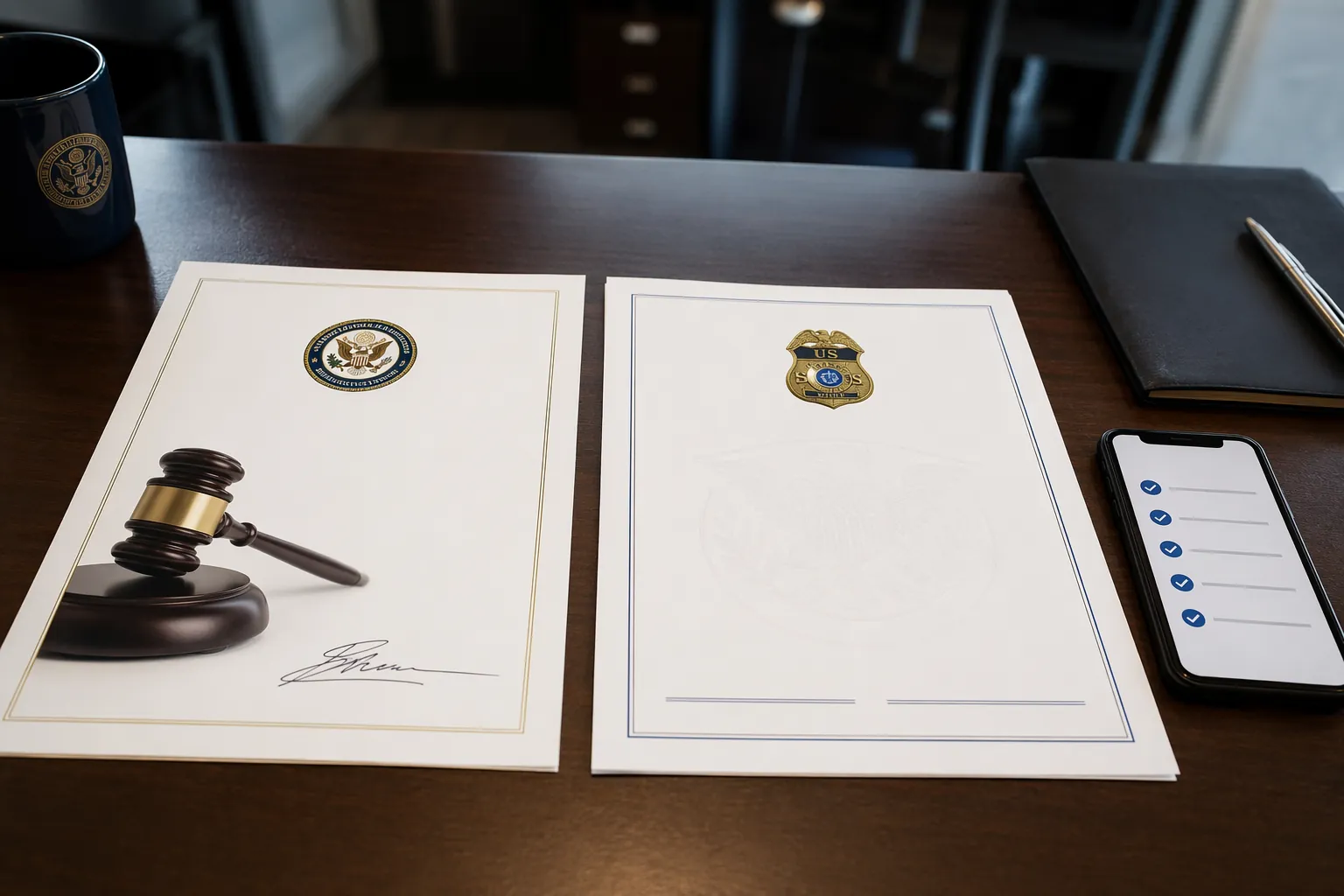
The signature block is not a clerical detail. A document with DHS, ICE, or HSI insignia may look official and may still be administrative rather than judicial. A judicial warrant should show a federal court, a judge or magistrate judge’s signature, and a scope that can be read: the person or place covered, the relevant address or location, and any limits on time or search authority. An administrative warrant may authorize ICE personnel internally to arrest or remove a person, but employer guidance consistently treats it as insufficient to compel employer consent to enter private workspaces.[6][7][8]
This is where airport operations are unusually exposed. A terminal contains public-facing counters, security-screened areas, airline-controlled offices, crew rooms, break rooms, ramp-adjacent spaces, and other areas governed by layered security rules. The warrant classification still matters, but the access analysis may require a fast read of both immigration enforcement authority and site-control authority. The available materials do not establish how TSA-ICE data-sharing or airport security architecture would be resolved by an appellate court in this specific setting, so the safer description is current best-practice interpretation rather than settled circuit law for every airport configuration.
Public areas, nonpublic areas, and the consent problem
If ICE agents are in a public area, the employer’s control is limited. A public lobby, a customer-facing counter, or another area open to the public is not the same as a locked office, employee-only crew room, records room, operations center, or secured workplace area. The employer may not be able to prevent agents from standing where any member of the public may stand.
The decision changes when agents ask to go beyond that public space. Without a judicial warrant, employer guidance says the company may lawfully decline consent to enter nonpublic areas. That refusal should be calm, documented, and limited to access. It should not become interference with an arrest occurring in a place agents may lawfully be, and it should not include hiding an employee, moving an employee out of sight, destroying records, or giving instructions designed to defeat enforcement.
A usable script is short because the person using it may not be a lawyer: “Please provide the warrant or document authorizing entry. I am not authorized to consent to entry into nonpublic areas without a judicial warrant. I will contact the company’s designated response lead now.” The supervisor should then preserve the document, note the agents’ names and agencies if available, record the time and location, and avoid argument about the employee’s immigration status.
If a judicial warrant is presented, the company’s response is not to debate the policy of enforcement at the threshold. The response is to read the warrant, honor it within its scope, and control collateral access. If the warrant names a person, it does not automatically authorize a broader search of unrelated records or spaces. If it identifies a place, the employer should keep agents within the described place. If the document is unclear, the access lead should ask for clarification while avoiding physical obstruction.
This is also why “cooperate with law enforcement” is too broad as a workplace instruction. Cooperation can mean receiving agents professionally, asking for documents, preserving copies, contacting counsel, and complying with a valid judicial warrant. It does not have to mean consenting to nonpublic-area access on the strength of an administrative form. A company can be orderly without surrendering every threshold decision.
Employee rights can be preserved without coaching resistance
Employees retain basic rights in an ICE encounter, including the right to remain silent, the right to request counsel, and protection against compelled self-incrimination. Employer guidance permits companies to inform employees of those rights, but warns against directing employees to resist, flee, conceal information, or refuse lawful orders.[7][8]
That line is important for managers. A supervisor may say, “You may choose to remain silent and may ask to speak with counsel.” A supervisor should not say, “Do not answer anything,” “Do not go with them,” or “Leave through the back.” The first statement preserves a right. The second set of statements may be characterized as interference, and it also puts the supervisor in the position of giving legal advice during an active enforcement action.
The company should also avoid forcing the employee to speak with agents, translate for agents, or produce personal documents beyond what the law requires. If agents ask management for employee schedules, addresses, phone numbers, travel records, personnel files, or immigration documents, the request should be routed to the response lead unless a judicial warrant or other compulsory process clearly covers the material. The worst response is informal helpfulness that later cannot be reconstructed.
Documentation should be factual, not argumentative. Record who arrived, what agency they identified, what documents were shown, whether copies were provided, which areas agents entered, who consented if anyone did, which employees were contacted, and when legal or HR was notified. If the company declined nonpublic access because only an administrative warrant was presented, the record should say that. If agents entered under a judicial warrant, the record should identify the warrant’s apparent scope and what was done to keep access within it.
Do not confuse an arrest visit with an I-9 inspection
Workplace immigration enforcement often gets compressed into one mental file: ICE came, therefore HR must immediately produce immigration paperwork. That is not the right operating assumption. An employee arrest encounter and an I-9 Notice of Inspection are different tracks.
When ICE serves a Notice of Inspection for I-9 records, employers generally receive at least three business days to produce the forms. Immediate production is not required merely because agents are present, and employer guidance treats the three-business-day period as a concrete deadline that should be calendared and managed through HR and counsel.[6][8]
That timeline is one of the most useful facts a frontline manager can know. It prevents two opposite mistakes: handing over records casually in the middle of an arrest encounter, or refusing a properly served records inspection because the company believes every ICE contact must be resisted. The correct response is to accept service, preserve the records, notify the designated internal team, and produce on the statutory timeline after review.
The Thompson reports do not allow an outside reader to decide whether Southwest completed I-9 verification correctly, whether any reverification issue existed, or whether a facially valid employment authorization document was presented and accepted in good faith. Those are document-specific questions. They depend on what the employer saw, when it saw it, what the document appeared to show, whether reverification was required, and how the records were maintained.
For employers, the practical separation is this: the access team handles the agent-at-the-door problem; HR or compliance handles the I-9 records problem; legal supervises both. A station manager should not improvise document production because an arrest is happening nearby. An HR manager should not assume the company can ignore an NOI because the arrest was upsetting or disputed.
A protocol that can survive the first thirty seconds
The protocol does not need to be theatrical. It needs to assign authority before the badge appears. In an airport or transportation workplace, the likely first recipient may be a gate supervisor, crew scheduler, receptionist, security contractor, station manager, or duty officer. If the only written instruction is “contact legal,” the company has left the hardest minute ungoverned.
- Designate a primary and backup ICE-response lead for each site or shift pattern, including after-hours coverage.
- Train front-desk, security, HR, and operations personnel to ask for and copy the document presented before consenting to nonpublic access.
- Use a warrant-classification checklist that distinguishes judicial warrants from ICE administrative forms, including Forms I-200 and I-205.
- Map public, restricted, and employer-controlled nonpublic areas at the site before an incident occurs.
- Give managers a rights-preservation script that informs employees of rights without directing resistance.
- Route requests for personnel files, schedules, immigration documents, and I-9 records to HR/legal unless compulsory process clearly requires immediate disclosure.
- Create an incident log template covering time, location, agents, documents shown, access requested, access granted or denied, employee contact, and internal notifications.
The access map is not an abstract exercise. In a normal office, the public/nonpublic boundary may be the reception desk door. At an airport, the line may run through a counter, jet bridge, crew room, ramp access point, shared tenant corridor, or badge-controlled area. The company should know in advance who controls each space and who is authorized to consent to entry. A supervisor who has never been told whether a crew room is nonpublic will not solve that question well while agents wait.
The warrant-classification checklist should be visual. It should ask: Is this signed by a judge or magistrate judge? Does it identify a federal court? Does it name the person or place? Is the workplace address correct? Is the date current? Does it authorize entry or only arrest/removal? Is it an ICE form signed by an ICE official? The answer should determine the next action, not the seniority or confidence of the person holding the document.
Training should also make clear that declining consent is not the same as blocking agents. A manager can stand aside in a public area, ask for documents, state that the company does not consent to entry into nonpublic areas without a judicial warrant, and call the response lead. That is different from physically preventing movement, concealing an employee, or creating a confrontation. The distinction is both legal and practical.
Compliance programs help, but they do not replace the threshold decision
ICE’s IMAGE program is a voluntary compliance framework that may reduce inspection risk, and Felhaber identifies it as one option employers may consider as part of broader employment-verification compliance.[8] For a large employer, participation or nonparticipation in such a program is a separate governance question from what a duty manager should do when agents appear at a workplace.
A strong I-9 program does not answer whether agents may enter a crew room with an administrative warrant. A carefully drafted ICE-response protocol does not cure deficient employment-verification records. The two systems should communicate, but they should not collapse into one another. Access decisions happen in minutes. I-9 inspections proceed on a records timeline. Employee-rights issues arise in real time. Each needs an owner.
The Nashville detention should not be stretched into a conclusion about Thompson’s ultimate immigration status or Southwest’s liability. The reliable employer-facing conclusion is narrower: the safest protocol is neither reflexive cooperation nor performative refusal. It is documented warrant classification, controlled access decisions, preserved employee rights, and separate I-9 compliance.
References
- Report on Lorenzo Thompson’s Nashville International Airport detention, AOL News, July 24–25, 2026.
- Report on Lorenzo Thompson’s Nashville International Airport detention, Newsweek, July 24–25, 2026.
- Report on Lorenzo Thompson’s Nashville International Airport detention, New York Post, July 24–25, 2026.
- More people booked into ICE detention in June than in any month since crackdown began, CBS News, July 2026.
- Immigration Enforcement Frequently Asked Questions, ICE.gov, updated February 2026.
- ICE Enforcement Actions: Understanding Employers Rights and Obligations, Morgan Lewis, February 2025.
- ICE in the Workplace: 2026 Update, Ballard Spahr, February 2026.
- Understanding Employer Rights and Obligations If ICE Knocks on Your Door, Felhaber.
Related records
Tool profile
Browse tool evaluations →Governing regulation
Browse the obligations tracker →Preventive workflow
Browse verification workflows →
Report a correction or tip
Spotted an outdated figure, a misstated fact, or a ruling this case record should reflect? Public comments are disabled for this content given the professional cost of a misreported case outcome, penalty amount, or rule text — use the structured correction channel instead.
Report a correction or tip for this record →