
YG Detention Exposes Investigative Gaps in Drakeo Murder Case
This article analyzes the July 23, 2026 detention of rapper YG in connection with the unsolved murder of Drakeo the Ruler, examining the procedural and jurisdictional questions it raises for defense counsel and the investigation's integrity.
Lex Machina Review is an independent risk-tracking and reference resource. Nothing on this site is legal advice, and using it does not create an attorney-client relationship. Every record is reviewed against primary sources but may not reflect the most current status of a matter — always verify directly against the cited court order, rule text, or a licensed attorney before relying on it.
Companion explanation — secondary to the source document above
The narrow confirmed event is this: on July 23, 2026, the California Highway Patrol executed a search warrant at a commercial property associated with YG, Burbank SWAT assisted, YG was detained during the operation, and he was released without arrest in connection with the continuing Drakeo the Ruler homicide investigation.[1][2] That is enough to make the detention worth reading closely. It is not enough to say what officers were looking for, what they already knew, or whether the search moved the case closer to charges.
“Detained but not arrested” is not a throwaway phrase. During a warrant execution, officers may temporarily control people at or near the premises for safety, evidence-preservation, and scene-management reasons. That can be procedurally lawful without being accusatory in the way an arrest is accusatory. It can also become important later if the detention produced statements, phone access, observed conduct, seizure disputes, or identification evidence. The missing papers matter more than the video of officers arriving.
Until the warrant, return, and any supporting affidavit are available, the safest legal reading is conditional. Counsel would want to know the exact premises covered, whether the warrant named YG or only the property, what categories of evidence were authorized, what was seized, whether digital devices were taken, whether any on-scene statements were obtained, and whether the warrant depended on old evidence, a new witness, forensic testing, or a fresh theory of association. A detention during a search is often explained by the scene. A search warrant in a cold homicide is explained by the affidavit.
What the detention does not prove
The detention does not prove that YG is a suspect, does not prove that prosecutors are close to filing charges, and does not prove that the search found evidence. It also should not be dismissed as meaningless simply because no arrest followed. In a cold case with years of public silence, a search warrant is a choice by investigators to present probable-cause material to a judge and to risk later scrutiny of that material by defense counsel.
That distinction is especially important here because the reported July 2026 operation appears, from the public record described in current coverage, to be the first documented law-enforcement action in the Drakeo homicide investigation since 2022.[1][2] The word “appears” is doing work. Public documentation is not the same thing as investigative activity. Agencies can interview witnesses, review footage, run forensic inquiries, and seek sealed orders without public notice. But when the first visible action in years is a SWAT-assisted search at a rapper’s commercial property, counsel should assume the paperwork—not the spectacle—will decide what the event means.
The reason the 2026 warrant lands differently
The July 2026 search does not arrive on a clean investigative record. Jeff Weiss’s February 2025 Los Angeles Times reporting described a homicide investigation marked by unresolved basic questions: a CHP detective was unreachable for comment, security-camera footage had not been released to the public, a private detective hired by Drakeo’s mother estimated that 113 assailants were involved, and no one had been charged.[3] That 113 figure is not an official count. It is an estimate by a privately retained investigator. Its legal significance is not that it should be treated as established fact; its significance is that it makes the gap between alleged scale and prosecutorial outcome hard to ignore.
The same Los Angeles Times account quoted attorney Kellen Davis as saying the CHP “isn’t equipped to handle an investigation of this magnitude,” and reported allegations that years passed without sustained witness-interview work.[3] It also described deposition material indicating that police and security were present during the attack and did not intervene.[3] Those details do not answer whether the 2026 warrant was justified. They explain why defense counsel should not treat the warrant as self-validating.
A cold-case warrant can be built in several ways. It might rest on newly cooperative witnesses. It might rest on prior surveillance that investigators finally matched to a person, vehicle, phone, location, or business record. It might rest on statements from someone facing exposure in another matter. It might rest on a theory that has become more attractive because earlier investigative avenues failed. Those possibilities lead to different defense questions. If the affidavit relies on fresh evidence, counsel will test where it came from and why it emerged now. If it relies on old evidence, counsel will test why the same material did not support earlier action. If it relies on witness accounts, counsel will test memory, inducements, prior inconsistent statements, and whether investigators showed witnesses media, social posts, or names before asking for identification.
The old case file matters because silence creates its own litigation terrain. Witnesses move, memories harden into stories, video is lost or degraded, phones are replaced, social-media posts are deleted, and business records age out of normal retention. When an agency resurfaces after years, a defense lawyer’s first task is not to guess what officers found. It is to preserve the right to ask what the agency failed to collect when the evidence was freshest.
The documents counsel should demand before anyone treats this as routine
The first useful document is the warrant itself. It should identify the place to be searched and the things to be seized with enough particularity to keep the search from becoming a general rummaging exercise. If the warrant covered a commercial property, counsel will want the address, units, offices, storage areas, vehicles, safes, electronic systems, and any named business entities. The difference between a warrant for one office and a warrant for every device found inside a building is not cosmetic.
The second useful document is the return. The return should show what officers actually took. That is where a narrow warrant can become a broad practical intrusion. If officers seized phones, computers, cameras, storage drives, business records, clothing, vehicles, or weapons, each category raises a different question about relevance and later search protocols. Digital evidence is especially sensitive because the physical seizure of a device is only the beginning; the later forensic search may require separate limits, filter procedures, or litigation over scope.
The third document is the affidavit or statement of probable cause, if and when it can be obtained. That is where counsel learns whether CHP presented a new witness, a revived theory, a forensic connection, surveillance analysis, social-media material, business records, or an inference from associations. If the affidavit is sealed, the sealing order and any redacted version become the next targets. Defense counsel cannot responsibly advise a detained person, property owner, employee, or witness based only on the fact that officers had a warrant.
| Document or record | Why it matters |
|---|---|
| Search warrant | Defines the authorized premises, property, and evidence categories. |
| Warrant return | Shows what officers actually seized and whether the search expanded in practice. |
| Probable-cause affidavit | Reveals what investigators claimed to know before entering the property. |
| CHP public statement or incident report | Clarifies agency position, participating units, and the stated investigative purpose. |
| Body-camera, entry, and inventory records | Helps test detention length, questioning, consent claims, and property handling. |
Jurisdiction is not just bureaucracy
The agency map is part of the evidentiary problem. The 2026 search was reported as CHP-led, with Burbank SWAT assistance.[1][2] The broader Drakeo case has long raised questions about CHP’s role, the overlap with Los Angeles-area law-enforcement agencies, and who had practical ownership of a complex homicide investigation.[3] That is not a turf complaint. It affects witness handling, evidence preservation, chain of command, homicide experience, report writing, disclosure obligations, and later accountability.
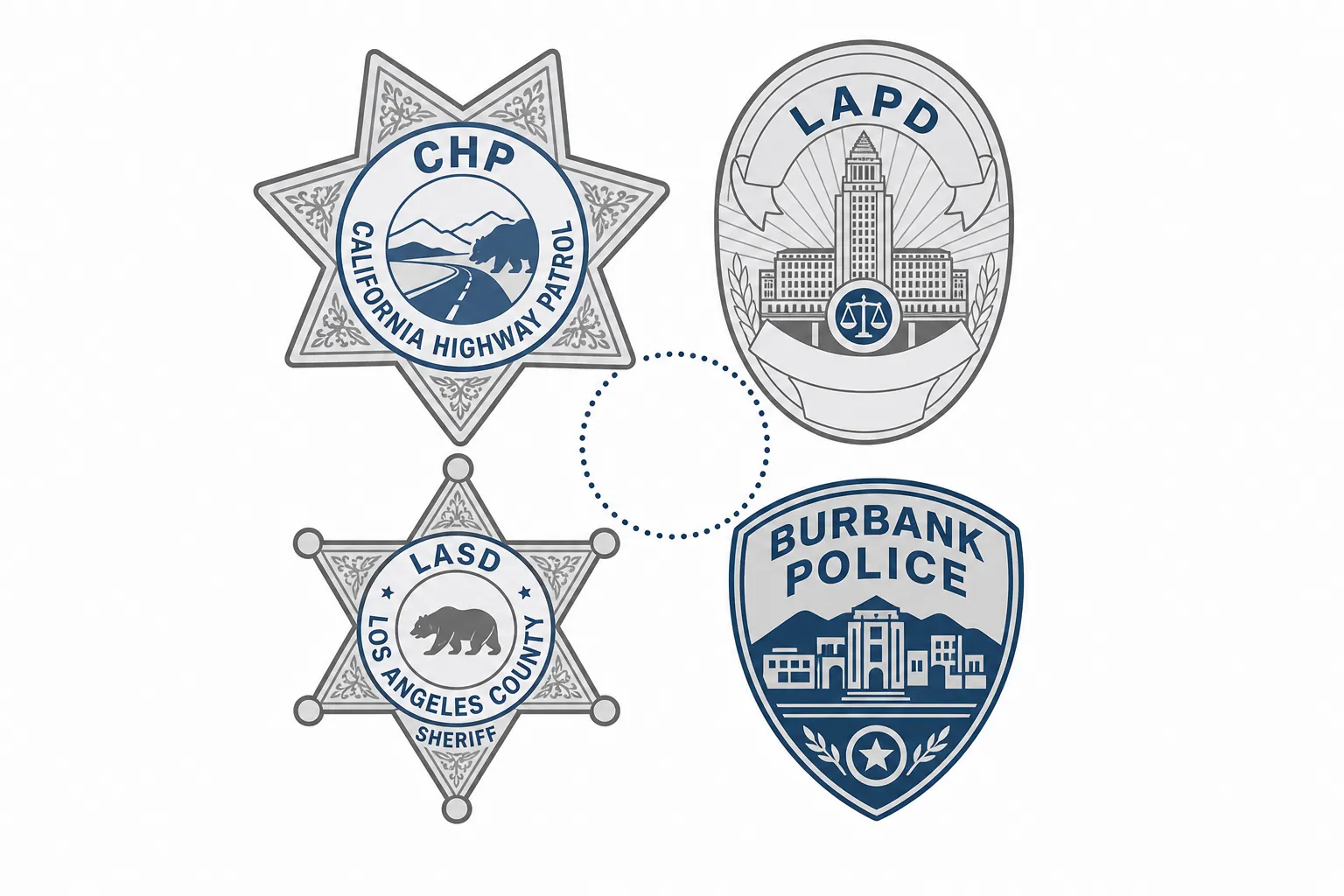
When several agencies touch the same event, defense counsel has to reconstruct who knew what and when. If one agency controlled the scene, another had homicide expertise, another had local intelligence, and another later assisted with tactical entry, the discovery map changes. Reports may sit in separate systems. Body-camera or radio records may be retained under different policies. Witness contacts may be logged by one agency and never fully absorbed by another. A prosecutor can later present “the investigation” as a single coherent thing, but the file may have been built through handoffs, gaps, and assumptions.
That matters acutely in a case where the Los Angeles Times reported that security footage had not been released to the public and that deposition material placed police and security at the attack without intervention.[3] The issue is not whether every piece of footage should be public. Criminal investigations often require confidentiality. The issue is whether investigators identified, preserved, reviewed, and disclosed the relevant footage in a way that can survive later adversarial testing.
A jurisdictional gap can also change how a witness experiences the case. A witness contacted by CHP years later may not know whether prior statements to event security, LAPD, LASD, private investigators, civil lawyers, or insurers are already in law-enforcement hands. A property owner served with a warrant may not know whether officers are looking for evidence of the homicide, communications with someone else, business records, or material that places third parties at a location. The practical advice is simple: do not let the agency logo substitute for an understanding of the request.
Why Drakeo’s earlier prosecution belongs in the background, not the center
Drakeo’s earlier prosecution is relevant because it explains why defense lawyers may be alert to investigative shortcuts in cases built around Los Angeles rap conflicts, social media, and group-association theories. The FADER reported in 2019 on Detective Hardiman’s methods, including reliance on Google and social media, and on the earlier prosecution’s use of rap lyrics as evidence of conspiracy under California Penal Code § 182.5.[4] That history does not prove anything about the 2026 YG detention. It does, however, sharpen the questions counsel should ask if the new warrant affidavit leans on lyrics, affiliations, old posts, online commentary, or broad claims of association rather than direct evidence tied to the homicide.
The danger in high-profile music cases is not only that speech can be overread. It is that investigators can make a familiar cultural narrative do work that evidence should be doing. If a warrant affidavit uses rap-world hostility, prior public disputes, or online reactions as context, counsel needs to separate context from probable cause. Context may explain why investigators looked in a direction. It does not, by itself, establish that a particular property contains evidence of a killing years later.
The civil case moved where the criminal case did not
The civil litigation provides a useful contrast, but it should be handled carefully. In January 2023, Rolling Stone and Billboard reported that Judge Yolanda Orozco allowed claims against Live Nation to proceed past a demurrer stage, applying a foreseeability analysis in the wrongful-death litigation.[5][6] That is not a criminal finding, and it is not a finding that any individual committed the killing. It shows something narrower: civil pleadings advanced far enough for a court to assess whether the alleged risk could be litigated, while the criminal investigation had still produced no charges.
The current trial posture of that civil case should not be updated without docket verification. The point here is not to convert a demurrer ruling into a liability conclusion. The point is that civil discovery appears to have surfaced material about security and police presence that bears on the factual environment of the attack.[3] If civil lawyers can develop deposition testimony about who was present and what they did, criminal investigators and later prosecutors will face obvious questions about why comparable fact development did or did not happen earlier.
How counsel should read a cold-case search contact
For anyone contacted after the July 2026 search—YG, employees at the searched property, business partners, witnesses, security staff, or people who were present around the original event—the worst mistake is to treat informal contact as low-risk because no one has been arrested. Cold-case investigators often use noncustodial interviews, consent searches, phone requests, and “just clearing things up” conversations to fill gaps before the defense has seen the theory.
- Identify the agency and every participating unit before answering substantive questions.
- Ask whether the person is a witness, a subject, a target, a property custodian, or merely present during the search.
- Do not consent to device searches, account access, or expanded premises searches without counsel reviewing the warrant.
- Preserve surveillance footage, access logs, messages, call records, calendar entries, and employee schedules that may show who was present and what officers did.
- Create a contemporaneous timeline of the search: entry time, detention length, questions asked, statements made, property seized, and whether officers gave receipts.
- Separate legal cooperation from casual conversation. A person can comply with a warrant while declining an interview until counsel is present.
Those steps are not obstruction. They are the ordinary safeguards that keep a witness from becoming an accidental source of ambiguity and keep a property owner from surrendering more than the warrant authorizes. In a case with reported investigative gaps, the obligation to be precise belongs to both sides.
The question the warrant must eventually answer
The legally important question is not whether the July 2026 operation looked serious. SWAT assistance and a commercial-property search already supply visible seriousness. The question is whether the warrant materials show a disciplined bridge between the evidence known before officers arrived and the place they searched. If that bridge is strong, the detention may mark a meaningful investigative development. If it is weak, the search may become another example of late movement in a case that needed early investigative competence.
The detention’s importance lies in what it exposes: a four-and-a-half-year-old unsolved homicide, no reported charges, a privately estimated 113 assailants rather than an official count, reported concerns about CHP homicide capacity, unreleased security footage, unresolved agency responsibility, and now a search whose scope has not yet been made public.[1][2][3] Before clients, witnesses, or property owners treat the next law-enforcement contact as routine, counsel should verify the warrant, the return, the affidavit, the agency chain, the seizure list, the interview history, and the preservation record.
References
- Rapper YG Detained as Cops Execute Search Warrant Over Drakeo the Ruler Murder — TMZ — July 23, 2026
- Rapper YG briefly detained during search warrant raid linked to Drakeo the Ruler murder investigation — Fox LA — July 23, 2026
- Three years later, rapper Drakeo's killing leaves behind more questions than answers — Los Angeles Times — February 25, 2025
- Stabbing, lies, and a twisted detective: Inside the murder trial of Drakeo the Ruler — The FADER — July 11, 2019
- Live Nation Must Face Lawsuit Over Drakeo the Ruler’s Killing, Judge Rules — Rolling Stone — January 12, 2023
- Drakeo The Ruler’s Family Can Move Ahead With Live Nation Lawsuit, Judge Rules — Billboard — January 11, 2023
Related records
Tool profile
Browse tool evaluations →Governing regulation
Browse the obligations tracker →Preventive workflow
Browse verification workflows →
Report a correction or tip
Spotted an outdated figure, a misstated fact, or a ruling this case record should reflect? Public comments are disabled for this content given the professional cost of a misreported case outcome, penalty amount, or rule text — use the structured correction channel instead.
Report a correction or tip for this record →