
The top AI product image legal risk for e-commerce is disclosure
AI-generated product images carry four categories of legal risk, but disclosure requirements under the EU AI Act, New York law, and platform policies like Amazon's IPTC metadata rule pose the highest enforcement likelihood for e-commerce brands in 2026. This article ranks the risks and provides a defensible compliance workflow.
- Tool
- AI product image generator
- Benchmark source
- AI Product Photography Legal Guide (Nightjar)
- Hallucination rate
- Not measured / undisclosed
- Test methodology
- Risk ranking based on regulatory and platform enforcement analysis
- Test date
- Jul 31, 2026
The first question e-commerce teams usually ask about an AI product image generator is whether the brand can be sued for copyright infringement. It is not a bad question. It is just rarely the first problem that takes down a listing.
For a catalog team operating in Q3 2026, the more immediate legal risk is disclosure: whether the image carries the required AI label, metadata, or synthetic-content notice in the right place, at the right time, on the right platform. Copyright uncertainty still matters, especially at the vendor-contract and indemnity stage. But the week-to-week business disruption is more likely to come from a platform suppression, a missing metadata field, or a statutory ad-labeling rule than from a court deciding whether one product-page image infringes a training work.

| Rank for Q3 2026 | Risk | Why it moves first | Typical consequence |
|---|---|---|---|
| 1 | Disclosure failure | Regulators and platforms can check for labels, metadata, and synthetic-content notices | Listing suppression, ad rejection, account review, statutory penalties |
| 2 | Right of publicity | Generated people can resemble real people, and state-law protection is expanding | Demand letter, lawsuit, campaign pullback, model-identity controls |
| 3 | Deception or misrepresentation | A labeled AI image can still make the product look materially different from what ships | FTC or state scrutiny, returns, platform product-misrepresentation enforcement |
| 4 | Copyright uncertainty | Important for ownership and vendor terms, but less likely to disrupt routine product-display images absent substantial similarity or contract failure | Contract dispute, takedown demand, indemnity fight, litigation in unusual cases |
Disclosure is now an operations problem, not a theoretical one
Disclosure rules have become the most practical legal risk because they are designed to be checked. A regulator can ask whether an AI-generated image of a person was labeled. A platform can scan an uploaded file for required metadata. An ads interface can add, require, or reject a synthetic-content label before the campaign runs. That is a different enforcement environment from an abstract debate about whether a model was trained on copyrighted works.
The EU AI Act is the clearest example. Article 50 transparency obligations are scheduled to apply from August 2, 2026, and noncompliance can carry fines up to EUR 15 million or 3% of total worldwide annual turnover, depending on the violation and entity involved.[1] For e-commerce teams selling into the EU, the relevant lesson is not that every product photo suddenly needs a dramatic warning label. It is that synthetic or manipulated content has moved into a formal compliance calendar.
New York has moved in a more advertising-specific direction. Its synthetic-performer labeling law took effect on June 9, 2026, and the reported penalty range is USD 1,000 to USD 5,000 per advertisement.[1] That is the kind of rule that turns a creative shortcut into a media-buying control. If a synthetic person appears in a product ad and the disclosure is missing, the issue is not whether the marketing team had a good reason to use AI. The issue is whether the ad carried the label the statute requires.
Platforms are moving in parallel. Etsy announced a three-action disclosure requirement for AI-generated content effective January 14, 2026.[1] Meta introduced an AI Content Label in Ads Manager in March 2026.[1] Amazon, in July 2026, reportedly began requiring sellers to use IPTC metadata to identify listing images containing photorealistic AI-generated people, with a carve-out for fictional characters.[2] None of these developments requires a lawsuit to become expensive. A suppressed listing during a launch window is already a commercial consequence.
Amazon's rule is especially important because it points to where enforcement is going: not just visible labels for buyers, but machine-readable provenance for marketplaces. A seller may be able to argue about the exact wording of a disclosure. It is much harder to argue with an upload pipeline that expects a metadata field and treats the missing field as a compliance defect.
There is a useful complication here. Amazon has reportedly said AI-generated images delivered 10.3% higher return on ad spend in its own materials.[2] That figure should not be repeated inside a company as a promise that AI images improve performance. It is a vendor-side performance claim in a specific advertising context. But it does weaken the casual argument that disclosure is automatically fatal to conversion. If a platform both promotes AI creative tools and requires labeling or metadata, the sensible response is not to hide AI use. It is to make the disclosure workflow boring enough that marketing can keep moving.
A defensible image workflow starts before generation
A defensible AI product photography workflow does not begin with a prompt. It begins with a real product photograph. The original image anchors the generator to the actual item being sold: its shape, color, proportions, finish, packaging, and included accessories. That anchor matters for deception risk, but it also gives counsel and marketplace operations something concrete to review when a platform asks why the generated image is accurate.
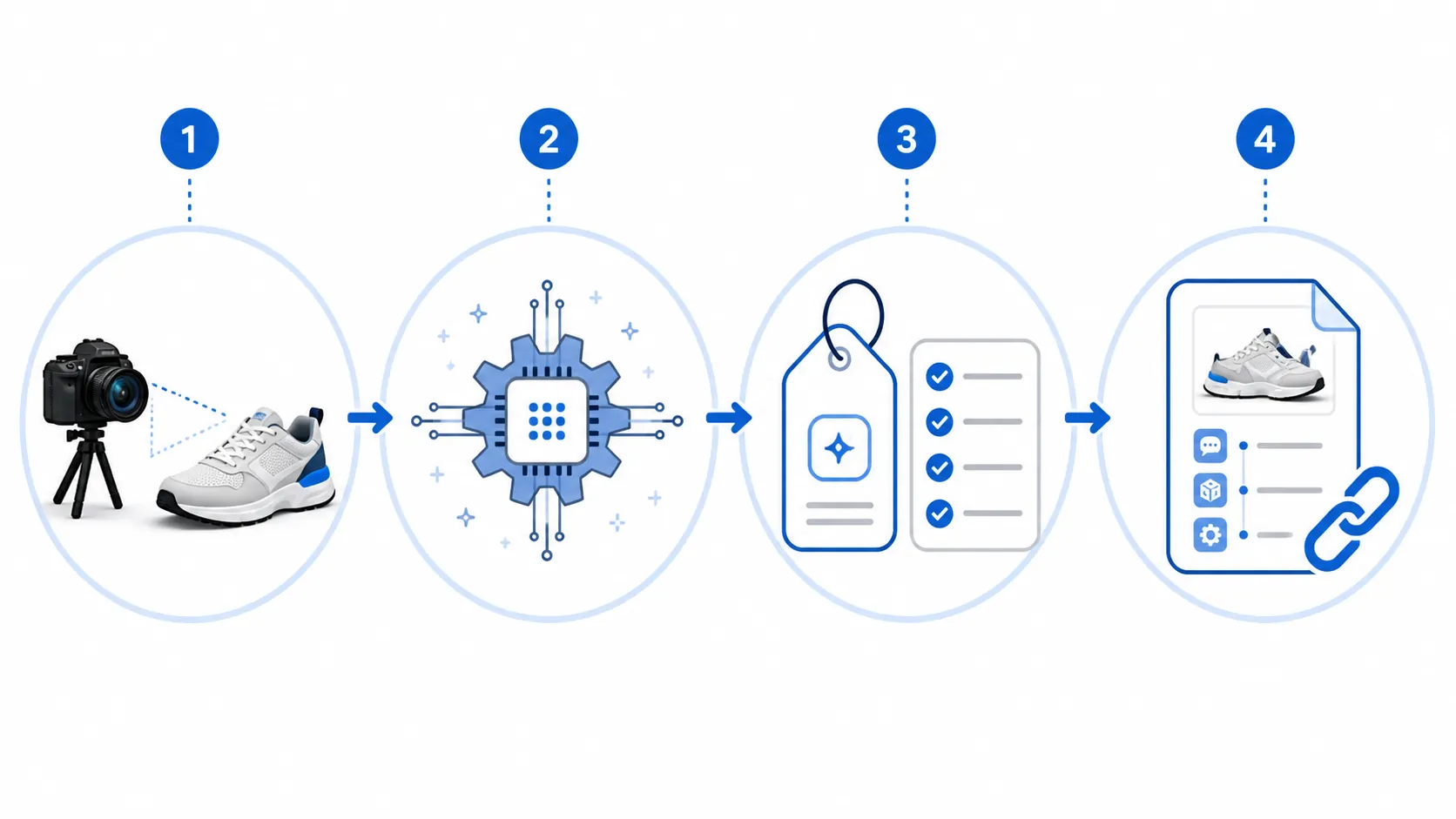
| Workflow control | What it does | What to keep |
|---|---|---|
| Use a real product shot as the anchor input | Reduces drift between generated image and shipped product | Original photograph, date, SKU, photographer or source |
| Control synthetic people | Avoids random faces that may resemble real individuals | Approved model profile, usage rules, generation settings |
| Attach disclosure and metadata | Satisfies platform and jurisdiction-specific synthetic-content rules | Visible label where required, IPTC or platform fields where required |
| Preserve the Recipe | Lets the brand reproduce or explain how the image was made | Prompt, seed, settings, tool version, input files, output file |
| Maintain an asset audit trail | Links the final catalog asset to its generation history | Asset ID, SKU, campaign, reviewer, approval date, takedown history |
The Recipe is the practical centerpiece. It should record the prompt, seed, model or tool version, settings, input files, output file, and any post-generation edits. A brand does not preserve that record because it expects to litigate every image. It preserves the record because most real disputes begin with a short request: explain this asset.
That request may come from a platform trust-and-safety queue, an advertising review desk, a rights claimant, a regulator, or a wholesale partner. The person responding needs to know whether the image used a real product input, whether the apparent model was synthetic, whether the required disclosure was attached, and whether the image was reviewed against the actual SKU. Without that chain, the brand is left reconstructing intent from a downloaded JPEG and a Slack thread.
Randomness is the enemy of defensibility. If a brand needs a person in the image, it should not generate a fresh face for each asset and hope the result is generic. A fixed synthetic model, approved for a defined product line or campaign, gives the team a stable identity to manage. The point is not that a synthetic model is risk-free. The point is that controlled reuse is easier to clear, label, document, and retire than a folder of one-off faces created by different marketers using different settings.
Right of publicity risk is a resemblance problem
Right of publicity is the second risk in the ladder because it can move quickly once a person believes a synthetic image is trading on their identity. This is not the same issue as copyright in the image file. It is about name, image, likeness, identity, and commercial association.
The Rainbow Shops/Pujols dispute is useful because it sits close to ordinary e-commerce practice: a fashion brand allegedly used an AI-generated model that resembled a real person. The matter was reportedly still in private settlement negotiations as of the source publication date, so it should not be treated as a final court ruling or a settled legal standard.[3] Its value is more practical than precedential. It shows how quickly a product image with a synthetic person can become an identity claim.
The state-law environment also makes this risk hard to standardize. Reported developments include the New York Fashion Workers Act, Tennessee's ELVIS Act, and at least 109 state AI laws enacted through July 1, 2026, without a single federal preemption rule that e-commerce teams can use as a clean override.[1] For a national seller, the operational answer is not to ask the creative team to memorize every state law. It is to control the source and identity of every human likeness used in commercial images.
The review question should be blunt: could a reasonable viewer think this synthetic model is a specific real person, celebrity, influencer, employee, customer, or fashion model? If the answer is yes, the file needs escalation before it goes live. The fact that the face was generated rather than photographed does not end the inquiry.
Disclosure does not cure a misleading product image
A properly labeled AI image can still deceive. That is why deception sits separately from disclosure in the risk ranking. The label tells the buyer something about how the image was made. It does not prove that the image accurately represents the product being sold.
The FTC's Section 5 deception framework looks at the overall impression conveyed to consumers, not merely at whether a claim is technically footnoted. In 2024, the FTC announced Operation AI Comply, a crackdown on deceptive AI claims and schemes, and later enforcement commentary continued to focus on how AI-related representations can mislead consumers.[4][5] For product imagery, the same discipline applies: what does the buyer reasonably understand from the image, and is that understanding materially wrong?
This matters most where generation improves the product instead of merely improving the photograph. A generated couch image that changes the fabric texture, a jewelry image that exaggerates stone size, a skincare image that implies a package size not shipped, or an apparel image that makes the fit look materially different can create a deception issue even if the image is labeled as AI-assisted. The buyer is not only purchasing a mood. The buyer is purchasing a thing.
Marketplaces enforce the same concern in their own language. Amazon's product-misrepresentation enforcement can suppress listings when the page does not accurately represent the product.[1] That is why the anchor photograph matters. It gives reviewers a baseline: the generated image may clean the background, vary the setting, or improve lighting, but it should not make the shipped item better, larger, more complete, or more premium than it is.
Copyright is real, but it is usually not the first catalog emergency
Copyright risk should be handled with care and without theater. The federal authorship point is clearer after Thaler v. Perlmutter: the Supreme Court denied certiorari on March 2, 2026, leaving in place the human-authorship requirement for copyright registration.[1] For AI product images, that affects ownership strategy. If a brand wants protectable creative assets, it needs to understand where human authorship, selection, arrangement, editing, or other creative contribution enters the process.
The broader litigation environment remains active. Copyright Alliance materials track major AI copyright lawsuit developments, including the Bartz v. Anthropic settlement discussion and a reported US$3,000-per-work baseline from law-firm analyses.[6] Norton Rose Fulbright has described more than 70 active AI copyright cases and analyzed the Getty Images v. Stability AI UK ruling landscape.[7] Those are significant developments for model developers, publishers, licensors, and vendors.
They do not automatically make copyright the top disruption risk for an ordinary product-display image. A claim that a generated output infringes a third-party work generally requires more than the fact that an AI tool was used; the claimant must connect the output to protectable expression and, in practical terms, show substantial similarity to something specific. For most catalog images, the commercially important assets are often the product, brand name, packaging, trade dress, and listing copy, which are governed by other IP and advertising regimes.
That does not mean the copyright file can be ignored. Vendor terms should answer who owns or can use the output, whether the vendor can reuse inputs, whether customer product photos train future models, what indemnity exists, and what happens if an output reproduces a watermark, logo, or brand element belonging to someone else. Trademark commentary has separately warned that AI image generators can reproduce marks or watermark-like artifacts, creating brand and marketplace risks beyond ordinary copyright ownership.[8]
The Q3 2026 compliance posture
A brand using an AI product image generator in e-commerce should rank its controls in the same order enforcement is likely to arrive. First, satisfy disclosure and metadata obligations by jurisdiction and platform. Second, prevent unmanaged synthetic identities. Third, review the image against the actual product for net-impression accuracy. Fourth, clean up copyright, trademark, and vendor-contract exposure before scale makes the problem expensive.
The internal owner should be obvious. Marketing can choose the visual direction, but marketplace operations or legal should own the release conditions: required labels, IPTC or platform fields, asset records, identity clearance, and SKU-level accuracy review. If nobody owns those controls, the company has not adopted AI product photography. It has adopted a faster way to create untraceable listing risk.
The practical question is no longer whether AI product images are possible. They are. The question is whether each image can carry the right disclosure, avoid synthetic identity problems, preserve product truthfulness, and leave behind enough records for the brand to defend its process when a platform, regulator, or claimant asks.
References
- AI Product Photography Legal Guide, Nightjar
- Amazon Requires Sellers To Label AI-Generated People In Listing Images, Forbes, July 25, 2026
- The AI Lawsuit That Every Jewellery Brand Using Model Photography Should Read, Chocianaite
- FTC Announces Crackdown on Deceptive AI Claims and Schemes, Federal Trade Commission, September 2024
- FTC Evaluating Deceptive Artificial Intelligence Claims, Holland & Knight, June 2025
- AI Copyright Lawsuit Developments 2025, Copyright Alliance
- AI in litigation series: an update on AI copyright cases in 2026, Norton Rose Fulbright
- From pixels to problems: AI image generators and trade mark risks, Maucher Jenkins
Chronological incident history
No sanction cases have named this tool in the tracked record set to date. This does not imply the tool is safe — see Risk Digest for ongoing monitoring.
← Compare peer toolsReport a correction or tip
Spotted an outdated figure, a misstated fact, or a ruling this tool profile should reflect? Public comments are disabled for this content given the professional cost of a misreported case outcome, penalty amount, or rule text — use the structured correction channel instead.
Report a correction or tip for this record →