
Navigating the Fragmented Regulation of AI in Sports Betting
This article surveys the evolving U.S. regulatory landscape governing artificial intelligence in sports betting prediction and odds-making, covering the SAFE Bet Act, state-level AI bills, the December 2025 executive order on preemption, and horizontal state AI laws — providing a jurisdiction-by-jurisdiction reference for compliance professionals tracking multi-state obligations.
- Hallucination rate
- Not measured / undisclosed
For a sportsbook using AI in odds-making, betting prediction, customer segmentation, promotions, microbet creation, or responsible gambling review, the legal question in Q3 2026 is no longer whether “AI” is regulated in the abstract. The harder question is which layer is speaking to the specific use case: a federal sports betting proposal, a state gaming bill aimed at AI-driven wagering features, an executive-branch preemption effort, or a horizontal state AI law that was not drafted for sportsbooks but may still reach their systems.
That distinction matters because the same model can sit in different compliance categories depending on what it does. A pricing model that adjusts a market internally raises a different issue from a tool that uses an individual bettor’s history to decide which promotion appears on a phone screen. A responsible gambling model that flags risk is not the same thing as an AI system that manufactures live microbets around every possession, pitch, or point. Current proposals draw many of their sharpest lines at those product moments.
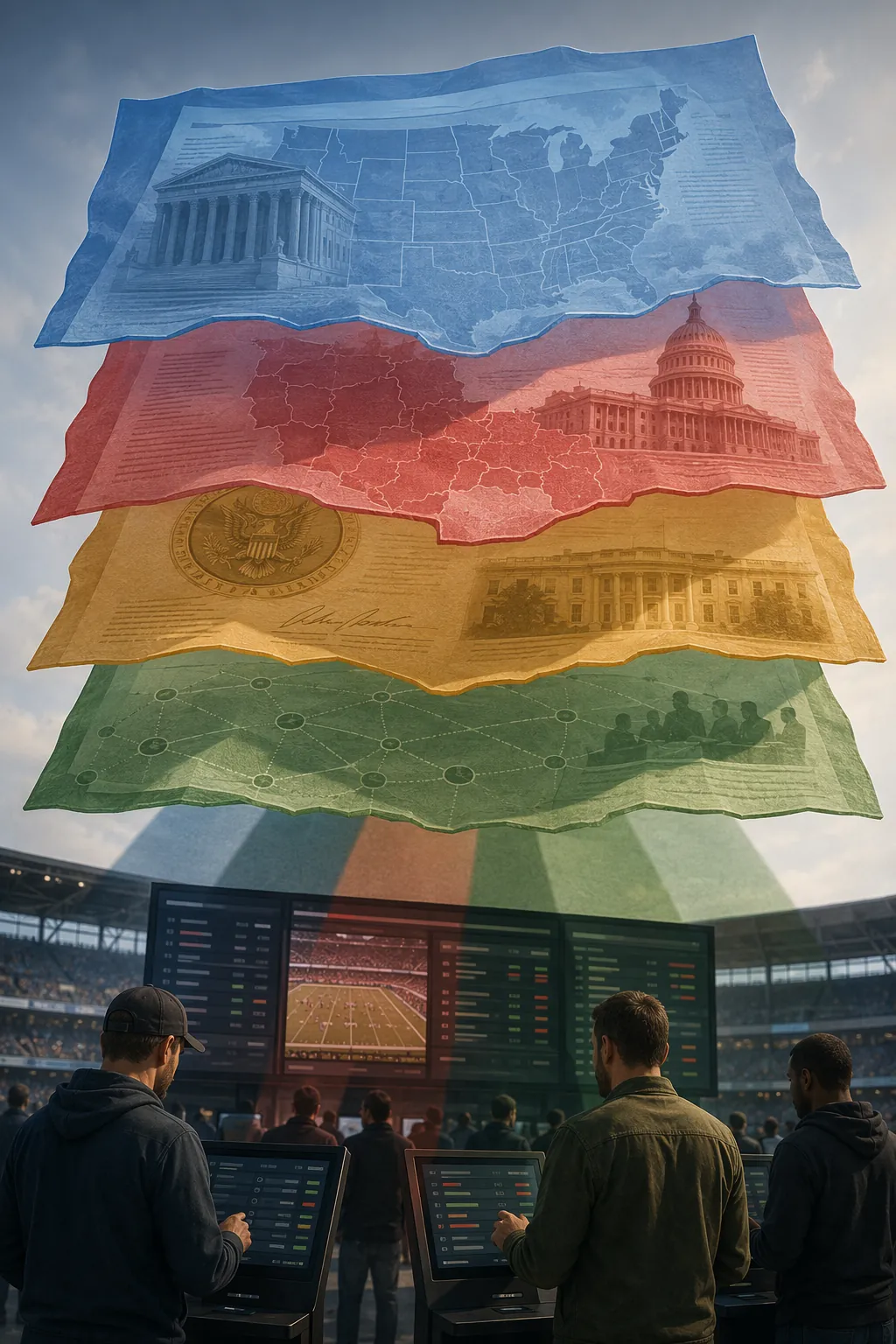
The Four Active Regulatory Fronts
The most direct federal proposal is the SAFE Bet Act, identified in the available materials as H.R. 9590 and S. 1033 and described as reintroduced in September 2024 by Rep. Paul Tonko and Sen. Richard Blumenthal. The bill would impose federal restrictions on AI in sports betting, including limits on AI-driven behavioral tracking of individual betting habits, personalized promotions based on betting history, and AI-generated microbets. It would also add advertising restrictions during live events and affordability checks at $1,000 per day and $10,000 per month thresholds.[1]
The second front is state-level legislation written specifically around AI in sports betting. The available tracker identifies Illinois SB 2398 as stalled in 2025 and likely to re-emerge in 2026, New York S5537, A4279A, and A8916 as pending, and Oklahoma HB 1537 as stalled. These measures are not interchangeable, but they cluster around the same compliance problem: whether operators may use AI to profile bettors, personalize inducements, or structure wagering opportunities in ways that state lawmakers view as increasing gambling harm.[2]
The third front is the federal-state conflict created by the December 2025 Trump executive order described in the available materials as an attempt to block state AI regulation. The same source says a proposed 10-year federal ban on state AI regulation was stripped from the “One Big Beautiful Bill” after public opposition. Because the executive-order account rests on a single source in the research materials, its current enforcement posture and constitutional status should be verified against primary materials before an operator treats it as controlling authority.[2]
The fourth front is horizontal state AI law. Colorado’s AI law, described as effective in 2026, and California’s AI-related requirements, described as effective in 2025, may impose algorithmic transparency, data minimization, or governance obligations on sports betting AI systems even where the statute is not gaming-specific.[3]
| Front | Primary compliance question | Sports betting AI use cases most exposed | Status caveat |
|---|---|---|---|
| SAFE Bet Act | Would federal law restrict AI-based behavioral tracking, personalized promotions, AI-generated microbets, live-event advertising, and affordability thresholds? | Player profiling, promotion targeting, microbet generation, advertising workflows, affordability checks | Available status materials are not confirmed by primary legislative sources as of Q3 2026.[1] |
| State AI-specific sports betting bills | Has a state proposed or adopted sports betting rules that target AI personalization, inducements, or behavioral monitoring? | State-specific promotional engines, betting-history segmentation, in-play wagering features | Illinois and Oklahoma are described as stalled; New York bills are described as pending in available tracker materials.[2] |
| Executive-order preemption fight | Could federal executive action limit state authority over AI rules that would otherwise reach sportsbook systems? | Any AI system subject to state AI or gaming regulation | Available executive-order material comes from a single source and requires independent verification.[2] |
| Horizontal AI laws | Do general AI governance, transparency, or data rules apply even without a gaming-specific AI restriction? | Risk scoring, automated decision systems, data-intensive personalization, responsible gambling tools | Application depends on statutory scope, implementing rules, and product facts.[3] |
SAFE Bet Act: Where Federal Sports Betting AI Restrictions Would Bite
The SAFE Bet Act is the cleanest example of why sports betting AI regulation cannot be scoped by asking whether a system “predicts outcomes.” The bill’s most operational provisions are aimed less at prediction in the abstract than at how AI is used against an individual bettor or a live betting environment.
The available analysis describes three AI-specific restrictions that would matter immediately in a product review queue. First, the bill would prohibit AI-driven behavioral tracking of individual betting habits. Second, it would restrict personalized promotions based on betting history. Third, it would ban AI-generated microbets.[1]
Those categories do not all land on the same internal team. A behavioral tracking restriction implicates data architecture, retention, identity resolution, and analytics permissions. A personalized-promotion restriction implicates CRM systems, bonus engines, affiliate campaigns, push notifications, and segmentation logic. An AI-generated microbet restriction implicates trading, in-play market creation, model governance, and vendor integrations.
The affordability-check thresholds would create another implementation problem. A sportsbook would need to know when a customer reaches $1,000 in a day or $10,000 in a month, and then determine what review, documentation, or pause is required before allowing further wagering activity. The available materials identify those thresholds, but not a settled compliance procedure for satisfying them.[1]
The bill also sits beside the GRIT Act, described in the research materials as a companion proposal that would dedicate 50% of federal sports betting excise tax revenue to problem gambling research.[1] That funding proposal does not itself define whether a model can generate a bet or target a promotion, but it shows the policy channel through which federal lawmakers are tying sports betting expansion to gambling-harm infrastructure.
For compliance purposes, the important limitation is status. The available materials give a detailed account of the SAFE Bet Act’s substance, but the most recent legislative-status information in the research set comes from late 2025 and has not been independently confirmed through primary legislative records for Q3 2026. The bill is therefore best treated here as a serious federal proposal defining the outer edge of possible obligations, not as a settled federal rule.
State AI Sports Betting Bills: Similar Targets, Different Calendars
The state bill landscape is narrower than general AI policy and more useful for sportsbook counsel because it names the conduct regulators are watching. Illinois, New York, and Oklahoma appear in the available tracker materials as the principal state examples of AI-specific sports betting bills, but their status posture differs enough that they should not be collapsed into a single “state trend.”[2]
| Jurisdiction | Measure identified in available materials | Reported status | AI sports betting conduct implicated |
|---|---|---|---|
| Illinois | SB 2398 | Stalled in 2025; described as likely to re-emerge in 2026 | AI-driven personalization, behavioral tracking, and inducement-related controls |
| New York | S5537, A4279A, A8916 | Pending | AI restrictions connected to sportsbook targeting, bettor profiling, and promotional practices |
| Oklahoma | HB 1537 | Stalled | AI-related restrictions in sports betting, with status unresolved |
Illinois matters because a stalled bill can still change behavior inside a multi-state operator. If a measure is expected to re-emerge, a product team preparing a national promotion engine cannot safely assume the state is irrelevant merely because the prior session ended without enactment. The practical question is whether the architecture can isolate Illinois users, suppress certain AI-generated offers, or document that a feature does not use betting history in the way the bill targets.
New York matters for the opposite reason: the available materials describe multiple pending bills. A pending bill does not create the same obligation as an enacted statute, but it can affect licensing conversations, regulator expectations, government-relations priorities, and the risk analysis for features scheduled to launch during the legislative window.[2]
Oklahoma should be treated more cautiously. The available tracker describes HB 1537 as stalled, which supports a monitoring obligation more than an immediate product prohibition. For a state-specific matrix, that distinction should appear in the status field rather than disappearing into a generalized “AI bill” label.[2]
The state bills are also a reminder that the legal risk does not begin only when a law is enacted. A bill can force a company to identify where its own systems draw the lines: whether “personalization” means any segmented marketing, whether “betting history” includes deposits or failed wagers, whether a recommendation engine is explainable enough to describe in a filing, and whether a vendor contract allows the operator to disable a feature by jurisdiction.
The Preemption Fight Is Real, but the Record Needs Care
The December 2025 executive-order issue is the most volatile part of the landscape because it reaches beyond sports betting and asks who gets to regulate AI at all. The available materials describe a Trump executive order attempting to block state AI regulation and a separate proposed 10-year federal ban on state AI regulation that was removed from the “One Big Beautiful Bill” after public opposition.[2]
For a gaming operator, the practical stakes are obvious. If federal action could preempt or chill state AI regulation, then state bills restricting sportsbook AI may have a different risk profile. If that federal action is limited, unenforceable, enjoined, rescinded, or constitutionally vulnerable, state regulators may proceed as before. The research materials do not establish which of those outcomes controls in Q3 2026.
That caveat is not a minor footnote. The executive-order account in the available research rests on a single source, and the brief itself flags the need for independent verification. A publishable legal assessment should check the order text, any implementing agency guidance, litigation status, and any congressional action before advising that state AI rules are displaced.[2]
The preemption fight also intersects with the larger state-versus-federal tension already visible in sports-event contracts and prediction markets. A related internal discussion of Washington Gambling Injunction Rejects Kalshi Preemption addresses a parallel jurisdictional conflict in which state gambling authority and federally regulated market products collide. The analogy should not be overstated: prediction-market disputes and sportsbook AI bills arise under different legal regimes. But they show why state authority is not a footnote in wagering regulation.
Horizontal AI Laws Add a Second Compliance Layer
Colorado and California enter this analysis for a different reason than Illinois, New York, or Oklahoma. Their relevance is not that they are necessarily sports betting AI statutes. It is that general AI, data, or algorithmic-governance obligations may attach to sportsbook systems when those systems make or support decisions about users.
The available Snell & Wilmer analysis describes Colorado’s AI law as effective in 2026 and California’s AI-related requirements as effective in 2025, with obligations that may include transparency, data minimization, and algorithmic governance requirements applicable to sports betting AI systems.[3] The precise application depends on statutory scope and product facts, but the compliance point is straightforward: a sportsbook can be outside an AI-specific gaming bill and still inside a general AI or data-governance regime.
| Use case | Gaming-specific issue | Horizontal AI/data issue |
|---|---|---|
| Internal odds-making model | Usually less exposed than customer-facing inducement or microbet generation, unless state rules define covered AI broadly | Model governance, documentation, vendor oversight, and data provenance may still matter |
| AI-generated microbets | Directly implicated by the SAFE Bet Act’s proposed AI-generated microbet ban | Automation controls and system accountability may be relevant depending on state AI law scope |
| Personalized promotions | Implicated by restrictions on promotions based on betting history | Data minimization, profiling transparency, and automated-decision documentation may apply |
| Responsible gambling risk scoring | Often framed as harm-prevention, but still uses sensitive behavioral signals | Governance and explainability questions arise if users are scored, limited, or routed for intervention |
The responsible gambling example is especially easy to misclassify. A system designed to detect risky play may be favorable from a policy perspective, but that does not automatically exempt it from transparency, documentation, or data-use obligations. If the system changes a user’s experience, triggers outreach, limits activity, or feeds a compliance review, counsel still needs to know what data it ingests, what decision it supports, and who can explain the output.
Why Lawmakers Are Targeting Personalization
The policy rationale in the available materials is not simply that AI can predict games. The AIBM policy framework is described as focusing attention on behavioral profiling and personalization, which helps explain why the legal proposals repeatedly return to betting history, inducements, and user-specific targeting.[4]
That focus narrows the compliance analysis. Vendor claims about prediction accuracy or engagement lift may answer whether a tool is commercially attractive, but they do not answer the regulatory question. The risk turns on whether the system uses individualized betting behavior, whether it changes offers or market access for a particular bettor, whether it creates wagering opportunities in real time, and whether the operator can show how those decisions are controlled.
A sportsbook could therefore face a lower legal concern from an AI model used only to assist traders with aggregate pricing than from a less technically impressive model that identifies a recently active bettor and sends a tailored bonus before a live event. The lawmaking attention is clustering around the second scenario because the consequence is not just prediction; it is personalized inducement.
A Product-Based Compliance Map
A useful tracker should start with the feature, not the statute. The same operator may need one analysis for a pricing model, another for a bonus engine, another for in-play market creation, and another for responsible gambling review. Legal status then attaches to the use case by jurisdiction.
| Product function | Questions compliance should answer | Most relevant regulatory fronts |
|---|---|---|
| Odds-making and betting prediction | Is the AI tool internal, customer-facing, vendor-operated, or used to create new markets automatically? | SAFE Bet Act if market creation becomes AI-generated microbetting; horizontal AI laws if governance or documentation obligations attach |
| Player segmentation | Does the system use individual betting habits, deposits, losses, frequency, or live engagement to classify users? | SAFE Bet Act; Illinois, New York, and Oklahoma bill tracking; horizontal AI/data laws |
| Personalized promotions | Are offers based on betting history or inferred vulnerability? Can the operator disable personalization by state? | SAFE Bet Act; state AI-specific sports betting bills; advertising and inducement rules |
| AI-generated microbets | Does the model create or select real-time wagering opportunities during play? | SAFE Bet Act; state sports betting AI bills; gaming regulator review |
| Responsible gambling intervention | What data is used, who reviews the output, and what happens to the bettor after a flag? | Horizontal AI laws; responsible gambling obligations; any state law covering automated profiling |
This is where broad AI inventories often fail gaming teams. A single enterprise label such as “marketing AI” or “trading AI” is too coarse. The relevant legal line may be crossed when a model moves from aggregate audience analysis to individual targeting, from trader support to automated market creation, or from risk detection to an account-level intervention that affects a bettor’s access.
The product record should also identify the vendor role. If a third-party provider supplies microbet automation, recommendation logic, risk scoring, or customer segmentation, the operator still needs to know whether the feature can be audited, modified, disabled, or explained in a state-specific filing. A vendor statement that the model improves engagement is not a substitute for a jurisdictional control.
Open Status Questions for Q3 2026
Several points remain unsettled in the available record and should be treated as status questions rather than conclusions.
- SAFE Bet Act status: the substance of the bill is described in detail, but current Q3 2026 legislative status should be verified through primary congressional sources before treating it as active, inactive, amended, or superseded.
- Executive-order preemption: the December 2025 account comes from a single source in the available materials, so the order text, litigation posture, agency implementation, and constitutional effect need independent review.
- State bill movement: Illinois, New York, and Oklahoma should be monitored separately because “stalled,” “pending,” and “likely to re-emerge” carry different compliance consequences.
- Horizontal AI coverage: Colorado and California obligations depend on statutory definitions, implementing rules, and whether a sportsbook system falls within covered automated-decision, profiling, transparency, or data-use categories.
- Product facts: legal analysis will be unreliable unless the operator can describe what the AI system actually does, what data it uses, who sees the output, and whether the feature affects an individual bettor.
As of Q3 2026, the defensible operating assumption is fragmentation. Operators cannot scope AI sports betting risk by watching only Congress, only state gaming regulators, or only general AI statutes. They need a multi-source tracker that ties each AI deployment to legislative status, state jurisdiction, preemption developments, and the specific product function at issue before treating any obligation as settled.
References
- Richmond JOLT law review, Richmond Journal of Law & Technology, March 2025, Richmond JOLT law review
- AI bill tracker, GamblingHarm.org, GamblingHarm.org AI bill tracker
- What does fAIr play look like, Snell & Wilmer, 2025, What does fAIr play look like
- AIBM policy framework, AIBM, January 2026, AIBM policy framework
Chronological incident history
No sanction cases have named this tool in the tracked record set to date. This does not imply the tool is safe — see Risk Digest for ongoing monitoring.
← Compare peer toolsReport a correction or tip
Spotted an outdated figure, a misstated fact, or a ruling this tool profile should reflect? Public comments are disabled for this content given the professional cost of a misreported case outcome, penalty amount, or rule text — use the structured correction channel instead.
Report a correction or tip for this record →