
Inside the $1.82M immigration fine against an Arizona landscaper
The case of an Arizona landscaper fined $1.82 million for failing to depart the United States illustrates how DHS applies failure-to-depart penalties under the expanded enforcement framework. This article examines the factual specifics, regulatory mechanics, procedural vulnerabilities, and constitutional challenges that immigration attorneys need to understand.
- Hallucination rate
- Not measured / undisclosed
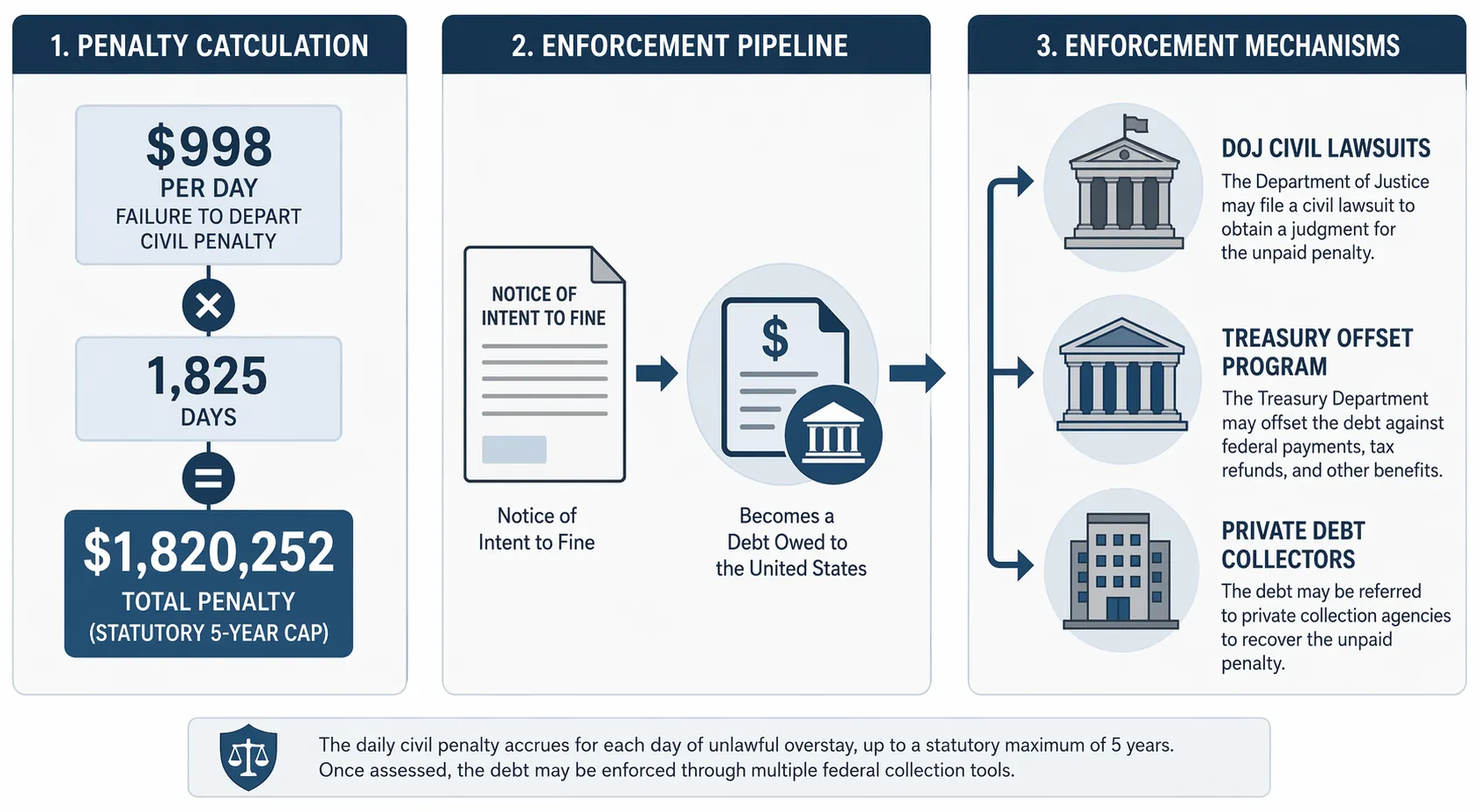
The number on the notice was $1,820,252. For Sanchez, described in public reporting as a Cuban landscaper living in Arizona with three U.S.-citizen children, it arrived not as a court judgment after a hearing, but as a Notice of Intent to Fine. The notice said he owed $998 for each day he had failed to depart the United States, multiplied across 1,825 days, the five-year cap used in the calculation. It was signed not by a named official but by “Immigration Officer 1,” and it included a QR code directing him toward payment or a payment plan he could not realistically satisfy.[1]

That is the first useful way to understand the Arizona case: not as a strange anecdote about an impossible debt, but as a document event. The fine becomes less mysterious when the formula is put back on the page. It also becomes more troubling, because the arithmetic is the easiest part to see.
Sanchez’s lawyer has said the fine was later sent to private debt collectors after Sanchez could not pay.[1] Before that point, the notice itself had already done most of the work. It treated the immigration history behind the penalty as settled enough to price, even though Sanchez’s attorney says Department of Homeland Security officers had given him a very different signal not long before.
The checkpoint detail that makes the file harder to read
The reported facts begin years before the fine. Sanchez had an old removal order. He also had a green card, according to the account provided by his attorney. In 2024, at an El Paso checkpoint, DHS officers allegedly reviewed that card and told him it was valid.[1]
That checkpoint encounter does not answer every legal question. A roadside or checkpoint statement by an officer is not the same thing as a reopened immigration case, a vacated order, or a written adjudication. But it matters in a practical way that immigration files often make invisible. A person who is told by federal officers that his green card is valid may continue working, parenting, traveling, filing taxes, and dealing with the government as though the government’s own signal can be relied on.
The fine notice later took the opposite position. It treated the underlying removal order as the operative fact and Sanchez’s continued presence as a daily violation carrying a statutory civil penalty. The tension is not abstract. It is the difference between a family reading a green card as permission to remain and an agency reading an old order as a ledger that has been accruing nearly $1,000 a day.
There is also a basic identification caution. Available reporting refers to him as Sanchez; the public record does not establish his full name, and the first-name-only presentation may reflect a pseudonym or partial identification.[1] That uncertainty should not be stretched into doubt about the existence of the notice mechanics, which are described in the reporting and match the regulatory system DHS put in place.
How $1.82 million appears from a short formula
The penalty authority comes from 8 U.S.C. §1324d, which permits civil fines against certain noncitizens who fail to depart after agreeing to depart voluntarily or after being ordered removed. In Sanchez’s notice, the working math was $998 per day for 1,825 days, producing $1,820,252.[1]
| Notice component | What it did in Sanchez’s case |
|---|---|
| Daily rate | $998 per day |
| Days counted | 1,825 days |
| Total stated penalty | $1,820,252 |
| Signature | Generic “Immigration Officer 1” |
| Payment route | QR code for payment or payment-plan process |
| After nonpayment | Referral to private debt collectors, according to Sanchez’s attorney |
The table is stark because the notice is stark. The human facts that would usually slow down a reader — three children, work history, the 2024 checkpoint statement, whether Sanchez understood any departure obligation to be active — do not alter the arithmetic on the face of the fine. The notice reduces the problem to a daily rate, a count of days, and a balance due.
For a lawyer receiving a similar letter from a client, that mechanical quality is the first diagnostic point. The important questions are not only whether the total is shocking, but whether the agency identified the removal order, the departure obligation, the start date, the end date, the legal basis for the rate, the recipient’s opportunity to respond, and the official who actually made the determination.
The June 2025 rule made the paper move faster
DHS’s June 27, 2025 interim final rule is the structural reason Sanchez’s notice should not be read as a one-off. The rule changed the process for failure-to-depart penalties by eliminating personal service, setting a 15-business-day response period, removing Board of Immigration Appeals review, and replacing in-person hearings with paper-only review by a DHS supervisory official.[2]
The government’s stated rationale was administrative pressure. In the rule, DHS cited 1.5 million unlawful entries in fiscal year 2024, 255,000 unexecuted removal orders, and a Board of Immigration Appeals backlog of 160,000 appeals.[2] Those figures explain why the department wanted a faster system. They do not explain why a person contesting a seven-figure fine should have no in-person hearing and no BIA review before the account moves toward collection.
The distinction matters because the rule did not merely announce that DHS would enforce an existing statute. It redesigned the route by which the statute reaches a person. A notice no longer had to be handed to the recipient personally. A response had to be prepared quickly, often by someone who may need to find counsel, retrieve immigration records, translate documents, and reconstruct years of agency contact. The review stayed inside DHS.
In a file like Sanchez’s, the agency’s paper efficiency collides with the kind of fact that is least likely to be resolved by a form deadline: a claimed prior government assurance that the green card was valid. The system can process that assertion as an attachment or argument. It is less clear that the system is built to pause over what the assertion means for willfulness, reliance, or fairness before debt collection begins.
Scale changes the meaning of a notice
Once Sanchez’s notice is understood as an output of that process, the larger numbers become relevant. The Marshall Project reported that by March 2026, the government had issued 65,101 fines totaling $36 billion.[3] A New York Times report visible in headline and lead form on July 22, 2026 stated that more than 100,000 fine notices had been sent by then.[4]
Those figures are scale markers, not proof that every notice is legally defective. They show that the Sanchez notice belongs to a mass workflow. When tens of thousands of penalties are produced through a paper-only process, small procedural choices become large practical consequences: whether the address was current, whether the recipient understood the notice, whether counsel could be found within the response period, whether old agency encounters were available to rebut willfulness, and whether supervisory review had enough independence to matter.
DHS has also claimed large self-deportation effects from its enforcement program, but those claims should be treated as agency claims unless independently verified. The useful point for Sanchez’s case is narrower. A civil penalty regime does not need to collect every dollar to alter behavior. A letter stating a seven-figure debt can pressure a recipient long before any court decides whether the fine is lawful.
What happens after the recipient cannot pay
The notice is only the front end. Reporting on the broader program describes several collection paths: civil lawsuits filed by the Department of Justice, Treasury Offset Program seizures, private debt collection contracts, and added interest or fees. Bloomberg Law reported in May 2026 that DOJ had filed more than 50 civil lawsuits tied to these penalties, seeking more than $16.2 million.[5]
The Marshall Project reported that the government had private debt collection contracts with at least four companies and described at least one $1.8 million fine that grew to $2.3 million with interest and fees.[3] That is the part of the system that tends to disappear when coverage stops at the original fine amount. The debt can become larger precisely because it is unpayable.
The Treasury Offset Program shows how collection can reach money that does not look like a voluntary immigration payment. In the Affisetou Tchedre matter in the Southern District of New York, $10,662 was seized from a joint tax refund involving an immigrant with four U.S.-citizen children and an active-duty military spouse.[3] That example does not mean every failure-to-depart fine will produce a tax-refund seizure. It shows the collection route is real and can affect household money shared with U.S.-citizen family members.
Sanchez’s reported referral to private debt collectors fits this same pipeline.[1] The agency’s decision does not remain confined to an immigration file. It becomes a consumer-debt problem, a tax-refund problem, a lawsuit risk, and a family-budget problem. For clients, that sequence is often more immediate than the constitutional theory.
Other cases show the pattern without replacing Sanchez
Sanchez is the most useful case to examine closely because the notice details, the green-card checkpoint allegation, and the debt-collection referral are all visible in one factual account. Other reported matters show the same machinery reaching different lives: a Florida woman sued for nearly $1 million, a Pennsylvania meatpacking worker, a Washington Vietnam refugee, and a Florida paramedic with decades of U.S. residence have all appeared in coverage of the expanded fine program.[6]
Those comparison cases should be used carefully. They do not establish that every recipient has the same reliance argument Sanchez raises. They do show that the program is not limited to one state, one occupation, or one family profile. The common element is the conversion of a departure obligation into a large civil debt through a notice process whose most important decisions may occur before any neutral adjudicator sees the file.
The legal challenge follows the paperwork
The organized litigation against the program attacks the same mechanics that make Sanchez’s notice legible. Maria L. v. Noem, filed in the District of Massachusetts in November 2025, challenges the failure-to-depart fine process on due process, excessive fines, jury-trial, and Administrative Procedure Act grounds.[7]
The Fifth Amendment argument is tied to the notice design: inadequate notice, a 15-business-day response window, no in-person hearing, and review inside DHS rather than before the BIA or a court in the first instance.[7] The Eighth Amendment argument focuses on whether penalties around $1.8 million are grossly disproportionate when imposed on people who often have no realistic ability to pay.[7] The Seventh Amendment theory argues that the government is seeking legal penalties of a sort that require a jury trial.[7]
The APA challenge goes to the rulemaking and application of the statute. The filings argue that DHS used an interim final rule without the ordinary notice-and-comment process and applied the statutory “willfully” requirement in an arbitrary or insufficiently individualized way.[7] In a case like Sanchez’s, that last point is not decorative. If a person says federal officers validated his green card in 2024, the agency must have some visible way to decide whether his later failure to depart was willful rather than the product of a status history the government itself made confusing.
The current posture of Maria L. v. Noem has not been independently verified beyond the publicly described filing details. It would be a mistake to predict the outcome from the pleadings alone. The safer conclusion is that the litigation is aimed not merely at the size of the fines, but at the route by which DHS issues, reviews, and collects them.
Why Sanchez’s notice matters
The Sanchez case matters because the $1,820,252 figure is not a rogue number scribbled at the edge of immigration enforcement. It is the visible output of a redesigned system: a statutory daily rate, a five-year cap, a generic notice, a short paper response period, no in-person hearing, no BIA review, and collection machinery waiting behind the form.
That system may be defended by DHS as a response to unexecuted removal orders and administrative backlogs. But once it is aimed at a person, the central question changes. The issue is whether the government has built enough procedure to distinguish someone deliberately defying a clear departure obligation from someone carrying years of contradictory government signals, old paperwork, and family reliance into a deadline measured in business days.
References
- Arizona landscaper fined $1.8M for failing to self-deport, Arizona Mirror / News From The States, May 5, 2026
- Civil Monetary Penalties for Failure To Depart, Federal Register, June 27, 2025
- Immigrants face massive fines as Trump administration ramps up debt collection, The Marshall Project, June 20, 2026
- Trump Administration Has Sent More Than 100,000 Fine Notices to Immigrants, The New York Times, July 22, 2026
- Immigration Fine Lawsuits Top 50 as DOJ Seeks Millions, Bloomberg Law, May 18, 2026
- Reporting on failure-to-depart fine cases, Reuters, Politico, CBS News, and WSFA, 2025–2026
- Maria L. v. Noem complaint and case materials, Public Justice, November 2025
Chronological incident history
No sanction cases have named this tool in the tracked record set to date. This does not imply the tool is safe — see Risk Digest for ongoing monitoring.
← Compare peer toolsReport a correction or tip
Spotted an outdated figure, a misstated fact, or a ruling this tool profile should reflect? Public comments are disabled for this content given the professional cost of a misreported case outcome, penalty amount, or rule text — use the structured correction channel instead.
Report a correction or tip for this record →