
Why Arm's supply gap matters for legal AI accuracy
Arm Holdings' Q4 FY2026 earnings reveal a compute supply-demand gap that introduces a mechanistic reliability risk for legal AI tools. This article explains how CPU-side latency dominance in agentic workloads can degrade inference consistency, and what counsel should ask about infrastructure when evaluating legal AI procurement.
- Tool
- RAG-based tool
- Benchmark source
- Georgia Tech/Intel
- Hallucination rate
- Not measured / undisclosed
- Test methodology
- Agentic workload latency measurement
- Test date
- Jan 1, 2026
The immediate question for a litigator is not whether Arm Holdings’ 2026 earnings report showed strong AI chip demand. It is narrower and more operational: when a legal AI tool returns an answer that might enter a brief, what hidden infrastructure condition could make that same tool less consistent during a high-volume filing week than it was during a vendor demo?
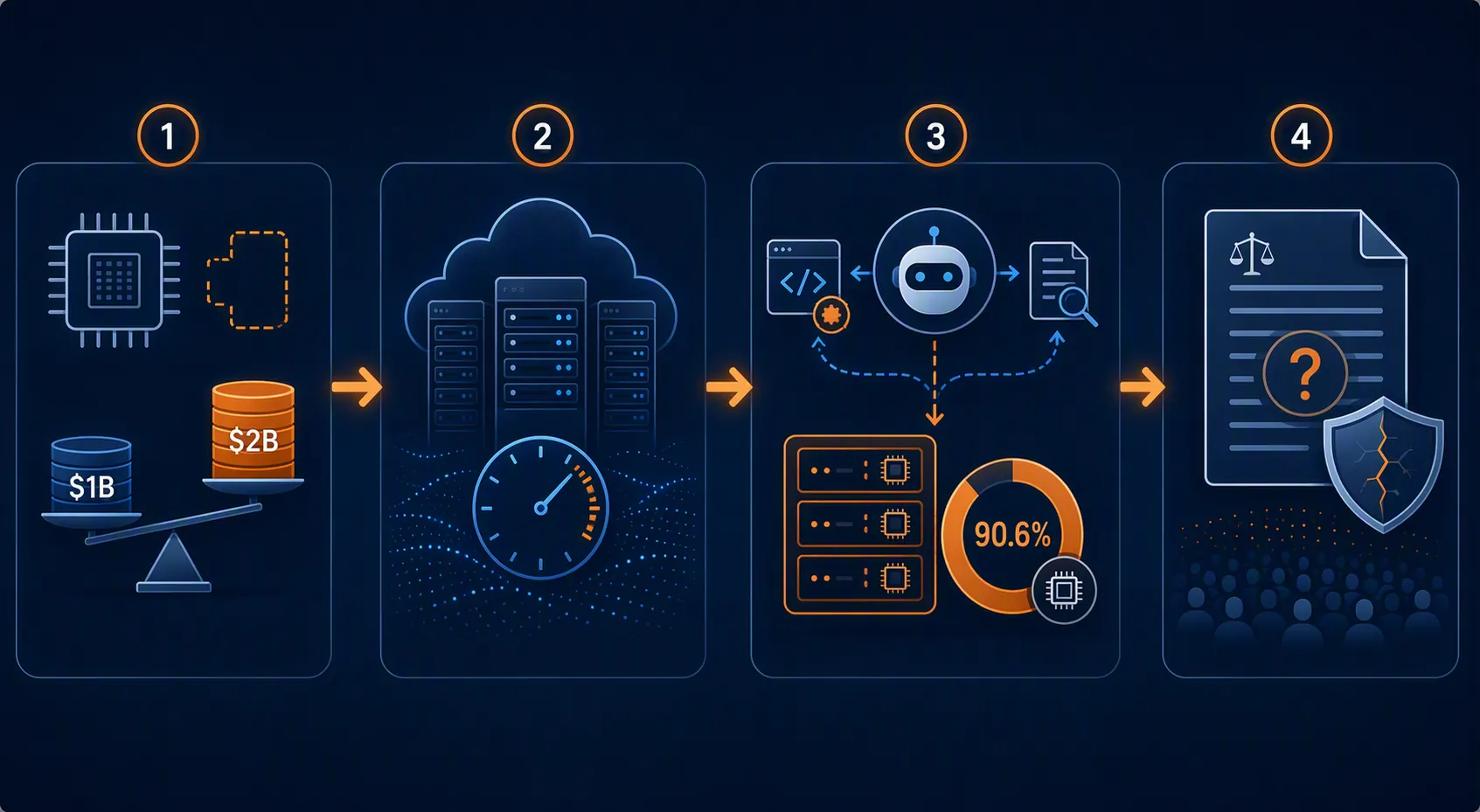
Arm’s May 6, 2026 Q4 FY2026 disclosure is useful because it puts numbers on a bottleneck that legal AI buyers usually see only as a spinning progress bar. Arm reported record quarterly revenue of $1.49 billion, 20% year-over-year growth, and data-center royalty revenue that more than doubled year over year.[1] On the earnings call, CFO Jason Child said Arm had secured supply-chain capacity for only $1 billion of $2 billion in AGI CPU customer demand.[2] Separately, Georgia Tech and Intel research found that CPU-side tool processing can account for up to 90.6% of total latency in agentic AI workloads.[3]
Those facts do not prove that a particular legal AI product will hallucinate because Arm supply is tight. They do make a more limited point worth taking seriously: if legal AI tools depend on agentic workflows, retrieval, tool calls, orchestration, retries, and cloud inference capacity, then infrastructure pressure can become a reliability issue before it becomes visible as a formal outage.
Where the supply gap enters the legal workflow
A legal AI answer normally looks like one event: the user asks for a case, a summary, a draft argument, or a citation check, and the system replies. Underneath, the answer may depend on several events that have to complete in order. The tool may route the request, retrieve documents, call a search index, rank passages, invoke a model, validate citations, retry failed calls, and assemble a final response. Each extra step is another place where latency, timeout behavior, or degraded capacity can change what the user sees.
The Georgia Tech and Intel latency finding matters because it identifies where much of that delay can sit. If CPU-side tool processing accounts for up to 90.6% of total latency in agentic workloads, then the bottleneck is not only the model’s raw text-generation step.[3] The surrounding tool-use path — the part that retrieves, coordinates, filters, and retries — can dominate the experience.
For a legal user, that distinction matters. A hallucinated citation is usually discussed as a model failure. Sometimes it is. But a legal AI system can also become less verifiable when the retrieval call times out, when a citation-checking tool silently falls back to a weaker path, when a retry returns a different passage set, or when the system truncates context to keep the session moving. None of those conditions requires the model weights to change. They require the infrastructure path serving the model to behave differently under load.
The risk chain, without overstating the proof
The supported chain is mechanistic, not epidemiological. Arm disclosed demand for AGI CPUs beyond secured supply-chain capacity.[2] Independent research reports that CPU-side processing can dominate latency in agentic AI workloads.[3] Many legal AI products use agentic or multi-step workflows for research, drafting, document analysis, and verification. Therefore, constrained or unstable inference infrastructure can plausibly affect response-time consistency, retry behavior, and output verifiability.
The unsupported leap would be to say that Arm’s supply gap has caused hallucinations in legal filings. The available materials do not show that. They do not measure legal AI hallucination rates before and after a specific Arm capacity constraint. They do not isolate Arm-based cloud clusters from GPU availability, model changes, software bugs, prompt design, retrieval quality, or user review failures. That boundary should remain visible, especially in a legal-risk article.
Still, the baseline failure environment is not theoretical. Haqq.ai reported, as of April 2026, more than 1,313 court proceedings involving AI-fabricated content globally, including 496 involving licensed attorneys.[4] That number should be reconciled against internal Risk Digest case records before being treated as the site’s definitive count. Its value here is contextual: legal AI verification failures already reach courts, and infrastructure instability gives counsel one more condition to ask about before relying on a generated answer.
Why CPU architecture is no longer background plumbing
Legal buyers often contract with a software vendor and never see the compute architecture behind the product. The product may run on one of the large cloud platforms; the cloud platform may use Arm-based CPUs in part of its data-center fleet; the legal vendor may depend on that platform for inference, retrieval, orchestration, or supporting services. To the lawyer, the interface looks like a single product. To the system, it is a chain of dependencies.
That is why hyperscaler concentration deserves more than a footnote. Arm has been described as holding roughly 50% CPU compute share among top hyperscalers, with adoption through AWS Graviton, Google Axion, and Azure Cobalt.[5] If a legal AI vendor relies on one of those clouds, and if its workload path is CPU-heavy, the vendor’s apparent product reliability may be downstream of infrastructure choices made by AWS, Google, or Microsoft rather than by the legal-tech company alone.
The engineering upside is real enough to matter. Arm’s AGI CPU launch materials described 136 Neoverse V3 cores on TSMC 3nm, a 300W TDP compared with 500W for x86 competitors, 2x rack density, and up to $10 billion per gigawatt in capital-expenditure savings versus x86.[6] Those are Arm’s estimates, not independently verified third-party reliability benchmarks. They help explain why data-center operators may accelerate toward Arm-based designs; they do not establish that legal AI outputs become more accurate or more court-ready because of that shift.
Futurum Group has projected the data-center CPU market reaching $76.6 billion by 2029, a 34.9% growth figure.[5] That forecast is not necessary to predict a specific legal failure. It is enough to show that CPU-side inference architecture is becoming a contested resource across industries. Legal AI is competing for the same infrastructure discipline as every other sector trying to run agentic systems at scale.
What changes under active litigation load
The dangerous period is not the quiet evaluation session. It is the week when a team is reviewing a large production, preparing a dispositive motion, checking authorities after an adverse ruling, or responding to a client’s demand for a fast answer. More users are making similar requests. More workflows are asking for retrieval, summarization, citation validation, and drafting at once. The vendor’s ordinary average-response metric may still look acceptable while edge cases become harder to inspect.
Latency itself is not the legal violation. The question is how the system behaves when latency rises. A well-designed legal AI product may slow down, disclose degraded mode, preserve logs, fail closed on citation validation, and tell the user that a source could not be verified. A weaker product may retry silently, skip a tool call, return a partial answer, or present a fluent draft whose retrieval path did not complete. The user receives prose either way; the difference is whether the prose has an auditable support trail.
This is where uptime metrics can mislead. A vendor can honestly report that the service was available while individual verification steps were degraded. A system can be “up” while citation checking is slower, document retrieval is partial, or fallback routing is active. For filing work, the important metric is not only whether the application responded. It is whether the answer came from the same verified path the user believed they were invoking.
Procurement questions counsel should ask before relying on the answer
The procurement conversation should move from model branding to inference-path evidence. These are diligence prompts, not legal advice. They also fit the practical duties addressed by ABA Formal Opinion 512: lawyers using generative AI need to understand the tool well enough to supervise its use, protect client information, and avoid submitting unsupported work product.[7]
- Inference architecture: Which parts of the legal workflow run on CPUs, GPUs, or other accelerators? Which parts depend on cloud-provider infrastructure rather than vendor-controlled systems?
- Cloud dependency: Does the product run primarily on AWS, Google Cloud, Azure, multiple clouds, or a private deployment? Can the vendor identify whether Arm-based infrastructure is material to the workload path?
- Capacity commitments: Does the vendor have reserved capacity for peak litigation periods, or does it rely on elastic capacity that may be shared with non-legal workloads?
- Degradation behavior: When latency rises, does the system slow down, fail closed, disclose degraded mode, or silently route around unavailable tools?
- Retry handling: Are retries logged? Can a user see whether the final answer came from the first retrieval pass, a later retry, or a fallback workflow?
- Verification path: Does the product separately monitor citation validation, source retrieval, quotation accuracy, and document-grounding success, or does it report only general availability?
- Benchmark conditions: Were accuracy and latency tests performed under peak-load conditions comparable to active litigation use, or only under controlled demonstration conditions?
The answer counsel wants is not a polished assurance that the vendor uses “enterprise-grade AI.” The useful answer identifies the route a legal query travels, the components that can degrade, the logs available after the fact, and the point at which the product refuses to present an answer as verified.
A small contract term can matter more than a large benchmark
A vendor benchmark showing strong average accuracy may be useful, but average accuracy does not answer what happened to a specific filing-bound response on a specific day. For that, counsel needs logging, incident notice, and degradation disclosures. If the product switches retrieval modes, skips citation validation, falls back to a cheaper route, or truncates context because capacity is constrained, the legal user needs a record of that event.
A practical verification workflow should therefore preserve more than the final text. It should capture the user query, retrieved sources, citation-check results, timestamps, model or workflow version where available, and any system notice about degraded service. If the vendor cannot provide those artifacts, the lawyer’s review burden increases. The absence of evidence about the infrastructure path does not make the output wrong, but it makes the output harder to defend.
The bounded takeaway from Arm’s Q4 FY2026 disclosure
Arm’s Q4 FY2026 earnings do not turn semiconductor supply into a direct explanation for any specific hallucinated citation. The disclosure does something narrower and more useful for legal procurement. It shows that demand for AI-related CPU capacity can exceed secured supply at the same time independent workload research points to CPU-side processing as a dominant source of agentic latency.[2][3]
That is enough to change the diligence posture. Counsel evaluating legal AI tools should not treat infrastructure reliability as a vendor-side abstraction hidden behind model names and interface demos. If an AI-generated answer may enter a filing, the path that produced it — including capacity, latency, retries, fallback behavior, and verification logs — belongs in the procurement record.
References
- Arm Holdings Q4 FY2026 Shareholder Letter & SEC Filing — Arm Holdings plc / SEC — May 6, 2026
- Arm Q4 FY2026 Earnings Call Transcript — Investing.com — May 6, 2026
- Georgia Tech/Intel Research on Agentic Workload Latency — Georgia Tech / Intel — 2026
- AI Hallucinations in Law: 1,313 Court Cases and Counting — Haqq.ai — April 2026 — haqq.ai
- Arm's $15 Billion CPU Opportunity Hinges on Agentic Data Center Design — Futurum Group — 2026 — futurumgroup.com
- Arm stock jumps 16% as company expects revenue windfall from new chip — CNBC — March 25, 2026 — cnbc.com
- Formal Opinion 512 — American Bar Association
Chronological incident history
No sanction cases have named this tool in the tracked record set to date. This does not imply the tool is safe — see Risk Digest for ongoing monitoring.
← Compare peer toolsReport a correction or tip
Spotted an outdated figure, a misstated fact, or a ruling this tool profile should reflect? Public comments are disabled for this content given the professional cost of a misreported case outcome, penalty amount, or rule text — use the structured correction channel instead.
Report a correction or tip for this record →