
What the Benavides verdict means for Tesla Autopilot crash liability
This article analyzes the Benavides v. Tesla verdict as the first federal jury precedent holding a manufacturer liable for a fatal ADAS crash, and explains the legal theories that succeeded and failed, the punitive damages ruling, and the implications for the pipeline of similar cases.
- Hallucination rate
- Not measured / undisclosed
The legally useful fact in Benavides v. Tesla is not just the size of the verdict. It is the allocation beside it: a Florida federal jury put 67% of the fault on the driver and 33% on Tesla, yet still returned a $243 million verdict in a fatal Autopilot crash case, and Judge Beth Bloom upheld that verdict in February 2026 when she rejected Tesla’s post-trial motions.[1]
That combination is why the case matters for Tesla Autopilot crash liability. It does not say driver conduct is irrelevant. It says driver negligence does not necessarily end an ADAS product-liability case when the manufacturer’s own design choices, warnings, branding, and public representations can be framed as part of the risk that reached the road.
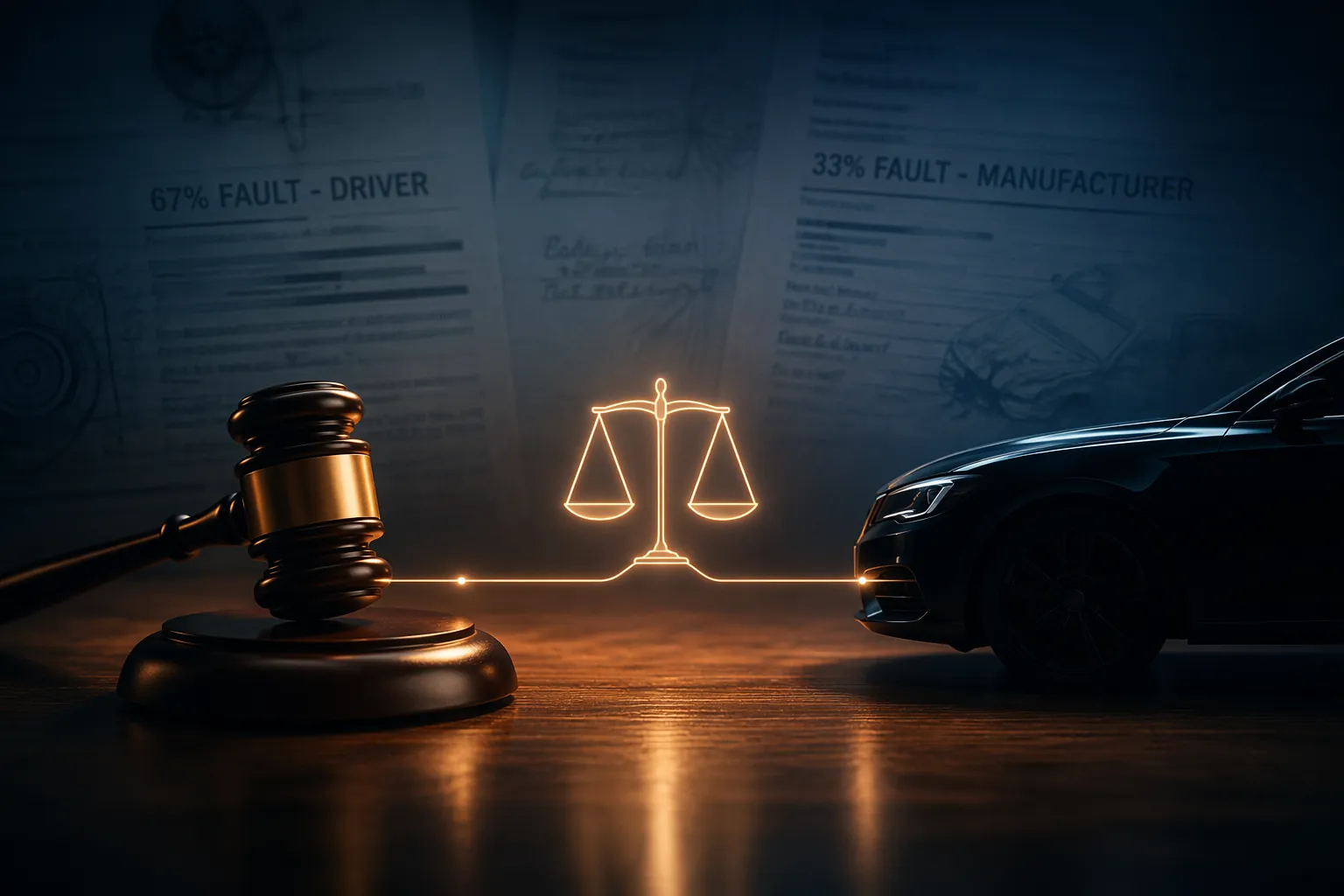
The crash itself must be kept in view without turning the liability analysis into accident spectacle. The case arose from a fatal collision involving Tesla’s Autopilot system, with death and injuries at the center of the underlying claims. The jury’s answer was not to absolve the driver or to declare Autopilot fully autonomous. It divided responsibility, then found Tesla’s share serious enough to support a nine-figure judgment.[1]
Why the post-trial order is the anchor
For lawyers, the February 2026 order is more important than the headline verdict because it tells us what survived after Tesla had the full post-trial toolkit available. Tesla asked the court to disturb the result. Judge Bloom declined, leaving intact the jury’s liability allocation and the damages award.[1]
That matters because ADAS cases are usually fought through filters before they are fought through closing arguments. A complaint may allege overbroad autonomy narratives. Experts may try to bring in other incidents. Plaintiffs may plead several theories and later discover that only some are trial-worthy. Benavides is useful precisely because it shows which portions of the case remained standing after dispositive motions, evidentiary limits, expert challenges, verdict, and post-trial review.
The defense-side account of the case identifies the core surviving theories as design defect and failure to warn, while noting that manufacturing defect and negligent misrepresentation did not make the same trip to the jury.[2] That is not a footnote. It is the map.
| Issue | Treatment in Benavides | Why it matters |
|---|---|---|
| Design defect | Survived and supported liability.[2] | Plaintiffs can argue that ADAS design choices, not only driver misuse, contributed to the crash risk. |
| Failure to warn | Survived and supported liability.[2] | Warnings and feature descriptions become central when a system depends on driver supervision. |
| Punitive damages | Permitted under Fla. Stat. §768.72 on a conscious-disregard theory tied to marketing evidence.[2] | The case moves from compensatory exposure to settlement-repricing exposure. |
| Manufacturing defect | Dismissed.[2] | The case was not treated as proof that this vehicle was defectively built. |
| Negligent misrepresentation | Dismissed.[2] | Marketing evidence mattered, but not every marketing-based theory survived. |
| Other-incident evidence | Limited under Rule 403.[2] | Plaintiffs did not receive an unlimited license to try Autopilot history in bulk. |
| Expert gatekeeping | Subject to Daubert limits.[2] | The ruling still leaves defense counsel meaningful admissibility fights. |
The plaintiff theory that survived
The strongest version of the Benavides plaintiff theory is not that Autopilot equals self-driving. A court would not need that imprecision, and a careful plaintiff should not invite it. The stronger theory is that Tesla sold and described an advanced driver assistance system in ways that shaped foreseeable driver behavior, while knowing enough about the system’s limits to make that presentation legally consequential.
That is where the name Autopilot, feature descriptions, and Elon Musk’s public statements become more than a public-relations archive. In the Benavides framework, marketing evidence helped plaintiffs argue conscious disregard of known safety risks. The point was not simply that the branding was optimistic. The point was that optimistic representations can become probative when the product requires continuous human supervision and the alleged danger is driver overreliance.[2]
Design defect and failure to warn work together in that structure. A design-defect claim can focus on whether the system should have been constrained, monitored, or presented differently given its operational limits. A failure-to-warn claim can focus on what the driver was told, what the driver was encouraged to believe, and whether warnings were adequate in light of the conduct the manufacturer could foresee.
The driver’s 67% fault allocation does real work here. It prevents the verdict from being read as a jury’s refusal to consider driver responsibility. The jury did consider it, assigned most of the fault to the driver, and still found Tesla liable for the remaining share.[1] That is the replicable feature: comparative fault can reduce the manufacturer’s responsibility without eliminating it.
Punitive damages are the settlement lever
The punitive-damages ruling is the part of Benavides most likely to change case valuation. Under the defense-side analysis, the court allowed punitive damages under Fla. Stat. §768.72 based on evidence that Tesla’s marketing could support a finding of conscious disregard.[2] That is a different risk category from ordinary negligence or even a contested warning claim.
For plaintiffs, this supplies a pleading and proof route: collect the manufacturer’s public claims, identify the operational limits of the ADAS feature, connect those limits to foreseeable misuse or overreliance, and argue that the company kept promoting the system in ways that made the known risk worse. For defense counsel, it identifies the immediate containment problem: separate aspirational branding from safety-critical warnings, separate generalized executive statements from product-specific reliance, and attack the causal bridge between public statements and the crash.
This is also where the rejected $60 million pre-trial settlement offer becomes legally intelligible rather than merely dramatic. Tesla declined that offer before the $243 million verdict was returned.[1] In a pipeline of roughly 50 to 60 additional fatal-crash cases, the number will be read less as a hindsight embarrassment than as a new data point for expected value when punitive damages survive.[1]
No careful lawyer should treat that as a universal multiplier. Venue, governing law, crash facts, driver conduct, warnings, software version, and admissible marketing evidence will vary. But after Benavides, a defendant cannot price every Autopilot fatal-crash case as though driver negligence will necessarily cap the case at a modest compensatory range.
The defense wins are not cosmetic
Benavides is a plaintiff template, but it is not a plaintiff blank check. The dismissed and limited theories matter because they are the most reusable parts of the defense playbook.
The manufacturing-defect dismissal narrows the case type. Plaintiffs did not prevail by proving that the specific vehicle departed from Tesla’s intended build. They prevailed on theories aimed at design, warnings, and presentation of system capability.[2] That distinction helps defendants resist efforts to turn every ADAS crash into a generalized defect case without vehicle-specific proof.
The negligent-misrepresentation dismissal is also important. Marketing evidence remained powerful, but not every claim labeled as misrepresentation survived. That gives defense counsel room to argue that public statements may be irrelevant, non-actionable, not relied upon, or insufficiently connected to the particular driver’s conduct, even when the same statements are offered for another admissible purpose.[2]
Rule 403 did work as well. Other-incident evidence was limited, not admitted wholesale.[2] That is one of the first fights defense counsel will want to replicate. In ADAS litigation, other incidents can quickly become a shadow trial over software history, media coverage, and regulatory investigations. Benavides does not eliminate that evidence, but it supports the argument that similarity, probative value, prejudice, and trial manageability remain live constraints.
The same is true of Daubert. Expert testimony remained subject to gatekeeping.[2] Plaintiffs will cite Benavides to show that ADAS design and warning theories can reach a jury. Defendants will cite the same case to insist that reaching a jury still requires disciplined expert proof, not broad claims about autonomy, automation, or corporate intent.
Regulatory context helps, but it does not replace proof
The broader regulatory record gives plaintiffs context for arguing that ADAS risks were not speculative. NHTSA’s EA22002 materials documented 467 collisions and identified a critical safety gap associated with Tesla Autopilot, a finding also reported by CNBC in April 2024.[3][4] That kind of record matters because it can make marketing language look less like isolated puffery and more like continued promotion against a known safety backdrop.
But regulatory material is not a substitute for the case-specific chain. A plaintiff still has to connect the product feature, the warnings or representations, the driver’s conduct, the crash mechanism, and the legally cognizable defect or warning failure. NHTSA’s investigation may support notice and context; it does not by itself prove causation in a given crash.
That distinction will matter in the remaining cases. Plaintiffs will want the regulatory record because it helps show Tesla knew Autopilot presented supervision and engagement risks. Defendants will try to confine it to notice, exclude dissimilar incidents, and keep the jury focused on the particular driver, location, software behavior, and warnings at issue.
A California deceptive-marketing ruling belongs in the same general family of legal signals, but not in the same procedural category as Benavides. It may show that Autopilot representations are becoming legally salient across forums. It does not carry the same weight as a federal jury verdict in a fatal-crash product-liability case that survived post-trial motions.
What lawyers can actually reuse
The reusable plaintiff structure is now visible. It starts with a supervised ADAS product, not a fully autonomous vehicle. It identifies driver overreliance as foreseeable. It uses the manufacturer’s public claims, branding, and feature descriptions to show how expectations were shaped. It then connects those representations to design and warning theories, with punitive damages available if the proof supports conscious disregard.
The reusable defense structure is visible too. Push comparative fault hard. Separate driver misuse from product defect. Attack reliance and causation. Move early against manufacturing-defect and misrepresentation theories that lack record support. Use Rule 403 to narrow other-incident evidence. Use Daubert to prevent the case from becoming a generalized referendum on autonomous vehicles.
In-house counsel should read the case less as a warning against marketing enthusiasm in the abstract and more as a warning against ambiguity around supervised automation. If the product depends on human monitoring, then the public-facing language, interface language, owner materials, release notes, and executive statements should not invite a different behavioral assumption. Litigation will not isolate the warning label from the sales narrative if plaintiffs can plausibly argue that both shaped foreseeable use.
That is the narrower and more durable consequence of Benavides. It does not decide the future of autonomous vehicles. It does not mean every Autopilot crash produces manufacturer liability. It does mean a jury can place most of the blame on the driver and still punish the manufacturer when the manufacturer’s own claims help define the risk that materialized.
References
- US judge upholds $243M verdict against Tesla over fatal Autopilot crash, Reuters, February 20, 2026
- Benavides v. Tesla: A Defense-Side Perspective on Florida's Landmark Autopilot Verdict, WSHB Law
- EA22002 Investigation Closing Resume, National Highway Traffic Safety Administration
- Tesla Autopilot linked to hundreds of collisions, has critical safety gap: NHTSA, CNBC, April 26, 2024
Chronological incident history
No sanction cases have named this tool in the tracked record set to date. This does not imply the tool is safe — see Risk Digest for ongoing monitoring.
← Compare peer toolsReport a correction or tip
Spotted an outdated figure, a misstated fact, or a ruling this tool profile should reflect? Public comments are disabled for this content given the professional cost of a misreported case outcome, penalty amount, or rule text — use the structured correction channel instead.
Report a correction or tip for this record →