
The Legal Risks From the Charleston White-Young Thug Confrontation
This article analyzes the March 2026 confrontation between Charleston White and Young Thug as a case study in post-RICO probation supervision. It explains the statutory revocation mechanisms under Georgia law, the preponderance-of-evidence standard, the unique plea conditions at stake, and the critical caveats about White's credibility and the lack of confirmed court filings as of mid-2026.
- Hallucination rate
- Not measured / undisclosed
The legal issues from the Charleston White-Young Thug confrontation start in an awkward place: as of July 23, 2026, there is no confirmed court filing, police report, or probation-violation petition in the available public materials. That should slow down any prediction about Young Thug going back into custody. It does not make the episode legally meaningless.
White said the March 28, 2026 run-in happened at Druski’s Coulda Been Love reunion at Opa-locka Executive Airport in Miami, then publicly claimed Young Thug told him, “We step on s***,” and that an associate was armed.[1][2] White also framed the incident as something he intended to take to supervision and law-enforcement channels, not merely as an online feud.[1] The important caveat is just as plain: the public record, at least as available now, has not produced an independent video of the alleged threat, a filed violation petition, or a confirmed new criminal case.
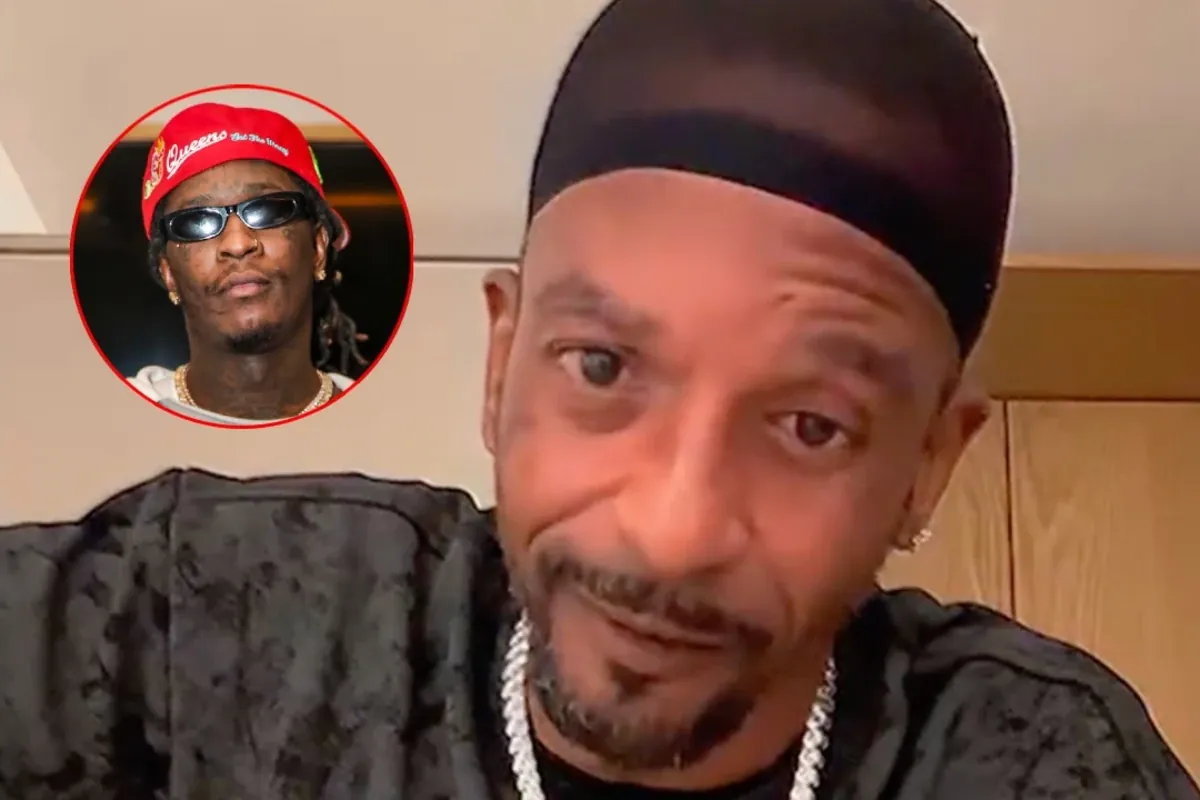
That gap between noise and filing is where probation law matters. A probation case does not wait for the clean evidentiary posture of a new criminal prosecution. It can begin with a report, a complaint, a supervising officer’s investigation, or a prosecutor’s motion. The question is not whether White has proved a Florida crime in public. The narrower question is whether the alleged facts, if credited by Georgia supervision authorities and a judge, could fit one of Young Thug’s existing probation conditions.
Why This Was Not an Ordinary Airport Argument
Young Thug’s plea did not leave him with generic probation terms only. His sentence included 15 years of probation with a 20-year backloaded sentence, along with conditions barring association with gang members, barring proximity to firearms, excluding him from Atlanta except for limited purposes, and requiring quarterly anti-violence presentations.[3] Those terms are not background color. They are the hooks that make a messy confrontation legally legible.
Start with the alleged phrase. White’s account depends heavily on the wording “We step on s***.”[2] In ordinary conversation, that could be bluster, slang, posturing, or an incomplete fragment lifted out of context. In a post-RICO probation file, prosecutors would look at different questions: Was the “we” meaningful? Did it imply a group identity? Did it suggest ongoing gang association? Was the statement directed as intimidation? Those are not the same questions a Florida prosecutor would ask when deciding whether a threat statute has been violated.
The firearm allegation is a separate problem. White’s claim that an associate was armed, if ever supported by more than his own account, would not require proof that Young Thug personally possessed a gun to create supervision risk.[1] The plea condition described in the reporting concerns proximity to firearms.[3] That kind of condition can make the orbit around a weapon more consequential than it would be for a person who is not on probation.
The Atlanta exclusion term is less central to the Miami encounter, but it shows the density of the supervision regime. Young Thug’s conditional freedom after the YSL case is not simply “do not commit a new crime.” It is a layered set of behavioral restrictions, location restrictions, association limits, and public-facing obligations.[3] The more particular the conditions, the more routes there are for a complainant to argue that a public incident is not just reputationally damaging but supervision-relevant.
| Alleged fact | Possible probation hook | What would still need support |
|---|---|---|
| White says Young Thug used “we” language during the confrontation | No gang association or association with known gang members | Context, identity of any associates, and whether the statement proves association rather than loose speech |
| White says an associate was armed | No proximity to firearms | Independent evidence of a firearm, Young Thug’s proximity to it, and whether he knew or reasonably should have known |
| White says he was threatened | General compliance with law and anti-violence obligations | Credible proof of the words, intent, and surrounding circumstances |
| The incident occurred in Miami | Interstate supervision and reporting duties | Which authority received notice and whether Georgia supervision acted on it |
The Revocation Standard Is Lower Than a New Criminal Case
Georgia’s revocation statute is the part of the analysis that tends to get flattened in public discussion. Under O.C.G.A. § 42-8-34.1, revocation turns on a preponderance-of-the-evidence framework rather than the beyond-a-reasonable-doubt standard that would govern a new criminal conviction.[4] Practitioners should verify the current statutory text before relying on any codification, but the core distinction matters here: probation court is not a second trial on a new offense.
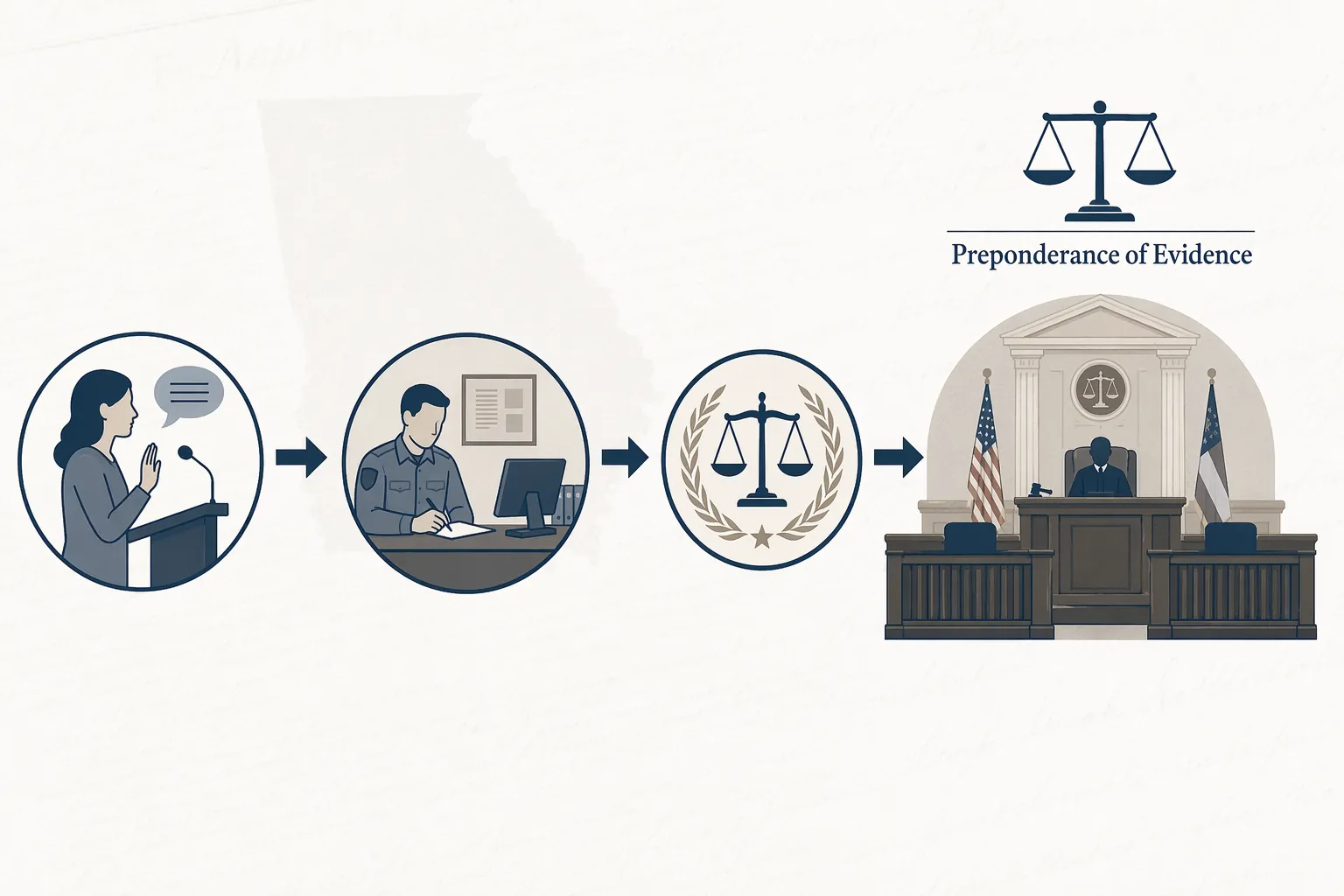
A third-party allegation can matter before it becomes a charge. A probation officer could receive the complaint, ask for statements, review public interviews, look for video, contact local authorities, and decide whether the conduct appears to violate a condition. A prosecutor could decide whether to file a revocation motion. The judge would then decide whether the state has shown a violation under the applicable standard, not whether White has won an argument on the internet.
That is why White’s lack of official authority is not the end of the matter. He cannot revoke anyone’s probation. He cannot transform an argument into a violation by announcing that he will call the right people. But he can supply the first version of a triggering fact. In a supervision system built around reporting, investigation, and judicial discretion, the first version sometimes starts the file.
The harder question is what survives once the machinery starts. A judge would not be required to accept White’s account just because the allegation maps neatly onto a condition. The state would need something more reliable than outrage: testimony, corroboration, records, video, admissions, local police documentation, or other evidence that makes the alleged violation more likely than not. The standard is lower than a criminal trial, but it is not no standard at all.
The April 2025 Motion Is the Useful Calibration Point
This was not the first time Young Thug’s probation terms were tested after the plea. In April 2025, Fulton County prosecutors moved to revoke his probation over a social media post involving Marissa Viverito, and Judge Paige Reese Whitaker denied the motion.[5] Reporting at the time also noted that the judge admonished prosecutors to “exercise restraint.”[6]
That prior denial cuts in two directions. It shows that prosecutors have already been willing to probe the outer edges of the plea conditions. It also shows that the court did not treat every provocative public-facing event as enough to send Young Thug back into custody. For the March 2026 confrontation, the April 2025 episode is not a prediction. It is a reminder that the courthouse filter still exists.
The restraint admonition matters because revocation power is remedial and punitive at the same time. It is supposed to enforce the sentence already imposed, not become an automatic response to every headline. In a high-profile case, that distinction is easy to lose. Prosecutors know the public is watching. Defense counsel know every ambiguous gesture can be repackaged as defiance. The judge is left to separate supervision risk from performance.
Miami Adds Complexity, Not a Shortcut
The location matters, but only within limits. White placed the incident at Opa-locka Executive Airport in Miami and reportedly characterized it as “FAA property.”[1] That phrase should not be treated as a jurisdictional conclusion. Legal analysis of Florida airport incidents cautions that offenses at airports are not automatically federal crimes simply because aviation infrastructure or federal regulation is involved.[7]
For a new Florida criminal case, authorities would need to examine Florida law, the exact location, the alleged words, the intended target, and the evidence of intent. The research materials specifically flag Florida’s threat statute as requiring intent to terrorize, which is a more precise inquiry than asking whether someone later described the encounter as frightening. That is a separate lane from Georgia probation enforcement.
The interstate issue is more practical than dramatic. A person on Georgia probation does not step outside supervision simply by standing in Florida. Interstate supervision rules, travel permissions, reporting duties, and officer-to-officer communication can all become relevant. But the current materials do not establish a filed interstate complaint, a Florida police report, or a Georgia violation petition arising from this encounter. Without that, the Miami setting remains a complication rather than proof of enforcement.
White’s Account Can Trigger Scrutiny and Still Be Weak Evidence
White’s credibility problems should not be used as a shortcut either. They do not make the legal theory disappear. They do affect whether the theory can carry weight in court.
The available biographical record describes White as a provocateur with a history of inflammatory public claims, and it notes that he previously admitted lying about macing Soulja Boy.[8] That kind of history would be obvious impeachment material if his account became central to a revocation hearing. A probation officer may still take a complaint from him. A judge may still listen to sworn testimony. But a case resting mainly on White’s unsworn public retelling would have an evidentiary problem.
This is the uncomfortable procedural point: a weak narrator can identify a real issue. If a person under gang-association and firearm-proximity restrictions is credibly shown to have participated in a threatening encounter with armed associates nearby, the supervision consequences could be serious. If the only proof is a publicity-prone adversary’s account, the same allegation may never become more than noise.
The distinction between witnessing an interaction and corroborating a violation is also important. Even if other people confirm that White and Young Thug crossed paths, that does not confirm the precise words used, the presence of a firearm, Young Thug’s knowledge of any weapon, or the legal significance of anyone standing nearby. Probation cases often turn on those small separations.
What Would Have to Happen Next
A meaningful enforcement path would need to move from public allegation to documented action. The cleanest version would include a report to a probation officer, preservation of any venue or security footage, identification of witnesses, inquiry into any alleged firearm, and a decision by Georgia authorities about whether the conduct fits an existing condition. If prosecutors filed a motion, the defense would then have room to challenge reliability, context, hearsay, identity, and whether the alleged behavior actually violated a term of probation.
The state would likely be strongest if it could separate the case from White’s personality. Independent video, neutral witnesses, admissions, police documentation, or evidence from supervision records would matter more than another interview. The defense would be strongest if the record stayed where it appears to be now: vivid public allegations, no confirmed filing, no independent proof of the threat, and no verified evidence of firearm proximity.
That is the real legal risk exposed by the confrontation. High-profile post-RICO probation can make ordinary public movement fragile. A sentence with unusual association, location, firearm, and anti-violence terms gives outsiders more language to invoke when they want to turn an encounter into a supervision issue. But the same system still requires a court to decide whether the alleged facts are reliable enough and legally connected enough to justify revocation.
As of Q3 2026, the strongest enforcement theory remains unproven. It rests on White’s unverified account, unusual plea conditions, Georgia’s lower revocation standard, and the possibility that supervision authorities could act even without a new criminal conviction. That is enough to make the confrontation legally relevant. It is not enough, on the present record, to say it will send Young Thug back to prison.
References
- Charleston White Threatens to Get Young Thug Sent to Prison After Run-In in Miami — XXL Mag
- EXCLUSIVE: Charleston White on Young Thug Altercation — VladTV
- READ: Young Thug's plea deal, probation requirements — Atlanta News First, 2024-11-04
- Georgia Code § 42-8-34.1 — Revocation of Probated or Suspended Sentence — Justia, 2020
- Young Thug fends off Fani Willis' attempt to revoke his probation — Courthouse News Service
- Young Thug to remain on probation despite outcry over social media post — LA Times, 2025-04-03
- Are Offenses at Florida Airports Automatically Federal Crimes? — Robert Foley Law
- Charleston White — Wikipedia
Chronological incident history
No sanction cases have named this tool in the tracked record set to date. This does not imply the tool is safe — see Risk Digest for ongoing monitoring.
← Compare peer toolsReport a correction or tip
Spotted an outdated figure, a misstated fact, or a ruling this tool profile should reflect? Public comments are disabled for this content given the professional cost of a misreported case outcome, penalty amount, or rule text — use the structured correction channel instead.
Report a correction or tip for this record →