
For Law Firms, Claude Opus 5 Offers Better Compliance Than Fable 5
This article compares Claude Opus 5 and Claude Fable 5 for law firm use, focusing on data retention, cost, and benchmark performance. It concludes that Opus 5's zero-data-retention option makes it the more defensible choice for firms handling privileged client data, despite slightly lower benchmark scores.
- Tool
- Claude Opus 5
- Benchmark source
- Harvey Legal Agent Benchmark, Legal Benchmarks, Artificial Analysis, LLM Stats
- Hallucination rate
- Not measured / undisclosed
- Test methodology
- Published benchmark scores from Harvey Legal Agent Benchmark, Legal Benchmarks, and Artificial Analysis, with per-task cost from LLM Stats
- Test date
- Jul 25, 2026
For client-facing legal work involving privileged or confidential material, the safer procurement answer in a Claude Opus 5 vs Fable 5 comparison for legal use is to approve Claude Opus 5 before Fable 5. That is not because Fable 5 is weak. On the available legal benchmarks, it is often slightly ahead. The problem is that Fable 5’s mandatory 30-day retention term changes the approval question before the firm ever reaches model quality.
This is a Tool Reliability Evaluation current as of Q3 2026 and based on the materials available on July 25, 2026. It is not legal advice. The analysis relies on vendor retention documentation, Anthropic’s Opus 5 launch materials, Harvey’s legal benchmark reporting, Legal Benchmarks, Artificial Analysis, LLM Stats pricing, and dated reporting on Fable 5’s suspension and restoration.

A firm can reasonably prefer the stronger model for a particular task. It cannot treat confidentiality as a feature preference to be weighed after speed, tone, or drafting polish. For work covered by client confidentiality duties, outside-counsel guidelines, protective orders, or internal data-handling rules, retention mechanics are part of the threshold record the firm may later have to defend.
The Retention Term Is the Approval Problem
Anthropic’s June 9, 2026 Help Center article states that Covered Models in the Mythos class are subject to 30-day data retention “on every platform,” and that the policy overrides prior zero-data-retention arrangements for covered models.[1] That is the sentence a law-firm risk manager will underline before looking at any benchmark table.
By contrast, Anthropic’s July 24, 2026 announcement for Claude Opus 5 states that Opus 5 supports zero data retention on API and Enterprise plans.[2] For a firm with an existing ZDR workflow, that is not a cosmetic difference. It means the firm can preserve the basic shape of an approval memo it may already know how to write: approved platform, approved plan, approved data category, no vendor retention for covered prompts and outputs.
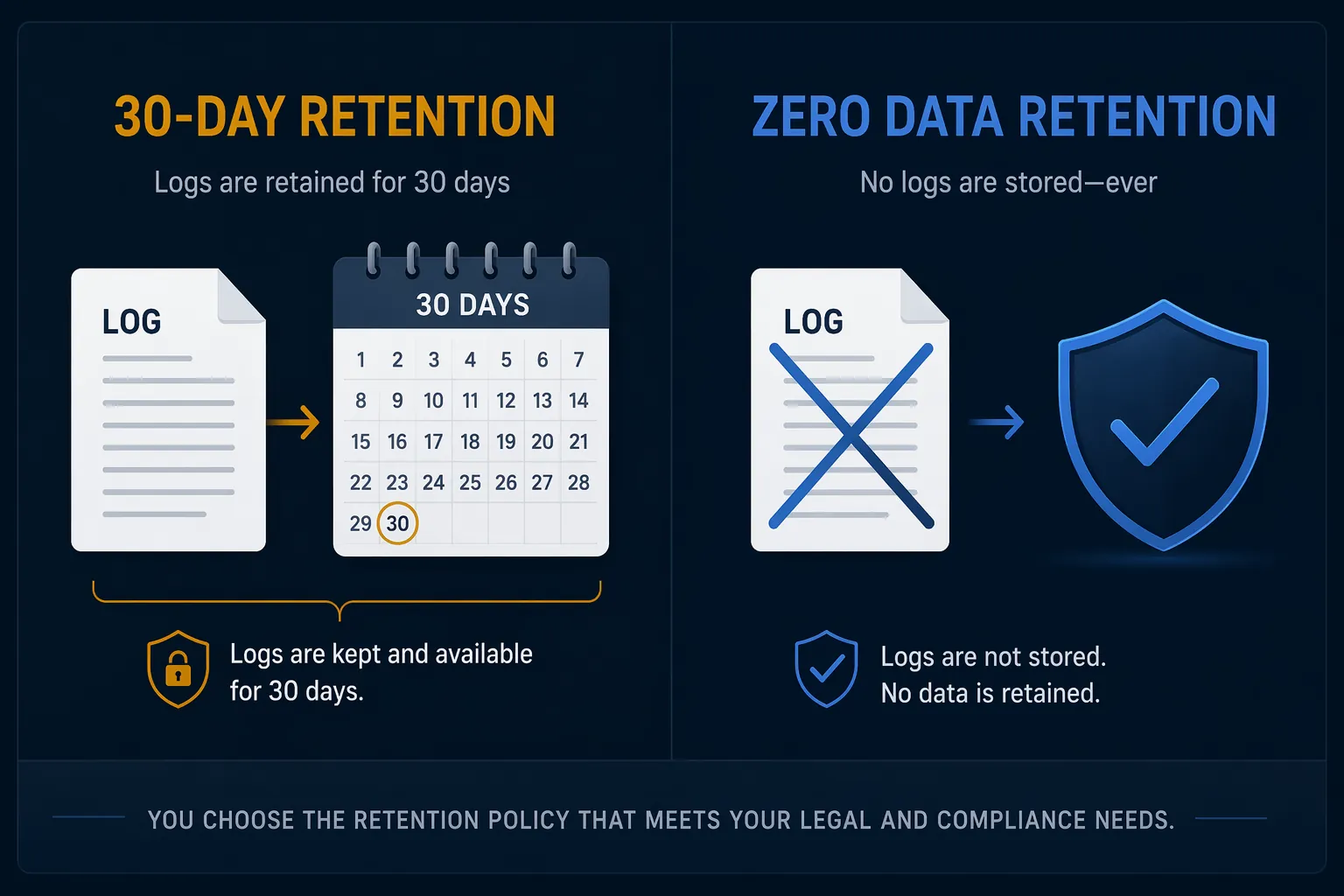
The Fable 5 issue is sharper for business and enterprise users than for consumer accounts. Consumer plans already operated under standard retention. The uncomfortable change is for firms that believed they had bought, documented, and trained around ZDR, only to find that covered-model use now sits outside that prior comfort zone.
The fallback detail makes the policy harder to cabin. JLEllis’s June 2026 analysis notes that even where a Fable 5 session falls back to Opus 4.8, the data remains subject to Fable 5’s 30-day retention policy because the session began on Fable 5.[3] That matters operationally. A user may experience the answer as coming from a safer or older model, while the retention analysis follows the session origin.
That is exactly the kind of mismatch that produces bad internal records. The partner remembers the model name in the response. The vendor questionnaire asks about retention. The client guideline asks whether confidential information may be submitted to third-party AI systems. The information-governance team then has to explain why the firm approved a workflow whose retention rule followed a hidden routing condition rather than the lawyer’s visible experience.
Regional processing adds another constraint. Harvey’s June 9 Fable 5 availability note states that Anthropic offers no regional processing for Fable 5 and that all data is processed in the United States.[4] That does not make Fable 5 unusable for every matter. It does mean the procurement memo cannot simply say “enterprise plan approved” and move on. Matters with data-residency commitments, European client restrictions, or negotiated processing locations need a separate answer.
Fable 5’s Benchmark Lead Is Real, but Narrow
The performance case for Fable 5 deserves a fair reading. Harvey reported Fable 5 at 13.3% all-pass on its Legal Agent Benchmark on June 9, 2026.[4] Harvey then reported Opus 5 at 11.7% all-pass on July 24, 2026.[5] On that measure, Fable 5 leads by 1.6 percentage points.

That lead is useful, but it is not the kind of gap that usually justifies a different confidentiality posture. A 13.3% all-pass result does not mean the model can run unsupervised legal work. An 11.7% result does not mean the competing model is unsuitable. Both figures describe a demanding benchmark where full success remains difficult, and both still require lawyer review for client-facing output.
| Measure | Fable 5 | Opus 5 | Procurement reading |
|---|---|---|---|
| Harvey Legal Agent Benchmark all-pass | 13.3% [4] | 11.7% [5] | Fable 5 leads by 1.6 percentage points |
| Legal Benchmarks contract drafting reliability | 61.8% [6] | 61.8% [6] | No reliability separation on this task |
| Legal Benchmarks usefulness score | 2.66 [6] | 2.47 [6] | Fable 5 is modestly ahead |
| Artificial Analysis Legal Index | 59 [7] | 58 [7] | Near tie |
Legal Benchmarks’ July 2026 contract-drafting results are especially important because they flatten the headline race. Both models are listed at 61.8% reliability on contract drafting, while Fable 5 has a usefulness score of 2.66 compared with Opus 5’s 2.47.[6] Artificial Analysis shows the same basic shape: Fable 5 at 59 and Opus 5 at 58 on its Legal Index.[7]
Those numbers support a narrow conclusion. Fable 5 may be the better model on some legal tasks, particularly where the firm is optimizing for drafting fluency, markup analysis, or multi-document synthesis. They do not support the broader conclusion that a law firm should accept mandatory retention of privileged or confidential material to capture the difference.
The timing also calls for caution. Opus 5 was released on July 24, 2026, only one day before this evaluation. The first benchmark picture may be directionally useful, but it is not settled. Firms should not build a permanent model policy around launch-day certainty, especially where later evaluations may change the relative ranking.
Cost Helps Opus 5, but It Is Not the Main Reason
Listed per-token pricing favors Opus 5. LLM Stats lists Fable 5 at $10 per million input tokens and $50 per million output tokens, compared with Opus 5 at $5 per million input tokens and $25 per million output tokens.[8] On published list prices, Opus 5 is half the input and output price.
That does not mean every matter-level invoice will be half as expensive. Legal Benchmarks’ contract-drafting task lists approximate per-task cost at $0.64 for Fable 5 and $0.74 for Opus 5, because Fable 5 used fewer tokens in that benchmark.[6] Enterprise discounts, platform packaging, retrieval architecture, and prompt design may also move the real number.
Still, price does not rescue Fable 5 from the retention problem. If a firm can use Opus 5 under ZDR and at lower listed token prices, the case for taking on Fable 5’s mandatory retention needs to rest on a meaningful work-product advantage. The currently published legal scores do not show that kind of separation.
Availability Belongs in the Memo
Fable 5 also carries a recent availability fact that should be recorded without exaggeration. It was suspended globally from June 12 to July 1, 2026 under a U.S. Commerce Department export-control directive, and Layer3 Labs’ July 17 guide notes that firms planning around Fable 5 must account for sudden unavailability.[9] Best Practice AI also discussed the law-firm implications of the interruption in its coverage of the episode.[10]
That history is not a prediction that Fable 5 will be suspended again. It is a documented regulatory-vulnerability signal. For a pilot project, the firm may tolerate that. For a production workflow tied to filing deadlines, deal timetables, or high-volume review, the procurement record should identify the fallback model, the fallback platform, and the work types that may not move to Fable 5 if access changes suddenly.
Where Practice-Area Results May Still Matter
A sensible policy can still leave room for task-specific testing. Harvey reported that Opus 5’s biggest legal gains appeared in corporate governance, corporate M&A, energy, real estate, arbitration, and international disputes.[5] The same Harvey materials describe Fable 5 as leading in drafting, markup analysis, and multi-document scenarios, while showing mixed results on multi-step tax calculations and fund waterfall modeling.[4]
Those distinctions matter most for non-confidential evaluation, internal knowledge work using cleared materials, or controlled pilots where the firm has already decided the retention term is acceptable. They do not eliminate the need to classify the input data first. A model that is marginally better at markup analysis is not automatically approved for an unredacted merger agreement if the client’s guidelines or the firm’s own approval record require no vendor retention.
A Defensible Use Policy
The cleanest approval record is not “Opus 5 good, Fable 5 bad.” It is more precise than that.
- Approve Opus 5 on API or Enterprise plans for client-facing legal work involving privileged or confidential data, subject to the firm’s normal matter-level restrictions and lawyer review.
- Do not approve Fable 5 for privileged or confidential client material where ZDR is required by firm policy, client guideline, protective order, or matter-specific instruction.
- Permit Fable 5 only for approved data categories where 30-day retention, U.S. processing, and potential availability interruption have been reviewed and accepted.
- Require users to start new sessions under the approved model rather than relying on fallback behavior to change the retention analysis.
- Re-verify this comparison when Anthropic changes retention terms, when Opus 5 has more post-launch benchmark history, or when a platform offers materially different enterprise controls.
For law firms, the decisive distinction is not that Opus 5 wins every legal benchmark. It does not. Fable 5’s published scores are slightly better in several places, and firms should keep testing it where the data category permits. But for privileged client work, a mandatory 30-day retention rule turns a narrow performance edge into an approval problem. On the evidence available as of July 25, 2026, Opus 5 is the more defensible model to approve.
References
- Data retention practices for Covered Models, Anthropic Help Center, June 9, 2026.
- Introducing Claude Opus 5, Anthropic, July 24, 2026.
- The fundamental privacy difference between Claude’s Fable and previous models: no ZDR, JLEllis, June 2026.
- Fable 5 Now Available in Harvey, Harvey, June 9, 2026.
- Opus 5 in Harvey, Harvey, July 24, 2026.
- Leaderboard, Legal Benchmarks, July 2026.
- Legal, Artificial Analysis, July 2026.
- Claude Fable 5 vs Claude Opus 5, LLM Stats.
- Claude Fable 5 for Law Firms, Layer3 Labs, July 17, 2026.
- Were law firms ever going to use, Best Practice AI.
Chronological incident history
No sanction cases have named this tool in the tracked record set to date. This does not imply the tool is safe — see Risk Digest for ongoing monitoring.
← Compare peer toolsReport a correction or tip
Spotted an outdated figure, a misstated fact, or a ruling this tool profile should reflect? Public comments are disabled for this content given the professional cost of a misreported case outcome, penalty amount, or rule text — use the structured correction channel instead.
Report a correction or tip for this record →