
Why CoreWeave's Stock Price Target Matters for Legal AI
CoreWeave's extreme stock volatility, $25B debt load, and ongoing securities litigation signal real service-continuity risk for law firms that depend on AI tools running on its cloud infrastructure. This article translates financial-market signals into concrete vendor-due-diligence questions for legal AI buyers.
- Tool
- generic-chatbot
- Benchmark source
- MarketBeat
- Hallucination rate
- Not measured / undisclosed
- Test methodology
- Financial data analysis
- Test date
- Jul 29, 2026
As of July 29, 2026, CoreWeave traded at $60.82, barely above its 52-week low of $60.55 and far below its 52-week high of $153.20. MarketBeat showed a “Moderate Buy” consensus from 37 analysts and a $136.25 consensus price target, implying roughly 124% upside from that day’s price. The same snapshot showed a beta of 7.17, short interest near 19% of float, and a year-over-year share-price decline of about 46%.[1]
That is the answer an investor expects when searching for “coreweave stock price target and ai cloud computing 2026.” For a law firm buying legal AI, it is only the start of the file. The practical question is not whether the analysts are too optimistic or the short sellers are too aggressive. It is whether volatility around a major AI cloud provider should change the questions asked of the legal AI vendor sitting across the procurement table.

One more date belongs in the margin: CoreWeave’s Q2 2026 earnings call was scheduled for August 11, 2026, so the debt, cash-flow, backlog, and guidance figures available on July 29 may move quickly.[1] This article is not investment advice and does not recommend buying, selling, or shorting CoreWeave. It treats public market and financing data as service-continuity signals for legal AI procurement.
A Bullish Target Does Not Remove the Continuity Question
There is a real demand case for CoreWeave. The company reported FY2025 revenue of $5.13 billion, up 168% year over year, and Q1 2026 revenue of $2.08 billion, up 111.7% year over year. It also reported a $99.4 billion revenue backlog and 2026 capital-expenditure guidance of $31 billion to $35 billion.[2]
Those are not cosmetic numbers. GPU-heavy AI workloads need specialized capacity, and CoreWeave has positioned itself as one of the companies selling that capacity at scale. NVIDIA’s additional $2 billion equity investment in Q1 2026 also matters, because it signals support from the most important upstream chip supplier in the AI infrastructure stack.[2]
But demand does not answer every operational question. In the same Q1 2026 period, CoreWeave reported operating expenses that grew 127%, total liabilities of $50.8 billion, and negative quarterly free cash flow of $4.71 billion.[2] Market data also showed roughly $25 billion in debt, a 0.31 current ratio, and a 3.68 debt-to-equity ratio.[1] A buyer does not need to predict default to care about that combination. It is enough to ask whether capacity expansion, redundancy, and service commitments depend on continued access to financing on tolerable terms.
That distinction is especially important in legal AI. A law firm usually contracts with the application vendor, not with every cloud, model, data-center, chip, or colocation provider underneath the product. The application vendor may say it uses enterprise-grade infrastructure. That phrase does not tell the firm whether a workload can move if a capacity provider misses a buildout milestone, tightens customer allocations, reprices compute, or prioritizes a larger customer.
How Financial Stress Becomes a Legal AI Service Risk
The mechanism is not mysterious. CoreWeave’s business requires enormous upfront spending on GPUs, power, data-center capacity, networking, and long-term leases before the revenue from contracted workloads is fully realized. When a company is growing that fast while burning cash, the market’s confidence affects more than the share price. It affects the cost and availability of the capital needed to keep building.
For a legal AI buyer, that matters because AI service quality is not only a software issue. Latency, queueing, model availability, document-processing throughput, and batch-review timelines all depend on compute capacity. If a legal team is using AI to triage productions, draft research memos, summarize deposition transcripts, or run contract analysis near a deal deadline, the failure mode is rarely a neat error message. It is a partner waiting, a client asking for status, or a litigation team losing time it cannot recover.
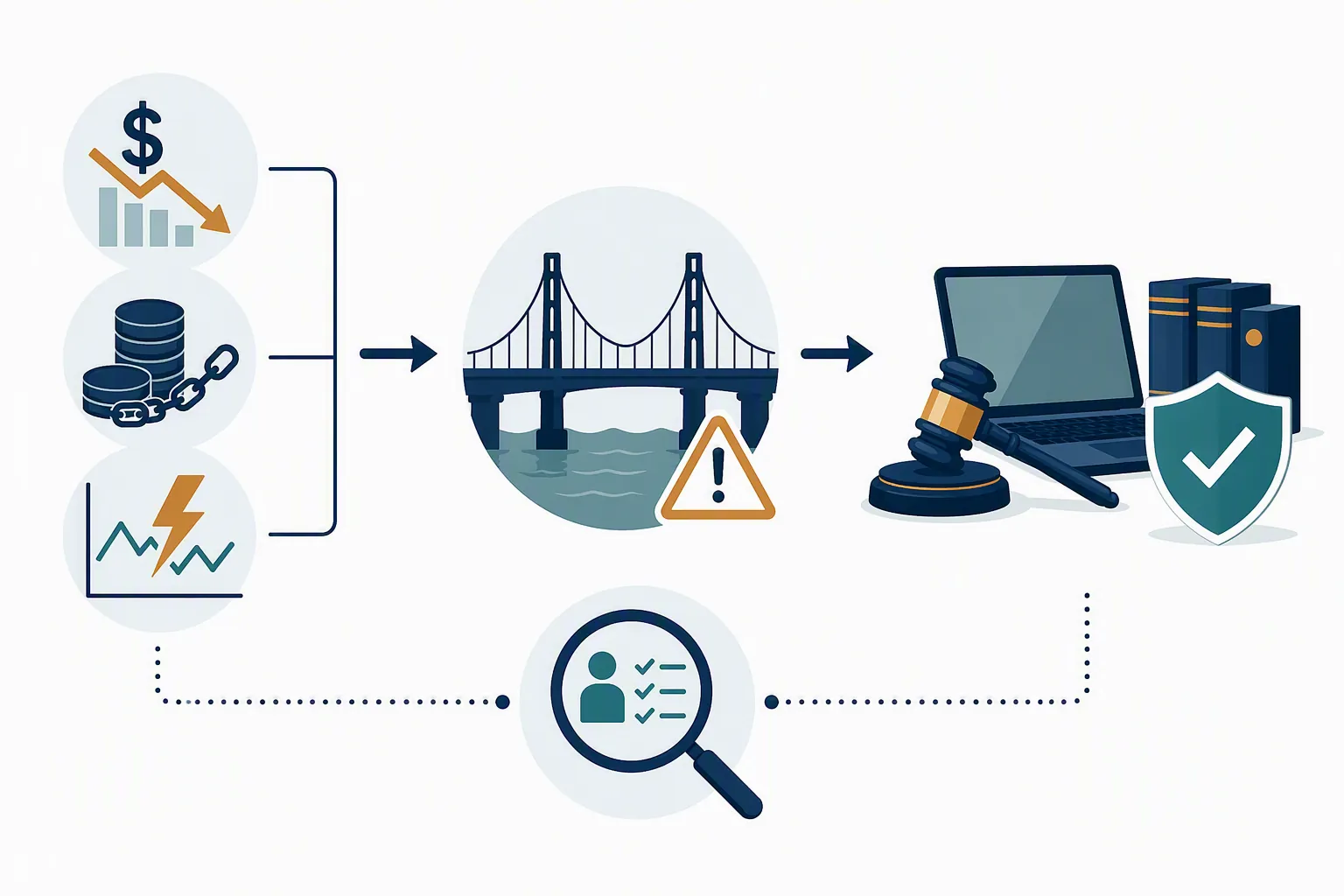
The dependency is also hard to see from the outside. No public source cited here confirms which specific legal AI products run on CoreWeave. That means the correct diligence posture is conditional: do not accuse a vendor of using CoreWeave unless it says so; do ask every GPU-heavy AI vendor to identify material infrastructure dependencies and explain what happens if one provider becomes constrained.
A useful procurement record should connect the financial signal to the operational control. If the stock is volatile, ask about failover. If debt and cash burn are material, ask about capacity guarantees. If a provider relies on a single developer for a major facility, ask what deadlines and remedies flow through to the application layer. The firm does not need a trader’s view of CoreWeave. It needs a continuity view of the services that may sit on top of it.
The Signals Worth Translating Into Vendor Questions
Market volatility is the least precise signal and still the easiest to ignore. A beta of 7.17 says the stock has been moving far more sharply than the broader market, while short interest near 19% of float says a meaningful group of investors has positioned against the shares.[1] Those metrics do not prove service instability. They do justify asking whether the legal AI vendor has documented hosting redundancy, tested failover, and contractual rights to shift workloads.
Debt and cash flow are more concrete. A company with about $25 billion in debt, $50.8 billion in total liabilities, a 0.31 current ratio, and negative Q1 2026 free cash flow of $4.71 billion is funding growth under pressure.[1][2] The diligence question is not “Will CoreWeave fail?” It is “If compute capacity tightens, which customers get priority, which workloads are degraded, and what service credits or termination rights does our firm actually have?”
Capex guidance belongs in the same conversation. CoreWeave guided to $31 billion to $35 billion in 2026 capital expenditures, which is consistent with the size of the AI infrastructure opportunity but also raises execution risk.[2] A legal AI vendor that depends on newly built or newly leased capacity should be able to say whether promised performance assumes future capacity coming online, not merely capacity already under control.
Backlog cuts both ways. A $99.4 billion backlog supports the analyst demand case and helps explain why a bullish target can coexist with financial strain.[2] It can also create prioritization questions. If demand exceeds immediately available capacity, a mid-market law firm or a narrow practice-group deployment may not sit in the same queue as the largest AI labs or enterprise customers.
Insider selling should be handled without theater. MarketBeat reported that CoreWeave’s CEO sold approximately $37.7 million of stock on June 30, 2026.[1] Insider transactions can have many explanations, and one sale is not a continuity event. In a procurement file, however, it can be another reason to ask whether the vendor’s risk disclosures, renewal assumptions, and service-continuity representations are current rather than recycled from a calmer financing environment.
| Public signal | What it does not prove | Vendor question it should trigger |
|---|---|---|
| Consensus target of $136.25 with a $60.82 share price | That analysts are right or wrong | Does our service commitment depend on one AI cloud provider’s continued capacity expansion? |
| Beta of 7.17 and short interest near 19% | That an outage is likely | What tested failover exists if the primary AI infrastructure provider is constrained? |
| About $25B debt and -$4.71B Q1 2026 free cash flow | That the company cannot finance growth | Are capacity guarantees backed by committed infrastructure or by expected future buildout? |
| $99.4B backlog | That every customer gets equal priority | Where would our firm rank during a capacity allocation event? |
| CEO sale of about $37.7M on June 30, 2026 | That management lacks confidence | Have risk disclosures and renewal materials been updated after recent market volatility? |
Concentration Risk Is the Part Procurement Can Actually Test
The securities complaint materials are relevant here, but they need careful handling. Kessler Topaz describes Masaitis v. CoreWeave, Inc., Case No. 26-cv-00355 in the District of New Jersey, as a securities class action alleging that CoreWeave concealed or misrepresented risks tied to, among other things, a single third-party data-center developer.[3] Those are allegations in a complaint, not findings of fraud or liability.
For legal AI diligence, the value of the complaint is not that it proves wrongdoing. It identifies a risk category that buyers can test: whether a cloud provider’s growth plan depends on a concentrated facility partner, lease counterparty, power arrangement, or developer timeline that the application vendor does not control.
Applied Digital announced an additional 150 MW lease with CoreWeave at Polaris Forge 1, bringing the site to 400 MW and representing approximately $11 billion in lease revenue.[4] That is a large infrastructure commitment, and it may support significant future AI capacity. It also gives a buyer a concrete line of questioning: if a major site is delayed, power-constrained, disputed, or repriced, what happens to the legal AI workloads that expected to use that capacity?
The collapsed Core Scientific acquisition belongs in the same bucket, not as a stand-alone drama. Its relevance is that AI cloud capacity is increasingly tied to a small number of large data-center transactions. When one transaction falls away, the buyer’s question should be whether the vendor has already secured substitute capacity or is still relying on a roadmap.
Memory-chip exposure adds another layer. Reuters reported in July 2026 that CoreWeave was exploring Wall Street-style hedging for memory-chip price risk.[5] Hedging can be prudent risk management. It also confirms that the economics of AI cloud capacity are sensitive to hardware inputs that most law-firm users will never see in a product demo.
The Growth Case Still Belongs in the File
A fair diligence memo should not turn every risk signal into a failure prediction. CoreWeave’s reported revenue growth, backlog, and NVIDIA investment show substantial demand and market support.[2] Gartner also named CoreWeave a Visionary in the 2026 Magic Quadrant for Cloud AI Infrastructure.[6] Those facts matter because a distressed-looking balance sheet can coexist with a business that customers badly want.
The mistake is treating those positives as if they cancel the financing questions. A law firm does not get paid to admire a vendor’s growth curve. It gets judged when a deadline slips, a client file cannot be processed, or a partner has to explain why a tool was unavailable during a critical review window.
That is why legal AI infrastructure diligence should sit beside the more familiar controls: data retention, privilege protection, hallucination testing, audit logs, uptime commitments, and human verification workflows. For a broader checklist that maps AI vendor review to professional-responsibility concerns, see the ABA Model Rules–Mapped AI Vendor Due Diligence Checklist. For infrastructure-stack context, the comparison of CoreWeave and Applied Digital for legal AI users is the more detailed companion.
What to Ask Before Renewing a Legal AI Contract
The questions below are not a substitute for technical diligence, and they should not be limited to vendors that name CoreWeave. They are the questions a buyer should ask any legal AI provider whose service depends on GPU-intensive cloud infrastructure.
- Identify material infrastructure providers: Which cloud, GPU, data-center, model-hosting, and colocation providers support the product, and which of them are material to the services our firm uses?
- Separate current capacity from planned capacity: Are our promised response times, batch limits, and availability commitments based on infrastructure already deployed or on facilities expected to come online later?
- Document failover rather than architecture labels: If the primary AI infrastructure provider is unavailable or capacity-constrained, where do workloads move, how often has that failover been tested, and what service degradation should we expect?
- Ask about allocation priority: During GPU shortages or capacity rationing, are legal workloads contractually protected, or can the vendor throttle, queue, or defer them behind larger customers?
- Tie disclosures to renewal timing: Have any infrastructure dependencies, financing assumptions, or capacity commitments changed since the last security questionnaire, SOC report, or renewal memo?
- Connect continuity to legal consequences: If the AI service is unavailable during a filing, review, investigation, or closing window, what notice, support, export, refund, termination, and transition rights does the contract provide?
The answer “we use enterprise-grade cloud infrastructure” should not satisfy any of those questions. It may be true and still incomplete. Procurement needs names, dependency levels, continuity procedures, tested recovery paths, and contractual remedies.
A narrower question for litigation and investigations teams
Litigation and investigations teams should add one more layer: whether the vendor can preserve, export, and verify work product if infrastructure access changes. A research memo can be redone, painfully. A document-review decision trail, privilege log workflow, or investigation chronology may need to be reconstructed under time pressure. The continuity plan should say what data remains available, in what format, and with what audit trail.
This is where securities-litigation signals become operationally useful without being overstated. Rosen Law Firm’s materials also describe claims against CoreWeave relating to alleged misstatements and omissions, but those materials are plaintiff-side allegations, not adjudicated facts.[7] The procurement use is to ask whether the vendor has a duty to notify customers when material infrastructure assumptions change, and whether the contract gives the firm a right to reassess or exit.
Where the Stock Price Target Fits
The $136.25 consensus target is not meaningless. It tells the buyer that analysts still see strong demand and potential upside despite the share-price collapse.[1] That matters because a vendor under market pressure is not necessarily a weak vendor; it may be a capital-intensive company trying to meet demand faster than its balance sheet comfortably allows.
But the target is not a service-level agreement. It does not say whether a legal AI vendor can reroute workloads, whether a law firm receives notice of infrastructure changes, whether capacity is reserved for legal workloads, or whether the firm can export data and work product during a disruption.
CoreWeave’s stock price target matters for legal AI because it sits next to signals that procurement can translate into questions: extreme volatility, heavy debt, negative free cash flow, large capex requirements, concentrated infrastructure relationships, and pending securities allegations. Lawyers do not need to trade the stock. They do need to decide whether the AI tools they buy can survive stress one layer below the brand name on the contract.
References
- CoreWeave Stock Forecast, Price & News — MarketBeat
- CoreWeave Reports Strong First Quarter 2026 Results — CoreWeave, 2026
- CoreWeave, Inc. Securities Fraud Class Action Lawsuit — Kessler Topaz Meltzer & Check
- Applied Digital Finalizes Additional 150MW Lease With CoreWeave at Polaris Forge 1 Campus — Applied Digital
- AI cloud company CoreWeave explores Wall Street playbook to hedge memory-chip price — Reuters, July 14, 2026
- CoreWeave Named a Visionary in the 2026 Gartner Magic Quadrant™ for Cloud AI Infrastructure — CoreWeave, 2026
- CoreWeave, Inc. — Rosen Law Firm
Chronological incident history
No sanction cases have named this tool in the tracked record set to date. This does not imply the tool is safe — see Risk Digest for ongoing monitoring.
← Compare peer toolsReport a correction or tip
Spotted an outdated figure, a misstated fact, or a ruling this tool profile should reflect? Public comments are disabled for this content given the professional cost of a misreported case outcome, penalty amount, or rule text — use the structured correction channel instead.
Report a correction or tip for this record →