
Why CoreWeave Reports 8x More Revenue Than Applied Digital
CoreWeave's $5.1B revenue dwarfs Applied Digital's $611M, but the gap is less about market position and more about how each company monetizes its infrastructure. This comparison breaks down the business model difference and what it means for legal-tech buyers evaluating AI data center vendors.
- Tool
- CoreWeave, Applied Digital
- Benchmark source
- CoreWeave Investor Relations, Applied Digital Investor Relations, Sacra
- Hallucination rate
- Not measured / undisclosed
- Test methodology
- Revenue comparison based on public financial filings and analysis of business models
- Test date
- May 31, 2026
The revenue comparison between CoreWeave and Applied Digital in AI data centers looks simple until the revenue line is asked to do too much work. CoreWeave reported $5.13 billion of FY2025 revenue, up 168% year over year; Applied Digital reported $611 million of FY2026 revenue, up 167% year over year. That is roughly an 8.4x gap between two companies tied to the same AI infrastructure demand cycle, before adjusting for the fact that CoreWeave’s fiscal year ended December 31, 2025, while Applied Digital’s fiscal year ended May 31, 2026.[1][2]
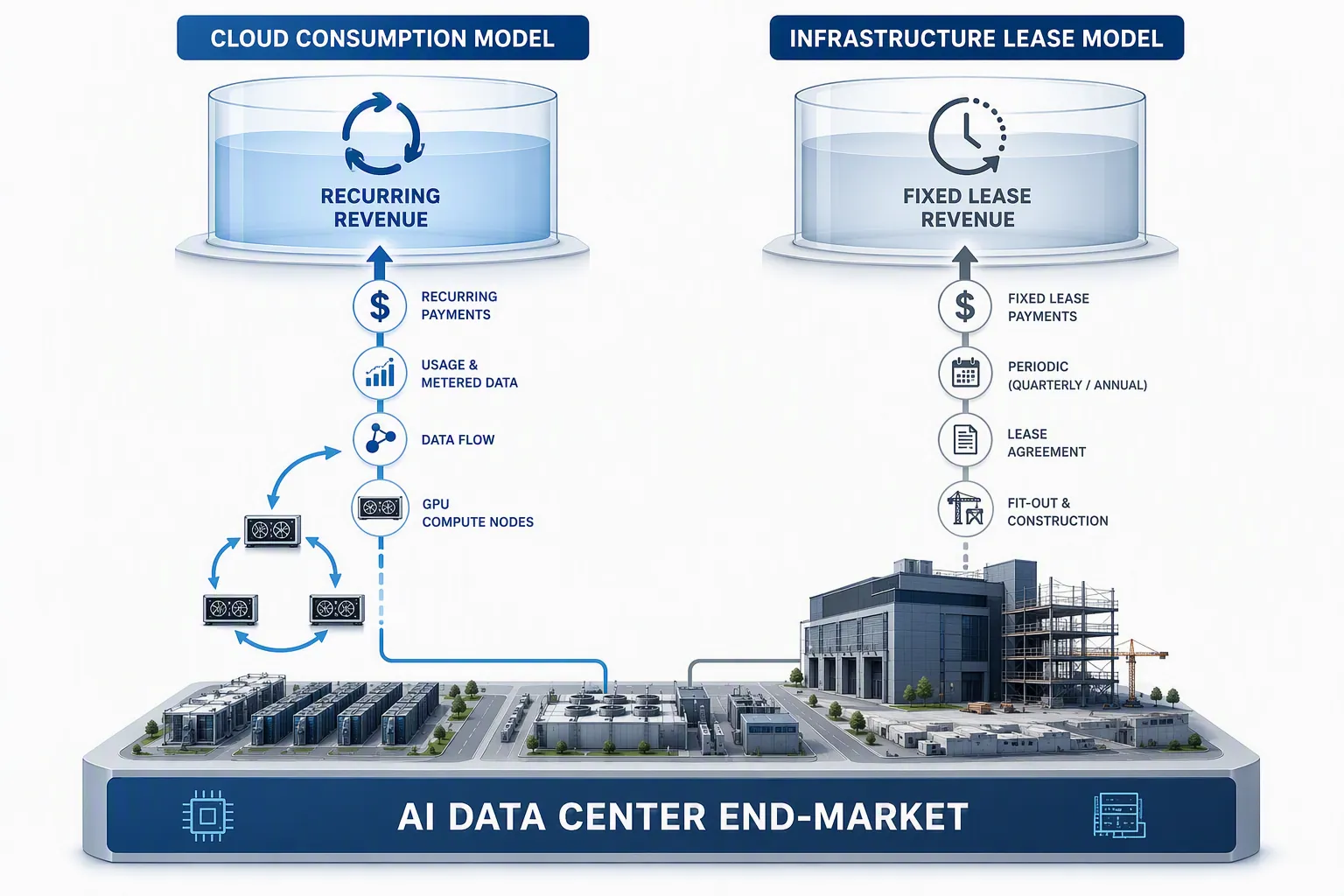
The tempting read is that CoreWeave is simply much farther ahead. The more useful read is narrower: CoreWeave and Applied Digital monetize different layers of the AI data center stack. CoreWeave sells GPU-compute cloud services. Applied Digital sells physical data center capacity through leases and, in a very visible recent quarter, tenant fit-out construction services. Those are not interchangeable revenue streams.
| Metric | CoreWeave | Applied Digital | Why the comparison needs care |
|---|---|---|---|
| Annual revenue | $5.13B in FY2025, up 168% YoY[1] | $611M in FY2026, up 167% YoY[2] | Similar growth rates, very different revenue bases and fiscal calendars. |
| Quarterly scale marker | $2.08B in Q1 2026 revenue[3] | $258.7M in Q4 FY2026 revenue[2] | CoreWeave’s single quarter exceeded Applied Digital’s full fiscal year, but the models are not the same. |
| Main monetization layer | Recurring GPU-compute cloud services | Data center leases plus tenant fit-out services | Cloud consumption can recognize revenue faster than long-term physical infrastructure leases. |
| Large forward commitment figure | $99.4B revenue backlog[1] | Roughly $36B in contracted lease revenue over 15-year initial terms[2] | Both are substantial, but backlog and long-duration lease schedules do not convert to annual revenue in the same way. |
| Profitability and capital intensity markers | $3.09B adjusted EBITDA, 60% adjusted EBITDA margin; $3.06B operating cash flow; $10.3B capex[1] | $107M adjusted EBITDA; $4.2B cash and $5B debt[2] | Revenue quality has to be read alongside margin definition, cash conversion, debt, and capex obligations. |

The revenue gap is real; the inference is the problem
A revenue line can be a reliability signal. It can show that customers are buying, that operations are scaling, and that the company has moved beyond proof-of-concept economics. CoreWeave’s figures do that. A business that can report $5.13 billion of annual revenue, a 60% adjusted EBITDA margin, $3.06 billion in operating cash flow, and a $99.4 billion backlog is not merely trading on AI enthusiasm; it is running a large compute platform with significant contracted demand behind it.[1]
But revenue is also an accounting output. It reflects what is being sold, when performance obligations are satisfied, how much of the customer relationship is recurring, and how the contract converts infrastructure into recognized revenue. For legal-tech buyers relying on AI research, drafting, due diligence, or document-review tools, that distinction matters more than the scoreboard effect. The question is not just which infrastructure company is larger. It is what kind of dependence sits underneath the software vendor’s promise.
CoreWeave’s Q1 2026 number makes the scale imbalance vivid: $2.08 billion in a single quarter, more than Applied Digital’s $611 million for its entire FY2026.[2][3] That fact is operationally meaningful. It is not, by itself, a clean verdict that CoreWeave “owns” AI data centers while Applied Digital is marginal. It shows that CoreWeave is recognizing revenue from a higher-velocity monetization layer.
CoreWeave turns infrastructure into recurring GPU-cloud revenue
CoreWeave’s business is closer to a specialized cloud platform than a data center landlord. The customer is not primarily paying for a building. The customer is paying for access to GPU compute capacity and related cloud services. That pushes the economic unit away from square footage and toward consumption, reserved capacity, utilization, service availability, and the ability to deliver compute when AI workloads need it.
That difference helps explain why the revenue base can become so large so quickly. A cloud-compute provider can layer customer commitments, usage, and service revenue on top of an infrastructure footprint. Once the platform is contracted and operational, revenue can recur through the compute relationship rather than waiting for a lease schedule to trickle through annual recognition. CoreWeave’s reported $99.4 billion backlog is therefore important, but not because it should be treated as the same thing as cash in hand. It is important because it signals the scale of future revenue obligations attached to its cloud-compute business model.[1]
The margin line also needs a procurement reading. CoreWeave reported $3.09 billion of adjusted EBITDA in FY2025, equal to a 60% adjusted EBITDA margin.[1] That suggests strong operating leverage in the reported cloud model. It does not eliminate infrastructure risk. The same release shows $10.3 billion of capex, which is the other side of selling scarce AI compute at scale.[1] A buyer should not read high adjusted EBITDA as a promise that the platform is financially effortless to run; it is evidence of substantial revenue generation inside a capital-intensive machine.
The customer concentration point also belongs in the reliability file. Sacra has put Microsoft at roughly 67% of CoreWeave’s FY2025 revenue.[4] A large customer can validate a platform, stabilize demand, and help finance expansion. It can also make a large revenue base less diversified than the headline number implies. For a legal-ops team assessing AI vendor dependencies, the issue is not whether Microsoft is a good customer. The issue is whether the infrastructure provider’s revenue durability depends heavily on one relationship, and what that could mean if priorities, pricing, or capacity allocation shift.
Applied Digital’s lower revenue does not mean it is selling less relevant infrastructure
Applied Digital’s model makes the opposite mistake easy. If CoreWeave’s revenue is treated as proof of dominance, Applied Digital’s lower revenue can be misread as weak end-market position. The better starting point is that Applied Digital is monetizing physical AI data center capacity through leases and associated build-out work. A long-term lease business can have large contracted value while recognizing revenue more slowly than a cloud provider selling compute services.
The size of Applied Digital’s contracted lease base is not trivial. The company reported roughly $36 billion in contracted lease revenue over 15-year initial terms.[2] That number deserves to be taken seriously. It indicates long-duration customer commitments around physical infrastructure. But it also explains why annual recognized revenue can look small next to CoreWeave’s cloud revenue. A 15-year lease stream is, by design, spread across time. It does not hit the income statement like fast-scaling cloud consumption.
Applied Digital’s Q4 shows why decomposition matters
Applied Digital’s Q4 FY2026 revenue is where a surface comparison does the most damage. The company reported $258.7 million of Q4 revenue, up 407% year over year.[2] On its face, that looks like explosive operating momentum. But the same quarter included $152.4 million from fit-out services.[2] Those services are tied to tenant build-out work, not a recurring lease stream of the same quality.
This does not make the revenue fake. Fit-out work is economically meaningful. A tenant needs the facility prepared, and the provider may be paid for construction-related services that are necessary to bring capacity online. But it is not the same as recurring cloud usage, and it is not the same as a stabilized lease payment schedule. A quarter with a large non-recurring fit-out contribution can inflate the apparent growth rate while saying less about the steady-state revenue run-rate.
There is also a reporting wrinkle. Applied Digital reported $258.7 million of GAAP revenue for Q4 FY2026, while adjusted revenue was $240.4 million after excluding revenue related to the ChronoScale cloud business spinoff.[2] That gap is not the whole story, but it reinforces the same point: the Q4 number needs to be unpacked before being used as a clean proxy for recurring AI data center lease economics.
For a buyer, the practical question is what survives after the fit-out surge and reporting adjustment are separated. The long-duration leases may matter more than the quarter’s growth rate. The cash and debt position may matter more than the headline comparison to CoreWeave. Applied Digital reported $4.2 billion of cash and $5 billion of debt, which should keep attention on execution, financing, and build-out obligations as much as on demand.[2]
What revenue scale can and cannot tell a legal-tech buyer
Legal teams rarely contract directly with CoreWeave or Applied Digital. They usually buy software from legal-AI vendors, and those vendors make their own infrastructure choices. Still, the infrastructure layer matters when a tool becomes embedded in research workflows, contract review, litigation support, or knowledge management. If the compute or data center provider underneath a legal-AI product is financially stretched, capacity-constrained, or exposed to abrupt contract changes, the user may experience the problem as latency, degraded features, price increases, or vendor instability.
That is why revenue scale belongs in procurement diligence, but only as one input. The same framework applies when evaluating hyperscaler infrastructure stress, as discussed in What Alphabet’s Negative Free Cash Flow Means for Legal AI. Infrastructure financial health is not an investor-only concern. It can become a service-continuity concern when legal work depends on AI systems that consume scarce compute.
The diligence questions should be more specific than “which provider has more revenue?” A procurement team looking through a legal-AI vendor’s infrastructure stack should ask:
- Is the underlying infrastructure revenue recurring cloud consumption, long-term lease revenue, construction-related services, or some mixture of all three?
- How much of the provider’s reported growth came from repeatable services rather than one-time fit-out or migration activity?
- Does backlog represent cloud-service commitments, fixed lease payments, or another contract structure with a different recognition schedule?
- How concentrated is the provider’s customer base, and could one large customer influence capacity allocation or financial stability?
- What capital commitments, debt obligations, and construction timelines sit behind the revenue promise?
- If the legal-AI vendor depends on this infrastructure indirectly, what contractual remedies exist for outages, latency, or capacity shortages?
CoreWeave scores strongly on visible revenue scale, operating velocity, backlog, and adjusted EBITDA. Those are meaningful reliability signals, especially compared with infrastructure businesses that have demand narratives but little recognized revenue. The caution is that its scale comes with capex intensity and customer concentration that should not disappear behind the $5.13 billion number.[1][4]
Applied Digital requires a different reading. Its $611 million annual revenue line is much smaller, and the Q4 composition makes recurring run-rate analysis harder. But the roughly $36 billion contracted lease figure points to a serious physical-infrastructure role, not a side note in the AI data center market.[2] The issue is that lease value converts into recognized revenue on a different timetable than GPU-cloud consumption.
The cleaner comparison
The cleanest version of the CoreWeave vs Applied Digital revenue comparison is not that one company is an AI data center winner and the other is not. It is that CoreWeave sits closer to the monetized compute layer, while Applied Digital sits closer to the physical capacity and lease layer. That location in the stack affects revenue recognition, margin presentation, backlog interpretation, and procurement relevance.
CoreWeave’s 8x-plus revenue advantage is real and operationally important. It shows that the company has converted AI compute demand into a large recurring cloud business. It does not, by itself, prove superior AI data center dominance. Buyers should read the gap alongside contract structure, recurrence, customer concentration, backlog quality, capex burden, debt, and the specific role each provider plays underneath the legal-AI tools their organizations now depend on.
References
- CoreWeave Reports Fourth Quarter and Full Year 2025 Financial Results — CoreWeave Investor Relations
- Applied Digital Announces Fiscal Fourth Quarter and Full-Year 2026 Results — Applied Digital Investor Relations
- CoreWeave Reports First Quarter 2026 Financial Results — CoreWeave Investor Relations
- CoreWeave analysis — Sacra
Chronological incident history
No sanction cases have named this tool in the tracked record set to date. This does not imply the tool is safe — see Risk Digest for ongoing monitoring.
← Compare peer toolsReport a correction or tip
Spotted an outdated figure, a misstated fact, or a ruling this tool profile should reflect? Public comments are disabled for this content given the professional cost of a misreported case outcome, penalty amount, or rule text — use the structured correction channel instead.
Report a correction or tip for this record →