
How the Eric Adjepong Case Tests Protective Order Procedure
This procedural case study of the two Eric Adjepong protective order cycles examines how improper service, voluntary dismissal, and the preponderance-of-evidence standard interact in Maryland's domestic violence system, offering actionable insights for family law practitioners.
- Hallucination rate
- Not measured / undisclosed
The useful legal question in the Eric Adjepong matter is not whether a celebrity divorce produced another set of ugly allegations. It is what happened to those allegations as they moved, or failed to move, through Maryland protective order procedure. The first cycle, reported from the January-February 2025 court record, began with a temporary order and ended before a final merits ruling; the later Howard County cycle, filed May 1, 2026, reached a full hearing and produced a final protective order after an abuse finding on July 10, 2026.[1][2]
That distinction does most of the work. A temporary ex parte order can change conduct immediately, but it is not the same procedural event as a final protective order entered after both sides have had the opportunity to be heard. In the Adjepong matter, the fork between those two tracks matters more than the public label attached to either filing.

Two Protective Order Cycles, Two Different Legal Postures
Maryland procedure separates temporary relief from final relief for a reason. A temporary protective order may be issued on a compressed record, including ex parte circumstances, to address immediate safety concerns. A final protective order requires a hearing and proof sufficient to support judicial findings before longer-lasting restrictions are imposed.[3]
The January-February 2025 cycle did not cross that second threshold. Reporting on the court record describes a temporary order that was later voluntarily dismissed before a final protective order hearing produced a merits determination.[1] That does not mean the allegations were adjudicated false. It means the court did not reach the procedural point at which it would decide whether the evidence satisfied the final-order standard.
The 2026 cycle is different in kind. The later petition, reported as filed in Howard County on May 1, 2026, went to a hearing before Judge Maurice C. Frazier. The resulting final order barred Adjepong from unsupervised contact with his daughter and required parenting classes and reunification therapy after the court found physical abuse more likely than not.[2]
| Procedural point | January-February 2025 cycle | May-July 2026 cycle |
|---|---|---|
| Initial posture | Temporary ex parte protective order | Petition filed after a nurse reported concerns to DC Child and Family Services |
| Merits hearing | No final merits determination reported before voluntary dismissal | Full hearing before a Howard County judge |
| Result | Temporary order dismissed; allegations unresolved in that cycle | Final protective order entered after civil abuse finding |
| Safe legal inference | The dismissal corrected or ended the temporary posture, not the factual dispute | The court found abuse proved for civil protective order purposes |
That table is intentionally procedural. It does not sort the parties into heroes and villains. It identifies when the legal system had enough of a record to act finally, and when it did not.
A Temporary Order Is Not a Final Finding
Temporary protective orders are often misunderstood outside the courthouse because they can look final to everyone who has to obey them. They can restrict contact, shape custody logistics, and create immediate enforcement risk. But procedurally, they are built for speed, not final adjudication.
Maryland's final protective order process is where the court hears evidence and decides whether the statutory requirements for longer relief have been met.[3] The legal consequence of never reaching that stage is limited but important: the first Adjepong cycle left no reported final civil finding resolving the allegations. It should not be cited as a vindication of Adjepong, and it should not be cited as a final judicial finding against him.
This is the point entertainment coverage tends to flatten. A dismissal can be meaningful for the parties, especially if it releases restrictions or reflects negotiated terms. It is not, by itself, a transcript of truth. For a lawyer or paralegal reading the docket, the question is not merely whether the case closed. It is whether the court ever held the hearing that would convert allegation into final civil finding.
The Service Problem Shows Due Process Working and Enforcement Failing
The March 2025 service issue is the kind of event that looks technical until someone is arrested, or nearly arrested, on paperwork that did not reach the right place. Reporting on the court record states that an arrest warrant tied to an alleged protective order violation was rescinded because the summons contained an incorrect address.[1]
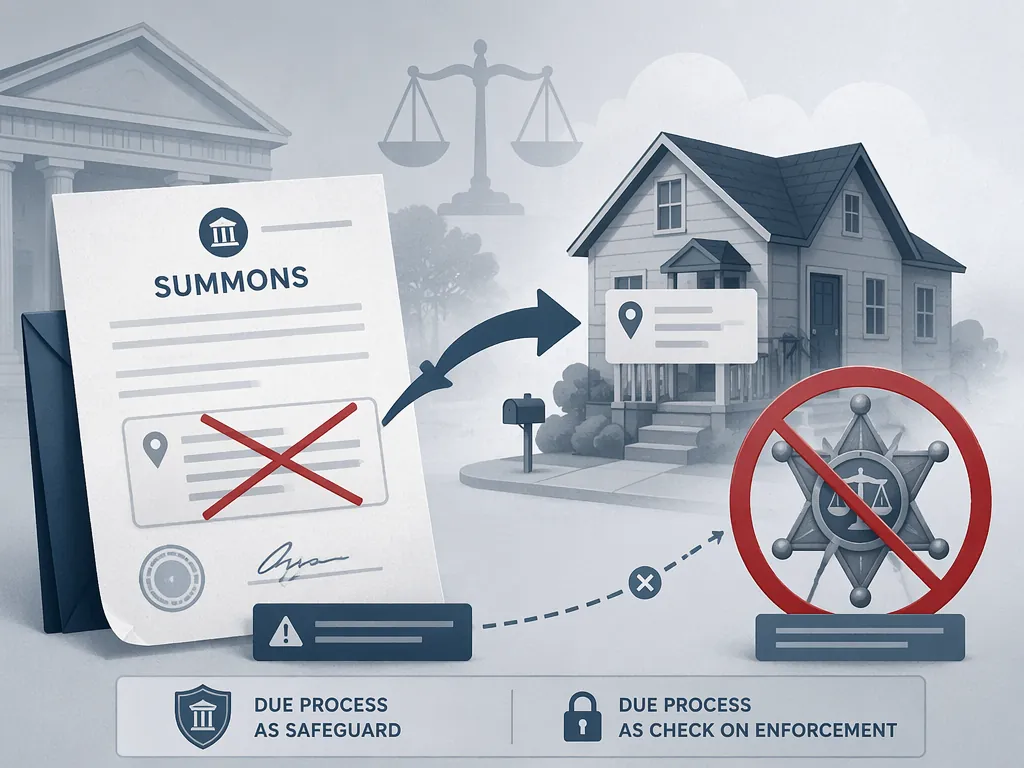
That is not a merits ruling. It says nothing reliable about whether the underlying conduct occurred. It says the enforcement machinery could not fairly proceed on that defective notice. Maryland service rules exist because a court order cannot carry ordinary enforcement consequences against a person who has not been properly brought within the process.[4]
The uncomfortable part is that both things can be true at once. Correcting a bad address protects the respondent's due process rights. It can also interrupt protection for the petitioner if the order's force depends on proof of notice and the paperwork cannot support it. In domestic cases, that is not a clerical footnote. It is the hinge between an order that can be enforced and an order that may exist on paper while failing at the point of service.
For practice purposes, the service lesson is blunt: confirm address data before relying on enforcement, and treat a returned or defective summons as a live risk rather than a back-office cleanup item. A protective order packet can be substantively urgent and procedurally unusable at the same time.
The Mandated-Reporter Trigger Changed the Second Cycle's Starting Point
The second petition did not begin in exactly the same posture as a repeated filing by one former spouse against another. Reporting states that the May 1, 2026 petition followed a nurse's report of concerns to DC Child and Family Services.[2][5]
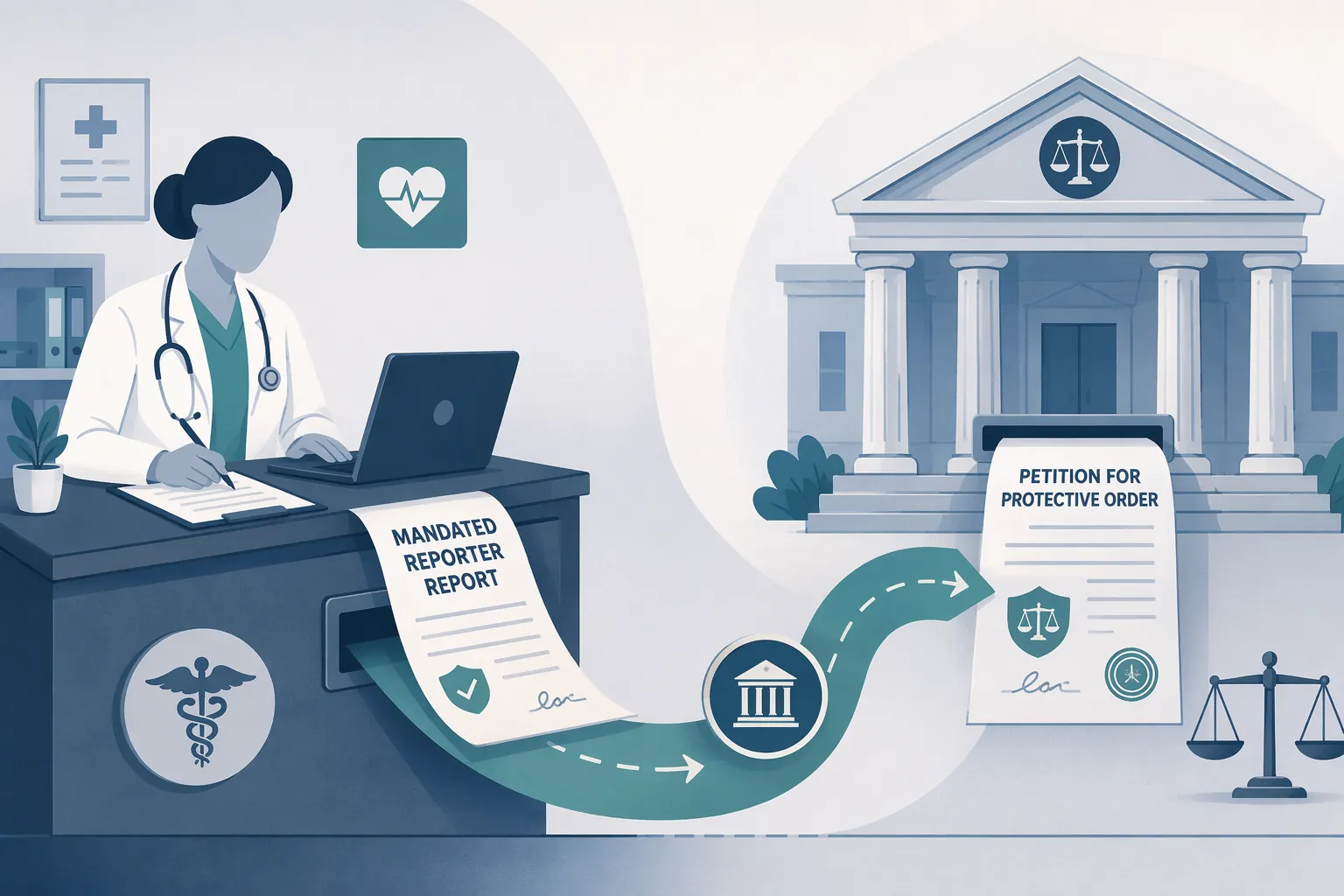
That fact does not prove the allegations. It does, however, change the evidentiary posture worth noticing. A mandated-reporter referral is an institutional action, not merely an allegation traded in a custody fight. The court still had to hear evidence. The respondent still had the right to contest it. But the origin of the second cycle helps explain why a court might be looking at a record different from the one that existed in early 2025.
This is where loose public commentary becomes especially risky. If the first cycle is treated as a failed accusation and the second as a duplicate accusation, the mandated-reporter step disappears. If the mandated report is treated as proof, the hearing disappears. Neither shortcut is good enough for legal work.
What the July 2026 Finding Did, and Did Not, Establish
At the July 2026 hearing, the reported final order rested on a civil finding that abuse was proved by a preponderance of the evidence.[2] Maryland domestic violence protective order analysis is commonly tied to Katsenelenbogen v. Katsenelenbogen, which describes the final protective order standard as proof that abuse was more likely than not.[6]
That standard is lower than proof beyond a reasonable doubt. It is enough for civil protective relief; it is not the same thing as a criminal conviction. No criminal charges have been reported in connection with the protective order cycles discussed here.[2][5]
The remedies reflect the civil nature of the proceeding. The reported order bars unsupervised contact, requires parenting classes, and mandates reunification therapy.[2] Those are parenting and safety restrictions. They are consequential. They are not criminal punishment.
Adjepong, through counsel, has disputed the allegations while stating that he strictly complies with the order. His attorney also framed the matter within a long-running divorce and custody proceeding.[5] That position matters for fairness, especially because the public record available through reporting is incomplete. It does not erase the final order, and it does not convert the civil finding into something broader than what the court reportedly found.
The Practitioner Takeaway Is Procedural, Not Cynical
The Adjepong record is useful because it resists the two easiest stories. It does not support the claim that a dismissed temporary order proves abuse of process. It also does not support treating the first temporary order as if it were a final adjudication. The first cycle stopped short of a merits ruling; the second reached one.
For family law teams, the most important checkpoints are practical:
- Separate temporary orders from final protective orders before describing what the court has found.
- Audit service details early, especially addresses, because enforcement may fail on notice even when safety concerns are serious.
- Identify whether a petition originated with a party, a professional report, or another institutional trigger.
- Use the correct burden of proof when explaining a final order to clients, reporters, or related counsel.
- Avoid importing criminal-law conclusions into a civil protective order record unless a criminal case actually exists.
None of those checkpoints answers the human question that sits behind the file. Procedure does not tell the whole truth about a family. It tells the court when it may act, when it must wait, and when an order can be enforced against a person whose liberty and parenting rights are at stake.
The two cycles show why the route matters. Allegations can remain unresolved after dismissal. Enforcement can collapse when service is defective. A later petition, especially one following a mandated-reporter referral, can proceed to a hearing and become a final civil order if the evidence satisfies the preponderance standard. That is not a technical afterthought in protective order practice. It is the legal process itself.
References
- Food Network star Eric Adjepong's nasty divorce erupts - protective orders, 'cruel conduct' claims and an arrest warrant — The Sun.
- Judge bars chef Eric Adjepong from being alone with daughter after abuse finding — The Washington Post, July 22, 2026.
- Preparing for the Final Protective Order Hearing — Maryland People's Law Library.
- Maryland Rule 3-121. Process--Service--In personam — Maryland Rules.
- Top Chef Eric Adjepong Allegedly Abused Daughter, Ordered to Stay Away From Her — TMZ / AOL.
- How Maryland Courts Evaluate Domestic Violence And Protective Orders — Schlaich & Thompson.
Chronological incident history
No sanction cases have named this tool in the tracked record set to date. This does not imply the tool is safe — see Risk Digest for ongoing monitoring.
← Compare peer toolsReport a correction or tip
Spotted an outdated figure, a misstated fact, or a ruling this tool profile should reflect? Public comments are disabled for this content given the professional cost of a misreported case outcome, penalty amount, or rule text — use the structured correction channel instead.
Report a correction or tip for this record →