
FBI digital forensics in the Nolan Wells death investigation
How phone, Snapchat, and geolocation data interact with federal evidence law to resolve timeline contradictions in the Nolan Wells case — and what legal frameworks govern each stream.
- Hallucination rate
- Not measured / undisclosed
Updated as of July 23, 2026: the Nolan Wells investigation is still developing. As of the July 22 independent autopsy update, cause and manner of death remain undetermined, and there have been no charges, no judicial findings, and no resolved evidentiary ruling on the digital records now drawing public attention.[1] That posture matters. When the medical record does not yet explain the death, the phone, app records, location logs, boat data, and witness accounts begin carrying more weight than they should be asked to carry casually.
The public contradiction is easy to state and harder to prove: Wells was last associated with Horn Island, while reported location data has raised questions about whether his phone was on land at a relevant point in the timeline. WLOX’s published chronology remains the cleanest public spine for the early sequence of disappearance, search, recovery, and official statements.[2] But a chronology built from witnesses and a chronology built from devices are not the same thing. One records people’s recollections. The other records events generated by hardware, software, servers, settings, and sometimes someone other than the person whose name is on the account.
The FBI’s role is therefore not just a dramatic escalation. Horn Island’s federal-land status within the Gulf Islands National Seashore supplies the jurisdictional basis, while Jackson County officials have described the case as a priority and reported FBI assistance with digital evidence and witness interviews.[3] For anyone who has had to make phone data usable in a courtroom, the useful question is narrower than whether “the FBI has the phone.” It is whether each evidence stream can be obtained lawfully, preserved reproducibly, authenticated under the rules of evidence, and explained without collapsing different data sources into one vague bucket called digital proof.
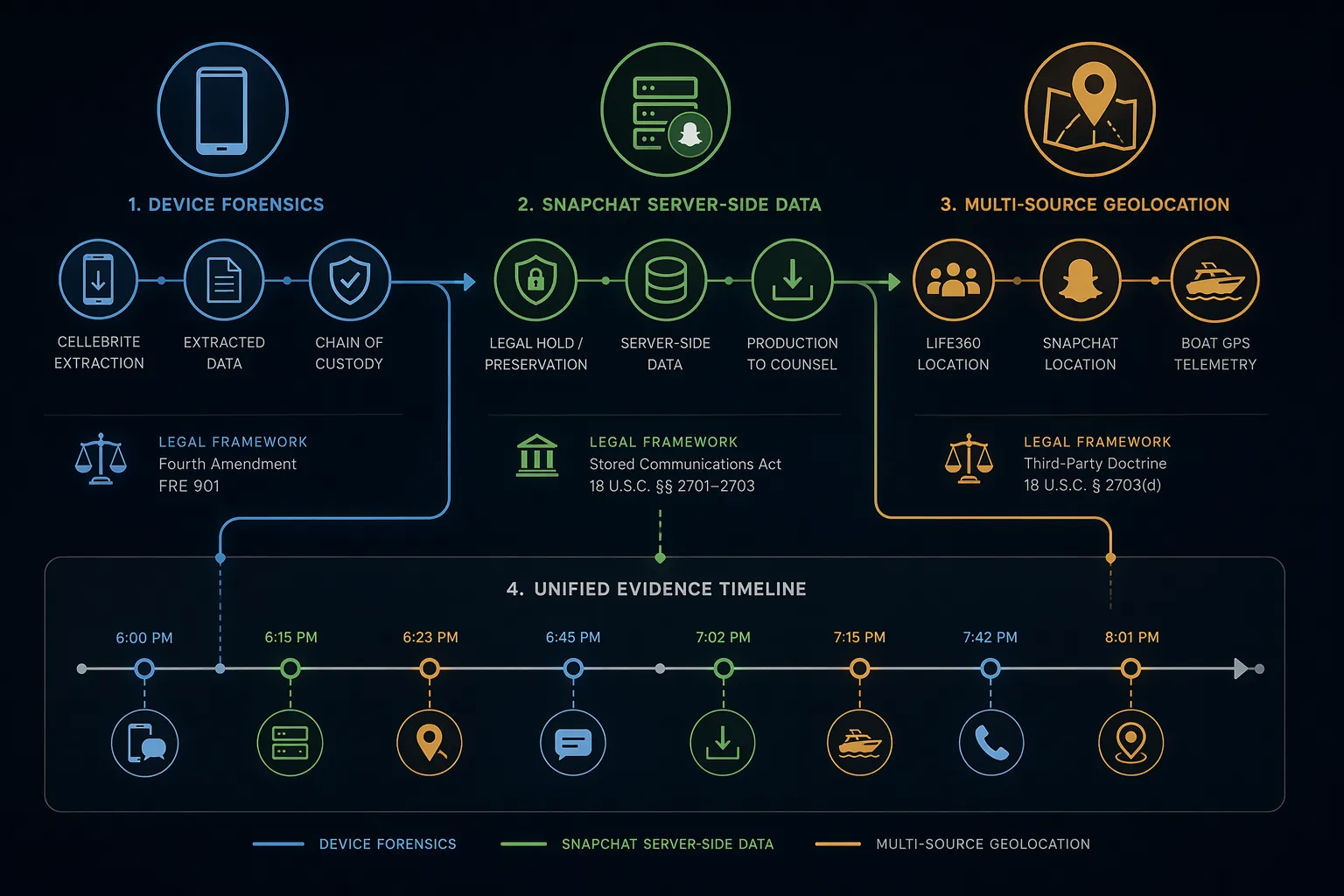
The Three Streams Need Separate Treatment
The useful working map has three lanes: device-level phone forensics, Snapchat server-side records, and multi-source geolocation comparison. They may eventually point toward the same timeline. They may also expose why the public timeline has appeared inconsistent. But legally and technically, they do not enter the case through the same door.
| Evidence stream | What it can test | Main legal or evidentiary pressure point |
|---|---|---|
| Phone device forensics | Local photos, videos, messages, app artifacts, location cache, deletion traces, device time settings | Consent or warrant basis, chain of custody, forensic imaging, hashing, Rule 901 authentication |
| Snapchat server-side records | Account data, preserved records, certain logs, possible location-related records depending on what exists and what legal process reaches it | Stored Communications Act process, preservation, distinction between content and non-content records |
| Geolocation comparison | Whether Life360, Snapchat, boat GPS, audio timing, and witnesses can be reconciled | Source reliability, timestamp alignment, device possession, explainability to a grand jury or trial factfinder |
That separation is not academic housekeeping. If the phone shows one thing, Snapchat another, and a location-sharing app a third, the next question is not which one is “lying.” It is what each system measured, when it measured it, whether the device was with Wells, and whether the record was collected in a way that can survive scrutiny later.
The Phone Is the Most Concrete Evidence Fight So Far
The reported agreement for both the family’s experts and law enforcement to examine Wells’ phone is one of the most procedurally meaningful developments in the public record. NewsNation reported that Ben Crump’s team and Jackson County reached an arrangement for joint forensic examination, and trial attorney Donte Mills described a practical distinction that matters in this setting: “Phone data is going to be consistent” across examinations in a way physical evidence may not be.[4]
That does not mean a phone extraction is self-authenticating. It means the object can be imaged, hashed, logged, and re-examined in a way that gives later reviewers something to compare. A proper device workflow should identify who had the phone before law enforcement, who transferred it, when it was powered on or off, whether it was isolated from networks, what extraction method was used, whether a forensic image was created, and whether hash values were calculated so later analysts can show the examined data did not change.
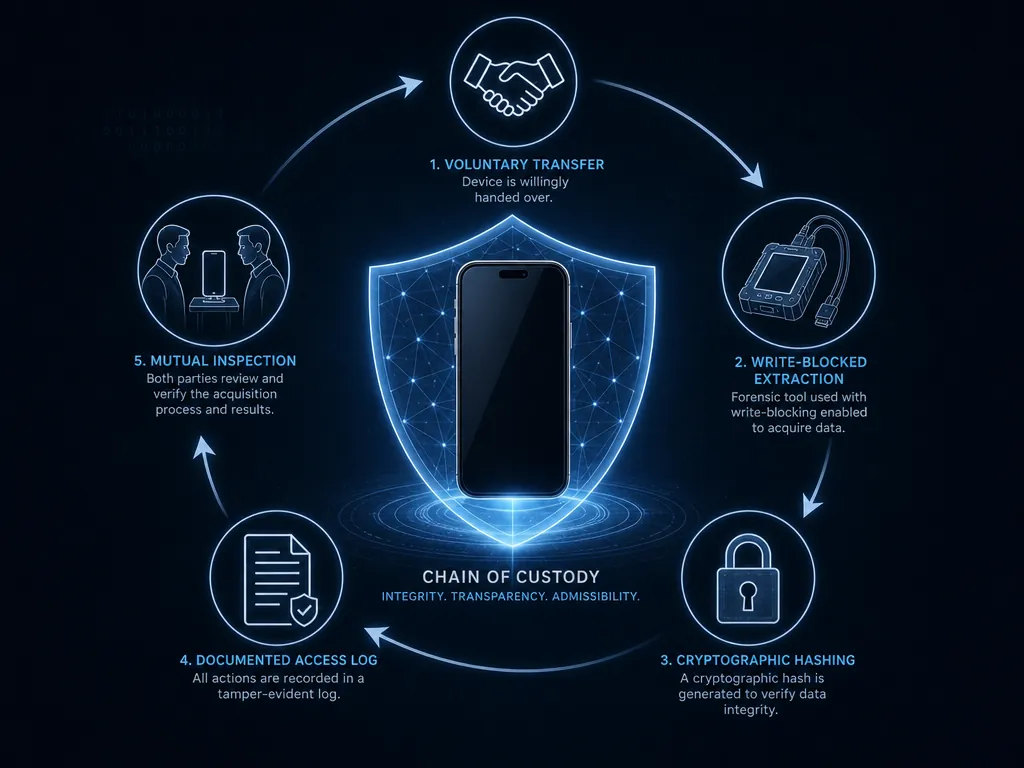
The Fourth Amendment analysis is also more delicate than a slogan about phone warrants. Riley v. California held that police generally need a warrant to search a cell phone seized incident to arrest, recognizing the immense privacy interests contained in modern devices.[5] The Wells phone, as publicly described, was not seized from Wells in an arrest search. It was reportedly handed from friends to his mother before becoming part of the investigative process. That changes the warrant calculus, but it does not erase the need to document the legal basis for any government search and the consent or process relied upon at each stage.
From an evidence-law perspective, the future fight would likely sound in authentication as much as search law. Federal Rule of Evidence 901 asks whether there is evidence sufficient to support a finding that the item is what the proponent claims it is. In a digital-phone context, that usually means the proponent has to connect the device to the person, the extraction to the device, the artifacts to the relevant apps or system functions, and the timestamps to a defensible time standard.
The FBI Law Enforcement Bulletin’s digital evidence guidance emphasizes the practical fragility of electronic material: digital evidence is easily altered, damaged, or destroyed, so collection and handling methods must protect integrity from the beginning.[6] That is exactly why the phone’s pre-law-enforcement handling matters. Friends and family touching a device before a forensic image is made does not automatically make the evidence unusable. It does mean the later witness or examiner has to be able to say what is known, what is unknown, and why any gap does or does not affect the specific artifact being offered.
What a Phone Extraction Could Actually Clarify
A device extraction may show local media, app databases, cached location points, message fragments, deletion indicators, paired devices, network connections, account identifiers, and system logs. In this case, the public question about missing July 4 photos or videos is important only if the examiner can distinguish between material never created, material created and deleted, material stored only in an app cloud, material lost through app behavior, and material inaccessible through the extraction method used.
That distinction is the kind of thing that gets blurred in public commentary. “Nothing was on the phone” can mean no visible file in the camera roll, no locally retained Snapchat media, no recoverable deleted artifact, or no artifact found under the tool settings used in that extraction. Those are not equivalent findings. A careful report would say which storage locations were examined, what tool and version were used, whether a full file system extraction was possible, and whether encrypted or app-protected containers limited the result.
Snapchat Records Are a Different Legal Problem
Snapchat is not just “on the phone.” Some Snapchat evidence may exist locally on the device. Other records, if they still exist, would have to come from Snap’s servers through legal process. Snap’s law enforcement guide states that the company responds to valid legal process and explains that unopened and opened Snaps are subject to deletion practices, including the company’s position that it generally cannot retrieve ephemeral Snaps after all recipients have viewed them or after they expire under its systems.[7]
That is where the Stored Communications Act does real work. A preservation request under 18 U.S.C. § 2703(f) can require a provider to preserve existing records while law enforcement obtains the appropriate subpoena, court order, or warrant. But preservation is not resurrection. It can freeze what is there; it cannot guarantee that content already deleted under the provider’s retention design will reappear.
The distinction between subscriber information, transactional records, and content also matters. Subscriber or account-identifying records generally raise a different legal-process question than message content. Location-related logs may fall into their own disputed and fact-sensitive lane depending on what is requested, how it is stored, and what privacy doctrine applies. For readers who work with provider records in other settings, the same statutory architecture appears in workplace and platform disputes as well; the Stored Communications Act issues discussed in Lex Machina Review’s analysis of the JPMorgan email spying allegations are part of the same broader family of access rules.
Retired FBI agent Kieran Ramsey told NewsNation that law enforcement can obtain “several layers” of data from Snapchat accounts, including geolocation-related information.[8] That is a useful statement of capability, not a finding that any particular Wells account data has been recovered or that it resolves the timeline. The legal question is whether the right process reached the right category of record before the relevant data aged out or was deleted. The evidentiary question is whether the resulting production can be tied to the right account, device, user, timestamp, and location methodology.
Why “Possible to Request” Is Not “Confirmed Recovered”
In a developing case, this is the gap that needs the most discipline. A provider may be legally able to produce certain records. Investigators may have sent preservation demands. A forensic expert may know the categories of data that sometimes exist. None of those facts proves that the data existed for Wells, that it was preserved in time, that the production has been received, or that the records say what commentators hope they say.
If Snapchat records become important in a later grand jury or evidentiary hearing, the production history will matter: date of preservation request, date and type of legal process, account identifiers used, provider response language, time zone convention, field definitions, and any declaration or custodian certification supplied by Snap. A screenshot of an app screen and a provider-certified server record are not interchangeable, even when both appear to describe the same account activity.
The Location Dispute Is a Comparison Problem, Not a Single-Map Problem
The reported tension between Life360 placing the phone on land and accounts placing Wells on Horn Island is the center of the evidentiary puzzle. It is tempting to treat that as a binary: either the app is wrong or the witnesses are. A courtroom-grade reconstruction has more possibilities to eliminate before reaching that conclusion.
- The phone may not have been with Wells at every relevant moment.
- A location app may report the last known point rather than a live point if service, battery, permissions, or background-refresh behavior changed.
- Different systems may use different timestamp conventions, including local time, UTC, server receipt time, device time, or event-generation time.
- A map pin may simplify an uncertainty radius that is crucial to the actual inference.
- A witness may accurately describe a person’s location while a device record accurately describes the phone’s location.
Snapchat location data, if preserved and produced, would not automatically defeat Life360 or confirm it. Boat GPS records from the Mississippi Department of Marine Resources, the audio recording associated with the sinking-boat call, witness interviews, phone connection logs, and any device-side app artifacts would need to be placed on the same time axis. Only then can an examiner ask whether the records overlap, diverge, or describe different objects.
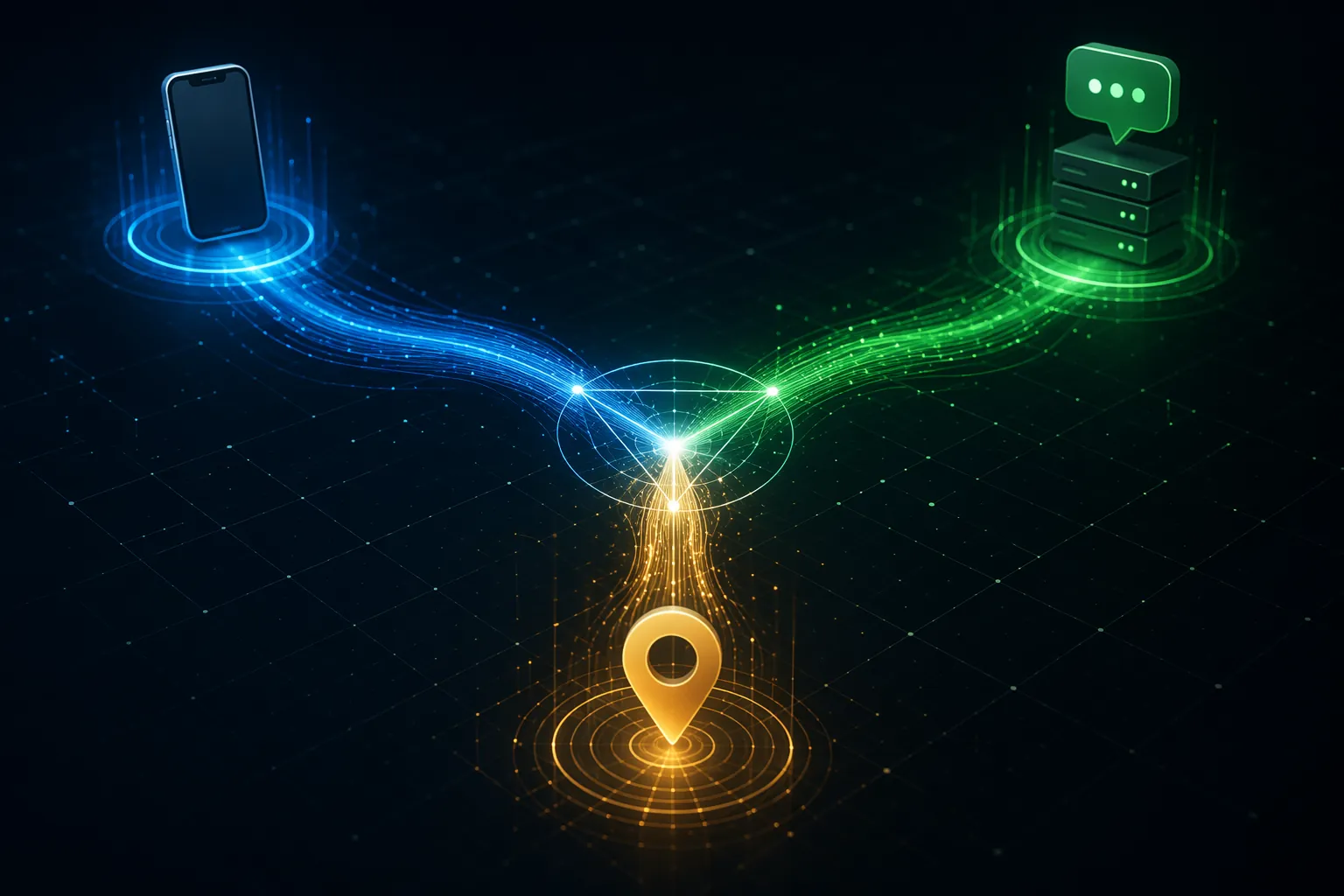
This is also where the reported claim that forensic analysis could retrieve a large share of geolocation history should be handled carefully. The research record supports treating such statements as attributed expert expectations or commentary, not as a confirmed recovery result in this case. A percentage without the underlying export, date range, device state, app settings, and provider response is not yet evidence a court can do much with.
What a Usable Timeline Would Need
A usable digital timeline would not simply stack app screenshots in chronological order. It would identify the source for each event, the original timestamp field, the converted timestamp, the confidence level or accuracy radius if available, the person or device associated with the event, and the legal path by which the record was obtained. It would also mark unknowns plainly rather than smoothing them into a cleaner story.
| Timeline entry should show | Why it matters |
|---|---|
| Original source system | Life360, Snapchat, phone OS, boat GPS, and audio records do not measure events the same way |
| Timestamp convention | A timeline can shift if server time, device time, UTC, and local time are mixed |
| Device possession assumption | The location of a phone is not always the location of its owner |
| Collection method | A provider production, forensic extraction, screenshot, and witness statement carry different authentication burdens |
| Known limitation | Gaps, uncertainty radii, missing content, or delayed syncing may explain apparent conflicts |
This kind of charting may look clerical, but it is where many digital-evidence disputes are won or lost. A paralegal or analyst who preserves the original fields and labels the assumptions gives a later expert room to testify carefully. A timeline that turns every data point into a confident sentence creates impeachment material.
The Autopsy Result Raises the Stakes Without Solving the Digital Case
The independent autopsy finding of undetermined cause and manner does not make the digital evidence more accurate. It makes the digital evidence more consequential. NBC News reported that Dr. Michael Baden and Dr. Allecia Wilson Mitchell found the cause and manner of death undetermined after the independent examination, with limitations tied to the condition and prior handling of remains.[1] That leaves investigators and the family with fewer physical answers than the public pressure around the case demands.
There is a useful but limited analogy between autopsy limitations and phone-forensic limitations. In both settings, later reviewers are constrained by what was preserved, what was altered before they arrived, and what can still be independently checked. The analogy should not be pushed too far. Human remains and device data raise different scientific and legal questions. But both require the same humility in public claims: an inconclusive result is not the same as an exonerating result, and a missing artifact is not the same as proof that the event never happened.
The racial dynamics and national attention around Wells’ death have intensified the demand for transparency. In evidence terms, that pressure translates into a concrete need: procedures that let both the family and the state inspect the same digital object, compare methods, and challenge conclusions without relying on trust alone. That is a better transparency mechanism than dueling press conferences about what an app supposedly proves.
Where a Grand Jury or Court Would Press the Evidence
If the investigation reaches a grand jury or later motion practice, the digital evidence will likely be tested in layers. First comes acquisition: who had authority to consent to a phone examination, what warrants or orders were obtained, and what provider process was used. Then comes integrity: whether the evidence was imaged, hashed, logged, and stored in a way that protects against alteration. Then comes authentication: whether a witness, examiner, or custodian can connect each record to the thing it is claimed to be.
Finally comes explanation. A judge or grand jury does not need a lecture on every database table inside a phone. It needs a defensible account of what the artifact is, how it was created, what it does and does not measure, and how it fits with the rest of the record. That is especially true for location evidence, where visual precision can exceed technical certainty.
The cleanest legal presentation would keep three questions apart: what the data shows, how the data was obtained, and whether the data can be authenticated and explained. Mixing those questions is how weak evidence sounds stronger than it is, and how strong evidence becomes vulnerable to avoidable attack.
The Mutual Inspection Agreement Is the Development to Watch
The Nolan Wells FBI investigation may eventually turn on a Snapchat production, a device artifact, a location comparison, a witness account, a medical finding, or some combination that is not public yet. It is too early to predict charges or outcomes, and the available record does not support treating any single app as the case’s answer.
What is already visible is the value of letting opposing or independent experts inspect the same device under a documented process. Mutual inspection does not guarantee truth. It does not eliminate disputes over consent, retention, interpretation, or authentication. But it can make those disputes more inspectable. It gives later reviewers a better chance to ask the right question: not which side’s black box should be trusted, but whether the same data, handled under a reproducible method, supports the timeline being offered.
References
- Nolan Wells' independent autopsy results in 'undetermined' cause and manner of death, NBC News.
- TIMELINE: Here's what we know about the disappearance and death of 18-year-old Nolan Wells, WLOX, July 7, 2026.
- FBI examining digital evidence in Nolan Wells investigation, Sun Herald.
- Nolan Wells' phone to be examined by family, law enforcement after July 4 death, NewsNation, July 2026.
- Riley v. California, 573 U.S. 373 (2014), Supreme Court of the United States, 2014.
- Digital Evidence, FBI Law Enforcement Bulletin.
- Snapchat Law Enforcement Guide, Snap Inc.
- Nolan Wells case: Could Snapchat and phone evidence be used to solve his death?, NewsNation.
Chronological incident history
No sanction cases have named this tool in the tracked record set to date. This does not imply the tool is safe — see Risk Digest for ongoing monitoring.
← Compare peer toolsReport a correction or tip
Spotted an outdated figure, a misstated fact, or a ruling this tool profile should reflect? Public comments are disabled for this content given the professional cost of a misreported case outcome, penalty amount, or rule text — use the structured correction channel instead.
Report a correction or tip for this record →