
What the FDA Peptide List Loosening Actually Means for Liability
Despite the FDA's removal of 12 peptides from Category 2 and recent PCAC votes favoring several popular compounds, enforcement actions against compounders have not slowed. This article examines the warning letter surge, supply chain import alerts, and state board actions to assess the real liability risk during this transitional period.
- Tool
- FDA
- Benchmark source
- Sheppard Mullin; PeptideJournal
- Hallucination rate
- Not measured / undisclosed
- Test methodology
- Analysis of warning letters and PCAC votes
- Test date
- Jul 24, 2026
A client says the FDA peptide compounding list is loosening restrictions. The useful answer is: yes, something changed; no, that is not the same as permission to compound, advertise, import, or dispense the peptides as if the enforcement problem has cleared.
The legal hinge is narrower than the market chatter. FDA removed 12 bulk drug substances from Category 2 after a formal notice published April 15-16, 2026, with the removal effective April 23, 2026.[1] Category 2 removal means FDA no longer treats those substances, for that interim purpose, as bulk substances presenting significant safety risks that make them unsuitable for compounding while the agency evaluates them. It does not place the substances in Category 1. It does not make every 503A or 503B use lawful. It does not sanitize website claims, cure deficient sterility controls, register a foreign API source, or bind a state pharmacy board.
The July advisory committee votes add one more transitional signal, not a final safe harbor. On Day 1 of the July 23-24, 2026 PCAC meeting, the committee voted 8-6-1 in favor of adding BPC-157, KPV, and TB-500 to the 503A Bulks List, and 7-5-2 in favor of MOTS-c.[2][3][4] FDA scientists’ briefing documents, however, recommended against all seven peptides then under review, and Day 2 votes on Emideltide/DSIP, Semax, and Epitalon had not occurred as of July 24, 2026.[1]

The Process Moved; Enforcement Did Not Stand Down
For liability purposes, the question is not whether the list changed. It did. The question is whether the agencies and boards that create exposure behaved as though the risk profile had relaxed. The available record points the other way.
One marker is the broader warning-letter environment. Sheppard Mullin reported that FDA’s Jill Furman stated at the 2025 Enforcement Conference that CDER warning letters rose 50% in FY2025 over FY2024. The same discussion described the September 2025 GLP-1 compounding crackdown as exceeding 100 warning and untitled letters, calling it the largest single enforcement action in compounding history.[5] That was not a peptide-list vote, but it matters because it shows the enforcement apparatus being used aggressively against compounders and telehealth-linked distribution models before the 2026 peptide reconsideration became the headline.
The peptide-specific secondary counts also deserve attention, with a caveat. PeptideJournal reported 30 FDA warning letters in March 2026, the month the Category 2 removal was announced, and 25 in June 2026, two months after the effective date.[6] Those totals should be checked against FDA’s warning-letter database before they are quoted in a complaint, board response, investor memo, or coverage opinion. But even treated cautiously, the pattern is hard to square with the casual advice that “the FDA loosened the peptide list, so enforcement risk is falling.”
Warning letters are not final judgments. They are still a serious map of FDA’s theory of control. They show what the agency thinks counts as unlawful drug marketing, what claims it refuses to tolerate, which quality failures it is willing to put in writing, and which business models it is prepared to describe as evading the drug approval system. For a compounder or telehealth platform, that map often matters before anyone files a complaint.
What Did Not Change on April 23
Category 2 removal did not answer the central statutory questions that still determine day-to-day exposure. A pharmacy still needs to fit within the applicable 503A or 503B framework. A product still cannot be marketed with disease-treatment or performance claims that trigger unapproved new drug theories. A sterile operation still has to satisfy the controls regulators expect. A bulk ingredient still has to move through a defensible supply chain. A state license still has to survive state board review.
That is why the FDA scientists’ negative briefing position matters even after the Day 1 votes. Advisory committee votes are influential, but they are non-binding. A favorable vote may improve the political and administrative posture of a substance under review; it does not itself rewrite the FDCA, preempt a state board, or convert a risky website into compliant labeling.
| Event | What it supports | What it does not support |
|---|---|---|
| April 2026 Category 2 removal | FDA moved 12 substances out of the interim high-risk Category 2 bucket | Final Category 1 status or broad permission to compound and market |
| July 2026 Day 1 PCAC votes | Committee support for BPC-157, KPV, TB-500, and MOTS-c on the 503A Bulks List | Binding FDA action or a defense to current enforcement allegations |
| FDA briefing documents | Agency scientific staff recommended against all seven peptides under review | A final FDA decision before the agency acts |
| Warning-letter activity | FDA continued using enforcement tools around the same period | A court ruling resolving every underlying legal theory |
The Warning-Letter Wave Is About Control, Not Just Peptides
The easiest mistake is to read the peptide-list activity as if the only question is whether BPC-157 or MOTS-c is popular, safe enough, or therapeutically promising. FDA warning letters usually operate at a different level. They ask who is making the product, where the ingredient came from, what claims appear on the website, whether the product is sterile, whether the operation is trying to look like research while functioning like retail distribution, and whether a compounding exemption actually applies.
That distinction matters for counsel because a client can be right about one narrow fact and still wrong about the risk. A substance can leave Category 2 while the seller’s landing page still creates an unapproved new drug problem. A PCAC vote can be favorable while a foreign API source remains exposed at the border. A prescriber network can point to patient demand while a state board focuses on whether the pharmacy compounded a substance outside the state’s view of permissible practice.
The September 2025 GLP-1 letter wave is useful here because it shows FDA’s appetite for coordinated action against modern compounding distribution patterns, not because GLP-1s and peptides raise identical legal issues. The targets included online marketing, copycat-style positioning, and drug claims in a market where demand outran conventional access. Those are the same kinds of facts that can make peptide sellers conspicuous when they treat a pending list decision as a green light.[5]
The Border May Move Before the Merits Are Resolved
The peptide-list headline also misses a less forgiving enforcement channel: imports. Import Alert 66-80 and related FDA import controls can stop active pharmaceutical ingredients associated with non-FDA-registered manufacturers before a domestic operator gets to argue about patient access, medical need, or the finer points of a PCAC vote. PeptideJournal’s analysis identifies Import Alert 66-80 as a supply-chain enforcement mechanism and cites the Darmerica API warning letter from December 2025 and the Hangzhou Yiqi sterility warning from April 2026 as concrete examples in the recent pattern.[6]
For a compounder, that is not a technical sidebar. If the API source is blocked, questioned, or tied to quality concerns, the business interruption happens before a final peptide-list resolution can do much work. If the pharmacy has been relying on a vendor’s paperwork without validating the manufacturer’s registration, quality history, and import posture, the liability question becomes less about “Is the peptide being reconsidered?” and more about “Who approved this supply chain, and on what record?”
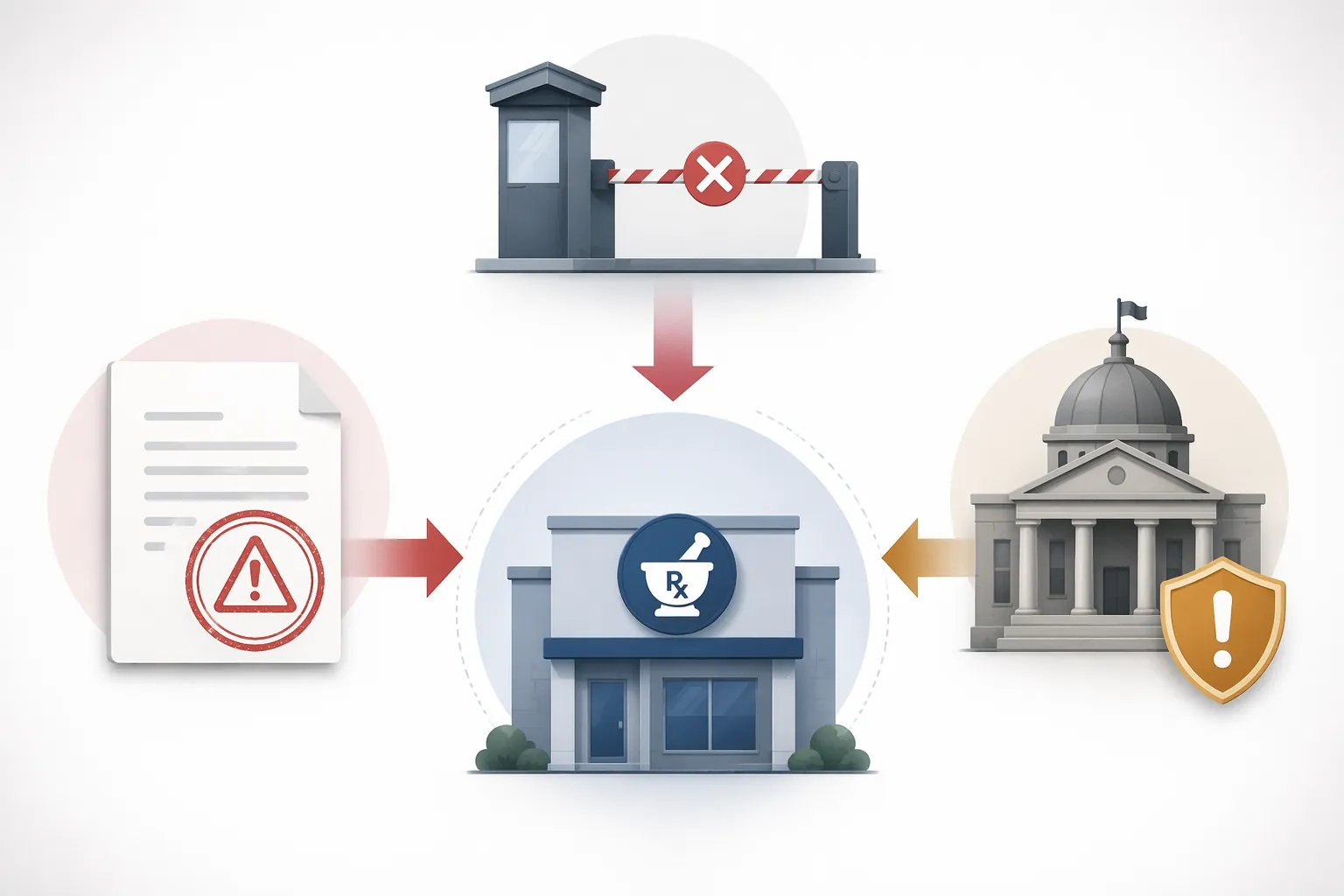
State Boards Do Not Have to Wait for FDA
State pharmacy boards are another reason the “FDA loosened the list” shorthand is too thin. PeptideJournal reports that Ohio fined Brooksville Pharmaceuticals $250,000 for compounding retatrutide and that Indiana declined to renew CRE8 Pharmacy Group’s license.[6] Those examples should not be inflated into a 50-state rule. State boards vary in authority, appetite, procedure, and politics. But they show why federal list status is not the only permission structure that matters.
A state board can discipline on state-law grounds while FDA is still working through federal advisory processes. It can focus on a pharmacy’s practice standards, license representations, nonresident operations, drug sourcing, or patient-specific prescription files. It can also act on a record that looks different from FDA’s record. A favorable federal advisory vote does not prevent a state board from asking whether the pharmacy’s actual conduct complied with state pharmacy law at the time it occurred.
“Research Use Only” Is a Weak Place to Park the Business Model
The same caution applies to “research use only” disclaimers. PeptideJournal’s review of FDA warning letters reports that the agency has characterized RUO disclaimers as “a ruse to avoid FDA scrutiny.”[6] That language should be treated with precision. A warning letter is not a universal federal-court holding. The RUO theory has not been conclusively defeated in every possible posture. But if the business is selling in a way that looks like clinical or consumer use, a disclaimer at the bottom of a page is unlikely to carry the risk analysis.
The harder facts are usually operational: product pages describing benefits, dosing guidance, patient testimonials, prescriber-facing funnels, checkout flows, affiliate scripts, and customer service messages. Those facts tell regulators whether the seller is really supplying research material or using research language as a paper screen. Counsel who reviews only the label and not the surrounding sales system is reviewing the cleanest exhibit, not the case.
How to Read the Current Posture Without Overreading It
There is a legitimate pro-access reading of the April and July developments. Category 2 removal is better for affected substances than remaining in Category 2. Favorable PCAC votes are better for BPC-157, KPV, TB-500, and MOTS-c than unfavorable votes. If FDA later issues final Category 1 decisions, the posture may change in important ways.
That is different from the advice some operators want to hear now. As of Q3 2026, the defensible reading is narrower: the legal classification is in transition while enforcement pressure remains active across marketing, manufacturing, import, and state-licensing channels. The transition may eventually reduce some federal-list uncertainty for some substances. It has not erased the exposure created by claims, sourcing, sterility, licensing, or conduct that predates final FDA action.
A practical review should therefore start with the actual enforcement surface, not the most favorable headline. Verify the current FDA warning-letter totals directly before relying on secondary counts. Separate Day 1 PCAC outcomes from unresolved Day 2 substances. Check whether the substance has final list status, not only interim movement. Trace the API manufacturer and import path. Read the website like an investigator would. Then check the relevant state board record, because the state license may be where the first concrete consequence lands.
This is a risk assessment, not legal advice and not a prediction of FDA’s final rulemaking. The point is simply that “FDA peptide compounding list loosening restrictions” is an incomplete liability sentence. The missing clauses are where the exposure sits.
References
- FDA Publishes Briefing Documents for July 2026 PCAC Meeting — Newtropin
- FDA advisory committee votes to add popular peptide BPC-157 — ABC News
- FDA committee votes on peptides — The Hill
- FDA advisory committee backs two controversial peptides — RAPS
- FDA's Focus Returns to Compounding and Telehealth: Another Wave of Warning Letters — Sheppard Mullin
- FDA Warning Letters to Peptide Companies Analysis — PeptideJournal
Chronological incident history
No sanction cases have named this tool in the tracked record set to date. This does not imply the tool is safe — see Risk Digest for ongoing monitoring.
← Compare peer toolsReport a correction or tip
Spotted an outdated figure, a misstated fact, or a ruling this tool profile should reflect? Public comments are disabled for this content given the professional cost of a misreported case outcome, penalty amount, or rule text — use the structured correction channel instead.
Report a correction or tip for this record →