
Federal judge blocks TPS work permits ruling in temporary stay
A federal judge temporarily blocked four immigration policy changes affecting TPS holders and asylum seekers on July 21, 2026. This article explains what the administrative stay covers, who it protects, what it does not block, and the timeline for a follow-up ruling.
- Hallucination rate
- Not measured / undisclosed
The July 21 order in Venezuelan Association of Massachusetts v. USCIS is easy to misread if reduced to the headline “federal judge blocks TPS work permits ruling.” Judge Nathaniel Gorton temporarily blocked four consequences tied to recent TPS and asylum work authorization changes. He did not block the $100 annual asylum fee itself, and he did not revive the former 30-day clock for initial asylum-based work permit decisions.[1][2]
That distinction matters immediately for anyone checking an I-9 file, advising an asylum applicant, or deciding whether an EAD that looked valid last week can still be treated as valid this week. The order is an administrative stay under 5 U.S.C. § 705, not a final ruling on the merits and not a permanent injunction.[3]
| Issue | Current effect of the July 21 stay |
|---|---|
| Retroactive shortening of certain TPS EAD validity periods | Temporarily blocked |
| Rejection of asylum applications solely for non-payment of the $100 annual fee | Temporarily blocked |
| Termination of work authorization solely for non-payment of the $100 annual fee | Temporarily blocked |
| Initiation of removal proceedings solely for non-payment of the $100 annual fee | Temporarily blocked |
| Collection of the $100 annual asylum fee | Not blocked |
| Restoration of the former 30-day processing timeline for initial asylum-based EADs | Not restored |
| Longer-term § 705 stay | Still pending; follow-up ruling due by August 5, 2026 |
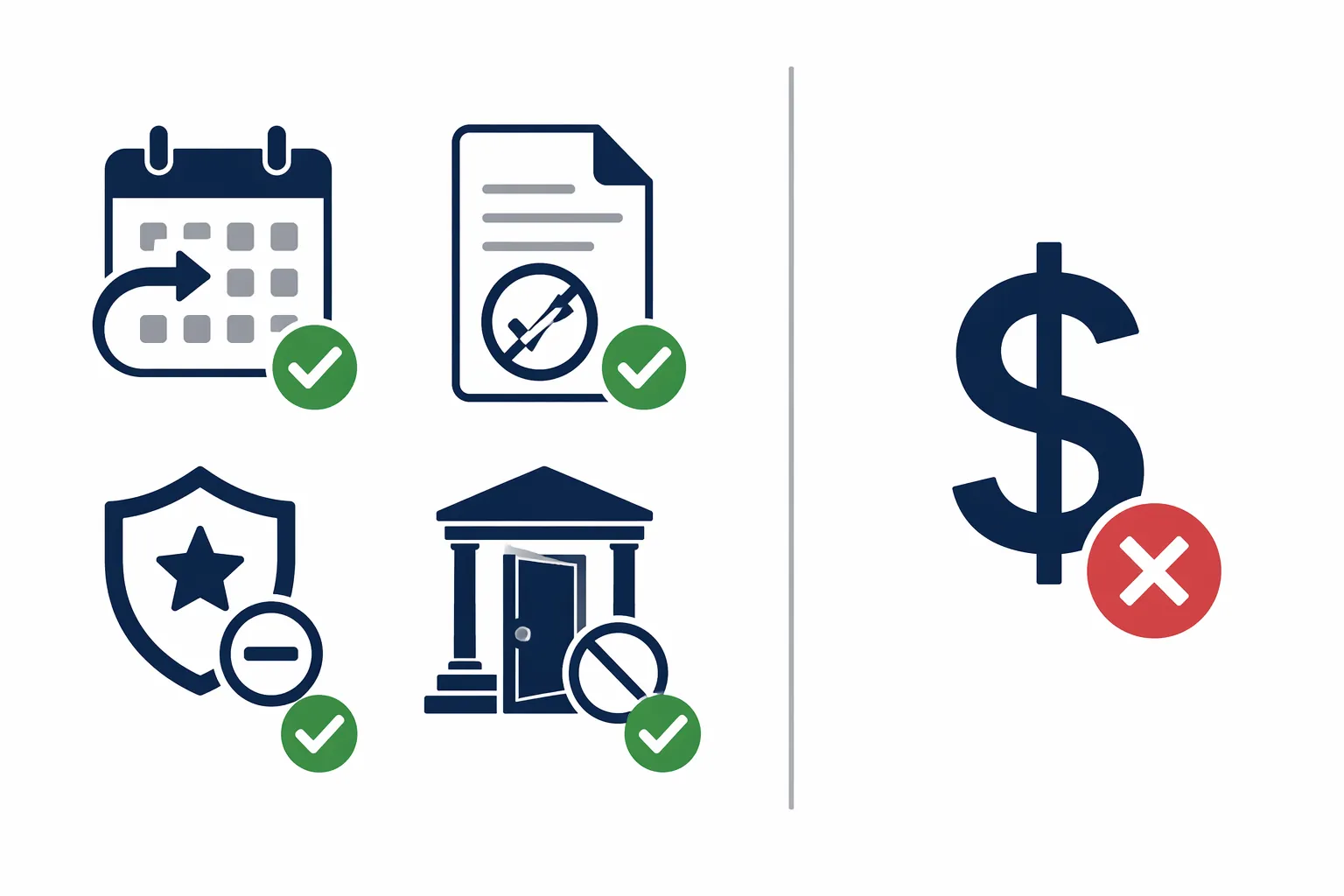
What Judge Gorton Actually Paused
The emergency relief has two tracks: one for TPS-related work authorization and one for asylum-related consequences attached to non-payment of the new annual fee. Reuters described the order as blocking the administration from stripping immigrants of work permits, while Bloomberg Law framed it as blocking policies disrupting work authorization.[1][2] Both formulations are directionally right, but the operative question is narrower: which legal consequences cannot be imposed while the stay remains in effect?
First, the government is temporarily barred from retroactively shortening previously extended employment authorization document expiration dates for covered TPS holders. The practical dates supplied in the post-order breakdown are specific: El Salvador EADs remain valid through September 9, 2026, while Sudan and Ukraine EADs remain valid through October 19, 2026.[4]
Second, USCIS may not reject an asylum application solely because the applicant has not paid the $100 annual asylum fee. The word “solely” does work here. The stay does not insulate a filing from every other eligibility, procedural, or documentary problem; it blocks the non-payment consequence identified in the order.[1][4]
Third, the government may not terminate work authorization solely because of non-payment of that annual fee. For employers and counsel, this is the portion that most directly affects the risk of treating a worker as no longer authorized based only on the fee issue. The stay does not create a new independent work authorization category; it prevents that particular termination rationale from taking effect during the stay.[1][4]
Fourth, the government may not initiate removal proceedings solely because the annual asylum fee has not been paid. Again, that is not a broad immunity from removal proceedings. It is a temporary bar on using non-payment alone as the trigger.[1][4]
The Fee Was Not Blocked
The order does not suspend collection of the $100 annual asylum fee. That is the most common point at which a headline becomes operationally unsafe. A lawyer can tell a client that the court temporarily blocked rejection, work authorization termination, and removal initiation solely for non-payment. The lawyer cannot truthfully convert that into “the fee is gone.”[4]
Nor does the order restore the 30-day processing timeline for initial asylum-based EAD applications. That separate procedural change remains outside the relief granted on July 21. For pending first-time applicants, the difference is not academic: protection from a non-payment consequence does not guarantee a quick adjudication.[4]
This is why the ruling should be treated as a stay of specified consequences, not as a wholesale freeze of the underlying fee regime. The difference determines what must still be paid, what can still be processed slowly, and what agency actions are temporarily off the table.
Who Is Most Directly Protected Right Now
For TPS holders, the most concrete protection concerns EAD validity periods that the government had moved to shorten retroactively. The groups with the clearest practical dates in the available materials are TPS holders from El Salvador, Sudan, and Ukraine: September 9, 2026 for El Salvador, and October 19, 2026 for Sudan and Ukraine.[4]
Reuters and Al Jazeera both emphasized El Salvador, Sudan, and Ukraine in describing the affected TPS populations.[1][5] El País, by contrast, framed the ruling around thousands of immigrants and specifically discussed Haitian and Venezuelan TPS holders.[6] That is not necessarily a contradiction. It reflects two different lenses: which designations faced immediate EAD-expiration consequences in the July 2026 window, and which broader communities were within the litigation’s practical or political field.
For compliance purposes, the safer distinction is between imminent document-validity harm and broader category coverage. The order’s most administrable TPS dates are the El Salvador, Sudan, and Ukraine dates identified above. Other TPS populations may appear in coverage and advocacy materials, but shifting USCIS SAVE dates for countries including Haiti, Syria, and Yemen between July 10 and July 17, 2026 are a warning against relying on a single news formulation as a status database.[4][6]
For asylum seekers, the protected class is not limited by nationality in the same way. The stayed consequences concern asylum applications, asylum-linked work authorization, and removal proceedings based solely on non-payment of the $100 annual asylum fee.[3][4] That means the nationality split in TPS coverage should not be imported into the asylum-fee portion of the order.
Population counts should be read with care. Some coverage uses “thousands”; other summaries refer to “tens of thousands.” The available materials do not supply a single verified authoritative count for every person affected by every part of the stay. The most reliable way to describe the impact is that the order materially protects covered TPS holders with affected EAD dates and asylum seekers exposed to the specified non-payment consequences.
Why the Court Issued a Temporary Administrative Stay
The plaintiffs’ theory, as described by Democracy Forward, is that the administration imposed the challenged work authorization and asylum-fee consequences without complying with Administrative Procedure Act notice-and-comment requirements.[3] That is the legal frame for the emergency relief; it is not yet a final judicial determination that the policies are unlawful.
Section 705 of the APA allows a court to postpone agency action while judicial review is pending. Judge Gorton used that tool temporarily, preserving the status quo for the specified consequences while he considers whether to enter a longer stay.[3][4]
The Boston venue and the judge’s background are useful context but not the center of the order. Reuters noted that Boston has become a hub for challenges to Trump immigration policies and that Judge Gorton was appointed by President George H.W. Bush.[1] Those facts help situate the litigation, but they do not expand the relief granted.
The Supreme Court and OBBA Background
The July 21 stay also sits against two recent legal developments affecting work authorization mechanics. On June 25, 2026, the Supreme Court issued its opinion in Mullin v. Doe, a decision that appears in the surrounding employer-compliance discussion of TPS-related work authorization.[7]
Separately, the One Big Beautiful Bill Act changed the EAD landscape by imposing a one-year cap on certain TPS work permits and eliminating the 540-day automatic extension that had mattered heavily for employer verification planning.[8] Those changes help explain why a retroactive shortening of EAD dates would create immediate pressure on workers and employers rather than a merely theoretical dispute.
None of that background should be used to pad the July 21 order into something broader than it is. The court did not use the administrative stay to rewrite every downstream employment-verification problem created by recent immigration legislation and agency implementation. It paused the four specified consequences while the court reviews the challenge.
How HR and Counsel Should Read the EAD Dates
The most usable data points are the EAD expiration dates identified for the affected TPS designations: September 9, 2026 for El Salvador; October 19, 2026 for Sudan; and October 19, 2026 for Ukraine.[4] Those dates are the immediate compliance anchors.
An employer reviewing work authorization should not treat the July 21 stay as permission to ignore ordinary I-9 rules. The narrower point is that a retroactive agency shortening that the stay blocks should not be used as the sole reason to treat the covered EAD as already expired. If USCIS or SAVE guidance changes again, the employer’s analysis may have to change with it.
For lawyers, the same caution applies in reverse. A client with one of the protected EAD dates may have a strong reason to rely on the stay today, but the advice should be tied to the current order, the country designation, the document category, and the next court deadline. “Protected by the July 21 administrative stay” is more precise than “the court restored TPS work permits.”
What Happens by August 5

The next date is not vague “uncertainty”; it is August 5, 2026. Judge Gorton is expected to rule by then on whether to convert the temporary administrative stay into a longer-term § 705 stay.[4]
Until that follow-up ruling issues, the operative position is limited but meaningful: the government is temporarily blocked from retroactively shortening covered TPS EAD dates and from rejecting asylum applications, terminating work authorization, or initiating removal proceedings solely because of non-payment of the $100 annual asylum fee.[1][4]
After August 5, the answer may become narrower, broader, or more durable depending on how the court rules. For now, the stay protects against specified EAD and asylum-processing consequences. It does not erase the annual fee, it does not restore the 30-day initial EAD processing timeline, and it should not be treated as a final merits ruling.
References
- US judge blocks Trump administration from stripping immigrants of work permits, Reuters, July 21, 2026.
- Judge Blocks Policies Disrupting Immigrants' Work Authorization, Bloomberg Law, July 21, 2026.
- Court Grants Emergency Relief Protecting Work Authorization for Asylum Seekers and TPS Holders, Democracy Forward.
- Judge Blocks USCIS Changes: What the Order Means for TPS and Asylum Work Permits, Jesus Reyes Law.
- US judge blocks Trump bid to strip work permits from immigrants, Al Jazeera, July 21, 2026.
- Federal judge blocks revocation of asylum applications and work permits for thousands of immigrants, El País, July 22, 2026.
- Mullin v. Doe, Supreme Court of the United States, June 25, 2026.
- One Big Beautiful Bill's Impact on TPS Work Permits, Littler, March 24, 2026.
Chronological incident history
No sanction cases have named this tool in the tracked record set to date. This does not imply the tool is safe — see Risk Digest for ongoing monitoring.
← Compare peer toolsReport a correction or tip
Spotted an outdated figure, a misstated fact, or a ruling this tool profile should reflect? Public comments are disabled for this content given the professional cost of a misreported case outcome, penalty amount, or rule text — use the structured correction channel instead.
Report a correction or tip for this record →