
Free Legal AI Apps: The Consumer vs. Professional Market Bifurcation Every Lawyer Must Understand
This article analyzes the two-tier free legal AI app market for legal professionals. It distinguishes consumer-facing tools marketed as 'AI lawyers' from professional-facing productivity aids, examines the disproportionate risks of UPL, fabricated authority, and misplaced reliance in consumer tools, and provides a framework for advising clients and managing litigation risk.
- Hallucination rate
- Not measured / undisclosed
Introduction: The Two-Tier Free Legal AI Market
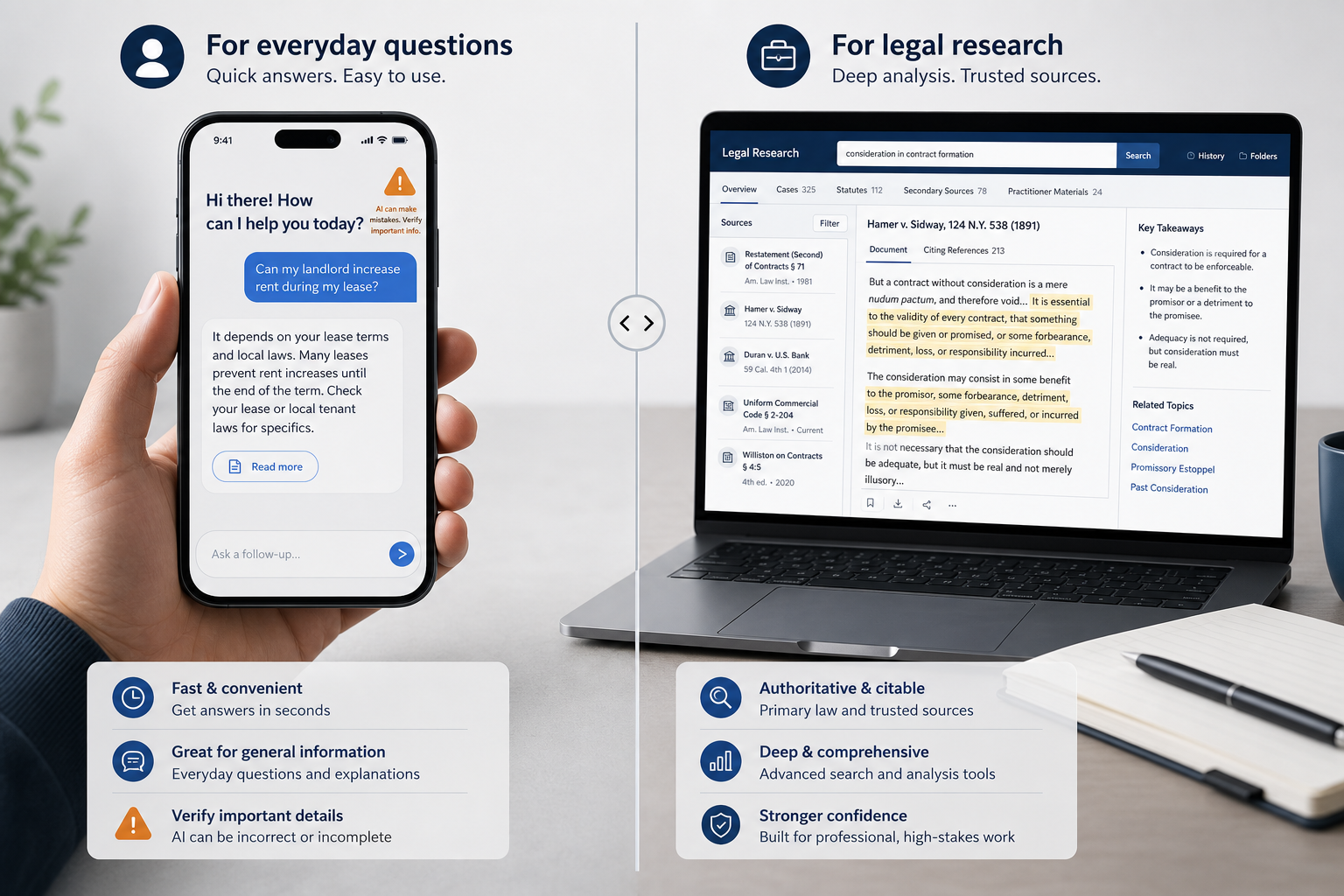
The phrase "free legal AI app" currently describes two fundamentally different product categories that share almost nothing except a price point of zero. On one side sit consumer-facing applications — DoNotPay, LawConnect, Vikk, AI Lawyer — that market themselves as "AI lawyers" or "robot attorneys" and promise to handle legal tasks directly for end users. On the other side sit professional-facing tools — the free tiers of ChatGPT, Claude, Perplexity, Humata, and Casetext — that position themselves as productivity aids for people who already understand the legal work they are doing.
This distinction is not academic. For practicing attorneys, paralegals, and legal operations professionals, understanding the bifurcation has become a practical necessity. Clients walk into consultations having used consumer AI apps to draft their own pleadings. Opposing parties file briefs generated by free chatbots. Pro se litigants flood federal courts with documents that contain fabricated citations — 1,357 of the 1,623 AI hallucination cases tracked by Damien Charlotin as of June 17, 2026, involved fabricated citations, and 948 of those cases involved self-represented litigants. The consumer tools that generate these filings carry risks — unauthorized practice of law, privilege waiver, data exposure — that their marketing materials systematically downplay.
The professional stakes are high. The Federal Trade Commission ordered DoNotPay to pay $193,000 in February 2025 for misleading consumers into believing its service performed like a human lawyer. The first lawsuit alleging unauthorized practice of law by a general-purpose chatbot — Nippon Life Insurance v. OpenAI, filed in the Northern District of Illinois in March 2026 — tests whether a company can be held liable when its free AI tool dispenses legal conclusions without a license. And in February 2026, Judge Jed S. Rakoff ruled in United States v. Heppner that documents created using a consumer AI tool and later shared with an attorney were not protected by attorney-client privilege or work product doctrine, on three independent grounds: the AI tool is not an attorney, confidentiality was not maintained under the platform's privacy policy, and retroactive sharing cannot create privilege.
This article maps the two-tier market, identifies the specific risks each tier carries, and provides a framework attorneys can use to advise clients, evaluate filings, and meet the emerging duty of technological competence that ABA Formal Opinion 508 and multiple state bar guidance documents now require.
The Consumer Shelf: What "Free AI Lawyer" Apps Actually Do
Consumer-facing legal AI apps share a common value proposition: they promise to perform legal work — draft documents, answer legal questions, generate court filings — without requiring a lawyer. The reality is more complex and, in several documented cases, more dangerous for the user.
| App | Pricing (as of June 2026) | Business Model | Key Risk / Regulatory Action |
|---|---|---|---|
| DoNotPay | $36 every 2 months | Subscription for automated legal documents and chatbot advice | FTC order: $193,000 settlement for misleading 'robot lawyer' claims (Feb 2025); 1.8 Trustpilot rating |
| LawConnect | Free AI chat → paid lawyer matching | Free chatbot routes users to paid attorney referrals; undisclosed referral fees | Conflict of interest: free 'legal AI' is a lead-generation funnel for paid legal services |
| Vikk AI | First chat free; paid plans unpublished | Freemium chatbot with undisclosed pricing tiers | Lack of pricing transparency; unclear data retention and confidentiality terms |
| AI Lawyer | $9.99/week, $19.99/month, $99.99/year | Subscription for AI-powered legal document templates and Q&A | Self-interested comparison blog; claims attorney-built templates but no independent verification of accuracy |
| Rocket Lawyer | From $149/year | Subscription with human attorney access + AI document assembly | Hybrid model: AI handles templates, human attorneys review; lowest risk among consumer tools |
| JustAnswer (Law) | ~$65/month for law category | Subscription for Q&A with 'verified' lawyers | Not AI-first; human-mediated but quality of legal advice varies by provider |
Chronological incident history
No sanction cases have named this tool in the tracked record set to date. This does not imply the tool is safe — see Risk Digest for ongoing monitoring.
← Compare peer toolsReport a correction or tip
Spotted an outdated figure, a misstated fact, or a ruling this tool profile should reflect? Public comments are disabled for this content given the professional cost of a misreported case outcome, penalty amount, or rule text — use the structured correction channel instead.
Report a correction or tip for this record →