
Enterprise toddler case tests no-body murder prosecutions
The Genesis Reid case demonstrates how converging digital evidence—surveillance video, GPS tracking, garbage truck data—enabled prosecutors to pursue capital murder charges without a body. The article examines the legal challenges this evidence chain presents, including authentication and chain of custody issues in no-body homicide prosecutions.
- Hallucination rate
- Not measured / undisclosed
Genesis Reid was not found safe. As of Q3 2026, the Enterprise, Alabama toddler case remains a developing no-body prosecution, with arraignment scheduled for August 6, 2026. That correction matters because the phrase “enterprise alabama toddler found safe legal investigation” points in the wrong factual direction: investigators and prosecutors are proceeding on the allegation that Genesis was killed, while no remains have been recovered.
The legal problem is sharper than the usual missing-child chronology. Investigators reportedly used surveillance footage, garbage route information, landfill equipment GPS, and forensic search methods to narrow a large landfill operation to a specific search zone. Then, after a 40-day search involving more than 10 million pounds of refuse and the individual review of more than 20,000 non-human bones, the search ended without Genesis’s body being found.[1][2]
That is not a small procedural footnote. It is the center of the case. Digital evidence may explain why prosecutors believe they know where the child’s remains should have gone. The absence of recovered remains is why each link in that explanation will have to be proved with care rather than confidence.

The case begins with a gap, not a discovery
The reported timeline starts with Christmas night 2025. According to reporting on the investigation, neighbor surveillance footage from about 11:30 p.m. allegedly showed a duffel bag being taken to a dumpster. Genesis was not reported missing until February 16, 2026, at 3:10 a.m., creating a 53-day gap between the alleged killing date and the missing-person report.[1]
For trial purposes, that gap does two different things. It gives prosecutors a period in which to argue concealment, delay, and consciousness of guilt. It gives the defense a long interval in which to question what was known, when it was known, and how much of the state’s theory depends on reconstruction after the fact.
The surveillance footage is described in public reporting as the sole direct evidence tied to the alleged murder theory.[1] But “direct” in this setting should not be confused with self-proving. A neighbor camera clip still has to be authenticated: the system time, the camera angle, the continuity of the recording, the identity of the person shown, the object being carried, and the absence of editing or material gaps all become foundation questions. A timestamp can look exact on a screen and still require testimony about how the device kept time.
From a dumpster to a landfill, the alleged path gets more fragile at each handoff
The prosecution theory, as publicly reported, appears to depend on following an alleged disposal path through ordinary waste infrastructure. That path matters because no witness has been publicly identified as seeing Genesis’s body, and no remains were recovered from the landfill search. The state’s burden is not just to show that a dumpster was serviced. It must connect the alleged item from the surveillance footage to the waste stream and then to the search area.
| Stage | What investigators appear to rely on | Why it matters legally |
|---|---|---|
| Neighbor surveillance | Video reportedly showing a duffel bag taken to a dumpster at about 11:30 p.m. on Christmas night 2025 | Authentication, timestamp reliability, identification, and interpretation of what the video actually shows |
| Dumpster pickup | Garbage route records linking the dumpster to a pickup sequence | Whether the relevant dumpster contents were collected when and how investigators say they were |
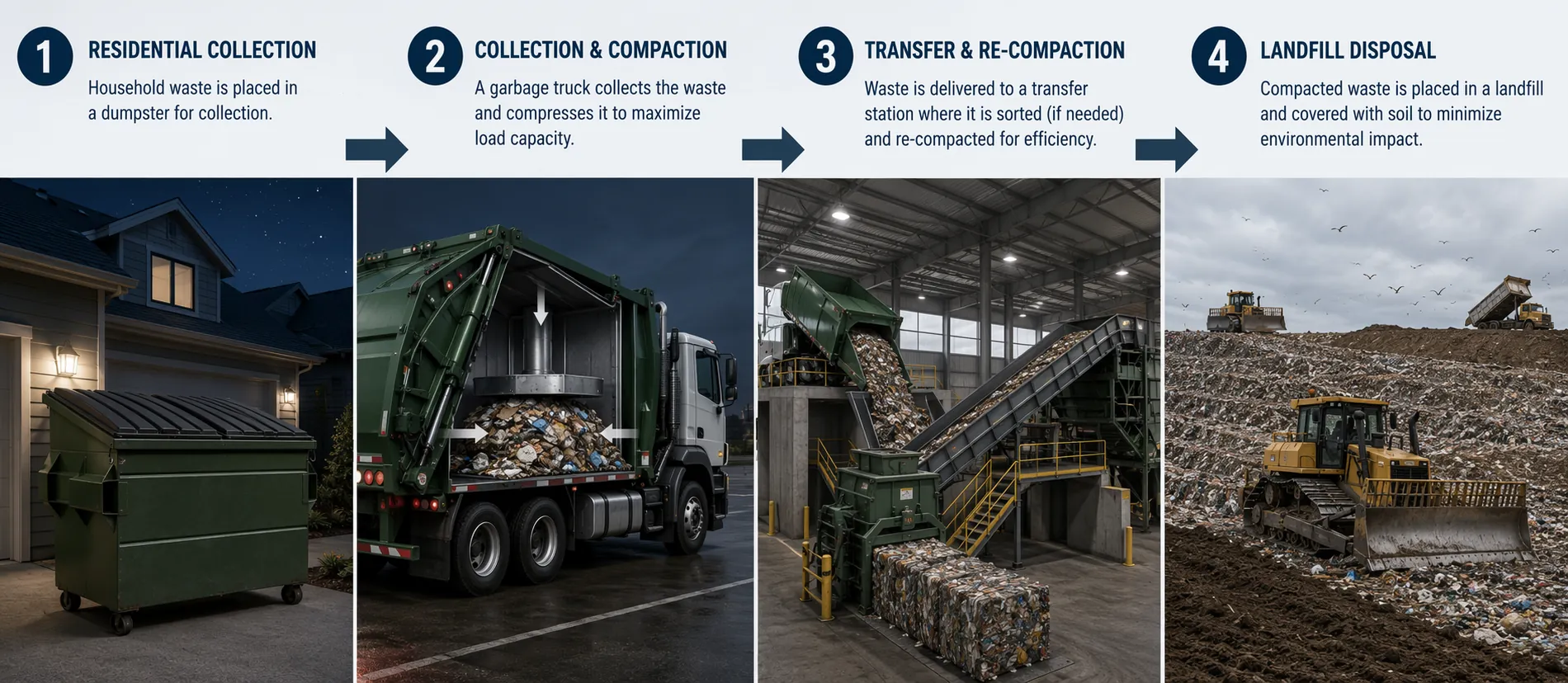
| Truck compaction | Waste handling inside the truck after pickup | Possible destruction, compression, or commingling before the waste reached the next facility |
| Distribution or transfer facility re-compaction | Additional processing before landfill delivery | Another point where contents could be mixed, moved, or physically altered |
| Landfill processing | Equipment GPS and landfill operations used to narrow the search zone | Whether the final mapped area reliably corresponds to the original dumpster contents |
This is the part of the case that can sound cleaner in a press briefing than it may look at an evidentiary hearing. A garbage route is not a sealed evidence bag. A compactor is not a storage locker. At each stage, material can be crushed, shifted, mixed with unrelated refuse, or redistributed by equipment whose records were created for operations, not courtroom proof.
Public reporting describes a four-stage waste path: dumpster pickup, garbage truck compaction, distribution facility re-compaction, and landfill processing.[1] That sequence may help explain why investigators believed a landfill search was justified. It also gives the defense multiple points at which to test continuity. The farther the theory moves from the original surveillance clip, the more it depends on records, system logs, employee testimony, and assumptions about how waste moved on a particular route.
The landfill search shows both the force and the limit of the digital trail
Coffee County Sheriff Scott Byrd described landfill equipment as heavily trackable, saying, “We know when they are, where they are, and how they are at all times.” The reporting tied that capability to modern equipment including drones, GPS trackers on bulldozers, and GPS on garbage trucks.[2]
That kind of data can be powerful in an investigation. Instead of searching a landfill as a single undifferentiated mass, investigators reportedly narrowed the target to an area about 200 feet by 100 feet, 8 to 10 feet deep.[2] In practical terms, that is the difference between speculation and an operational search plan.
The search effort was not casual. Reports described a 40-day operation, more than 10 million pounds of refuse moved, more than 20,000 non-human bones individually examined, and assistance from teams connected to the National Center for Missing and Exploited Children, Atlanta, and Arkansas.[1][2]
But effort does not become corroboration merely because it is extensive. The same search statistics that show diligence also create the “no-result” problem for the prosecution. If the digital trail was precise enough to justify that search zone, why did it produce no remains? The answer may be that compaction, commingling, decomposition, equipment movement, or landfill conditions made recovery impossible. It may also be that one or more assumptions in the route-to-landfill chain were wrong. The public record does not yet resolve that question.
What the defense is likely to attack
Defense attorney David Harrison has already framed the case as one built on “theories and educated guesses” rather than proof beyond a reasonable doubt.[3] In a no-body capital case, that is not just a sound bite. It is a preview of the foundation fight.
The first attack point is the surveillance footage. A court will not treat a video as reliable simply because it exists. Someone must be able to explain the camera system, account for the recording, establish the relevant timestamp, and support any identification or interpretation the state wants the jury to draw from it.
The second is the GPS and routing data. Landfill and truck GPS systems can show locations and movement, but the proponent still has to explain what the system records, how often it records, whether there are gaps, how the data were preserved, and whether the plotted location actually corresponds to the waste material at issue. “The truck went there” is different from “the relevant contents remained identifiable through every handling stage.”
The third is chain of custody in a setting where custody is not designed around evidence preservation. In a laboratory, a chain-of-custody log is supposed to protect against substitution, contamination, or loss. In a waste stream, the normal process is destruction and commingling. That does not make the state’s theory inadmissible by itself, but it changes what must be explained.
The fourth is the legal meaning of the failed search. Prosecutors may argue that the absence of remains is consistent with the mechanics of waste processing and landfill conditions. The defense may argue that an exhaustive search of the very area identified by the state’s digital theory produced no physical confirmation. Both arguments can come from the same fact.
The charges raise the stakes of every foundation question
Adrienne Reid has been charged with capital murder involving the murder of a child under 14, abuse of a corpse, and false reporting to law enforcement, according to public reporting on the case.[4] Prosecutors have also filed a death penalty notice, which makes the evidentiary posture even more consequential.
Capital litigation magnifies technical proof problems because the defense has every incentive—and every obligation—to test each premise. If the state’s case depends on a sequence of digital and operational records, those records are not background scenery. They are the case.
The bond dispute showed that posture early. Reid was initially held on a $1 million cash bond on a false reporting charge, even though reporting described the standard range for that charge as $2,500 to $15,000. A prosecutor argued that Reid was “the only person who knows where Genesis is.”[5] That argument may make practical sense in a missing-child investigation. In court, however, pressure and suspicion still have to be separated from admissible proof.
Harrison filed a speedy trial motion in June 2026, and public reporting described the case as moving toward the scheduled August 6, 2026 arraignment.[6] That timing matters because the state cannot wait indefinitely for remains that may never be recovered. It also means the defense may press the prosecution to proceed on the record it has, rather than on what investigators hoped the landfill search would produce.
No-body prosecution does not mean no evidence
A homicide prosecution does not automatically fail because no body is recovered. The law can permit a conviction based on circumstantial evidence if the evidence proves the required elements beyond a reasonable doubt. The Genesis Reid case is not unusual because prosecutors are trying to use circumstantial proof. It is unusual because the public theory appears to lean so heavily on digital reconstruction of a physical path that ended without physical recovery.
That distinction is important. Surveillance footage, cell phone information, route records, and GPS logs can be relevant and probative. They can also be misunderstood if treated as though they speak for themselves. Data points require witnesses. Maps require methodology. System logs require explanation. Operational records require someone who knows how the operation actually worked on the dates in question.
A prosecutor can use the digital chain to argue a coherent sequence: late-night disposal, delayed report, pickup, compaction, transfer, landfill placement, and a targeted search. A defense lawyer can use the same sequence to argue accumulated uncertainty: ambiguous video, delayed reconstruction, destructive waste handling, imperfect tracking, and no body at the end of the search.
The narrow lesson of the Genesis Reid case
The case should not be reduced to a claim that technology can solve a no-body homicide. It shows something more limited and more useful for lawyers: ordinary digital infrastructure can make a no-body capital prosecution operationally possible. A neighbor camera can give investigators an alleged starting point. Route records can identify a waste-handling path. GPS can narrow a landfill search to a defined area.
What the case does not show, at least not yet, is that digital precision can substitute for recovered remains. The absence of a body does not end the prosecution, but it changes the work. Every asserted link has to be authenticated, explained, and tied to the next one without letting a map stand in for proof.
As of July 23, 2026, the central tension remains unresolved: investigators reportedly narrowed the search with remarkable specificity, searched at substantial scale, and still found no remains. That does not prove the state is wrong. It does mean the courtroom fight is likely to be less about whether digital records exist and more about whether they can carry the weight prosecutors are placing on them.
References
- What happened to Genesis Reid? — al.com, July 2026.
- Months-long landfill search for Enterprise toddler ends without her body — WTVY, July 13, 2026.
- Reid's attorney claims case is built on theories — WTVY, March 10, 2026.
- Genesis Reid missing Enterprise mother arrest murder — WVTM 13.
- Missing toddler's mom hires attorney — WTVY, February 24, 2026.
- Adrienne Reid seeks speedy trial — WBRC, June 9, 2026.
Chronological incident history
No sanction cases have named this tool in the tracked record set to date. This does not imply the tool is safe — see Risk Digest for ongoing monitoring.
← Compare peer toolsReport a correction or tip
Spotted an outdated figure, a misstated fact, or a ruling this tool profile should reflect? Public comments are disabled for this content given the professional cost of a misreported case outcome, penalty amount, or rule text — use the structured correction channel instead.
Report a correction or tip for this record →