
IBIT or FBTC? Legal Custody and Regulatory Risk Compared
For legal professionals evaluating Bitcoin ETF exposure, this article compares BlackRock's IBIT and Fidelity's FBTC through custody architecture, issuer structure, and regulatory exposure rather than returns, helping determine which ETF minimizes legal risk for firm-managed assets.
- Tool
- IBIT
- Benchmark source
- CoinDesk
- Hallucination rate
- Not measured / undisclosed
- Test methodology
- Custody architecture and regulatory exposure comparison
- Test date
- Jun 1, 2026
A committee comparing BlackRock’s iShares Bitcoin Trust and Fidelity’s Wise Origin Bitcoin Fund does not get much help from the usual first screen. Both are spot Bitcoin ETFs. Both give economic exposure to the same underlying asset. Both now carry a 0.25% standard expense ratio, notwithstanding older comparisons that still show IBIT at 0.12% because they captured a temporary fee waiver that has expired.[1]
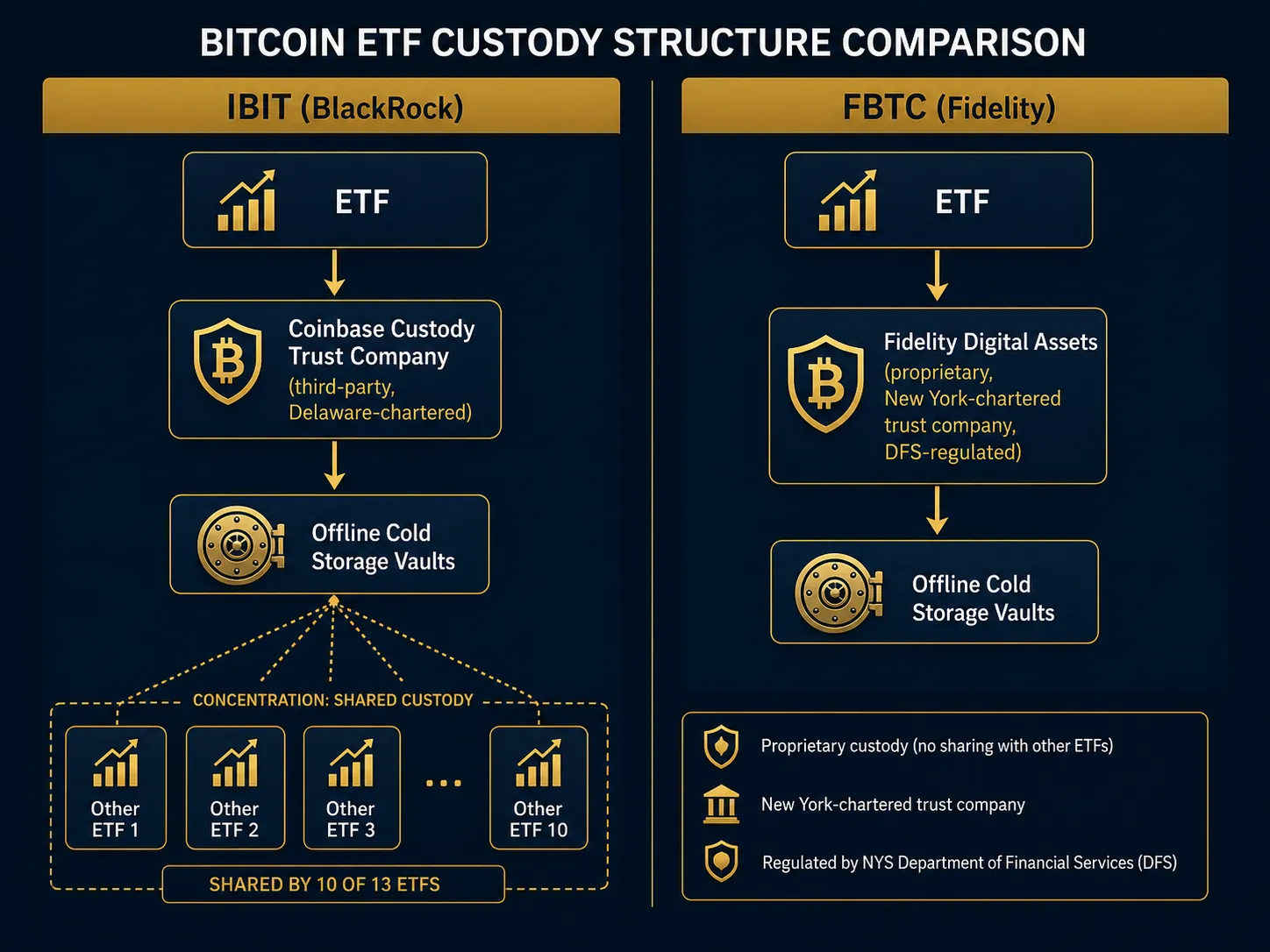
That removes the convenient answer. The harder question is which risk surface a fiduciary can defend after the fact: the one that routes custody through Coinbase Institutional, as IBIT does, or the one that keeps custody inside Fidelity Digital Assets, a Fidelity-affiliated New York-chartered trust company, as FBTC does.[1][2]
| Issue | IBIT | FBTC | Why it matters legally |
|---|---|---|---|
| Issuer | BlackRock | Fidelity | Both are institutionally credible issuers; issuer scale is context, not a custody answer. |
| Standard expense ratio | 0.25% | 0.25% | Fee no longer resolves the comparison; older 0.12% IBIT references reflect an expired waiver.[1] |
| Custodian | Coinbase Institutional / Coinbase Custody structure | Fidelity Digital Assets | The legal dependency chain differs materially. |
| Custody model | Third-party custody within a heavily shared ETF infrastructure | Proprietary custody through an affiliated New York-chartered trust company | The defensibility question is counterparty exposure, control narrative, and claims-path uncertainty. |
| Market infrastructure | Deeper trading and options ecosystem | Narrower options ecosystem | IBIT may be easier to hedge or manage tactically in institutional accounts. |
| Tax-loss swaps | Unsettled | Unsettled | Do not assume the IRS will treat cross-ETF Bitcoin swaps as clearly outside wash-sale concerns. |
Performance Is a Boundary Condition, Not the Governing Fact
A bitcoin ETF performance comparison between Fidelity and BlackRock still has to acknowledge returns, because losses are where fiduciary explanations become real. As of mid-2026, both funds were down roughly 29% year to date, reflecting the same underlying Bitcoin exposure rather than a product-specific breakdown.[2]
The more useful performance-related fact is not that one fund magically avoided Bitcoin beta. It did not. The useful fact is that IBIT showed net-inflow resilience during the mid-May to early-June 2026 selling pressure, absorbing smaller redemption waves than peers according to Farside Investors data cited by CoinDesk.[2] For a risk officer, that matters because flows and secondary-market depth can affect execution, rebalancing, and the ability to unwind or hedge under stress.
But performance should not be allowed to do work it cannot do. A fund that tracks Bitcoin more liquidly is not necessarily a fund with a cleaner custody narrative. A fund with a cleaner custody narrative is not necessarily easier to hedge in a large account. Those are different risk questions, and they belong in different boxes in the memo.
The Custody Split Is the Core Legal Difference
IBIT’s custody architecture depends on Coinbase Institutional. That fact is not unusual in the current spot Bitcoin ETF market; it is the dominant pattern. Coinbase custody supports 10 of the 13 spot Bitcoin ETFs, representing more than $85 billion in combined assets, according to CoinDesk’s June 2026 market review.[2] That makes Coinbase a central piece of the U.S. spot Bitcoin ETF operating stack.
The legal implication is not that Coinbase custody is defective. The implication is that concentration risk is structural. If a committee selects IBIT, it is selecting not only BlackRock as sponsor but also a third-party crypto custody chain shared across much of the market. The due-diligence file should therefore show that the committee considered operational dependency, service-provider concentration, cyber and key-management controls, business-continuity arrangements, and the practical consequences of a disruption at the common custodian.
FBTC’s structure is different. Fidelity self-custodies through Fidelity Digital Assets, which is described in the cited sources as a Fidelity-affiliated New York-chartered trust company. Among major ETFs, the cited sources identify FBTC and VanEck’s HODL, which uses Gemini, as the principal examples of custody fully independent of Coinbase.[2]
That difference matters because it changes the claims story a fiduciary would have to tell. In IBIT, the sponsor and the digital-asset custodian are separate institutional actors. In FBTC, the custody function sits within the Fidelity enterprise, though still through a legally distinct trust-company structure. Neither model eliminates insolvency, operational, or control risk. But they do not present the same map of counterparties, contractual rights, oversight duties, and possible dispute paths.
No responsible analysis should promise how a court would resolve a hypothetical custodian insolvency, a shortfall in segregated assets, or a contested beneficial-ownership claim. The point is narrower and more useful: FBTC gives counsel a more vertically integrated custody-control narrative; IBIT gives counsel a larger, more liquid product tied to the market’s dominant third-party custody provider. Those are different files to defend.
Issuer Scale Helps, but It Does Not Answer the Custody Question
BlackRock’s size is relevant. Research materials cite BlackRock at about $11.6 trillion in assets under management, compared with Fidelity at about $5.8 trillion.[3][4] That scale supports BlackRock’s credibility as an ETF sponsor, its market-making relationships, and its ability to operate within institutional procurement systems.
Fidelity’s counterweight is not simply that it is also large. It is that Fidelity’s digital-asset custody buildout dates to 2014, giving FBTC a longer proprietary crypto-custody development history than a sponsor that outsources the custody layer.[3] For a committee focused on fiduciary documentation, that history may be more relevant than total enterprise AUM.
The right comparison is therefore not BlackRock versus Fidelity as brand names. It is BlackRock plus Coinbase custody versus Fidelity plus Fidelity Digital Assets custody. Brand reputation enters the analysis only after the legal operating chain is drawn.
The Regulatory Setting Is More Legible, Not Fully Settled
As of Q3 2026, Bitcoin ETF regulation is less opaque than it was before spot ETF approvals, but it is not a solved compliance exercise. The SEC’s March 2026 interpretive taxonomy classifies Bitcoin as a “digital commodity,” which gives committees a clearer regulatory vocabulary for Bitcoin exposure than the older, generalized “crypto asset” label.[5]
That classification does not make every related issue a commodity-law question. ETF listing, disclosure, custody, broker-dealer handling, retirement-plan suitability, tax reporting, and investment-policy compliance can still involve different regulators and different legal standards. The label is helpful because it reduces one category of uncertainty; it does not collapse the whole diligence memo into a single sentence.
The SEC and CFTC also signed a memorandum of understanding on March 11, 2026, committing the agencies to coordinated digital-asset rulemaking.[6] For ETF selectors, that is a coordination signal, not a private-law safe harbor. It helps explain why Bitcoin-related products are moving into more standardized market infrastructure, but it does not decide fiduciary prudence, custodian selection, or tax treatment.
The competitive landscape changed further when the SEC approved generic listing standards for commodity-based trust shares in September 2025, eliminating the need for individual 19b-4 approval for new crypto ETFs that satisfy the generic standards.[7] That matters because IBIT and FBTC are no longer isolated products in a one-off approval environment. They sit inside a market where additional commodity-based trust products can reach listing more efficiently.
OCC Interpretive Letter 1184, issued May 7, 2025, is another relevant marker because it addresses national-bank cryptoasset custody activity and related bank-custody frameworks.[8] It does not turn every ETF custodian into a bank custodian, and it should not be overread. Its practical significance is that bank-regulatory expectations are now part of how institutional investors evaluate digital-asset custody controls, especially where the Customer Protection Rule and custodial segregation concepts are part of the broader legal review.
There is also anticipated SEC rulemaking reported in July 2026, but the cited reporting describes rulemaking plans rather than rules already in effect.[9] A current memo should separate effective law and binding approvals from expected proposals. Procurement committees have a bad habit of treating “regulators are working on it” as if it were the same as a rule text. It is not.
Liquidity and Options Can Be Legal Risk Controls
IBIT’s strongest argument is not merely that it is popular. Its larger trading ecosystem and deeper options chain can become part of risk management. If an institution needs to hedge exposure, adjust position size, meet liquidity windows, or manage downside limits inside a defined investment policy, market depth is not cosmetic.
This is where a legally careful comparison should give IBIT real credit. A product with a deeper options market may allow more precise implementation of a committee-approved risk limit. It may also reduce execution slippage when a portfolio manager needs to enter or exit quickly. Those are not performance-chasing arguments; they are implementation-risk arguments.
FBTC’s narrower options ecosystem does not make it unsuitable. It means the committee should not pretend that proprietary custody and derivatives depth are the same virtue. A firm that values a cleaner custody-control narrative may reasonably accept less developed hedging infrastructure. A firm that actively manages exposure around volatility limits may reasonably prefer the instrument with deeper derivative support.
The Tax Swap Question Should Stay Caveated
Tax-loss harvesting is one place where the two-ETF comparison tempts overstatement. Because IBIT and FBTC are separate trusts from different sponsors, some investors may want to sell one Bitcoin ETF at a loss and buy the other to maintain exposure. The unsettled issue is whether the IRS would treat the two positions as “substantially identical” for wash-sale purposes.
The important finding is the absence of explicit IRS guidance on IBIT-to-FBTC or FBTC-to-IBIT swaps, not a confident conclusion that the trade works or fails. A legal memo should therefore avoid stating that cross-ETF Bitcoin swaps are safe tax-loss substitutes. The defensible phrasing is narrower: current guidance leaves uncertainty, and any harvesting strategy should be reviewed under the investor’s tax posture, timing, and exposure-maintenance objective.
Where MSBT Fits—and Why It Does Not Change This Comparison Yet
Morgan Stanley Bitcoin Trust, launched April 8, 2026, is worth noting because it points toward a possible bank-issued trust category. But available sources identify it as having effectively zero assets under management and no meaningful options market. That makes it a development to monitor, not a present substitute for the IBIT-versus-FBTC decision.
For now, MSBT does not offer the same evidence base on liquidity, trading behavior, or institutional adoption. A committee may track it as part of market surveillance, but it should not use a thinly established product to avoid making the harder custody choice between the two dominant funds.
A Defensible Selection Framework
For firm-managed assets, ERISA-adjacent reviews, model portfolios, or client advisory platforms, the decision file should begin with the actual risk owner. A retirement-plan fiduciary, an in-house legal department, and a trading desk subject to internal liquidity limits may all reach different answers for legitimate reasons.
FBTC is easier to defend where the committee’s primary concern is custody architecture. Its proprietary custody through Fidelity Digital Assets gives counsel a more direct account of who controls the custody layer, why that provider was selected, and how Fidelity’s digital-asset infrastructure fits the product. That does not make FBTC legally risk-free. It makes the custody-control narrative cleaner.
IBIT is easier to defend where execution, liquidity, and hedging depth are central to the mandate. Its Coinbase dependency must be documented rather than waved away, especially given Coinbase’s role across most spot Bitcoin ETFs. But if the account needs deeper options, tighter implementation, or stronger secondary-market resilience, IBIT’s market infrastructure can be part of a prudent risk-management rationale.
The memo should not say “BlackRock is safer” or “Fidelity is safer” in the abstract. It should say which risk was prioritized, who owns that risk, what alternatives were considered, and why the selected custody and market structure fit the institution’s obligations. That is the same discipline used in other legal-technology and institutional-risk reviews, whether evaluating Palantir procurement due diligence, AI compliance tools, or large-cap free-cash-flow risk.
If the institution wants the more self-contained custody story, FBTC has the stronger claim. If the institution needs the deepest market infrastructure for trading and hedging, IBIT has the stronger claim. Either way, the legally relevant comparison starts with custody and regulatory risk, then moves to execution. Bitcoin returns come after that, because both funds are ultimately holding the same volatile asset.
References
- IBIT vs FBTC, BTCETFCalc
- BlackRock and Fidelity are quietly turning bitcoin ETFs into a two-firm market, CoinDesk, June 10, 2026
- Fidelity’s FBTC vs BlackRock’s IBIT: A Deep Dive into Bitcoin ETF Performance, Crypto Research Report
- IBIT vs FBTC: Which Bitcoin ETF Better Buy?, Forbes
- SEC Interpretive Release 33-11412, U.S. Securities and Exchange Commission, March 2026
- SEC-CFTC Announce Historic Memorandum of Understanding Between Agencies, U.S. Securities and Exchange Commission, March 11, 2026
- SEC Approves Generic Listing Standards for Commodity-Based Trust Shares, U.S. Securities and Exchange Commission, September 2025
- OCC Interpretive Letter 1184, Office of the Comptroller of the Currency, May 7, 2025
- P&I: SEC reiterates crypto rulemaking plans, Pensions & Investments
Chronological incident history
No sanction cases have named this tool in the tracked record set to date. This does not imply the tool is safe — see Risk Digest for ongoing monitoring.
← Compare peer toolsReport a correction or tip
Spotted an outdated figure, a misstated fact, or a ruling this tool profile should reflect? Public comments are disabled for this content given the professional cost of a misreported case outcome, penalty amount, or rule text — use the structured correction channel instead.
Report a correction or tip for this record →