
Japan Revises Imperial Law, Keeps Male-Only Succession
Japan's July 2026 Imperial House Law revision allows princesses to retain imperial status after marriage and permits adoption of male heirs from former princely houses — but explicitly preserves the male-only succession rule, leaving Princess Aiko ineligible for the throne and deferring the question with a 30-year review clause.
- Hallucination rate
- Not measured / undisclosed
Japan's July 2026 Imperial House Law revision passed the lower house on July 10 and the upper house on July 17, and it does only two things: lets princesses keep imperial status after marrying commoners, and allows male descendants aged 15 or older from the 11 former princely houses to be adopted into the imperial family with their consent. It leaves the male-only succession rule untouched, so Princess Aiko remains ineligible for the throne.[1][2][3]

The two changes
The first change is mostly about status, not succession. A princess who marries a commoner can now remain imperial, but her spouse and children stay commoners and do not gain succession rights. The second change opens a narrow adoption path, but only for male descendants aged 15 or older from the former collateral houses, so it widens the pool without opening the throne itself.[2][3]
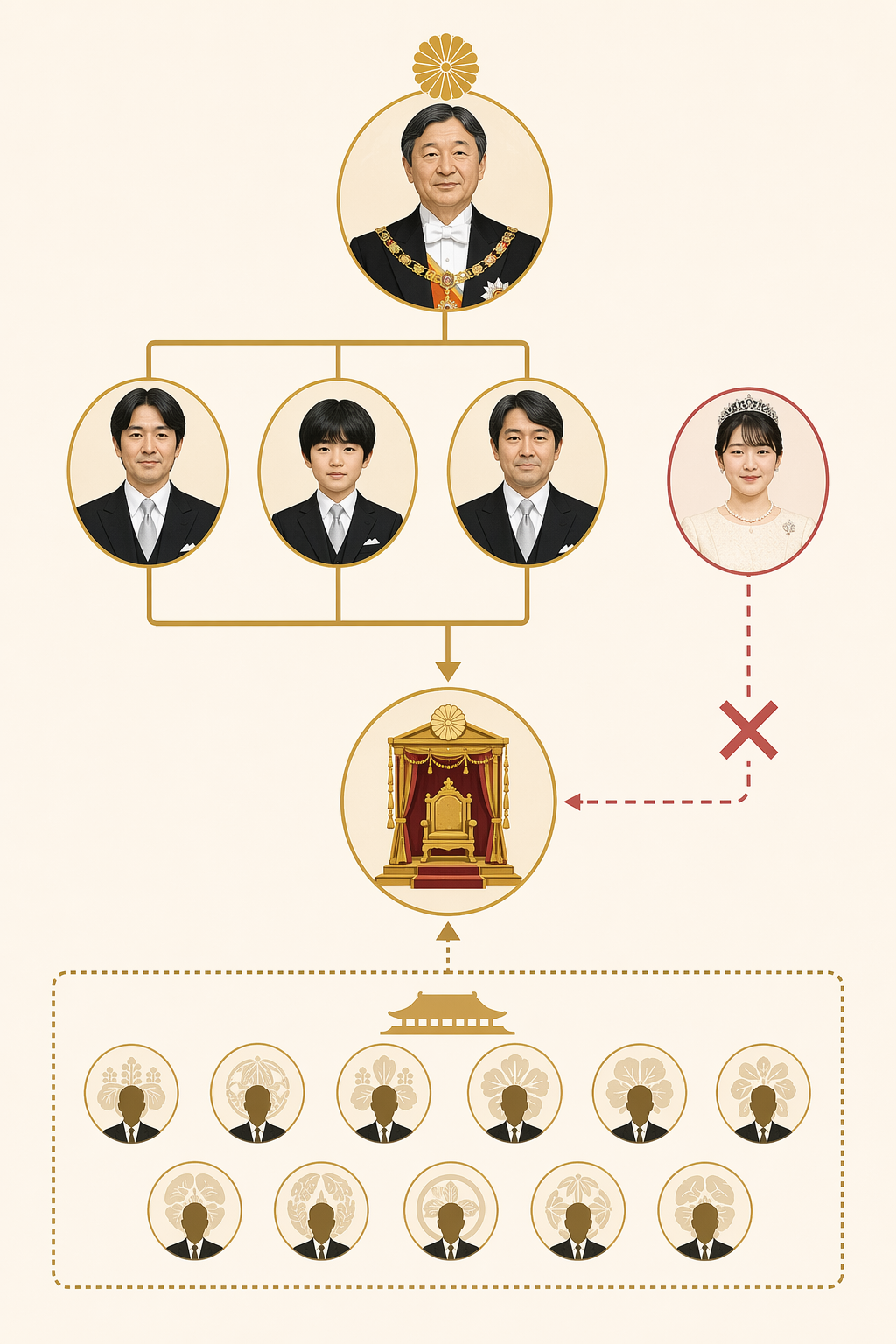
That distinction matters because the current line is thin. Only three men are eligible to inherit now: Crown Prince Fumihito, Prince Hisahito, and Prince Hitachi. The law does not name a rescue candidate; it leaves the government to look inside the 11 former houses, and as of July 17 no one had been publicly identified or approached.[2][3][4][5]
What remains fixed
The part the law leaves untouched is the part that defines it. Succession stays male-only, and Princess Aiko, Emperor Naruhito's only child, stays outside the line. That is why the revision reads less like a move toward equality than like a legal repair aimed at keeping the present rule intact.[1][2][4]
A 30-year review clause pushes the sex question farther out, not nearer. Polling reported by major outlets has shown strong majority support for a female emperor, so the compromise sits in plain view: public opinion is ahead of the statute, while the statute is designed to outlast the argument.[1][4][6]
This is not an ancient structure being gently updated. Japan has had eight empresses regnant, the last in the 18th century, and the male-only rule was codified in the Meiji-era Imperial House Law of 1889. The revision preserves that modern exclusion and gives it more administrative room.[1][4]
That is the compromise on the page: married princesses keep status, a narrow adoption channel stays open, and the throne remains male. It preserves the line, buys time, and defers the gender question for decades.[1][2][3][5]
References
- Japan changes imperial succession law but keeps ban on female emperor — France 24, July 17, 2026
- Japan relaxes royal succession rules - but ban on female emperors remains — BBC
- Japan revises imperial law for sustainable system, keeps male-line throne — Mainichi, July 17, 2026
- Japan is running out of royals. So why won't it let women become emperor? — CNN, July 13, 2026
- Parliamentary panel approves draft proposal on revising Imperial House Law — Japan Times, June 10, 2026
- Japan revises imperial succession law but retains ban on female emperors — Euronews, July 17, 2026
Chronological incident history
No sanction cases have named this tool in the tracked record set to date. This does not imply the tool is safe — see Risk Digest for ongoing monitoring.
← Compare peer toolsReport a correction or tip
Spotted an outdated figure, a misstated fact, or a ruling this tool profile should reflect? Public comments are disabled for this content given the professional cost of a misreported case outcome, penalty amount, or rule text — use the structured correction channel instead.
Report a correction or tip for this record →