
How Jersey Mike's Up-C IPO Creates Securities Litigation Exposure
Analyzes the securities litigation risks embedded in Jersey Mike's Up-C IPO structure, drawing on empirical research showing a 34.8% litigation rate for Up-C IPOs and Delaware precedent cases, to equip securities litigators and risk managers with a benchmarkable risk profile.
- Tool
- Jersey Mike's Up-C IPO
- Benchmark source
- Management Science, 2023
- Hallucination rate
- Not measured / undisclosed
- Test methodology
- Empirical comparative analysis of 66 Up-C IPOs from 2004 through 2019
- Test date
- Jan 1, 2023
No securities class action has been filed against Jersey Mike’s as of July 31, 2026. That caveat matters. So does the benchmark: in a peer-reviewed study of 66 Up-C IPOs from 2004 through 2019, 34.8% of Up-C issuers were sued after the IPO, compared with 16.6% of matched traditional IPO issuers; among profitable Up-Cs, the litigation rate rose to 37.5%.[1]
Those numbers do not predict that JMKE will be sued. They do, however, put Jersey Mike’s IPO in a risk category that deserves more than generic “new public company” monitoring. The relevant question is not whether public shareholders like the sandwiches, or whether Blackstone sponsorship is inherently suspect. The question is whether the offering structure creates identifiable plaintiff theories if later disclosures, trading performance, tax payments, or sponsor transactions give plaintiffs a loss narrative to plead.
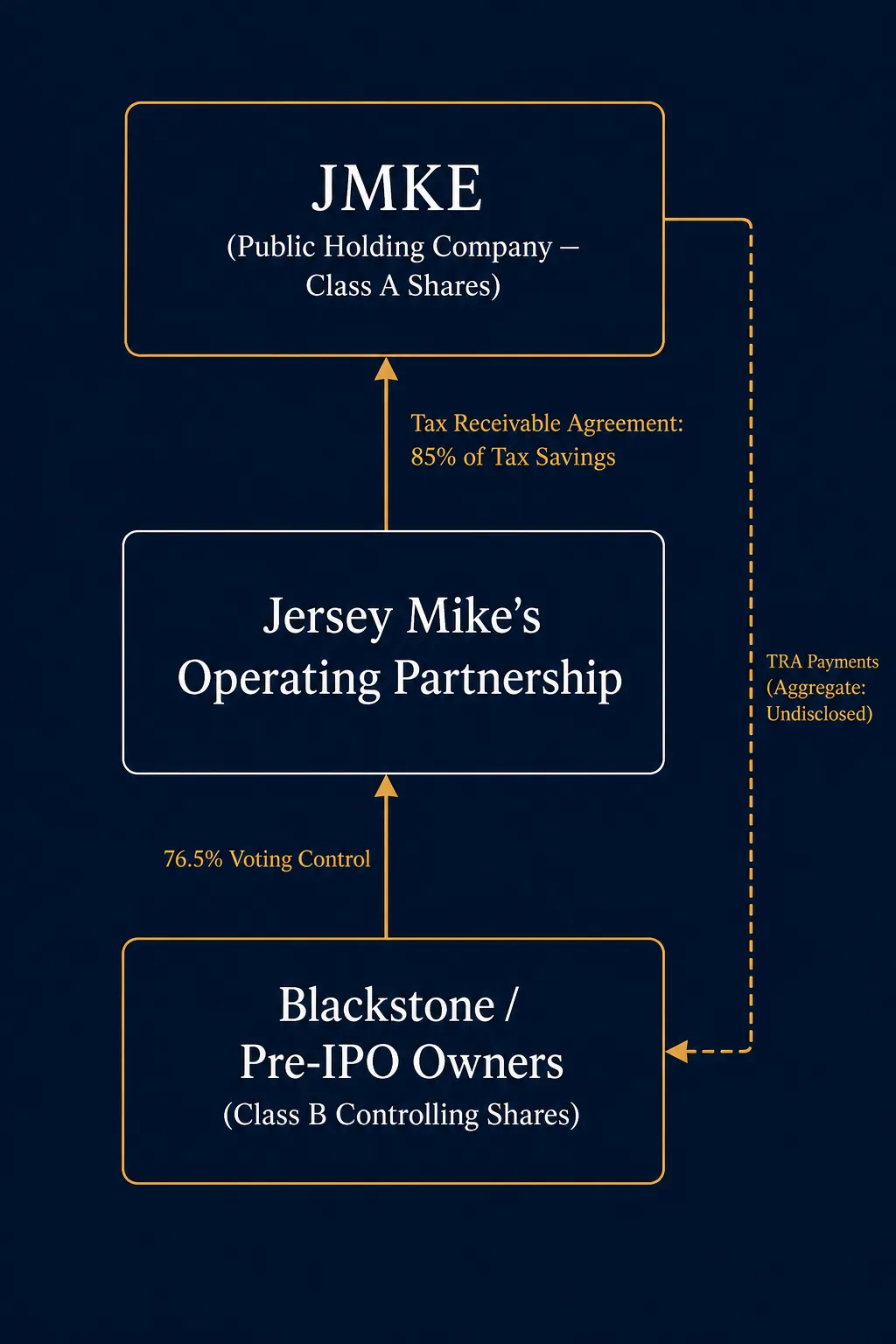
Jersey Mike’s belongs in that higher-risk set because the offering combines the features that make Up-C litigation different from ordinary post-IPO disappointment: a public holding company, a continuing operating partnership, a tax receivable agreement that redirects tax benefits to pre-IPO owners, concentrated sponsor voting control, controlled-company governance exemptions, and a large secondary component in which much of the IPO cash goes to selling holders rather than to the issuer.[2]

Why the Up-C benchmark matters here
An Up-C IPO lets a newly public corporation sit above an existing pass-through operating business. Public investors buy shares in the new corporation. Pre-IPO owners often retain interests in the operating partnership and receive paired voting rights at the public-company level. The structure can preserve tax advantages for legacy owners while giving the company access to public equity markets.
That is not, by itself, a securities-law problem. The litigation issue appears when the same structure decides who receives cash, who controls board composition, and who benefits when tax assets are monetized. In the Management Science study, the authors found not merely higher lawsuit incidence but also negative abnormal returns for Up-C IPOs over three years, reported in a range from -28% to -50%.[1] The useful point for a litigation memo is narrower than “Up-Cs underperform.” It is that public-company losses and legacy-owner economics can become visible at the same time, giving plaintiffs a way to frame the offering documents as having under-described a wealth transfer.
Jersey Mike’s has the components that make that framing available. JMKE is the public holding company. The operating partnership remains the economic engine. Blackstone retains substantial voting power through the post-IPO class structure. A TRA requires the company to pay pre-IPO owners a large percentage of realized tax savings from basis step-ups. The draft filing and secondary S-1 analyses identify the payment percentage, but the aggregate TRA obligation was left blank in the draft disclosure.[2][3]
The cash-flow facts that change the posture
The TRA is the first fact that should survive into any Jersey Mike’s IPO securities legal risks memo. Under the disclosed arrangement, Jersey Mike’s must pay Blackstone 85% of future tax savings attributable to tax-basis increases and related benefits.[2] A TRA can be lawful, common, and fully disclosed, but it still changes the economics public shareholders are buying. Future cash that might otherwise remain with the public company is contractually routed to legacy owners when tax savings are realized.
The disclosure problem is not the existence of a TRA in isolation. It is the combination of an 85% sharing rate and a draft-registration-statement blank where an aggregate estimated payment obligation would help investors understand scale.[2][3] If the final S-1 supplies the missing estimate with clear assumptions, that reduces one obvious Section 11 target. If the final disclosure remains incomplete, difficult to reconcile, or heavily caveated without a usable range, plaintiffs would have a cleaner path to argue that the offering documents described the mechanism while obscuring its magnitude.
The second fact is control. Blackstone’s 76.5% post-IPO voting control gives it the ability to shape corporate governance after the offering and allows JMKE to rely on NYSE controlled-company exceptions from requirements for a majority-independent board, an independent compensation committee, and an independent nominating committee.[2] Controlled-company status is not a disclosure defect. It is disclosed in many sponsor-backed IPOs. But it matters when paired with a TRA because the sponsor is not merely a large shareholder with governance influence; it is also a contractual counterparty that receives cash from the public company.
The third fact is the offering’s secondary weight. Secondary shares represented 29.7 million of 43.5 million shares, or about 68% of the IPO shares, meaning most offering proceeds went to existing holders, including Blackstone and ADIA, rather than to the company.[2] Secondary-heavy IPOs are not unlawful. But when a sponsor sells into the offering, keeps voting control, and remains entitled to TRA payments, the later litigation narrative becomes easier to draft: legacy owners took liquidity, preserved control, and retained a contractual claim on future tax benefits while new shareholders bore public-market risk.
| Feature | JMKE fact | Why it matters for litigation monitoring |
|---|---|---|
| Up-C structure | Public holding company above operating partnership | Creates separate public-shareholder and legacy-owner economics |
| TRA | 85% of future tax savings payable to Blackstone | Turns tax attributes into recurring cash-transfer allegations if later challenged |
| TRA disclosure | Aggregate obligation blank in draft S-1 | Potential Section 11 focus if final disclosure does not quantify scale |
| Sponsor control | 76.5% voting control post-IPO | Supports conflict framing and affects board-independence analysis |
| Controlled-company status | NYSE exemptions available | Reduces formal independence protections public investors might otherwise expect |
| Secondary proceeds | 29.7M of 43.5M shares sold by existing holders | Supports liquidity-and-control narrative rather than growth-capital narrative |
What Delaware Up-C cases add, and what they do not
The Delaware cases around Up-C structures are useful here as theory markers, not as predictions. They show the kinds of conflicts plaintiffs have already tested when operating-company cash, TRA rights, sponsor exits, and public-shareholder interests diverge. They do not establish that Jersey Mike’s has committed any breach, and they do not replace the securities-law requirement to identify a misstatement, omission, loss, and procedural hook.
Schumacher v. Mariotti is the marker for the “double-dip” distribution theory: pre-IPO owners allegedly receive operating-LLC distributions directly while cash at the public holding company is trapped or unlikely to reach Class A shareholders. IBEW v. Winborne, involving GoDaddy, is the marker for TRA termination and buyout conflicts, including a challenged $850 million TRA buyout. Garfield v. BlackRock Mortgage Ventures is the marker for entire-fairness scrutiny in sponsor-led exit settings involving Up-C-style conflicts.[4][5]
Jersey Mike’s does not yet have the later-stage transaction that drove some of those disputes. There is no pleaded TRA buyout. There is no challenged sponsor exit transaction. There is no filed derivative complaint. For now, the resemblance is structural: sponsor control, separate legacy-owner economics, and a contractual stream of tax-related payments. That resemblance is enough to justify monitoring, but not enough to import Delaware fiduciary findings into the IPO record.
The practical use of those cases is to identify what future facts would matter. A TRA amendment, early termination, buyout, sponsor-led recapitalization, conflicted asset transaction, unusual operating-partnership distribution, or board decision favoring TRA counterparties would move the matter from offering-structure watchlist to governance-conflict review. At that point, securities claims and fiduciary-duty theories could begin to overlap: plaintiffs may use the IPO disclosures to argue public investors were not adequately warned about the conflict that later matured.
The Section 11 angle is disclosure quality, not structure alone
For a Securities Act claim, the more disciplined framing is not “Up-C equals liability.” It is whether the registration statement omitted or softened material facts about the Up-C economics, TRA magnitude, sponsor incentives, governance exemptions, or use of proceeds. A court would not need to dislike Up-Cs to ask whether investors were given enough information to value the cash-flow burden and conflict profile they were accepting.
The blank aggregate TRA obligation is therefore more important than generic risk-factor language. If a registration statement tells investors that 85% of tax savings will be paid away but does not quantify the expected payment stream or explain why it cannot be estimated, plaintiffs can argue the document disclosed the legal form without the economic substance. The strength of that argument will turn on the final S-1, not on the draft description alone.
By contrast, AI and quantum-computing risk-factor language, noted in secondary analyses as part of the draft disclosure mix, is peripheral to the Jersey Mike’s exposure unless plaintiffs use it comparatively: a filing that finds room for broad technology hypotheticals but leaves a concrete TRA estimate blank invites an argument about disclosure priorities.[3][6] That does not mean boilerplate creates liability. It means boilerplate can become unhelpful evidence when the challenged omission concerns a specific contractual payment obligation.
The same-store sales trajectory is also contextual rather than central. Secondary analyses report same-store sales growth of 8.4% in 2023, 2.0% in 2024, 3.2% in 2025, and 2.5% in the first half of 2026.[3][6] Those figures describe moderating operating momentum. They become legally important only if the final offering documents presented growth, resilience, or franchise economics in a way that plaintiffs later characterize as incomplete or misleading. Ordinary restaurant volatility is not the same thing as an Up-C conflict; it matters when it interacts with disclosure adequacy and stock-drop pleading.
The first-day decline is a pleading ingredient, not the case
JMKE priced its IPO at $23 per share, opened at $21, and closed down about 6% on its first trading day.[7][8] That is not, standing alone, a securities claim. Many IPOs trade poorly without producing a viable complaint. For monitoring purposes, the drop matters because it gives future plaintiffs an early market-loss fact that could be attached to a disclosure story if later information appears to confirm that IPO risks were under-described.
A stronger complaint would need more than the first-day chart. It would need a theory that the offering documents misstated or omitted material facts and that the market later absorbed the truth. In a Jersey Mike’s scenario, the more plausible disclosure themes would likely involve TRA economics, sponsor control, proceeds allocation, growth trajectory, or some combination of those items. The initial trading decline supplies atmosphere and damages framing; it does not supply the missing misstatement.
Separating securities, governance, and coverage exposure
The cleanest way to monitor JMKE is to separate three risk buckets that often get blurred in IPO commentary.
- Securities-disclosure exposure: centered on whether the S-1 adequately described the TRA, its expected magnitude, controlled-company governance, sponsor incentives, secondary proceeds, and operating trends.
- Governance or derivative-style exposure: centered on later decisions by controlled boards, sponsors, or conflicted fiduciaries, especially TRA buyouts, amendments, early terminations, distributions, recapitalizations, or sponsor exits.
- D&O coverage exposure: centered on whether claims about Up-C dilution or structural wealth transfer trigger standard policy language, particularly where the alleged harm arises from the corporate structure itself rather than classic operational fraud.
That last bucket is not just administrative. Wiley Rein has warned that Up-C dilution claims may fall outside standard D&O policy coverage triggers because the alleged injury can arise from the structure of the enterprise rather than from a conventional wrongful act in company operations.[9] For an underwriter, the relevant question is not simply whether JMKE is likely to be sued. It is whether a suit, if filed, would plead into a coverage gap or force an allocation fight among securities, fiduciary, and structural-dilution theories.
That distinction also matters for law-firm monitoring. A Section 11 watch memo should focus on the final registration statement, offering-date knowledge, and post-offering corrective-disclosure candidates. A governance memo should track board composition, related-party approvals, TRA transactions, and sponsor liquidity. A coverage memo should compare the pleaded theory to the policy’s securities-claim, derivative-claim, insured-versus-insured, and loss-definition language. The same Up-C facts can feed all three workstreams, but they do not create the same claim.
What to verify next
The first checkpoint is the final S-1. The draft-filing concern is concrete because the TRA aggregate obligation was reportedly blank, but final offering documents may cure, narrow, or complicate that issue. A useful review should capture the final TRA estimate, assumptions behind the estimate, sensitivity language, payment timing, early-termination provisions, exchange mechanics, and any disclosure about how payments could affect liquidity available to public shareholders.
The second checkpoint is the first cycle of public-company reporting. Watch for whether management updates same-store sales, franchise expansion, margin pressure, tax receivable obligations, and related-party balances in a way that is consistent with the IPO narrative. A quarterly miss is not automatically a disclosure case. A mismatch between the registration statement’s risk framing and soon-after public facts is what would interest plaintiffs.
The third checkpoint is any transaction that crystallizes the sponsor conflict. A TRA termination, sponsor sale, secondary offering, refinancing, distribution policy change, or conflicted board approval would make the Delaware Up-C cases more than background. Until then, Jersey Mike’s is best treated as a benchmarkable higher-risk IPO structure rather than a live docket.
That is the monitoring judgment as of July 31, 2026: Jersey Mike’s is not a filed securities case, and the public record still needs final S-1 verification. But its Up-C structure, 85% TRA, 76.5% Blackstone voting control, controlled-company exemptions, secondary-heavy proceeds, and draft TRA disclosure blank give litigators, underwriters, and risk teams a concrete profile to watch rather than a generic IPO-risk label.
References
- Innovations in IPO Deal Structure: Do Up-C IPOs Harm Public Shareholders? - Management Science, 2023, link
- Jersey Mike's, Inc. Form S-1 Registration Statement - SEC EDGAR, July 2, 2026, link
- Jersey Mike's IPO S-1 Breakdown - Mostly Metrics, link
- The Up-C Goes to Court - Debevoise & Plimpton, May 2023, link
- Court Scrutinizes Sponsor and Financial Advisor Conflicts Under Up-C Structure - Harvard Law School Forum on Corporate Governance, July 11, 2024, link
- Jersey Mike's Stock Faces The Same IPO Risk At A Lower Price - Forbes, July 20, 2026, link
- Jersey Mike's IPO: JMKE starts trading on the New York Stock Exchange - CNBC, July 30, 2026, link
- Restaurant chain Jersey Mike's prices IPO at $23 per share, sources say - Reuters, July 29, 2026, link
- D&O Risks in Up-C Dilution Claims - Wiley Rein, link
Chronological incident history
No sanction cases have named this tool in the tracked record set to date. This does not imply the tool is safe — see Risk Digest for ongoing monitoring.
← Compare peer toolsReport a correction or tip
Spotted an outdated figure, a misstated fact, or a ruling this tool profile should reflect? Public comments are disabled for this content given the professional cost of a misreported case outcome, penalty amount, or rule text — use the structured correction channel instead.
Report a correction or tip for this record →