
What We Know About the Coronilla Duran Death Investigation
The criminal investigation into Juan Jairo Coronilla Duran's death remains shrouded in an information vacuum nearly two weeks after the incident. This article examines what is known — and what remains unknown — about the investigation, and analyzes the legal mechanisms, including Mexico's criminal complaint, that could compel disclosure.
- Hallucination rate
- Not measured / undisclosed
Last updated July 23, 2026: the public record on the criminal investigation into Juan Jairo Coronilla Duran’s death remains unusually thin for a fatal encounter involving federal immigration personnel. The available U.S. agency statement says only that the Florida Highway Patrol and Homeland Security Investigations are investigating “an incident resulting in the death of a Mexican national.” It does not name the person who died, identify any agent, explain why the encounter began, disclose whether a pursuit occurred, describe the governing pursuit or use-of-force policy, or account for the three other people who were reportedly in the vehicle.[1][2]
That is not a finding of concealment. Criminal investigations can be damaged by premature release of witness statements, forensic details, or agent interviews. But the present gap is broader than the normal withholding of evidentiary particulars. Nearly two weeks after a man was killed in St. Augustine, the basic official architecture of the case is still missing from public view: who initiated contact, under what authority, what agency role each participant had, who is investigating whom, and what immediate steps followed the death.
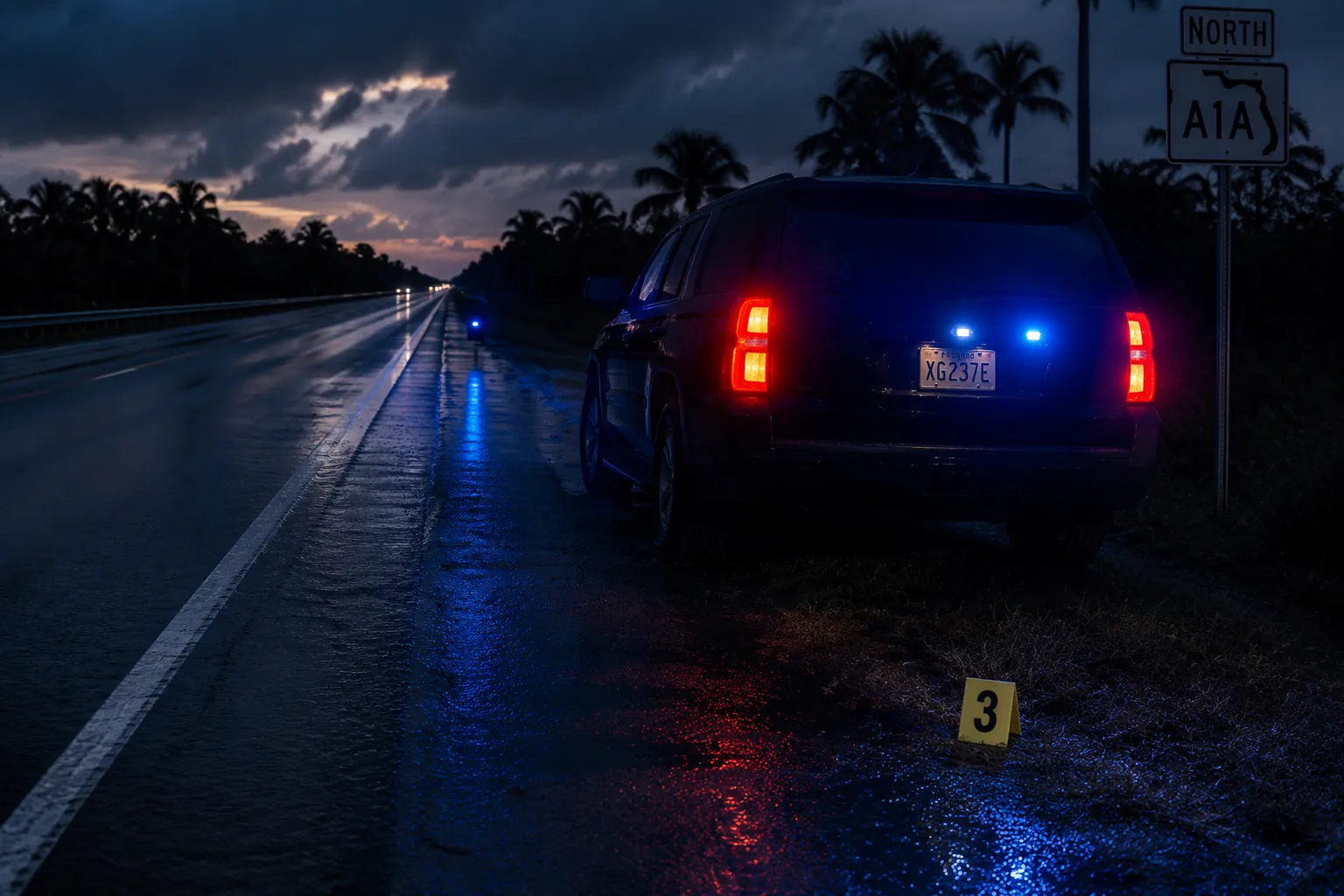
The Public Record Starts Outside the Agencies
U.S. authorities did not publicly identify Coronilla Duran in the materials now available. His name reached the public through the Mexican consulate and local media reporting, later picked up by national outlets.[3][4] That matters because identification is not a decorative fact in a death investigation. It is the point at which a family, a consulate, counsel, reporters, and oversight bodies can begin matching the official account against the human being who died.
The widow’s account makes the notification gap harder to treat as an administrative footnote. Yezzika Alamilla told the Miami Herald she learned of her husband’s death while watching television.[1] In legal process terms, that is more than a heartbreaking sequence. It shows how far the family was from the investigative center at the moment when agencies controlled the scene, the records, and the first public characterization of the incident.
The public also learned key scene details from witnesses and local reporting rather than from a federal narrative. Jose Rivera, a garbage truck driver, told the Miami Herald he saw unmarked blue SUVs with tinted windows and agents in green uniforms. The St. Johns County Sheriff’s Office said it was not involved in the immigration operation and responded only to the traffic accident.[1] Those details do not prove a legal violation. They do make the official phrase “incident” inadequate.
What Is Known About the St. Augustine Encounter
The reported sequence is narrow. Coronilla Duran, a Mexican national, died after an encounter involving immigration authorities in Florida. Reports describe him as having fled and then being struck and killed by a truck. The Florida Highway Patrol and HSI have acknowledged an investigation, but the public statement released through DHS remains generic.[1][2]
| Publicly Reported Point | Status as of July 22–23, 2026 |
|---|---|
| Identity of the person killed | Reported by the Mexican consulate and media as Juan Jairo Coronilla Duran; not publicly supplied by U.S. authorities in the available statements |
| Agencies connected to the investigation | Florida Highway Patrol and Homeland Security Investigations identified in the generic statement |
| Initial reason for the encounter | Not publicly disclosed by DHS, HSI, or FHP in the materials reviewed |
| Whether a pursuit occurred and what policy governed it | Reported circumstances raise the question, but no pursuit-protocol explanation has been released |
| Identity or status of any agent under scrutiny | No named agent, target, subject, or witness-agent status has been publicly disclosed |
| Three other people reportedly in the vehicle | Reported to have fled; their custody, witness, immigration, or charging status has not been disclosed |
The three other occupants are not a minor loose end. If they were passengers, witnesses, targets, or arrestees, their status affects almost every serious assessment of the case. They may know why the encounter began, whether officers identified themselves, whether the vehicle was boxed in or followed, and what happened in the seconds before Coronilla Duran was struck. Public reporting says they fled; DHS and FHP have not disclosed what happened to them afterward.[1][2][5]
The immigration-status question should stay where the record supports it: unresolved and legally secondary to the death investigation. CBS, the Associated Press, and Newsweek reported that Coronilla Duran was in the United States on a tourist visa, while El País cited a family audio recording saying he had a work visa. DHS has not confirmed either account.[2][3][4][5] Even if the discrepancy is later resolved, visa category does not answer whether the encounter was lawful, whether agents followed policy, whether a pursuit occurred, or whether anyone’s conduct caused a death in a criminally cognizable way.
The Investigation Exists, but Its Shape Is Still Hidden
The phrase “FHP and HSI are investigating” identifies activity, not accountability. It does not tell the public whether the inquiry is being treated as a traffic fatality investigation, an internal agency review, a potential criminal investigation of federal personnel, a review of operational compliance, or some combination of those tracks.
That distinction matters because each track asks different questions. A crash investigation may reconstruct vehicle movement and causation. An internal review may examine policy compliance. A criminal inquiry may require proof of culpable conduct by a specific person. A civil-rights review would ask still different questions about authority, force, seizure, and deprivation of rights. The public statement does not say which of those doors, if any, has actually opened.
Nor has any agency disclosed whether body-worn camera footage, vehicle video, radio traffic, dispatch logs, or contemporaneous incident reports exist. That silence sits within a broader evidence problem already familiar in immigration-enforcement cases. For readers tracking the camera and disclosure side of the issue, Lex Machina Review has separately examined the legal void around ICE body cameras and DHS use-of-force accountability gaps. Here, the immediate point is narrower: without knowing what records exist, even the investigative posture cannot be tested.
Mexico’s Criminal Complaint Track Changes the Pressure Point
Mexico’s involvement is not limited to consular identification or public protest. President Claudia Sheinbaum announced that Mexico had requested criminal charges in the United States over the deaths of Mexican nationals in ICE custody or operations, a group reported as 17 deaths. The request was directed through the Department of Justice and state or district prosecutors, while the U.S. State Department reportedly returned Mexico’s diplomatic letters concerning migrant detention center deaths.[6][7]
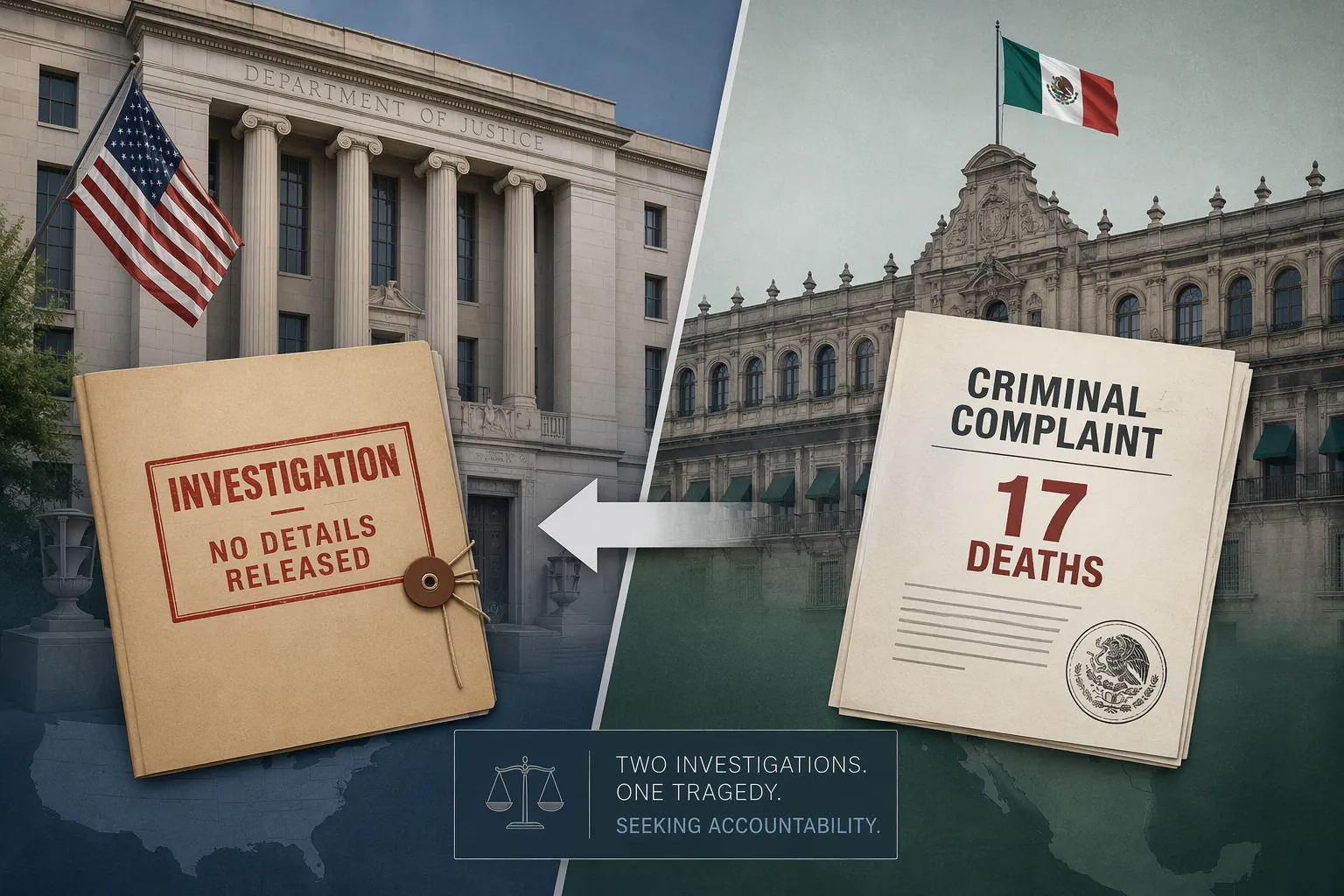
A foreign-government complaint does not compel an indictment. It does not substitute for probable cause, state criminal elements, federal civil-rights statutes, or grand jury proof. It also does not make every death in the 17-case group legally comparable. But it can change the institutional cost of silence. A consular government can keep asking who handled the operation, what records were preserved, which office has jurisdiction, whether prosecutors declined review, and whether any investigative agency has a conflict.
That is why the Mexico track matters for Coronilla Duran even before it produces any legal result. Domestic agencies have not volunteered the basic facts. A parallel complaint routed through DOJ and local prosecutorial channels may force those agencies to answer questions in a setting less dependent on their own press language. The mechanism is pressure, not proof.
For legal readers, the most important near-term question is not whether Mexico can “bring charges” in the colloquial sense. It is whether Mexico’s complaint causes a U.S. prosecutor, inspector general, civil-rights unit, state attorney, or local charging authority to create a record: referral received, jurisdiction assessed, evidence requested, witnesses identified, charges declined, or investigation opened. Any one of those steps would be more concrete than the current public posture.
Why the Case Is Being Read Beyond Florida
The St. Augustine death is being read against a broader set of recent immigration-enforcement fatalities, but the numbers need careful handling. The Guardian reported on July 9 that 10 people had been fatally shot by ICE or CBP in President Trump’s second term.[8] The New Republic later wrote that the count rose to at least 11 with Coronilla Duran’s death.[9] Those are not necessarily identical methodologies: one formulation focuses on fatal shootings, while the other includes Coronilla Duran, who was reported killed by a truck after an ICE encounter.
The pattern is still relevant, but not as a shortcut to liability. It explains why an agency statement that might once have been treated as a placeholder now reads like part of a larger disclosure problem. If multiple fatalities are followed by sparse public accounting, the legal concern is not only what happened in one roadway encounter. It is whether the ordinary machinery for naming, preserving, reviewing, and explaining fatal enforcement events is functioning at all.
There is a separate civil-remedies conversation about wrongful death, FTCA claims, state tort theories, and Bivens limits. That analysis is better handled on its own terms. Lex Machina Review has covered legal pathways for a Mexican tourist killed fleeing ICE and the broader question of legal options after a death in ICE custody. The criminal-investigation question here is more immediate: what public mechanism can require the facts to surface before civil discovery, if civil litigation ever comes?
What Disclosure Would Actually Clarify
A meaningful public update would not need to expose every witness statement or forensic conclusion. It could still protect the investigation while answering basic structural questions: which agency initiated the encounter, whether officers were acting under ICE, HSI, or another authority, whether the vehicles were government vehicles, whether lights or sirens were used, whether any pursuit was reported, and whether the other occupants have been located.
It should also identify the investigating bodies with enough precision to distinguish a crash investigation from a review of federal conduct. “FHP and HSI” leaves unresolved whether HSI is investigating its own personnel, assisting FHP, preserving federal records, or reviewing an enforcement operation that involved another DHS component. That ambiguity is especially consequential where the sheriff’s office has already said it was not part of the operation and responded only to the traffic accident.[1]
The records most likely to matter are ordinary ones: dispatch logs, radio traffic, CAD entries, incident reports, vehicle assignments, agent rosters, supervisor notifications, crash reconstruction materials, toxicology or medical examiner findings if any are released, and preservation notices. None of those records alone decides criminal liability. Together, they establish whether the fatal sequence was treated as a serious enforcement event from the first hour.
The Narrow Status Report
As of July 23, 2026, no public source in the reviewed record reports charges, an indictment, an agency disciplinary action, or a named agent under criminal scrutiny in Coronilla Duran’s death. The investigation exists in the sense that FHP and HSI have acknowledged one. It does not yet exist, publicly, as a discernible accountability process.
That is the defensible stopping point. The known facts do not support predicting charges. They also do not justify treating the generic agency statement as an adequate public accounting for a death following an immigration-enforcement encounter. The first serious disturbance of the silence may come not from the agencies that controlled the initial narrative, but from Mexico’s effort to push 17 deaths into prosecutorial channels where names, jurisdictions, and investigative decisions are harder to leave undescribed.
References
- Mexican father killed by truck was visiting U.S. on a tourist visa, non-profit says — Miami Herald
- Mexican man struck and killed by truck after ICE encounter in Florida was on vacation, officials say — CBS News
- Who Is Juan Jairo Coronilla Duran? Mexican National Dies in Florida ICE Incident — Newsweek
- Mexican man killed after ICE encounter in Florida was on vacation — Associated Press via ABC News
- Questions surround the death of Juan Jairo Coronilla, the Mexican who was fleeing ICE — El País
- Mexico's Sheinbaum announces criminal charges request in US over ICE deaths — Al Jazeera, July 14, 2026
- Mexico asks states to investigate migrant deaths in ICE custody — The Hill
- 'New terrifying levels': 10 people fatally shot by immigration officials in Trump's second term — The Guardian, July 9, 2026
- Man Who Died Running From ICE Was Tourist With a Ticket Home — The New Republic, July 21, 2026
Chronological incident history
No sanction cases have named this tool in the tracked record set to date. This does not imply the tool is safe — see Risk Digest for ongoing monitoring.
← Compare peer toolsReport a correction or tip
Spotted an outdated figure, a misstated fact, or a ruling this tool profile should reflect? Public comments are disabled for this content given the professional cost of a misreported case outcome, penalty amount, or rule text — use the structured correction channel instead.
Report a correction or tip for this record →