
Assessing Legal Claims from the Korean AI Chip Sell-Off
The July 2026 Korean AI chip stock rout created multiple concurrent legal-risk fronts—securities class actions, SEC AI-washing enforcement, Korean retail investor losses, and an active DRAM antitrust case—giving securities practitioners a framework to assess plausible claims across jurisdictions.
- Tool
- Harvey AI
- Benchmark source
- Alston & Bird securities class action filing data
- Hallucination rate
- Not measured / undisclosed
- Test methodology
- Legal risk assessment using securities filings, regulatory statements, and news reports
- Test date
- Jul 30, 2026
The Korean AI chip stocks sell-off has to be read as a risk map before it is read as a lawsuit story. Four lanes are already visible: a US securities lane around SK Hynix’s newly listed Nasdaq ADR and any AI-demand or risk disclosures attached to that offering; a Korean retail-product and regulatory lane around leveraged single-stock ETFs; an SEC enforcement lane shaped by the Commission’s recent AI-washing posture; and an antitrust lane created by a pending DRAM class action that predates the late-July rout but now sits uncomfortably close to the same issuers and supply-chain narrative.
The filing environment matters, but only as context. NERA data summarized by Alston & Bird counted 118 new federal securities class action filings in the first half of 2026, including 18 AI-related filings, already above the full-year AI-related count for 2025; the same summary reported that filings were on pace for 236 cases, that 68% were concentrated in the Second and Ninth Circuits, and that foreign-issuer filings had risen to 20.5% from 13.8% in 2025.[1] That does not make every AI-linked stock drop actionable. It does mean that a foreign issuer, a recent US offering, and an AI-demand story now arrive in a plaintiff-side screening environment already trained to look for disclosure gaps.
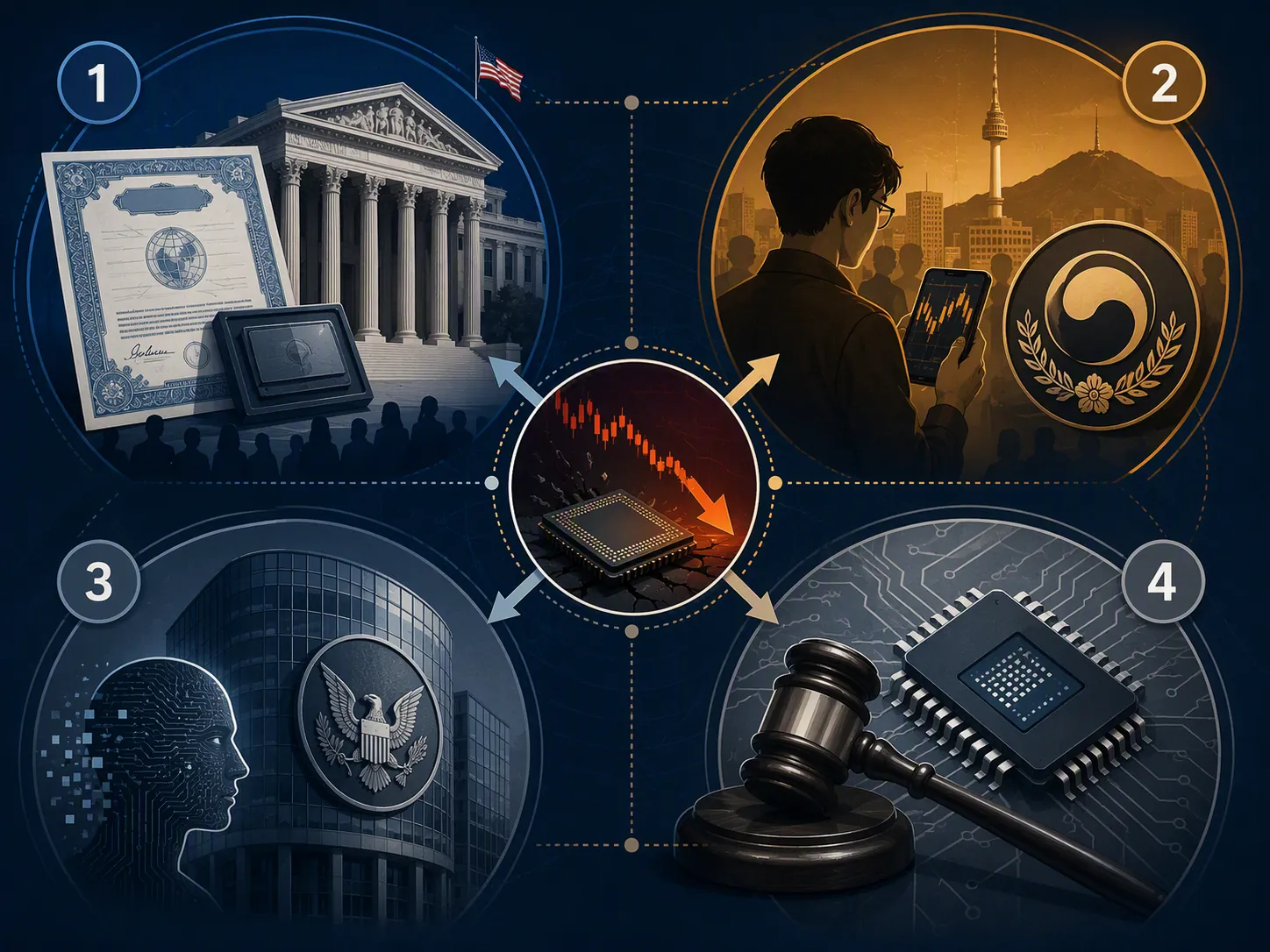
| Risk front | Legally useful facts | What still needs verification |
|---|---|---|
| US securities claims | SK Hynix Nasdaq ADR IPO at $149 on July 10, 2026; trading below IPO price by July 28; reported F-1 warning about volatility-linked litigation risk. | Exact F-1 language, offering materials, forum provisions, challenged statements, purchaser class, and loss-causation theory. |
| Korean retail and regulatory exposure | Leveraged ETF losses, net retail purchases, regulator product-approval admissions, July 16 ban on new listings, July 29 minister apology, deposit-minimum change. | Product approvals, suitability obligations, investor disclosures, broker conduct, methodology behind loss estimates, and available statutory remedies. |
| SEC AI-washing enforcement | Prior AI-related cease-and-desist orders and SEC examination priority around AI disclosures. | Whether Korean chip issuers or market participants made US-facing AI claims that are materially false or misleading. |
| DRAM antitrust litigation | Pending Northern District of California class action alleging coordinated restriction of DDR3/DDR4 output during the HBM transition. | Complaint allegations, docket status, class definition, causation theory, and overlap with securities-loss narratives. |
The US Securities Lane Starts With the Offering Documents
The SK Hynix ADR facts are attractive to securities lawyers because they are document-heavy. The company launched a Nasdaq ADR listing at $149 on July 10, 2026, in what Yahoo Finance described as a $28 billion offering; by July 28, the ADRs were trading below the IPO price.[2] The Wall Street Journal also reported that the company’s F-1 registration statement warned of volatility-linked litigation risk as a material factor.[3] Those facts give counsel a place to begin, not a completed complaint.
A post-offering price break matters differently depending on the claim. For a Securities Act theory, the first questions are whether the buyer has standing, whether the securities can be traced to the offering, and whether the challenged statement sits in the registration statement, prospectus, or incorporated materials. For an Exchange Act theory, the questions move toward scienter, market statements, corrective disclosures, reliance, and loss causation. A headline that the ADR traded below $149 within two weeks is useful for damages and materiality screening, but it does not identify the misstatement.
The reported F-1 litigation-risk warning is a particularly important but fragile fact. It should not be paraphrased into more than the available sourcing supports. If the filing warned that share-price volatility could lead to litigation, that may help the defense argue the risk was disclosed. It may also help plaintiffs argue the issuer understood volatility and litigation exposure as material, depending on what the document said elsewhere about AI demand, customer concentration, capacity, memory pricing, China competition, Nvidia-linked expectations, or market concentration. The exact SEC filing language needs to be pulled and read before anyone ranks that point.
The late-July market context supplies the loss environment. CNBC reported that chip stocks shed about $1 trillion as the sell-off hit companies powering the AI boom, with KOSPI circuit-breaker events and single-day declines of 14.7% for Samsung and 13.4% for SK Hynix.[4] Reuters tied Asian chip-stock weakness to China competition fears and concerns around Nvidia financing.[5] Those facts may help explain marketwide pressure. They may also complicate loss causation, because a defendant can point to sectorwide repricing rather than issuer-specific revelation.
That is why the chronology matters. If the alleged corrective event is merely “AI chip stocks fell,” the claim is weakly specified. If the chronology shows a mismatch between offering statements and later concrete information about demand, inventory, financing, regulatory constraints, customer orders, or memory-price assumptions, the pleading terrain changes. The legal work is not to prove that AI enthusiasm cooled. It is to identify whether a specific public statement or omission became false or misleading when made, and whether the later price move revealed that problem rather than a broader market shock.
Foreign-issuer status adds another filter rather than a shortcut. The NERA filing data show that foreign-issuer cases are taking a larger share of securities class action filings in 2026.[1] But a Korean issuer with Nasdaq-traded ADRs still requires attention to the purchase location, the security purchased, forum selection language, Morrison issues for non-US transactions, and whether the offering documents contain enforceable venue or arbitration provisions. Counsel triaging institutional losses should separate ADR purchasers from ordinary-share purchasers before investing heavily in merits analysis.
The Korean Retail-Product Lane Has a Different Evidentiary Gate
The Korean retail-investor front is not just the domestic version of the ADR problem. The loss channel is different: single-stock leveraged ETFs, retail purchases, margin exposure, product approval, distribution practices, and regulator response. The most useful facts are not just market losses but the sequence of product authorization, investor uptake, rapid drawdown, and official acknowledgement.
Chosun Biz reported Citi strategist commentary estimating about 56 trillion won, or $38.7 billion, in retail losses on leveraged ETFs, and reported 14 trillion won in net retail purchases of single-stock leveraged ETFs since May 27, 2026.[6] CNBC separately reported that an SK Hynix 2x leveraged ETF was down more than 80% from its peak, that margin-loan balances still stood at 32.7 trillion won as of July 27, and that about 65% of positions had been unwound.[7] The 56 trillion won figure should be handled as strategist commentary, not as an official loss finding, and the methodology matters if it later becomes part of a demand letter, regulatory submission, or pleading.
The regulatory timeline gives that loss channel its legal edge. Reuters reported that South Korea announced a ban on new listings of single-stock leveraged ETFs on July 16, 2026, and that the Financial Services Commission said new measures would be introduced for those products.[8] CNBC then reported that the FSC acknowledged the products had been approved without “careful consideration,” that the finance minister apologized on July 29, 2026, and that a 30 million won deposit minimum would take effect on August 5.[9]
That sequence is more legally useful than a generalized retail-loss narrative. A product was available. Retail investors bought it in size. Losses accumulated during a concentrated chip-stock correction. The regulator then acknowledged an approval problem, halted new listings, and tightened entry conditions. Those facts do not by themselves establish a private right of action or government liability, but they create a documentary trail that Korean investor counsel would want before deciding whether claims sound in product disclosure, suitability, broker conduct, administrative fault, or political compensation pressure.
There is also a causation issue that should not be skipped. A leveraged ETF investor’s loss may arise from the underlying stock decline, leverage mechanics, daily rebalancing, margin liquidation, investor misunderstanding, product disclosure defects, or a combination of those channels. The existence of large losses does not show which channel is legally recoverable. Counsel would need the ETF prospectus, exchange listing materials, broker risk warnings, margin-call records, and any FSC approval file that can be obtained.
The July 29 apology is politically powerful, but its litigation value depends on wording and forum. An apology for regulatory lapses may support pressure for compensation or reform. It may also become an exhibit in an administrative-law challenge. It is less likely, standing alone, to solve reliance, individual damages, or private-cause-of-action questions. The useful approach is to preserve the admission without asking it to do more work than Korean law allows.
AI-Washing Risk Belongs on the Map, but It Is Not a Label for Every Decline
The SEC enforcement backdrop is relevant because AI-related disclosure claims are no longer theoretical. Alston & Bird’s AI disclosure review described March 2024 SEC cease-and-desist orders involving penalties in the $175,000 to $225,000 range, a June 2024 CEO action, and a 2026 examination agenda that kept AI as a standing priority.[10] That history tells issuers and underwriters that AI claims in securities filings, investor presentations, and marketing materials can attract enforcement scrutiny.
For the Korean chip rout, however, “AI-washing” should be used narrowly. A chipmaker can be highly exposed to AI demand without having made a false AI claim. Enforcement risk would turn on the content of US-facing statements: whether the issuer overstated AI-related revenue visibility, misstated customer commitments, presented speculative demand as secured, omitted constraints on HBM capacity, or used AI language that was materially inconsistent with internal facts. A falling share price after AI-sector repricing is not the same thing as an AI-washing case.
This is where offering-document review and enforcement review overlap. The same sentence in an F-1, roadshow deck, earnings release, or investor presentation may be relevant to a private securities claim and to an SEC inquiry. But the standards and incentives are not identical. Private plaintiffs need a claim that survives pleading requirements and ties loss to the alleged disclosure failure. The SEC can focus on investor-protection concerns, examination priorities, and whether statements were materially misleading in context.
The DRAM Antitrust Case Is Adjacent, Not Interchangeable
The DRAM antitrust case should be kept in the same risk file, but not merged into the securities theory without discipline. Quartz reported that a class action filed on June 25, 2026, in the Northern District of California before Judge Noel Wise names Samsung, SK Hynix, and Micron; the report says 17 plaintiffs allege the companies used the industry-wide HBM transition as a coordinated pretext to restrict DDR3 and DDR4 output, with DRAM prices up about 700% over four years.[11] Quartz also noted prior DOJ price-fixing convictions and combined fines of $731 million against the defendants.[11]
Those allegations, if accurately reflected in the docket, are serious. They also run through a different legal architecture: agreement, market definition, output restriction, price effects, class certification, and antitrust injury. A securities plaintiff might look at the antitrust complaint for disclosure angles if a defendant had made statements about memory pricing, capacity discipline, competitive conditions, or HBM transition strategy. But the fact that an antitrust complaint exists does not automatically supply securities fraud.
The docket needs direct verification. The available research is based on news summaries rather than the PACER complaint. Before relying on the case in a securities-risk memo, counsel should pull the complaint, confirm the filing date, parties, judge assignment, alleged class period, product scope, and quoted statements. The antitrust front may become more important if discovery or motion practice produces admissions relevant to issuer disclosures, but that is a later bridge, not a present assumption.
How to Triage the Claims Before the Narrative Hardens
The practical triage begins by separating losses by instrument. ADR purchasers, Korean ordinary-share purchasers, leveraged ETF investors, margin borrowers, and DRAM purchasers do not stand in the same procedural position. Their losses may have occurred during the same week and involved the same issuer names, but standing, forum, governing law, causation, and damages proof differ.
- For ADR claims, start with the F-1, prospectus, roadshow materials, exchange notices, and trading records that show whether the shares trace to the offering.
- For Exchange Act exposure, build the corrective-disclosure chronology before drafting any theory around AI demand or memory pricing.
- For Korean leveraged ETF claims, collect product disclosures, listing approvals, broker warnings, margin records, and the FSC statements in their original Korean text.
- For SEC AI-washing risk, isolate US-facing AI statements and compare them with internal support, customer commitments, capacity data, and risk-factor language.
- For antitrust overlap, pull the Northern District of California complaint and docket before treating the allegations as usable securities-litigation facts.
The most tempting mistake is to let the size of the rout substitute for legal work. A $1 trillion sector sell-off, a 35% KOSPI correction, circuit breakers, and double-digit single-day declines are materiality and loss context. They are not a theory of liability. The better question is narrower: which public document, approval record, regulator statement, investor-loss estimate, or filed complaint can be attached to a pleading or motion, and what element does it actually support?
On the present record, the sell-off creates a dense legal-risk map rather than an obvious winner. The US securities lane depends on exact offering and disclosure language. The Korean retail lane depends on product records, regulator admissions, and the legal consequences of approval failures. The SEC lane depends on specific AI statements, not AI exposure as such. The antitrust lane depends on a complaint that must be read directly. Those files should be reviewed together before counsel ranks plausible claims, because the same week of market stress may produce very different answers depending on who bought what, where, and in reliance on which statement.
References
- Securities Class Action Filings Surge in the First Half of 2026. Alston & Bird.
- SK Hynix launches $28 billion Nasdaq ADR listing. Yahoo Finance.
- SK Hynix's $28 Billion Offering Brings Korean Market Concentration Risk Into Focus. The Wall Street Journal.
- Chip stocks shed $1 trillion as selloff hits companies powering AI boom. CNBC. July 29, 2026.
- Asian chip stocks slide as China competition fears rattle AI trade. Reuters. July 28, 2026.
- Citi warns Korea retail racks up 56 trillion won losses in leveraged ETFs. Chosun Biz.
- 'Give me my money back': South Korean traders' leveraged bets unravel. CNBC. July 20, 2026.
- South Korea to ban new listings of single-stock leveraged ETFs. Reuters. July 16, 2026.
- Minister apologizes as Korean leveraged ETF investors nurse heavy losses amid chip stock rout. CNBC. July 29, 2026.
- Navigating AI-Related Disclosure Challenges: Securities Filing, SEC Enforcement, and Shareholder Litigation Trends. Alston & Bird.
- Samsung, SK Hynix, Micron face antitrust class action lawsuit. Quartz. June 25, 2026.
Chronological incident history
No sanction cases have named this tool in the tracked record set to date. This does not imply the tool is safe — see Risk Digest for ongoing monitoring.
← Compare peer toolsReport a correction or tip
Spotted an outdated figure, a misstated fact, or a ruling this tool profile should reflect? Public comments are disabled for this content given the professional cost of a misreported case outcome, penalty amount, or rule text — use the structured correction channel instead.
Report a correction or tip for this record →