
The Legal Mechanics of a Long John Silver's Franchisee Bankruptcy
This article explains the three-phase legal process — automatic stay, executory contract treatment, and Chapter 7 versus Chapter 11 — that governs every Long John Silver's franchisee bankruptcy, using the Uplifted Foods LLC Chapter 7 filing as a timely illustration. Franchise attorneys and bankruptcy practitioners will learn how the Bankruptcy Code's sections 362 and 365 apply in a franchisee context.
- Hallucination rate
- Not measured / undisclosed
Uplifted Foods LLC did not make the bankruptcy docket because Long John Silver's is a famous name. It made the docket because a closed, single-unit franchisee reached the point where rent, franchise obligations, and ordinary trade debt stopped being a business problem and became a bankruptcy estate problem.
The Minnesota operator filed Chapter 7 on May 29, 2026, in the District of Minnesota, Case No. 3:26-bk-31793. It had operated Long John Silver's last Minnesota location at Mall of America and had closed the store before filing. The petition listed estimated assets of $0 to $100,000 and estimated liabilities of $100,000 to $1 million; secondary reports citing the underlying Minneapolis/St. Paul Business Journal account put total listed debts above $157,000, with about $111,000 owed to the mall's owners and rent around $11,000 per month.[1][2]
That is enough to frame the real question behind a Long John Silver's franchisee bankruptcy: once a franchisee files, who controls the next move? The answer is not the brand story. It is the Bankruptcy Code sequence: what existed on the petition date, what the automatic stay freezes, what happens to the franchise agreement as an executory contract, and whether the chapter selected leaves any practical room to preserve value.

The Petition Date Is the First Legal Cutoff
A franchise bankruptcy file should be read in petition-date order. Before asking whether the franchisor can terminate, whether the landlord can recover possession, or whether the trustee can sell anything, counsel has to identify what rights still existed when the petition was filed.
In Uplifted Foods, the store had already closed. That fact matters, but it does not answer every question. A closed restaurant may still have a lease, equipment, accounts, claims, or contract rights. It may also have defaults that make assumption expensive or impossible in practice. The filing opens the bankruptcy case; it does not by itself prove that the franchise agreement had value, that the trustee will try to preserve it, or that the franchisor will need to litigate for relief.
As of July 23, 2026, the Uplifted Foods docket is still too young to support outcome claims. The useful lesson is narrower: the filing shows the triage moment. A single-unit franchisee is no longer negotiating only with a franchisor and landlord. The estate, trustee, secured and unsecured creditors, and the automatic stay now sit between the parties and their usual remedies.
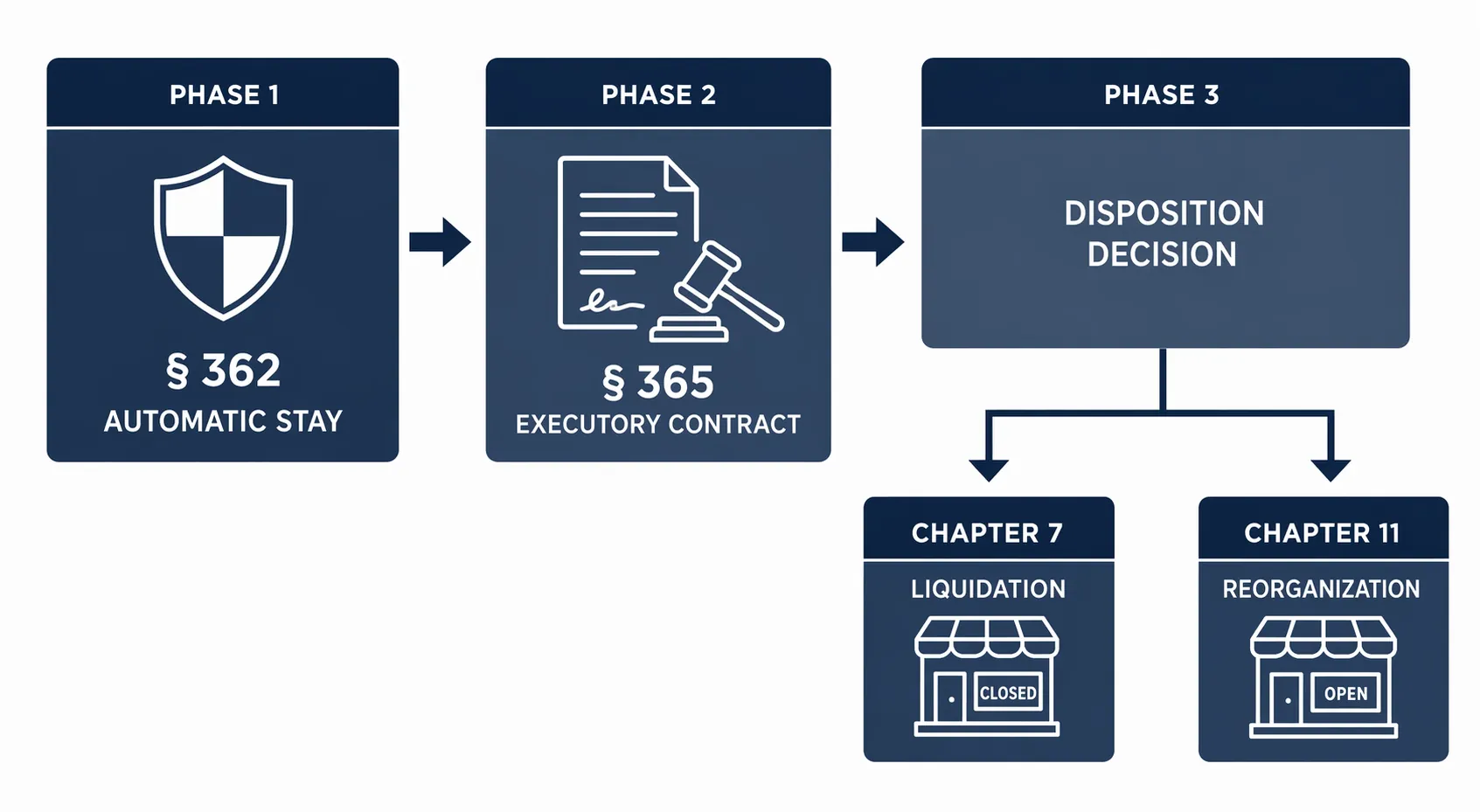
What the Automatic Stay Actually Freezes
Section 362 is the first hard stop. Once the bankruptcy petition is filed, the automatic stay generally bars creditors from continuing collection activity, enforcing prepetition claims, or taking unilateral action against estate property. In the franchise setting, practitioner guidance treats that stay as immediately relevant to franchisor termination efforts, royalty collection, and enforcement of default remedies tied to prepetition conduct.[3]
The stay is not a business rehabilitation plan. It is a temporary legal injunction. If a Long John Silver's franchisee files while the franchise agreement still exists, the franchisor should assume that ordinary default enforcement has become bankruptcy activity until a court says otherwise. Sending termination notices, cutting off operational access, or treating the filing itself as a default can create avoidable stay problems.
Ipso facto clauses are the related trap. A franchise agreement may say that insolvency, bankruptcy, receivership, or similar financial distress is a default. In bankruptcy, those clauses generally cannot be used simply to end the agreement because the debtor filed. That does not erase non-bankruptcy defaults, unpaid royalties, quality-control breaches, or operational failures. It does mean that counsel should separate the bankruptcy filing itself from the prepetition facts that may support relief from stay or later contract treatment.[3][4]
The distinction is not academic. A franchisor that terminated properly before the petition may be in a different position from one that was merely threatening termination. The automatic stay can freeze rights that still exist; it generally does not recreate a franchise relationship that was already gone.
The ARC Burger Contrast
ARC Burger, a 77-location Hardee's franchisee, filed Chapter 7 in April 2026 with more than $29 million in liabilities. Practitioner commentary uses that case to illustrate the other side of the petition-date line: the franchisor had terminated before the bankruptcy filing, so the automatic stay did not protect the debtor's ability to continue as a franchisee.[3]
That contrast is more useful than treating ARC Burger as another restaurant-distress anecdote. If termination was complete prepetition, the debtor may have no franchise agreement left for the estate to assume, assign, or operate under. If termination was incomplete, disputed, or stayed after filing, the estate may still have something to fight about. The docket posture controls the leverage.
Section 365 Is Where the Franchise Agreement Becomes the Main Asset or Burden
A franchise agreement is usually treated as an executory contract: both sides still have material performance obligations. The franchisee must pay royalties, follow brand standards, use approved supplies, maintain insurance, and operate within the system. The franchisor must provide the licensed marks, system access, operational rights, and whatever support the agreement requires. Section 365 is the Bankruptcy Code provision that tells the estate what it may do with that kind of contract.[3][4]
The estate has three broad paths: assume, reject, or, in some circumstances, assume and assign. None is automatic, and none should be discussed without defaults.
| Section 365 path | What it means in a franchise case | Practical pressure point |
|---|---|---|
| Assumption | The estate keeps the franchise agreement. | Defaults generally must be cured, and future performance must be adequately assured. |
| Rejection | The estate declines the contract. | The franchisor receives a bankruptcy claim rather than continued performance. |
| Assumption and assignment | The estate tries to transfer the agreement to a buyer. | The franchisor may object, especially where consent, trademark control, or nondelegable duties are implicated. |
Assumption is the cleanest concept and often the hardest economics. A debtor that wants to keep operating under the Long John Silver's system cannot simply tell the court that the brand relationship is important. It normally must cure monetary defaults or provide adequate assurance that cure will occur, compensate for certain losses, and show adequate assurance of future performance. In a restaurant case, that may require dealing with unpaid rent, royalties, supply obligations, insurance, taxes, deferred maintenance, and brand-standard issues at the same time.
Rejection is less dramatic but often more realistic. If the contract burdens the estate more than it benefits it, rejection converts the counterparty's rights into a bankruptcy claim. For a closed single-unit restaurant in Chapter 7, rejection may be the practical destination unless someone can identify sale value in the franchise rights, equipment package, lease position, or location-specific goodwill.
Assignment is where franchise counsel should slow down. Section 365(f) broadly favors assignment of executory contracts despite anti-assignment language, and practitioner commentary warns franchisors that a debtor may try to assign a franchise agreement over objection.[3] But franchise agreements are not ordinary supply contracts. They involve trademarks, system standards, personal qualifications, consent provisions, and ongoing control. Bloomberg Law has also noted the active split over Section 365(c)(1), including whether certain contracts can be assumed or assigned without the non-debtor party's consent.[5]
That split should keep both sides from overclaiming. A franchisee-side lawyer should not assume Section 365(f) makes every franchise agreement freely marketable. A franchisor-side lawyer should not assume a consent clause ends the inquiry. The question becomes jurisdiction-specific, contract-specific, and fact-specific: what applicable non-bankruptcy law says, what the contract requires, what defaults exist, and whether the proposed assignee can provide adequate assurance of future performance.
Chapter 7 and Chapter 11 Do Different Work
The chapter matters because it changes who is trying to create value. In Chapter 11, a debtor usually files because it wants breathing room to reorganize, sell assets as a going concern, negotiate with landlords and franchisors, or preserve enterprise value. In that posture, assumption or assumption-and-assignment may be part of the case strategy.
Chapter 7 is different. A trustee is appointed to liquidate estate property for creditors. If the restaurant is already closed, if the lease is deeply in default, if employees and inventory are gone, and if the franchise rights cannot be monetized without expensive cure or franchisor litigation, the agreement may be more burden than asset. That is a legal posture, not a prediction about Uplifted Foods. The case has not matured enough to know what the trustee will report or whether any party will seek relief from stay.
The Uplifted Foods facts point to the liquidation end of the spectrum: Chapter 7, one closed Mall of America location, limited scheduled assets, and a landlord claim that appears large relative to the size of the case.[1][2] Those facts make Section 365 valuable as a sorting device. They do not make the franchise agreement valuable as a matter of law.
Why These Restaurant Files Are Showing Up Now
The industry context explains why lawyers are seeing more of these questions, but it does not decide the bankruptcy outcome. Technomic reported that Top 500 chain sales grew 3% in 2025 against 3.8% menu-price inflation, producing a 1.3% real median sales decline.[6] That is the kind of margin compression that turns a workable rent number into a default notice.
Long John Silver's has its own system history, and it should be handled carefully. USA Today reported that Four Oaks Partners acquired the brand in 2022 and later closed about 110 locations as part of portfolio optimization, with 70 to 75 of those closures tied to ending co-branded arrangements.[7] Food Republic, citing company statements, reported about 477 current locations, including 214 company units and 262 franchised units, down from roughly 1,300 at the chain's peak; other public counts vary, likely because they count different categories of units.[8]
Past Long John Silver's franchisee disputes also show that distress in this system is not new. Treasure Isles, a franchisee, filed Chapter 11 in 2010 and brought a $5.4 million co-branding fraud lawsuit against Yum! Brands.[9] The same franchisee later filed another Chapter 11 case in 2019.[10] Those cases are not proof of what will happen in Uplifted Foods. They only show that franchisee insolvency often arrives with a contract history already attached.
The Filing-Date Checklist That Actually Matters
For counsel on either side of a Long John Silver's franchisee bankruptcy, the first review should be procedural, not atmospheric. The useful questions are narrow because the wrong broad story can lead to the wrong motion.
- Did the franchise agreement still exist when the bankruptcy petition was filed?
- Were termination notices sent, and if so, were they effective before the petition date?
- Which defaults are monetary, which are operational, and which depend only on insolvency or bankruptcy?
- Is the franchisor seeking relief from stay, or is the trustee moving toward rejection?
- Could assumption or assignment create value after cure costs, landlord issues, and brand-approval disputes are counted?
- Does the chapter selected leave time and purpose for reorganization, or is the estate only liquidating what remains?
Those questions are less satisfying than a brand narrative, but they are the questions that determine the next filing. In a franchisee bankruptcy, the famous sign over the counter is rarely the operative fact. The operative facts are whether the franchise agreement survived to the petition date, what Section 362 temporarily prevents, what Section 365 lets the estate do with the contract, and whether Chapter 7 or Chapter 11 leaves any realistic path other than liquidation.
References
- Long John Silver's franchisee files Chapter 7 bankruptcy, TheStreet.
- Seafood restaurant franchisee closes, files, Yahoo Finance.
- When Your Franchisee Files for Bankruptcy: What Every Franchisor Needs to Know Right Now, Stark & Stark.
- Franchisee Bankruptcy Basics, Goosmann Law.
- Fast-Food Franchisee Bankruptcies Portend Industrywide Struggles, Bloomberg Law.
- Technomic Top 500: Chain restaurant sales slowed again in 2025, Restaurant Business.
- Long John Silver's sales increasing despite closures, USA Today, June 26, 2026.
- The Largest Fast Food Fish Chain Was Once A Giant. What Happened To Long John Silver's?, Food Republic.
- Yum franchisee sues franchisor over co-branding, Nation's Restaurant News.
- Long John Silver's franchisee files bankruptcy, St. Louis Business Journal.
Chronological incident history
No sanction cases have named this tool in the tracked record set to date. This does not imply the tool is safe — see Risk Digest for ongoing monitoring.
← Compare peer toolsReport a correction or tip
Spotted an outdated figure, a misstated fact, or a ruling this tool profile should reflect? Public comments are disabled for this content given the professional cost of a misreported case outcome, penalty amount, or rule text — use the structured correction channel instead.
Report a correction or tip for this record →