
Marine Corps AI anti-drone turret exposes gaps in autonomous weapons law
The Marine Corps' July 2026 selection of the Bullfrog AI-powered anti-drone turret for the L-MADIS platform raises questions about what U.S. law and policy governs autonomous weapons systems. This article analyzes the system's classification under DoD Directive 3000.09, the decade-long absence of senior-level reviews, and the regulatory gaps exposed by rapid deployment.
- Hallucination rate
- Not measured / undisclosed
The Marine Corps did not buy a science-fiction premise in July 2026. It selected a gun-based counter-drone system: Allen Control Systems’ Bullfrog M240 AI-powered turret for integration with the Light Marine Air Defense Integrated System, or L-MADIS, under a $6.2 million Other Transaction Authority award.[1] That procurement fact matters because Bullfrog is being presented as a practical answer to a practical battlefield problem: cheap drones arriving in numbers that make expensive missile interceptors an awkward answer.
The legal question starts with the system’s own description. ACS describes Bullfrog as using artificial intelligence for autonomous detection, tracking, identification, and target acquisition, while emphasizing that firing remains under human command. The company’s formulation is blunt: “the computer doesn’t decide what to do — humans do.”[2] That sentence is doing substantial regulatory work. If the final shot is human-commanded, Bullfrog is easier to distinguish from the popular image of a weapon that roams, chooses, and kills on its own. But it also leaves the harder question in place: when the machine has already detected, tracked, identified, and acquired the target, what part of the targeting process is legally decisive?
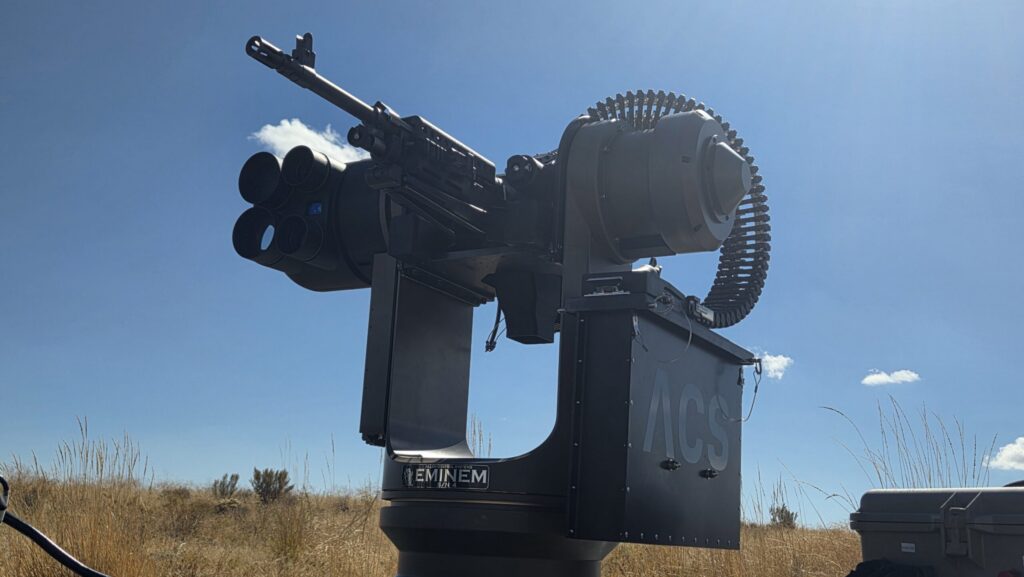
That is the right place to begin the legal analysis. The category cannot be chosen by the presence of software alone. It also cannot be resolved by pointing only to the last human command. The operative issue is how U.S. policy classifies a weapon whose autonomous functions sit upstream of firing but downstream of ordinary sensor assistance.
Why the Bullfrog procurement is moving faster than the law around it
The procurement pressure is not mysterious. Small unmanned aircraft have become a recurring tactical problem, and the Marine Corps’ L-MADIS program is built around mobile counter-drone defense.[3] Bullfrog’s appeal is that it uses a machine-gun-based approach rather than a high-end interceptor for every incoming drone. Breaking Defense reported the cost contrast in stark terms: roughly $10 per gun round compared with interceptors that can cost about $4 million.[1]
That comparison does not prove effectiveness. Cost-per-shot is not cost-per-successful-engagement, and public reporting does not establish how Bullfrog will perform across weather, clutter, swarming, spoofing, or mixed civilian-military environments. But it explains why commanders would want the capability quickly. A defense system that promises many low-cost attempts against many low-cost threats changes the procurement tempo before the legal vocabulary has settled.
The technical reporting also matters because Bullfrog is not described merely as a stabilized mount with better optics. Public accounts describe a turreted M240 system using AI-enabled perception and aiming functions, with the human retained at the firing-command stage.[4] That combination is precisely what creates the classification problem: the most legally sensitive targeting work may occur before the final authorization.

The likely Directive 3000.09 category is semi-autonomous, with an important caveat
The controlling U.S. policy framework is Department of Defense Directive 3000.09, Autonomy in Weapon Systems. The directive does not use “meaningful human control” as its legal test. Its standard is “appropriate levels of human judgment over the use of force,” a phrase that is more operationally flexible and less determinate than the international-policy shorthand often used in public debate.[5]
Under the directive’s definitional framework, an autonomous weapon system is one that, once activated, can select and engage targets without further intervention by an operator. A semi-autonomous weapon system, by contrast, is intended to engage only individual targets or specific target groups that have been selected by an operator.[5] The 2023 update to the directive preserved the basic definitional structure while modifying review and governance processes around autonomy in weapon systems.[6]
On the public record, Bullfrog appears much closer to the semi-autonomous side of that line. ACS says the system autonomously detects, tracks, identifies, and acquires targets, but that humans command firing.[2] If that description is accurate in fielded configuration, the weapon is not publicly described as selecting and engaging targets without further human intervention. It is described as automating much of the targeting chain while reserving the final engagement command to an operator.
That conclusion should be kept narrow. The Department of Defense has not publicly confirmed Bullfrog’s formal classification under Directive 3000.09. The analysis rests on ACS’s statements and press descriptions, not on a released legal review, capabilities-development document, test plan, rules-of-engagement package, or formal DoD autonomy determination. A later configuration with automated engagement authority would require a different analysis.
| Publicly described Bullfrog function | Why it matters under Directive 3000.09 |
|---|---|
| Autonomous detection | The system may determine that an object is present before the operator focuses on it. |
| Autonomous tracking | The system may maintain attention on a moving object and shape what the operator sees as salient. |
| Autonomous identification | The system may contribute to the judgment that the object is a drone or threat. |
| Autonomous target acquisition | The system may aim or prepare the weapon solution before the human firing command. |
| Human-commanded firing | This is the feature that likely keeps the system in the semi-autonomous category as publicly described. |
The difficulty is that Directive 3000.09’s categories are organized heavily around selection and engagement. Bullfrog’s public design places the human at the engagement command, but places the machine across functions that strongly influence selection in practice. For a lawyer reviewing the system, the key question is not whether the human touches the trigger. It is what the operator is actually judging at that moment: an independently assessed target, or a machine-presented target solution.
Why the senior-review gap changes the stakes
The semi-autonomous classification matters because Directive 3000.09 reserves its most stringent senior-level review process for certain autonomous and novel autonomy-related weapon systems. That process is not an academic safeguard. It is supposed to force senior officials to confront reliability, operator judgment, doctrine, training, testing, and legal review before the most consequential autonomy capabilities are fielded.[5][6]
The institutional record is thin in a way that should make compliance professionals uncomfortable. Public defense-policy analysis has reported that no weapon system has completed the Directive 3000.09 senior-level review process since the directive was first issued in 2012.[7] That fact does not prove unlawful evasion. It may mean systems have been structured, classified, or limited so they do not trigger the process. But either way, the result is the same from an oversight perspective: the government has had more than a decade of autonomous-weapons policy without a completed public example of the directive’s highest review mechanism operating on an actual weapon system.
Bullfrog illustrates why that matters. A system can be operationally significant, AI-enabled, and legally sensitive while still falling outside the strictest review trigger because the last firing decision remains human-commanded. The review architecture then depends on whether ordinary acquisition, testing, safety, and weapons-law review processes are adequate for autonomy that does not cross the formal autonomous-engagement line.
That is not a mere paperwork concern. If a human operator relies on machine classification and tracking under time pressure, the human judgment required by policy may become compressed into accepting, rejecting, or hesitating over an AI-generated engagement opportunity. The more the system improves speed and accuracy, the more tempting it becomes to treat the machine’s target presentation as the operative judgment. Directive 3000.09 can account for that concern only if reviewers examine the actual human-machine relationship, not just the location of the final command.
Congress is already signaling that the framework is under strain
The timing of the Bullfrog selection is awkward for anyone who would prefer to treat Directive 3000.09 as settled law-like infrastructure. At a Senate hearing in May 2026, Sen. Joni Ernst said the directive “was not designed to contemplate” the current integration of AI into targeting. Undersecretary of Defense for Research and Engineering Emil Michael agreed that it “absolutely needs updating.”[8] Those statements do not amend the directive. They do show that the policy’s fit with current AI-enabled targeting is now a live oversight issue at the senior political level.
Congress has also begun attaching procedural controls to the directive itself. The Fiscal Year 2024 National Defense Authorization Act required notification of changes to Directive 3000.09, and the Fiscal Year 2026 NDAA added notification requirements for waivers.[9][10] These provisions are not a comprehensive autonomous-weapons statute. They are narrower oversight tools. But they show Congress treating the directive as an instrument whose revision, exception, and application cannot be left entirely inside the executive branch.
For Bullfrog, the congressional point is not that the Marine Corps selection is unlawful. The point is that procurement is arriving at the edge of a policy framework that senior officials are already acknowledging needs revision. A $6.2 million OTA award is modest by defense-acquisition standards, but the autonomy issue it raises is not modest. The same classification logic can apply across many systems that automate target recognition, prioritization, cueing, and aiming while retaining a human command at the end.
The international-law concern is upstream of the trigger
International humanitarian law does not prohibit military AI as such. The relevant questions are familiar: distinction, proportionality, precautions in attack, and accountability for the use of force. A counter-drone turret used against unmanned aerial systems may look comparatively bounded, especially if deployed to defend forces against drones in a military operating area. But the legal sensitivity does not disappear merely because the target class is small drones rather than people.
Distinction problems can arise when the system must classify objects correctly. Proportionality and precautions problems can arise when the engagement environment includes nearby civilians, civilian objects, friendly aircraft, or ambiguous signals. Accountability problems can arise when a human operator’s decision depends heavily on machine-generated tracking and identification that the operator cannot meaningfully verify in the available time. Those concerns are not resolved by reciting that a human commands firing; they depend on what information the human has, how reliable the system is, how it is tested, and what doctrine tells the operator to do when the machine and the operator’s own perception diverge.
International discussions often use the phrase “meaningful human control,” especially in debates under the Convention on Certain Conventional Weapons. In March 2026, CCW Group of Governmental Experts chair Robert in den Bosch was quoted describing movement toward possible limits on autonomous weapons, while civil-society and legal experts continued to press for clearer human-control requirements.[11] Separate legal commentary has also described growing treaty momentum around autonomous weapons systems, even as states remain divided on how binding and specific those rules should be.[12]
The U.S. formulation is different. “Appropriate levels of human judgment” is not identical to “meaningful human control.” It may be more adaptable across systems, but adaptability is also the source of uncertainty. If the phrase is applied mainly by asking whether a human issued the final fire command, it will miss the functions that increasingly determine what the human is being asked to approve. If it is applied by examining the whole targeting chain, then systems like Bullfrog require a more searching review than the semi-autonomous label alone suggests.
What a disciplined review would need to ask
The available public record does not answer the questions that would matter most inside a serious legal and compliance review. That is not unusual; many relevant materials would be classified, procurement-sensitive, or operational. But the absence of public answers should not be confused with the absence of legal issues.
- What exactly counts as “identification” in the Bullfrog system: object type, hostile act, hostile intent, or something narrower?
- Whether the operator sees raw sensor data, an AI confidence score, a target box, a recommended aim point, or only a firing opportunity.
- How the system behaves when classification confidence is low, targets are clustered, communications are degraded, or friendly systems are nearby.
- Whether training requires operators to verify the machine’s target assessment or mainly to supervise and authorize rapid engagements.
- Whether the configuration selected for L-MADIS differs from the public product description in ways that affect autonomy classification.
These are not abstract ethics prompts. They are the questions that determine whether human judgment is substantively present at the legally important point in the targeting chain. A human command can be meaningful in one configuration and largely formal in another. The difference lies in interface design, doctrine, timing, training, system reliability, and the operator’s authority to reject or override the machine’s presentation.
The narrow conclusion Bullfrog supports
As publicly described, Bullfrog appears lawful under the existing U.S. policy framework and likely fits the semi-autonomous category under Directive 3000.09. The manufacturer says the system automates detection, tracking, identification, and target acquisition, but that humans command firing.[2] Nothing in the public record establishes that Bullfrog selects and engages targets without further human intervention, and the Department of Defense has not publicly classified it otherwise.
That is not the end of the analysis. It is the reason the system is important. Bullfrog exposes a mismatch between a classification system that places great weight on the final firing decision and AI functions that increasingly shape the legally significant targeting choice before that decision is made. The decade-long absence of completed senior-level reviews under Directive 3000.09 makes that mismatch harder to dismiss as a theoretical concern.[7]
The legal problem is not that every AI-assisted counter-drone turret is an unlawful autonomous weapon. The problem is that the line between semi-autonomous assistance and autonomous targeting influence is becoming operationally important before U.S. policy has shown, in public, how its highest review mechanisms handle a real weapon system at that line.
References
- Marine Corps picks Bullfrog AI-enabled counter-drone turret for L-MADIS, Breaking Defense, July 2026.
- Bullfrog, Allen Control Systems.
- Marine Corps picks AI-powered turret to shoot down drones, Military Times, July 21, 2026.
- US Marines tap AI-powered machine gun turret to swat drones, The Register, July 21, 2026.
- Directive 3000.09: Autonomy in Weapon Systems, U.S. Department of Defense, January 25, 2023.
- Decoding the Department of Defense’s 2023 Policy on Autonomy in Weapons Systems, Lawfare, January 2023.
- Autonomous Weapons Systems and the Law of Armed Conflict, Center for Strategic and International Studies, January 2024.
- Pentagon AI weapons policy needs update, defense official tells Senate, Military Times, May 20, 2026.
- National Defense Authorization Act for Fiscal Year 2024, U.S. Congress, 2023.
- National Defense Authorization Act for Fiscal Year 2026, U.S. Congress, 2026.
- Countries eye rules for AI weapons as battlefield use grows, Reuters, March 2026.
- Autonomous Weapons Systems and the Growing Momentum for a Treaty, American Society of International Law.
Chronological incident history
No sanction cases have named this tool in the tracked record set to date. This does not imply the tool is safe — see Risk Digest for ongoing monitoring.
← Compare peer toolsReport a correction or tip
Spotted an outdated figure, a misstated fact, or a ruling this tool profile should reflect? Public comments are disabled for this content given the professional cost of a misreported case outcome, penalty amount, or rule text — use the structured correction channel instead.
Report a correction or tip for this record →