
What the New Mega IRA Bill Means for High-Balance Accounts
This article provides a detailed legal analysis of the Wyden-Neal mega IRA bill, examining its two-tier forced-distribution system, contribution prohibitions, income and balance thresholds, and which wealthy-client strategies remain unaffected. It clarifies the bill's effective date and current political outlook so practitioners can assess planning implications.
- Hallucination rate
- Not measured / undisclosed
As of Q3 2026, the Wyden-Neal mega IRA bill is not an enforceable rule for high-balance retirement accounts. It is a reported legislative proposal, introduced by Senate Finance Committee Ranking Member Ron Wyden and House Ways and Means Committee Ranking Member Richard Neal, that would apply only after December 31, 2033 if enacted as reported.[1] For wealthy clients, plan sponsors, and advisers, its current significance is planning intelligence: it shows how lawmakers may try to convert very large tax-preferred balances into mandatory distributions, but it does not yet change contribution limits, required minimum distribution rules, Roth conversion practice, or self-directed IRA prohibited-transaction law.
This legal analysis relies on provision-level reporting from PLANSPONSOR, Senate Finance Committee materials, Bloomberg Tax, Morningstar/MarketWatch, and related tax-policy sources. The bill PDF itself was not directly reviewed for this article. That matters because small drafting choices in amendments to IRC §§ 408, 408A, and 401(a) can change administration, aggregation, and timing. The discussion below therefore treats the reported statutory mechanics as the best available public description, not as a substitute for reviewing enacted text or formal committee language.
| Issue | Reported treatment |
|---|---|
| Current legal status | Proposed legislation, not current law |
| Reported effective date | Taxable years beginning after December 31, 2033 |
| Income gate | Modified adjusted gross income above $400,000, or $450,000 for joint filers |
| Balance trigger | Aggregate retirement account balances exceeding $10 million |
| Core mechanism | Mandatory distributions from high-balance accounts, with a separate Roth excess rule above $20 million |
| Immediate compliance obligation | None unless and until enacted |
The First Question Is Whether the Client Is Even in the Regime
The reported bill does not target every taxpayer with a Roth IRA, every executive with a large 401(k), or every participant using after-tax contributions. It begins with two gates: income and aggregate retirement wealth. PLANSPONSOR reports that the mandatory distribution rules would apply to taxpayers with modified adjusted gross income above $400,000, or $450,000 for married taxpayers filing jointly, whose aggregate covered retirement account balances exceed $10 million.[1]
That pairing is important. A taxpayer with a high balance but income below the reported MAGI threshold is not described as subject to the forced-distribution rule. A taxpayer above the income threshold but below $10 million in aggregate balances is also outside the reported forced-distribution regime. The bill’s legal architecture is therefore not simply “large IRA equals distribution.” It is high income plus very high aggregate retirement balances.
The political reason for that architecture is not hard to find. The Senate Finance Committee cited Joint Committee on Taxation estimates that, at the end of 2024, 208 individuals held an estimated $85.1 billion in mega-IRAs, with an average balance of about $409 million.[2] Those are official estimates, not audited account-level facts, but they explain why Congress keeps returning to a problem that is numerically small in account-count terms and very large in tax-preference terms.
How the Two-Tier Forced-Distribution System Would Work
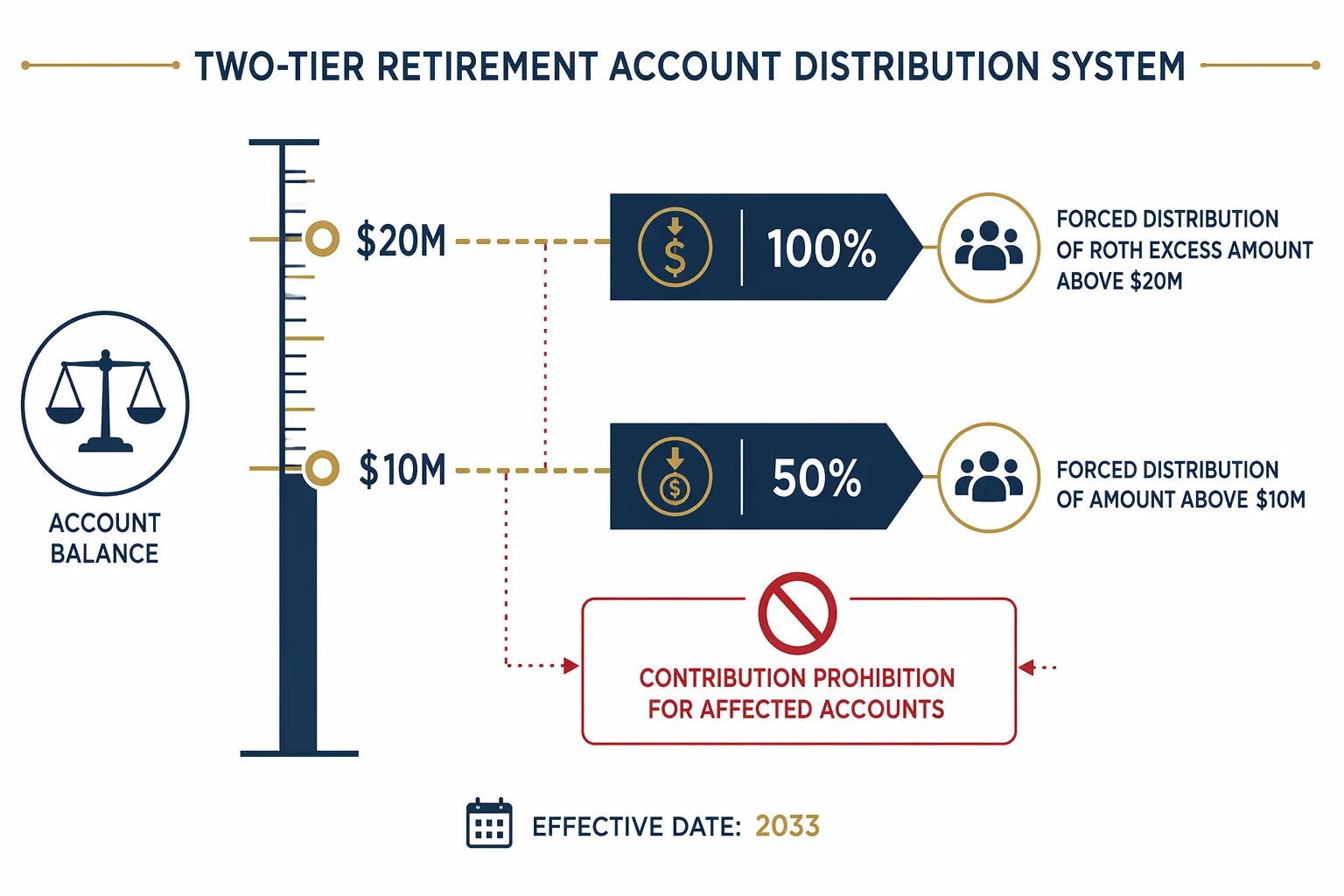
The bill’s main legal move is a two-tier distribution system. The first tier applies once a covered taxpayer’s aggregate retirement balances exceed $10 million. The second tier applies when Roth balances create excess above $20 million. The first tier is a partial drawdown rule; the second is a full forced distribution rule for a narrower Roth excess.
Tier One: 50% of the Excess Above $10 Million
For taxpayers above the reported MAGI threshold, the first mandatory distribution rule would be triggered when aggregate retirement account balances exceed $10 million. The reported formula requires a distribution equal to 50% of the amount by which those aggregate balances exceed $10 million.[1]
A hypothetical shows the shape of the rule without pretending to resolve all ordering questions. If a covered taxpayer had $14 million in aggregate covered retirement balances, the excess over $10 million would be $4 million. The first-tier distribution amount would be 50% of that excess, or $2 million, before considering whether the separate Roth rule above $20 million applies. In a real file, the operative questions would include which accounts are measured, on what valuation date, how distributions are sourced, and whether final statutory text or guidance imposes ordering rules.
The legal significance of this first tier is that it does not confiscate or immediately collapse every dollar above $10 million. It accelerates distribution of half of the excess. That still can be a major tax event, especially where the excess sits in traditional pre-tax accounts, but the percentage matters. A summary that says the bill “forces out balances over $10 million” is too crude.
Tier Two: 100% of Roth Excess Above $20 Million
The second tier is sharper. PLANSPONSOR reports that, for covered taxpayers with aggregate retirement balances above $20 million, the bill would require distribution of 100% of the Roth account excess above $20 million.[1] That rule is aimed at the place where the policy concern is strongest: extremely large balances inside accounts that may generate tax-free qualified distributions.
Here again, the wording matters. The reported rule is not a general liquidation mandate for every dollar above $20 million across all retirement accounts. It is described as a required distribution of Roth excess above that threshold. Traditional account balances still matter because they help determine aggregate balance status, but the second-tier 100% rule is specifically tied to Roth excess as reported.
For a taxpayer with a very large Roth IRA and employer-plan assets, the practical result could be that employer-plan balances help push the taxpayer into the regime while Roth balances determine the harshest distribution amount. That is exactly the kind of statutory fit issue that can get lost when commentary treats every retirement account balance as if it were subject to the same distribution command.
The Contribution Prohibition Is a Separate Consequence
The forced-distribution rules are not the only reported consequence. The bill also would prohibit further contributions for affected high-balance account holders.[1] That prohibition should be analyzed separately from the distribution formula. One rule removes value from tax-preferred accounts; the other stops additional value from entering those accounts while the taxpayer remains within the covered status described by the bill.
That separation matters for client advice. A taxpayer may care more about the liquidity and tax cost of a forced distribution; a plan sponsor or payroll department may care more about contribution eligibility and administrative controls. The bill as reported creates both issues, but not for the general participant population.
Employer-Plan Balances Count, but That Does Not Mean Ordinary Limits Are Cut
One of the easiest ways to misread the proposal is to focus only on IRAs because the political shorthand is “mega IRA.” The reported aggregation rule is broader. Employer-sponsored retirement account balances would count when determining whether the taxpayer crosses the aggregate balance threshold.[1] That means 401(k), 403(b), and similar plan balances can matter to the threshold analysis even if the most visible policy example involves a Roth IRA.
Counting employer-plan balances for aggregation is different from reducing ordinary contribution limits for rank-and-file employees. The research materials do not support saying that the bill lowers 401(k) or 403(b) elective deferral limits, reduces § 415(c) annual additions for non-highly-compensated employees, or otherwise rewrites the routine contribution ceiling for ordinary participants. Morningstar/MarketWatch likewise describes the proposal as not affecting middle-class savers.[3]
For plan sponsors, the concern is therefore not a universal redesign of contribution limits. The more plausible administrative issue, if the proposal were enacted as reported, would be identifying affected high-income, high-balance individuals and coordinating the plan’s role in distributions or contribution restrictions. That is a narrower compliance problem, but it is not a trivial one.
What the Reported Bill Does Not Do
The exclusions matter because the public vocabulary around Roth planning has become imprecise. The reported bill would amend retirement-account rules directed at high balances and distributions. It should not be described as a general shutdown of every Roth or self-directed IRA technique unless later text says so.
Backdoor Roth and Mega-Backdoor Roth Strategies
The materials reviewed do not report a restriction on routine backdoor Roth conversions or mega-backdoor Roth strategies. Those strategies raise their own technical issues under existing contribution, conversion, plan-design, and nondiscrimination rules, but they are not the center of the Wyden-Neal bill as reported. The proposal is aimed at very large aggregate balances, mandatory distributions, and contribution prohibitions for affected high-balance taxpayers.
That distinction is not cosmetic. A backdoor Roth strategy concerns entry into Roth status, usually because the taxpayer cannot make a direct Roth IRA contribution. A mega-backdoor Roth strategy typically depends on after-tax contributions in an employer plan and in-plan Roth conversion or rollover design. The Wyden-Neal proposal, as reported, concerns what happens when total tax-preferred retirement wealth exceeds statutory thresholds. Future amendments could add conversion limits, but the present summaries do not justify reading them into the bill.
Self-Directed IRA Prohibited Transactions
The bill also should not be treated as an amendment to IRC § 4975’s prohibited-transaction framework for self-directed IRAs. That framework already governs transactions involving disqualified persons, self-dealing, and certain investments inside retirement accounts. Kitces.com’s analysis of Roth IRAs holding early-stage private-company shares explains the existing § 4975 baseline that advisers must consider when self-directed IRA assets are used for closely held or pre-IPO investments.[4]
The Wyden-Neal bill, as reported, attacks the size and tax-preferred treatment of large balances through distribution and contribution rules. It does not appear to redefine disqualified persons, change the prohibited-transaction excise tax structure, or create a new general ban on self-directed IRA investments. A large self-directed Roth IRA may be politically salient, and it may still face § 4975 questions under current law, but those are different legal inquiries.
Why Congress Keeps Coming Back to Mega IRAs
The policy case for the bill rests on a mismatch between retirement-savings tax preferences and extremely large accumulations. Morningstar/MarketWatch reported that the Joint Committee on Taxation estimated the annual tax expenditure for traditional IRAs and 401(k)s at $249 billion for 2025.[3] That figure is not an estimate of abuse. It is the broader fiscal context in which lawmakers ask whether tax-preferred retirement accounts should shelter balances that far exceed retirement-consumption needs.
The Peter Thiel Roth IRA story supplies the political oxygen. ProPublica reported in 2021 that Thiel contributed less than $2,000 to a Roth IRA in 1999 and that the account later grew to about $5 billion through PayPal founders’ shares; CNBC covered the same example in the context of earlier House tax proposals that would have forced large IRA distributions.[5][6] The lesson for statutory analysis is not that one account proves a general pattern. It is that one account made the scale of the planning possibility legible to legislators.
The Senate Finance Committee’s 2026 release tries to convert that anecdotal salience into a broader official estimate: 208 individuals, $85.1 billion, and a $409 million average mega-IRA balance as of the end of 2024.[2] Those numbers should be cited as estimates, not as audited account files. Even so, they are large enough to explain why the proposed remedy is not merely disclosure or penalty tinkering, but a forced-distribution regime.
Revenue is part of the background as well. The Tax Law Center’s Tealbook describes Treasury’s 2025 Greenbook estimate that similar mega-retirement-account proposals would raise about $23.7 billion over 10 years.[7] That estimate concerns similar proposals, not necessarily the exact enacted effect of the Wyden-Neal bill, and it should be treated with that boundary.
The Effective Date Creates a Long Planning Window
The reported effective date is unusually important. PLANSPONSOR reports that the bill would apply to taxable years beginning after December 31, 2033.[1] If enacted on that timeline, affected taxpayers would not face an immediate 2026 distribution obligation. Advisers would instead have a multi-year window to evaluate balance growth, Roth versus traditional account composition, liquidity, estate-planning interactions, and possible legislative or regulatory changes.
A long effective-date runway does not make the proposal irrelevant. It changes the nature of the work. The near-term task is not mechanical compliance; it is monitoring and modeling. Practitioners would want to know which accounts are counted, how MAGI is measured, whether married filing status changes the analysis, how Roth excess is sourced, whether employer plans receive reporting obligations, and whether later drafts add anti-avoidance rules.
Nor should the window be treated as an invitation to rush into transactions based on a bill summary. Any real planning response would have to consider existing tax rules, fiduciary duties, plan-document limits, transfer restrictions, investment liquidity, and the risk that Congress changes the text before enactment or never enacts it at all.
Political Status: Unlikely Is Not the Same as Irrelevant
The bill enters a difficult Congress. Bloomberg Tax described the proposal as a Democratic push to crack down on wealthy savers’ retirement accounts, and the 119th Congress is Republican-controlled.[8] That makes near-term enactment unlikely as a standalone matter, especially for a proposal framed around tax increases or limits on high-wealth retirement planning.
But legislative probability is not the only reason to track statutory language. PLANSPONSOR quoted Mark Iwry, a former Treasury official now at Brookings, observing that the proposal could fit into a later SECURE 3.0-style retirement package.[1] That is not a prediction that the bill will pass. It is a reminder that retirement legislation often moves through negotiated packages, where today’s standalone bill can become tomorrow’s revenue offset, bargaining chip, or modified committee provision.
For advisers, the sensible posture is therefore neither alarm nor dismissal. The proposal is not present law. It is also not just a headline. It identifies thresholds, account categories, distribution formulas, and contribution consequences specific enough to become a future template.
The Working Legal Takeaway
The Wyden-Neal mega IRA bill, as reported, would amend the retirement-account rules to impose mandatory distributions and contribution prohibitions on high-income taxpayers with aggregate retirement balances above $10 million, with a more severe Roth excess rule above $20 million. Employer-plan balances matter for aggregation, but the reported bill does not cut ordinary 401(k) or 403(b) limits for non-highly-compensated employees. It does not rewrite backdoor Roth or mega-backdoor Roth strategies. It does not amend IRC § 4975’s prohibited-transaction regime for self-directed IRAs.
The provision to watch is not a slogan about billionaires’ retirement accounts. It is the statutory interaction among income thresholds, aggregate balance measurement, Roth-account sourcing, forced-distribution percentages, contribution eligibility, and the post-2033 effective date. Until there is enacted text, the bill is a concrete policy signal rather than a mandate. If it reappears in a later retirement package, those mechanics are where the legal analysis should start.
References
- Lawmakers Introduce Bill to Curb Tax Breaks for Very Large IRAs, PLANSPONSOR, July 22, 2026.
- Wyden, Neal Introduce Bill to Crack Down on Mega Retirement Account, Senate Finance Committee, July 22, 2026.
- The super-rich use 401(k)s and IRAs to sidestep taxes on millions of dollars. This proposed law would cut them off, Morningstar/MarketWatch, July 22, 2026.
- Roth IRA Investing In Early Stage Growth Companies Without Violating Prohibited Transaction Rules, Kitces.com.
- Lord of the Roths: How Tech Mogul Peter Thiel Turned a Retirement Account for the Middle Class Into a $5 Billion Tax-Free Piggy Bank, ProPublica.
- House tax bill would likely force Peter Thiel to pull $5 billion from his IRA, CNBC, September 17, 2021.
- Mega Retirement Accounts, Tax Law Center.
- Democrats Push Crackdown on Wealthy Savers’ Retirement Accounts, Bloomberg Tax, July 22, 2026.
Chronological incident history
No sanction cases have named this tool in the tracked record set to date. This does not imply the tool is safe — see Risk Digest for ongoing monitoring.
← Compare peer toolsReport a correction or tip
Spotted an outdated figure, a misstated fact, or a ruling this tool profile should reflect? Public comments are disabled for this content given the professional cost of a misreported case outcome, penalty amount, or rule text — use the structured correction channel instead.
Report a correction or tip for this record →