
Microsoft MAI Models: Legal Risk Without Independent Audits
Microsoft's MAI-Thinking-1 model and Word Legal Agent introduce clean data lineage and distillation-free training, but no independent audit has verified these claims for legal-specific accuracy. General benchmarks show strong math and coding performance, yet they do not measure citation accuracy, jurisdictional awareness, or contract clause analysis. This article assesses the risk profile for in-house counsel and recommends a documented verification protocol as a precondition for adoption.
- Tool
- Microsoft MAI-Thinking-1
- Benchmark source
- Forbes / LinkedIn (Microsoft Build 2026)
- Hallucination rate
- Not measured / undisclosed
- Test methodology
- General AI benchmarks (AIME math, SWE Bench Pro coding) – not legal domain
- Test date
- Jun 1, 2026
For a legal department already standardized on Microsoft 365, Microsoft’s in-house AI models are easy to evaluate. That is the attraction and the danger. The practical impact for the legal industry is not that counsel suddenly have a safe replacement for legal research platforms or specialist contract-review systems. It is that a familiar enterprise vendor has made the pilot feel administratively low-friction while the legal accuracy question remains largely unanswered.
The right answer is neither a green light nor a ban. Microsoft’s clean-data-lineage and zero-distillation pitch for its MAI model family matters because it speaks to real procurement concerns: training-data provenance, copyright exposure, and whether the model is borrowing behavior from other systems in ways the buyer cannot trace. Gizmodo’s coverage framed the pitch bluntly as Microsoft targeting legal anxiety around training-data lawsuits, and that framing is useful because legal anxiety is not imaginary here.[1] Norton Rose Fulbright’s 2026 sanctions update identifies 1,148+ documented hallucination cases, six specific 2026 sanctions matters with dollar amounts ranging from $2,500 to more than $15,000, and more than 40 sanctions in the first six weeks of 2026 alone.[2]
Those two facts belong together. Provenance is a legitimate legal-ops question. It is not, however, a legal-use finding. A model can be cleaner at the training layer and still fabricate a case, flatten a statutory distinction, miss a state-specific clause issue, or produce a confident answer that no one in the workflow verifies before filing, negotiating, or advising the business.
What Microsoft’s MAI claim actually improves
The strongest procurement argument for the MAI family is not that it is “legal AI.” It is that Microsoft is trying to reduce a category of model-supply-chain risk before the tool reaches a legal workflow. If the training inputs are commercially sourced, traceable, and not distilled from competing frontier models, then a buyer has a cleaner diligence story than it would have with a model whose provenance is opaque.
That is not a trivial distinction for in-house counsel. Enterprise legal teams are asked to bless tools that will sit near privileged material, contract negotiation history, HR disputes, regulatory analysis, and board-level documents. A model architecture that takes provenance seriously gives legal operations something concrete to ask about: data sources, licensing rights, retention, model training exclusions, tenant boundaries, audit logs, and whether prompts or outputs are used to improve the model.
Microsoft also has a distribution advantage that specialist tools do not always have. The Build 2026 coverage described a seven-model MAI family and highlighted MAI-Thinking-1 as a 35-billion-parameter model with reported scores of 97% on AIME and 53% on SWE Bench Pro, compared with 51.9% for Claude Opus 4.6 and 59.1% for GPT-5.4 on the latter benchmark.[3] Those figures will catch the eye of a CIO, and they may matter for general reasoning and code-related work. They do not tell a general counsel whether the model can safely handle Delaware fiduciary-duty research, California employment clauses, New York governing-law implications, or a citation-sensitive litigation memo.
This is the first procurement fork. Microsoft’s architecture claim can reduce some upstream concerns. It does not eliminate the downstream obligation to test the exact legal task, in the exact jurisdiction, under the exact confidentiality and review conditions the department intends to use.
The audit gap is the center of the risk analysis
Three things are easy to collapse into one another during procurement: architecture claims, general technical benchmarks, and legal-task reliability. They should stay separate.
| Claim type | What it can support | What it does not prove |
|---|---|---|
| Clean data lineage and zero distillation | A better diligence story around training-data provenance and model-supply-chain risk | That legal answers are accurate, current, jurisdiction-aware, or citation-safe |
| AIME and SWE Bench Pro performance | Evidence of strength on math and software-engineering benchmarks | Reliability on case citations, statutory interpretation, litigation filings, or contract clause analysis |
| Internal Microsoft legal-department productivity reports | Useful deployment color from a sophisticated enterprise legal function | Independent proof that outside legal teams will get the same accuracy or risk profile |
The missing item is an independent legal benchmark audit. As of July 27, 2026, the available public materials identify Microsoft’s MAI claims and general performance numbers; they do not identify an independent third-party audit of MAI-Thinking-1 for legal citation accuracy, statute interpretation, jurisdictional awareness, privilege-sensitive workflows, or contract clause analysis. That absence is not a footnote. It is the procurement fact that determines the adoption posture.
AIME is a math benchmark. SWE Bench Pro measures software-engineering task performance. A legal department can respect those results and still refuse to treat them as evidence for legal drafting or research. The failure mode in legal work is not merely that the model gets a hard problem wrong. It is that the output may look procedurally polished while the underlying authority is nonexistent, miscited, stale, jurisdictionally irrelevant, or taken from the wrong procedural posture.
That distinction matters because sanction decisions tend to punish the human filing and verification failure, not the abstract existence of generative AI. Norton Rose Fulbright’s 2026 update emphasizes recurring patterns around fabricated citations and failure to verify AI-generated material.[2] The same verification-gap problem is now showing up across legal AI deployments, as discussed in our analysis of delayed model releases and legal verification risk. A cleaner model lineage may help with one class of risk, but it does not document the lawyer’s independent review.
Word Legal Agent deserves attention for the right reason
Microsoft’s Word Legal Agent is more interesting than a generic legal chatbot because it meets lawyers where document work already happens. Artificial Lawyer reported that Microsoft launched its own Legal Agent for Word on April 30, 2026, with a deterministic redlining architecture and a team that included former Robin AI personnel.[4] The deterministic layer matters. In contract review, a redline that preserves document structure, tracks changes cleanly, and confines the model’s role to review suggestions is easier to govern than a free-form conversational answer pasted into a document by hand.

That is a real workflow advantage. Lawyers do not need another dashboard simply because a vendor prefers one. Contract review already lives in Word, email, document-management systems, and redline comparison habits that are painful to change. A tool that reduces the number of copy-paste steps can reduce avoidable human errors, version-control confusion, and the quiet loss of context that happens when a document moves between systems.
The current deployment constraints are just as important. TheLawGPT’s 2026 review describes the Word Legal Agent as tied to early-access conditions, with availability through the Frontier program in the United States on Windows desktop, and it identifies the $30/user/month Copilot add-on pricing context.[5] That is not broad market proof. It means any evaluation is still preliminary, and the teams most likely to test it first are those already positioned inside Microsoft’s enterprise stack.
The feature gap that should matter most to multi-jurisdiction legal teams is not whether the interface feels polished. It is whether the agent can analyze clauses against state-specific or jurisdiction-specific legal requirements. The current research record identifies a material limitation there: deterministic redlining may reduce formatting and pure hallucination problems, but the Legal Agent is not yet a substitute for jurisdiction-aware clause analysis. That is where specialist legal AI tools and legal research platforms still have a defensible role, especially when the task turns on local law, regulated contract language, or court-specific authority.
Internal productivity data is useful, but it is not an audit
Microsoft’s own legal department, CELA, is a meaningful reference point because it is not a toy user group. It is a sophisticated enterprise legal function operating under the same kinds of information-governance pressure that other large legal departments recognize. Microsoft Pulse reported that CELA users said they felt 87% more productive, completed tasks 32% faster, and achieved 20% greater accuracy in the context of Copilot adoption.[6]
Those figures belong in a procurement memo under “internal deployment color,” not under “independent validation.” They are self-reported Microsoft figures, not a third-party legal benchmark. They may support a business case for a controlled pilot: faster first drafts, easier summarization, less administrative drag, more consistent starting points for routine work. They do not answer whether a generated research summary correctly distinguishes binding from persuasive authority or whether a clause recommendation fits the governing law and deal context.
That distinction is not hostile to Microsoft. It is ordinary diligence. A legal department would not accept a contract lifecycle management vendor’s self-reported customer productivity statistics as proof that its clause library is legally correct in every jurisdiction. The same standard should apply here.
The licensing tier problem is a confidentiality problem
The easiest way for a Microsoft AI pilot to become riskier than it looks is for lawyers to say “Copilot” without specifying which Copilot. The Maryland State Bar Association’s discussion of Microsoft’s Copilot lineup distinguishes Standard, Pro, and Microsoft 365 Copilot tiers, and the relevant confidentiality protections for legal work attach to the enterprise Microsoft 365 Copilot environment rather than consumer or Pro use.[7]
That difference has to be documented before anyone tests client or company confidential material. A procurement approval that says “approved for Copilot” is too vague for legal operations. The approval should specify the tenant, license tier, data-retention setting, access group, permitted matter types, barred data categories, and whether prompts and outputs are logged for internal review.
This is also where blanket anti-AI advice becomes unhelpful. The risk is not identical across consumer chatbots, Copilot Pro, Microsoft 365 Copilot, a Frontier-only Legal Agent, and a specialist legal AI platform under a negotiated enterprise agreement. The procurement task is to identify the actual environment being used, not to approve or reject a brand name.
A verification protocol before legal use
A Microsoft-enterprise legal department can pilot MAI-powered tools, but the pilot should be built like a controlled legal workflow rather than a software trial. The record should make clear what was tested, who checked it, which outputs were barred from final use, and where the human lawyer made the final professional judgment.
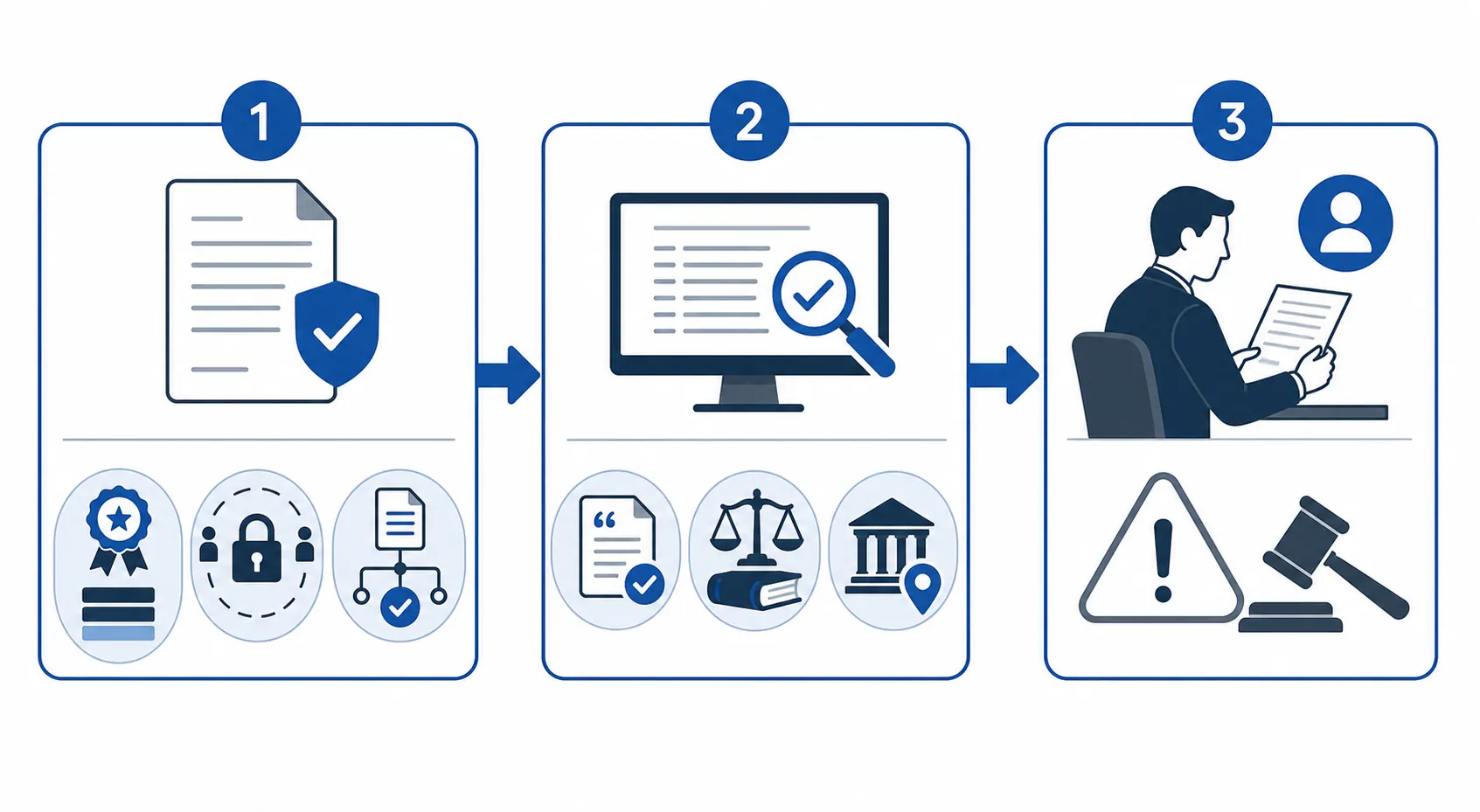
- Define the approved environment before testing: Microsoft 365 tenant, license tier, Frontier status if applicable, user group, matter types, data categories, retention settings, and whether prompts or outputs may be used for model improvement.
- Separate permitted use cases from barred use cases. Low-risk internal summarization, administrative drafting, and first-pass contract issue spotting may be eligible. Court filings, legal research memos, jurisdiction-specific clause advice, privilege calls, and final negotiation positions require stricter review or exclusion.
- Create an output log for the pilot. The log should record the source document, prompt category, model or agent used, reviewer, review date, changes accepted or rejected, and whether any cited authority or legal rule was independently checked.
- Require primary-source verification for every legal authority. Citations, quotations, statutory references, procedural rules, and jurisdictional assertions should be checked against authoritative sources, not against another AI-generated answer.
- Require clause-level review for contract outputs. If the tool proposes a redline, the reviewer should identify whether the issue is commercial, drafting, legal, regulatory, or jurisdiction-specific. State-specific or country-specific conclusions should not be accepted without a separate source-backed review.
- Assign accountability to a named human reviewer. The reviewer, not the model and not the procurement team, must be responsible for final legal use.
- Test failure modes, not only happy paths. The pilot should include outdated clauses, conflicting defined terms, missing exhibits, wrong governing-law assumptions, ambiguous indemnity language, and prompts that invite overconfident legal conclusions.
That workflow is not bureaucracy for its own sake. It maps to the sanction pattern. Courts and disciplinary bodies do not need to decide whether Microsoft’s data lineage is better than another vendor’s to sanction a lawyer who files fabricated authority or fails to verify a generated proposition. For law-firm reliability controls, the same separation of outage, hallucination, and privilege-breach failures discussed in our law-firm AI failure-mode framework applies here as well.
What should be independently checked
The review burden should not be spread evenly across every output. Some outputs are operationally useful and legally modest: summarizing meeting notes, turning comments into a checklist, identifying inconsistent defined terms, or drafting a neutral first-pass email. Those still require confidentiality controls, but they do not carry the same legal-authority risk as a research conclusion.
The hard stop should apply to outputs that purport to state the law. If an MAI-powered tool cites a case, quotes a statute, summarizes a regulation, explains a filing deadline, identifies a privilege rule, or recommends a clause because of state law, the reviewer should verify the proposition outside the model. The verification record should be good enough that knowledge-management staff can later reconstruct what happened without interviewing the lawyer from memory.
The same rule applies to contract analysis. A redline may be useful even when the legal rationale is incomplete, but the reviewer should classify what the tool actually did. Did it improve grammar? Did it align a defined term? Did it flag a missing limitation of liability? Did it make a legal judgment about enforceability? Only the last category requires legal authority, but that category cannot be treated as ordinary word processing.
Where specialist legal AI still has the advantage
Microsoft’s strongest position is enterprise integration. Specialist legal AI tools have a different advantage: they are usually built around legal content, legal workflows, and jurisdiction-specific expectations from the beginning. That does not make them automatically safe, and it does not excuse them from independent validation. It does explain why Microsoft’s general model strength and Word integration do not collapse the market for legal-specific platforms.
For legal research, the relevant comparison is not whether MAI-Thinking-1 can reason well in the abstract. It is whether the tool can retrieve, distinguish, and apply authoritative legal materials with enough transparency for a lawyer to verify the path. For contract review, the comparison is not whether Word Legal Agent can redline neatly. It is whether the system can evaluate clause risk against the governing law, industry context, fallback position, and negotiated business risk.
In many departments, the likely near-term architecture is therefore layered. Microsoft tools may handle low-friction drafting, summarization, document preparation, and first-pass review inside the existing productivity suite. Specialist tools remain appropriate for audited legal research, matter-specific clause analysis, large-scale contract review, and workflows where the legal content source is as important as the interface.
The procurement condition
A reasonable approval memo for Microsoft MAI tools should not say “approved for legal work.” It should say something narrower: approved for a controlled pilot in the enterprise Microsoft 365 environment, limited to specified use cases, with no unsupervised legal-authority outputs, no jurisdiction-specific clause conclusions without independent review, and no use of consumer or Pro-tier tools for confidential legal material.
The clean-lineage and zero-distillation story earns Microsoft a serious evaluation. The Frontier-only, US-only, Windows desktop gating limits the evidence base. The lack of an independent legal benchmark keeps the tool out of the replacement category. The sanction environment makes undocumented reliance indefensible. Microsoft MAI models are credible enough to test inside enterprise legal environments, but not yet credible enough to replace audited legal research, jurisdiction-specific clause review, or counsel’s own professional responsibility.
References
- Microsoft Targets Legal Fears to Sell Its Powerful New AI Model to Businesses — Gizmodo, June 2, 2026.
- AI in litigation: Update on Gen AI sanctions in 2026 — Norton Rose Fulbright, 2026.
- Microsoft Build 2026 MAI model family launch — Forbes / LinkedIn, June 2026.
- Microsoft Launches Its Own Legal Agent For Word — Artificial Lawyer, April 30, 2026.
- Microsoft Word Legal Agent: What Lawyers Need to Know (2026) — TheLawGPT, 2026.
- Embracing Copilot in the legal profession — Microsoft Pulse.
- Decoding Microsoft's Copilot Lineup — MSBA.
Chronological incident history
No sanction cases have named this tool in the tracked record set to date. This does not imply the tool is safe — see Risk Digest for ongoing monitoring.
← Compare peer toolsReport a correction or tip
Spotted an outdated figure, a misstated fact, or a ruling this tool profile should reflect? Public comments are disabled for this content given the professional cost of a misreported case outcome, penalty amount, or rule text — use the structured correction channel instead.
Report a correction or tip for this record →