
MLS tampering rules test Inter Miami in Casemiro probe
Inter Miami faces an MLS tampering investigation over its signing of Casemiro. This article explains the league's tampering rules, the Commissioner's penalty authority, and why the club's regulatory history heightens the legal stakes.
- Hallucination rate
- Not measured / undisclosed
Inter Miami has Casemiro. What MLS is now examining is whether Inter Miami first had the administrative permission to get to Casemiro.
That is the procedural oddity at the center of the MLS tampering investigation opened after the club signed the Brazilian international on a free transfer from Manchester United. LA Galaxy held discovery rights to Casemiro, Inter Miami completed the signing without first acquiring those rights, and the Galaxy filed a claim that triggered league review. The terms of the settlement between the clubs have not been disclosed and are expected to remain private until the investigation concludes.[1]

For anyone trying to understand MLS tampering investigation rules and legal implications, the question is not whether Casemiro is glamorous enough to merit the fight. It is whether MLS’s internal labor-market machinery can produce an answer that looks enforceable, proportionate, and credible when the club under investigation is the league’s most visible celebrity project and also a club with prior major regulatory sanctions.
The rulebook gives MLS plenty of room to act. Section 7 of the MLS Constitution prohibits any “member, officer, shareholder, director, partner, employee, agent, or representative” from attempting to influence a player to sign with the league or with a particular team, and it gives the Commissioner “sole discretion” to decide whether tampering occurred.[2] That language is not ornamental. It is the hinge between a transfer dispute and a league-governance case.
The hidden right behind the public signing
Discovery rights are one of those MLS devices that make an ordinary market event resemble a permitting process. A club may hold exclusive negotiation rights to a player who is not yet in the league, and that list is limited. Public reporting on the system describes a cap of five players per club. If another club wants to negotiate with a player whose rights are held elsewhere, it must acquire or trade for those rights before proceeding.[3]
The practical problem is notice. Discovery rights are not generally presented to the public like a transfer registration or a posted lien. A rival club, an agent, a journalist, and often the reader at home learn the relevant fact only when a claim surfaces. That opacity is not a side issue in the Casemiro matter. It is the source of the alleged violation: LA Galaxy’s claimed priority existed before the Inter Miami signing became a public transaction.[1]
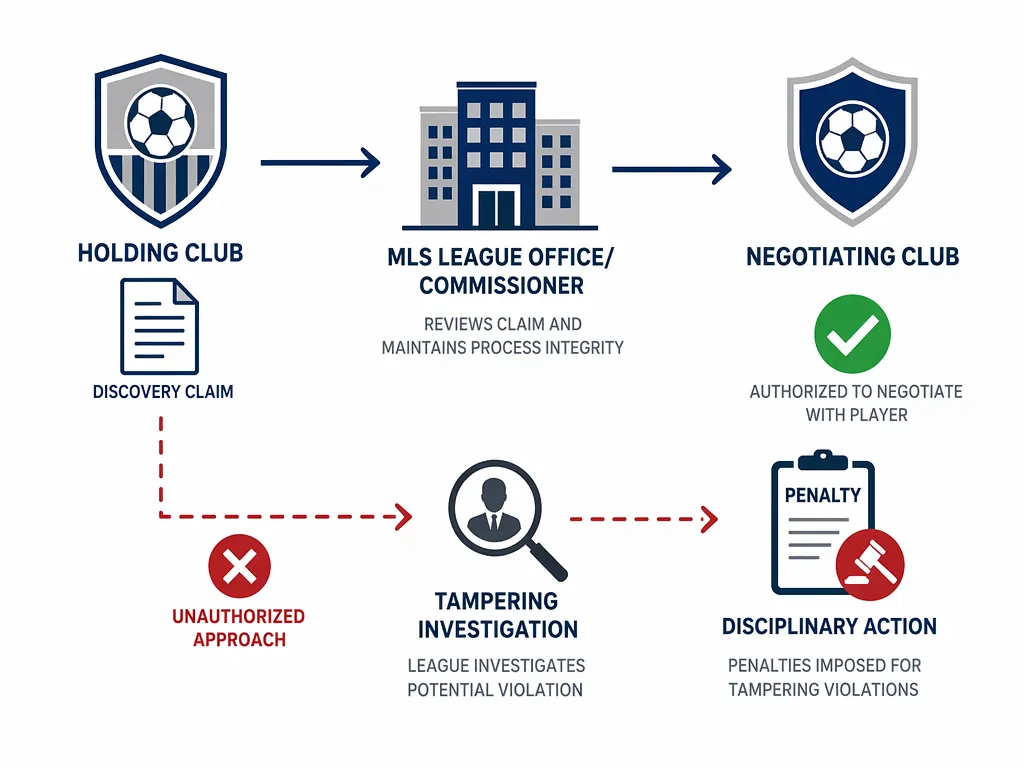
MLS has defended anti-tampering restrictions as a way to protect club-held rights and preserve orderly negotiations. The league’s own discussion of anti-tampering rules frames certain players as truly off-limits when another club already controls the relevant MLS rights.[4] That may be administratively coherent from the league office’s perspective. It is less legible from outside the league, where the same facts can look like a club signing a free agent from abroad.
The distinction matters because tampering exposure does not require the player to be under contract with the complaining MLS club. The right being protected is the league-created right to negotiate first. In that sense, the Galaxy’s claim is not a conventional complaint that Inter Miami poached a player from its roster. It is a complaint that Inter Miami allegedly crossed a protected negotiation boundary before buying its way through the proper gate.
| Issue | Why it matters in the Casemiro probe |
|---|---|
| Discovery rights | LA Galaxy reportedly held the MLS negotiation priority for Casemiro before Inter Miami signed him. |
| Tampering rule | Section 7 reaches a broad set of club-linked people and gives the Commissioner sole discretion to decide whether prohibited influence occurred. |
| Settlement terms | The Inter Miami-Galaxy arrangement has not been disclosed, limiting any outside assessment of harm or cure. |
| Penalty menu | MLS can impose sporting and roster-building sanctions, not merely a fine. |
Section 7 is broader than a back-channel phone call
Tampering is often imagined as a single forbidden conversation: an executive calls an agent, the agent calls a player, and the club later insists nothing happened. MLS’s constitutional language is broader. The covered actors include not only formal club employees but also owners, shareholders, partners, agents, and representatives. The prohibited conduct is framed around attempting to influence a player to sign with MLS or with a particular MLS team.[2]
That breadth gives the league office a practical enforcement advantage. It does not have to treat a club as insulated merely because a formal sporting executive was not the person who made contact. The same breadth also increases the importance of internal process. When a rule sweeps in a wide orbit of affiliated people and lets the Commissioner decide in sole discretion whether the line was crossed, the investigation has to do more than identify a messy sequence of negotiations. It has to show why the conduct fits the prohibited category.
That is especially true here because the signing and the discovery-rights issue are not disputed in the same way. Public reporting says the Galaxy held the rights and that Inter Miami signed Casemiro; the harder question is what Inter Miami or its covered representatives did before the rights issue was resolved.[1] A completed signing may be suspicious in context. It is not, by itself, the full evidentiary record of an unauthorized approach.
The fine cap is not the whole penalty
The number that travels fastest is the $500,000 cap. Section 7.C authorizes fines of up to $500,000 per violation.[2] In isolation, that figure looks oddly modest for a high-profile player move involving a club with Inter Miami’s commercial attention. But the fine is only one item in the Commissioner’s penalty menu.
The same section permits suspension of individuals, definite or indefinite; prohibitions on hiring or contracting with a person; forfeiture or deferment of draft picks; forfeiture or deferment of allocation slots or designated-player slots; deduction of league standings points; and disqualification from competitions.[2] Those remedies are more intrusive than a cash penalty. A fine punishes the balance sheet. Loss of allocation money, a designated-player slot, draft assets, standings points, or competition eligibility can alter the club’s roster strategy and sporting position.
That matters because MLS’s roster rules make non-cash assets unusually valuable. Allocation mechanisms and designated-player slots are not merely accounting labels; they are the tools that determine whether a club can fit a star-heavy roster inside league constraints. A sanction that touches those tools may deter more effectively than a fine that a wealthy ownership group can absorb.
Still, the existence of a broad penalty menu does not answer the proportionality question. MLS would need to match any sanction to the actual violation found: who made contact, when the contact occurred, whether the club knew or should have known that Galaxy held the relevant rights, whether the settlement cured the competitive harm, and whether the conduct was isolated or part of a more deliberate attempt to bypass the discovery process. Those facts are not public.
Inter Miami’s 2021 case changes the enforcement atmosphere
Inter Miami’s prior disciplinary history cannot prove tampering in the Casemiro matter. The earlier case involved salary-budget and roster-guideline violations related to Blaise Matuidi’s signing, not a Section 7 tampering finding. Conflating the two would be bad law and bad analysis.
But enforcement history is not irrelevant. In 2021, MLS imposed what it described as the largest fine in league history: $2 million against Inter Miami, $250,000 against owner Jorge Mas, a $2.27 million reduction in allocation money, and a suspension of sporting director Paul McDonough for salary-budget and roster-guideline violations.[5] ESPN also reported the discipline as an MLS-record $2 million club fine with a $2.2 million cap hit tied to designated-player dealings.[6]
That history affects the league’s deterrence problem. If MLS concludes that Inter Miami again violated core roster or player-acquisition rules, the Commissioner will be dealing with a club that has already been sanctioned for a major compliance failure. The prior case does not establish liability. It does make a purely nominal response harder to frame as credible if the new evidence shows knowing circumvention.
The 2021 sanctions also show that MLS is willing to move beyond the small-fine model when roster integrity is at stake. Allocation money reductions and individual suspensions did real regulatory work in that case.[5] That precedent sits adjacent to, not inside, the Casemiro analysis. It tells us something about MLS’s appetite for punishment in a high-profile Inter Miami matter, but not what Section 7 requires on these facts.
Why MLS enforcement is not just NBA or NFL tampering with a smaller number
Comparisons to other North American leagues are useful only up to a point. News reporting on NFL tampering penalties notes sanctions such as the Atlanta Falcons’ 2024 forfeiture of a fifth-round pick and $250,000 fine, and the Miami Dolphins’ 2022 loss of first- and third-round picks, $1.5 million owner fine, and six-week owner suspension.[7] News reporting on NBA rules describes potential fines up to $10 million and communication audits.[8]
Those comparisons sharpen the obvious question: is a $500,000 MLS fine cap enough for elite-player tampering? But they should not be treated as primary legal authority for MLS. The NBA and NFL are not built around MLS’s discovery-rights system, and MLS is not a conventional association of separately contracting clubs in the same way.
MLS’s single-entity structure is the reason the antitrust conversation looks different. Legal analysis of MLS has long emphasized that the league operates through a structure in which the league, rather than individual clubs acting entirely independently, holds player contracts; Fraser v. Major League Soccer is the leading case associated with that single-entity defense.[9] Later scholarship has questioned how far that defense should extend as the league has matured and club operators have gained more independent economic significance.[10]
For the Casemiro investigation, the single-entity point is not an academic detour. It explains why MLS tampering enforcement is an internal governance action first. The Commissioner is not simply refereeing a dispute among fully independent market actors; he is enforcing a league-created allocation of negotiation rights inside a structure designed to centralize player contracting. That gives MLS practical insulation from some theories that might appear in a different league structure, while making internal fairness and consistency more important.
The Commissioner’s discretion is both the tool and the vulnerability
Section 7’s “sole discretion” language is efficient. It lets the Commissioner resolve disputes quickly, preserve confidentiality where needed, and tailor sanctions to the competitive harm rather than litigating every roster controversy as if it were a civil trial.[2] In a league with opaque player-acquisition devices, speed has value.
The same language also creates the procedural pressure point. A rule can be broad and still enforceable if participants have notice of what it prohibits and if like cases are treated alike. But where the Commissioner controls both the liability determination and the sanction, the legitimacy of the result depends heavily on the quality of the investigation and the explanation the league is willing to provide.
That explanation may be constrained. The Galaxy settlement terms are not public.[1] MLS may also have investigative material involving agents, executives, communications, or club employees that it does not disclose in full. Those limits are ordinary in league investigations, but they make outside evaluation difficult. If MLS imposes a major sanction, observers will ask whether the record supports it. If MLS imposes a light sanction, they will ask whether the league protected a marquee club.
This is the uncomfortable place MLS has built for itself. Discovery rights are valuable enough to enforce, hidden enough to confuse, and flexible enough to settle. Commissioner discretion is broad enough to solve the problem, but broad discretion also leaves fewer visible guardrails when the problem involves the league’s most scrutinized club.
What remains unresolved after July 22
As of July 22, 2026, the public record supports only a limited conclusion: LA Galaxy held discovery rights to Casemiro, Inter Miami signed him without first acquiring those rights, the Galaxy filed a claim, and MLS opened a tampering investigation.[1] It does not establish who contacted whom, what Inter Miami knew at each stage, whether any covered representative attempted to influence Casemiro before rights were acquired or settled, or how the undisclosed settlement should affect any remedy.
The legal implications are therefore procedural as much as punitive. MLS must decide whether its discovery-rights system can give sufficient notice to support discipline. It must decide whether Section 7’s penalty menu fits the actual harm if the violation is proven. It must decide whether Inter Miami’s prior salary-budget sanctions matter as aggravating context without being treated as proof of a different offense. And it must do all of that under a single-entity governance model that gives the Commissioner unusual internal authority.
The Casemiro probe matters because it tests whether MLS can enforce a deliberately intricate player-acquisition system against a high-profile club in a way that appears lawful rather than improvised. The unknowns are still the decisive facts: the communications record, the timing, the settlement terms, the league’s reading of Section 7, and whether the Commissioner treats this as a rights-clearing mistake or a punishable attempt to bypass the market MLS itself designed.
References
- Inter Miami signs Casemiro, but MLS investigating club for possible tampering, The Athletic/New York Times, July 22, 2026.
- MLS Constitution, House Judiciary Committee.
- Kevin De Bruyne discovery rights issue highlights one of MLS' most puzzling rules, The Athletic.
- MLS anti-tampering rules clearly spell out when other players are truly off-limits, MLSsoccer.com.
- MLS announces sanctions for Inter Miami violating salary budget and roster guidelines, MLSsoccer.com.
- Inter Miami gets MLS-record $2M fine, $2.2M cap hit, ESPN.
- NFL tampering rules, penalties, NBC Philadelphia.
- What is tampering in the NBA?, AS USA.
- How MLS' single entity status works and its relationship with antitrust law, LawInSport.
- Reassessing MLS's Single-Entity Defense, Seton Hall Law.
Chronological incident history
No sanction cases have named this tool in the tracked record set to date. This does not imply the tool is safe — see Risk Digest for ongoing monitoring.
← Compare peer toolsReport a correction or tip
Spotted an outdated figure, a misstated fact, or a ruling this tool profile should reflect? Public comments are disabled for this content given the professional cost of a misreported case outcome, penalty amount, or rule text — use the structured correction channel instead.
Report a correction or tip for this record →