
How Nintendo's Palworld Payout Caps at $30,000
An analysis of the statutory damages ceiling, geographic patent limits, and pre-trial game patches that confined Nintendo's potential recovery in the Palworld lawsuit to roughly $30,000—far below its reported litigation expenses.
- Hallucination rate
- Not measured / undisclosed
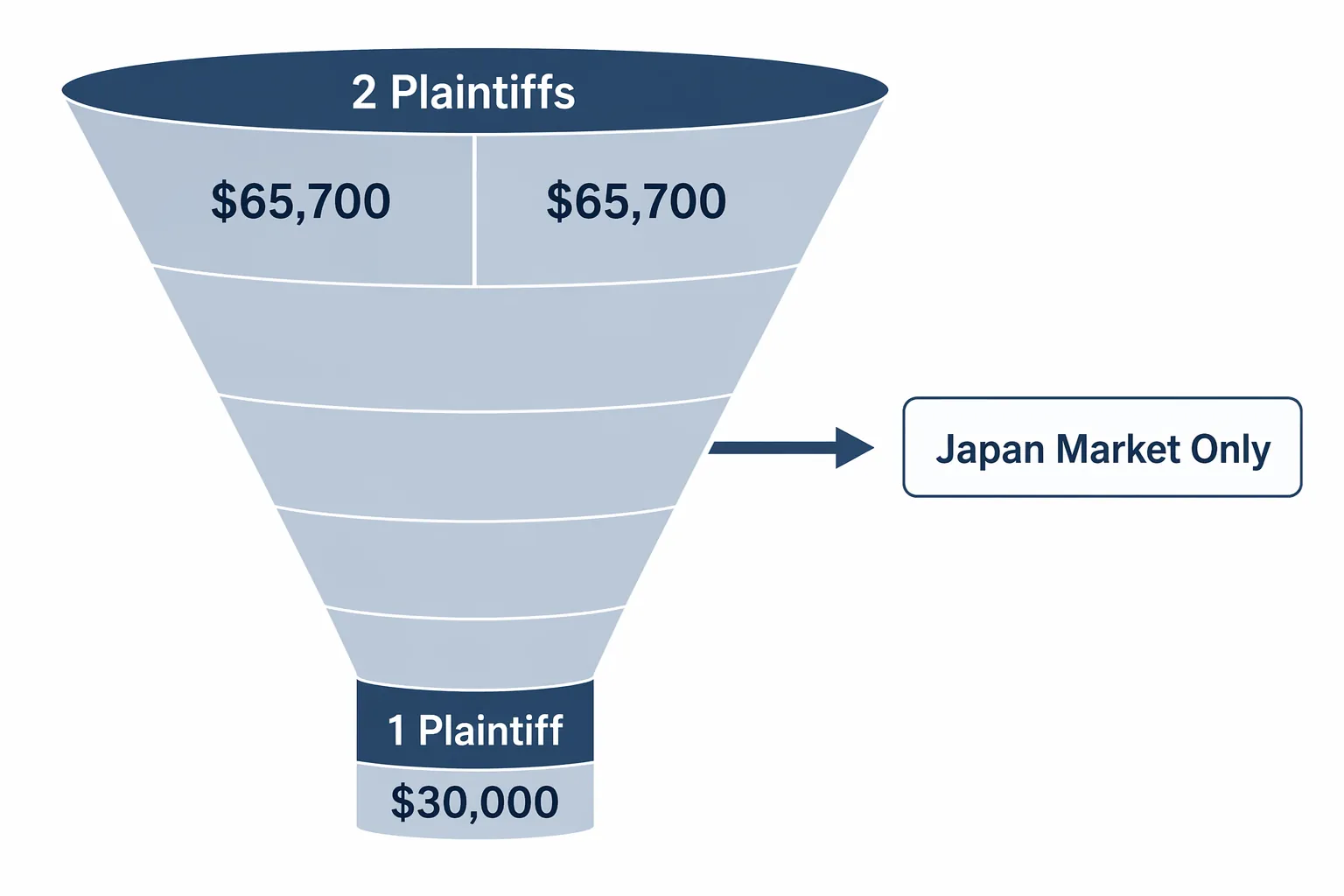
The phrase “palworld lawsuit nintendo payout 30k settlement” gets the most important word wrong. The roughly $30,000 figure now circulating around Nintendo’s Palworld case is not a public settlement, not a damages award, and not a concession that Pocketpair has bought peace. It is better understood as the approximate dollar expression of a damages ceiling after the case was narrowed: about ¥5 million, or roughly $30,000–$31,200, tied to one plaintiff’s remaining Japanese patent claims.
That distinction matters because Nintendo and The Pokémon Company did not file the Tokyo action merely to collect a small check. Nintendo’s September 2024 announcement said the companies had filed a patent-infringement lawsuit against Pocketpair in the Tokyo District Court seeking an injunction and compensation for damages, alleging that Palworld infringed multiple patent rights.[1] Early reporting put the requested damages at ¥5 million per plaintiff, meaning Nintendo plus The Pokémon Company together sought roughly $65,700 at then-current exchange rates.[2]
The public record now points to a much smaller recovery pool. IP commentator Florian Mueller described the remaining payout exposure as “chump change” and “just a rounding error,” while reporting framed the current maximum as approximately $30,000 rather than the original two-plaintiff total.[3] Japanese patent attorney Kiyoshi Kurihara likewise explained that the available damages may be capped around ¥5 million, a figure that would not allow Nintendo to recoup ordinary litigation spend even if it ultimately prevails.[4]
Why the Number Fell Before Any Final Judgment
The reduction is not mainly a story about a judge rejecting Nintendo’s theory. As of July 23, 2026, the Tokyo case remains pending. The more prosaic explanation is remedial architecture: statutory damages, plaintiff count, and territorial scope all operate before anyone reaches the emotional question of whether Palworld looks too much like Pokémon.
| Constraint | Effect on recovery |
|---|---|
| ¥5 million damages figure | Frames the practical ceiling discussed by Japanese patent commentary, rather than a negotiated settlement |
| Two plaintiffs reduced to one relevant claimant posture | Moves the public estimate from roughly $65,700 to roughly $30,000–$31,200 |
| Japanese patent rights | Confines the damages theory to Japanese-market exploitation, not Palworld’s global sales |
| Post-launch patches | Shift the case away from stopping the current game and toward older accused versions |
The plaintiff-count point is easy to miss because the earliest dollar figure was already small by U.S. patent-litigation standards. Engadget’s November 2024 report described Nintendo and The Pokémon Company seeking ¥5 million each, for a combined total around $65,700.[2] Once the operative posture is discussed as one plaintiff’s claims, the same damages logic no longer produces the eye-catching two-plaintiff number. It produces the roughly ¥5 million figure that has become the source of the “$30,000” shorthand.[3][4]
The territorial point is just as important. Japanese patents do not turn global sales into Japanese damages. A successful Japanese patent claim may be commercially useful if it blocks a product in Japan or forces a redesign, but it does not automatically reach every copy of Palworld sold or played elsewhere. That is why the payout discussion cannot be measured against Palworld’s worldwide visibility. The legal instrument is narrower than the public controversy.
The Patches Changed the Remedy
The most consequential Pocketpair activity was not a press statement. It was product revision. In November 2024, Pocketpair’s v0.3.11 update changed the Pal Sphere throwing and capture-indicator mechanics that had been central to the early infringement discussion. In May 2025, v0.5.5 decoupled gliding from mounted Pals by introducing a separate glider item. Reporting on Nintendo’s later amendment described the complaint as targeting older versions of Palworld rather than the patched live game.[5]
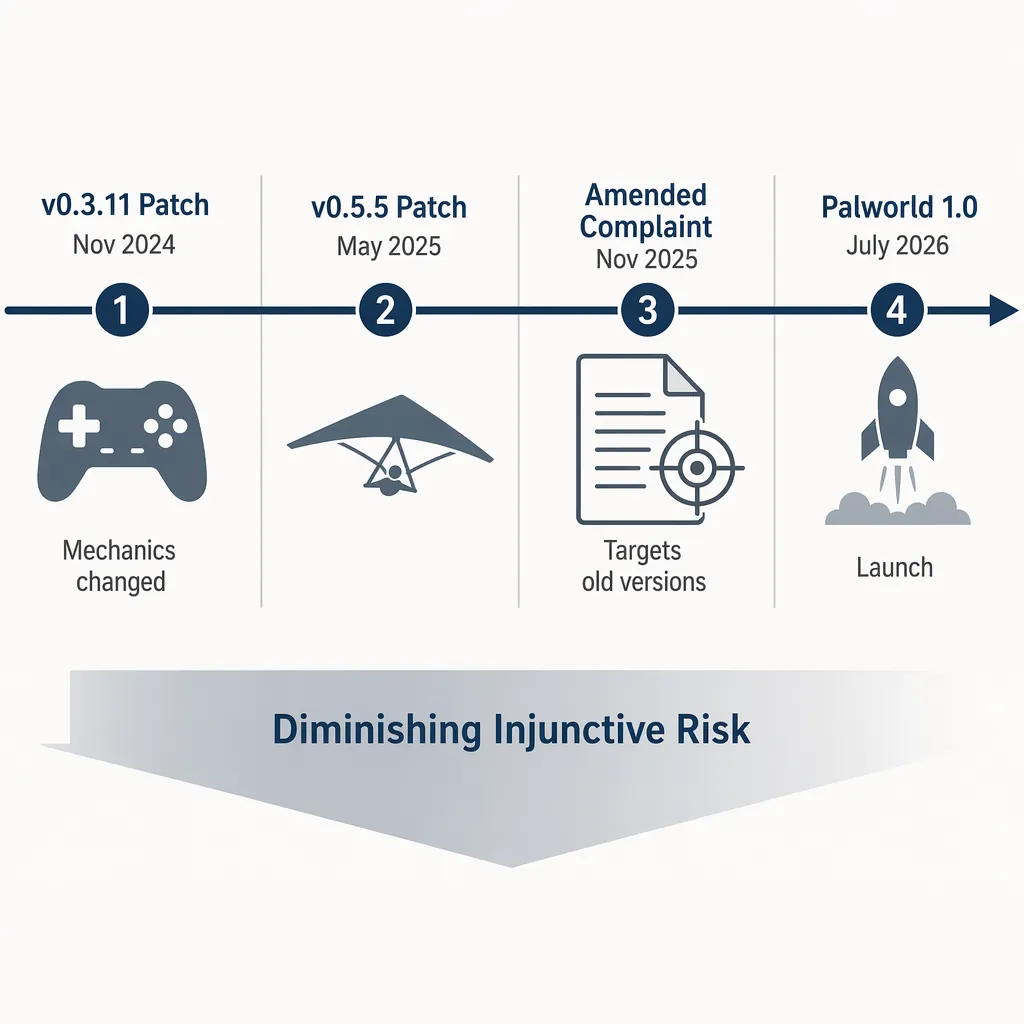
That sequence does not prove non-infringement. It does something more practical: it weakens the need for forward-looking injunctive relief against the version players are actually using in 2026. If the accused conduct is concentrated in superseded builds, the injunction fight loses much of its commercial force. Nintendo may still argue that past versions infringed. Pocketpair may still contest liability and validity. But the center of gravity shifts from “stop this product” to “what, if anything, is owed for earlier conduct.”
A patent owner can sometimes accept a small damages award if it also secures an injunction that changes market behavior. Here, the public reporting suggests the market behavior changed before trial, and Nintendo’s amended complaint followed the case back toward older versions.[5]
Palworld 1.0’s July 10, 2026 launch without visible legal restrictions is therefore relevant, but only in a limited way. It is not a verdict. It is a market fact consistent with reduced injunctive leverage: the live commercial release proceeded while the Tokyo case remained pending and while the reported target of the amended complaint sat in prior versions rather than the current build.[6]
The $41 Million Expense Figure Needs a Warning Label
The most dramatic contrast is between the roughly ¥5 million recovery ceiling and Nintendo’s FY2026 litigation-expense line. Nintendo’s consolidated financial results for the fiscal year ended March 2026 reported ¥6.414 billion in litigation-related losses, often converted in press coverage to roughly $41 million.[7] Set beside a ¥5 million Palworld damages ceiling, that number makes the case look like a financial absurdity.
But the comparison should not be overstated. The financial report does not, on its face, allocate the entire ¥6.414 billion to the Palworld lawsuit. GameRant’s coverage noted the litigation-loss figure while also discussing reporting that a separate Malikie Innovations matter involving former BlackBerry patents may be a more plausible explanation for much of that expense line.[8] Unless Nintendo or a court record ties the full amount to Pocketpair, treating “$41 million spent on Palworld” as established fact would be sloppy.
The narrower point is still sharp enough. Even if only a fraction of Nintendo’s broader litigation spend relates to Palworld, a Japanese damages ceiling in the neighborhood of ¥5 million does not function as cost recovery. It functions as residual exposure after the injunction value has been reduced and the damages base has been confined.
Validity Pressure Is Not the Same as Final Invalidity
The parallel patent-office developments add pressure on Nintendo’s position, but they should not be promoted into final defeats. In the United States, the USPTO issued a non-final rejection of all 26 claims of U.S. Patent No. 12,403,397 on obviousness grounds, according to PC Gamer’s reporting.[9] “Non-final” is doing real work there. Nintendo can respond, amend, and continue prosecution; the rejection is not a revocation in the ordinary final-judgment sense.
The same caution applies to the reported Japan Patent Office rejection of a touchscreen-related application aimed at Palworld Mobile. A rejection at that stage can be met with amendment or further prosecution. It may weaken leverage and complicate Nintendo’s broader campaign, but it is not the Tokyo District Court entering judgment for Pocketpair.
For the damages question, the patent-office news is secondary. The ¥5 million problem would exist even if Nintendo’s asserted Japanese patents survived. Validity pressure matters because it reduces settlement and injunction leverage. It does not create the $30,000 ceiling by itself.
What Nintendo Can Still Win
A small damages ceiling does not mean Nintendo has lost the case. The Tokyo District Court could still find infringement as to older versions of Palworld. Nintendo could still obtain a liability ruling that has reputational or strategic value beyond the yen amount. A judgment could also matter to future licensing postures, future patent drafting, and future disputes over similar mechanics.
But those are not the same as recovering meaningful money from Pocketpair. The public record now describes a pending lawsuit in which the live game has been revised, the asserted damages are geographically confined, the plaintiff posture has narrowed, and the discussed statutory recovery sits around ¥5 million. That is why “Nintendo may win” and “Nintendo can recover enough to justify the fight economically” have become different propositions.
The next procedural markers are still ahead: a technical briefing scheduled for October 1, 2026, and a preliminary opinion deadline reported for November 9, 2026.[6] Until then, the case remains pending. No final judgment has been entered. No public settlement has converted the $30,000 figure into a payment.
The cleanest reading is therefore the least sensational one. Nintendo could still obtain a liability finding, but the available public record points to a case whose current economic upside is capped at roughly ¥5 million while its broader injunction and patent-strength leverage has been materially weakened.
References
- Nintendo and The Pokémon Company — Filing Lawsuit for Infringement of Patent Rights, Nintendo, September 19, 2024.
- Nintendo Palworld lawsuit seeks $65,700 in damages, Engadget.
- Nintendo wanted to block Palworld — now it faces a 0% chance and a measly $30K payout, Windows Central.
- Nintendo may not be able to recoup legal expenses of Palworld lawsuit even if it wins, Japanese attorney suggests, Automaton Media.
- Nintendo May Only Win $30,000 Payout in Pokémon Legal Battle With Palworld Developer Pocketpair, IP Expert Says, IGN.
- Palworld lawsuit nears end with Nintendo reportedly poised to gain almost nothing, VGC.
- Nintendo Co., Ltd. Consolidated Financial Results for Fiscal Year Ended March 2026, Nintendo IR, May 8, 2026.
- Nintendo Reports Huge Litigation Losses as Palworld Lawsuit Continues, GameRant.
- US Patent Office revokes Nintendo's controversial Pokémon battling patent in nonfinal decision, PC Gamer.
Chronological incident history
No sanction cases have named this tool in the tracked record set to date. This does not imply the tool is safe — see Risk Digest for ongoing monitoring.
← Compare peer toolsReport a correction or tip
Spotted an outdated figure, a misstated fact, or a ruling this tool profile should reflect? Public comments are disabled for this content given the professional cost of a misreported case outcome, penalty amount, or rule text — use the structured correction channel instead.
Report a correction or tip for this record →