
How Nintendo's Palworld patent rejections reveal prior art gaps
This article analyzes how the Nintendo-Palworld patent dispute exposes a structural gap between patent office examination and the broader universe of prior art that emerges during litigation, particularly for software and game mechanic patents. It examines the JPO's third-party submission mechanism and the USPTO's rare Director-initiated reexamination as corrective measures that caught what initial examination missed.
- Hallucination rate
- Not measured / undisclosed
The most useful way into the Nintendo-Palworld patent fight is not the fan dispute over creature-catching games. It is a procedural mismatch: claims tied to the Palworld litigation could move through ordinary patent examination, while later proceedings put a much wider set of game evidence in front of patent offices and changed the posture of related claims.
That mismatch is especially stark in the United States. Nintendo’s US Patent 12,403,397 was allowed without the examiner citing any prior art reference, and Japanese patent attorney Kiyoshi Kurihara was quoted describing the situation as a patent granted without the examiner looking at a single game.[1] That is not the same as saying the patent is invalid. A clean face of prosecution can reflect a narrow claim, a poor search record, a hard-to-index field, or some combination of all three. But in software and game mechanics, a no-reference allowance should make the reader ask a narrower and more useful question: where would the relevant evidence have lived if it did exist?
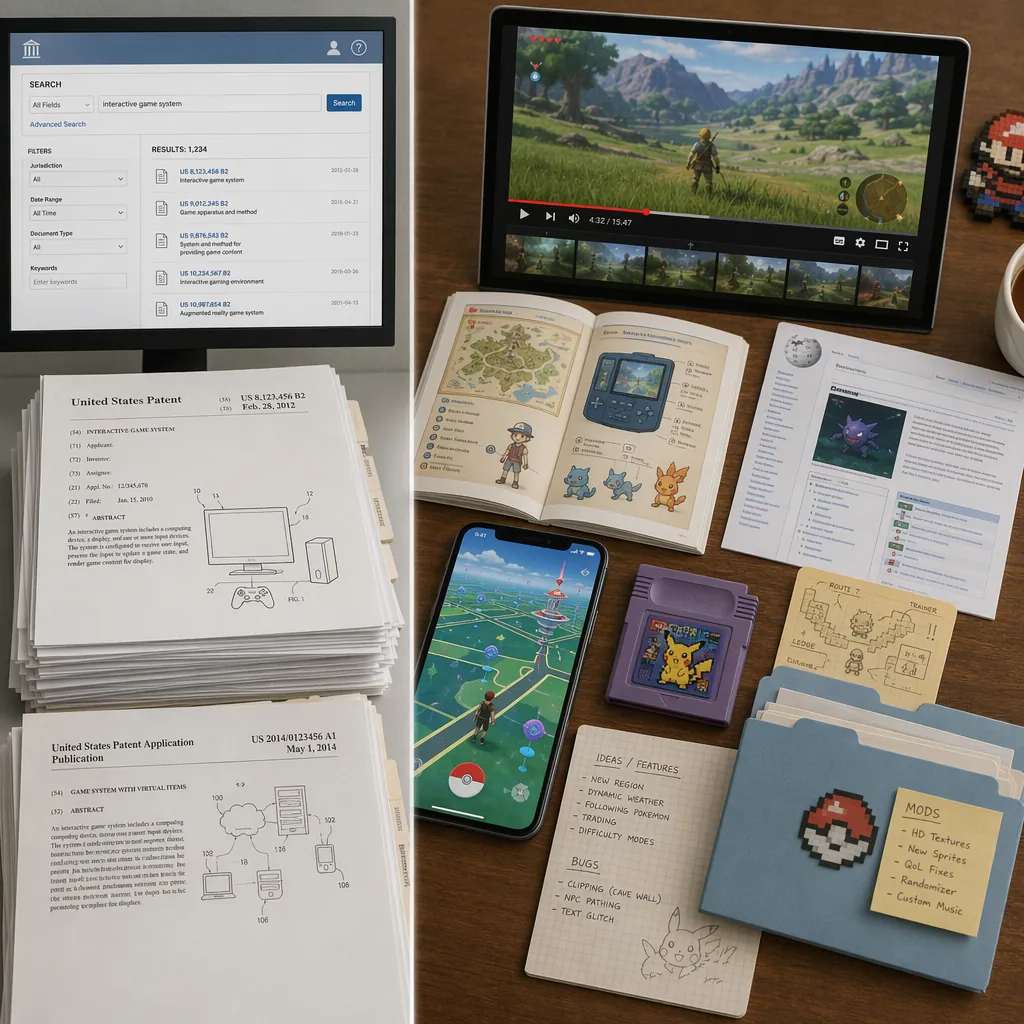
The Japanese Patent Office record gives a concrete answer. In October 2025, the JPO rejected Nintendo application 2024-031879 after third-party submissions placed game materials before the examiner, including YouTube gameplay of ARK from 2020, the Monster Hunter 4 official web manual from 2014, a Craftopia capture wiki from 2020, Kantai Collection, and Pokémon GO.[1][2] Those are not exotic sources to someone trying to reconstruct how a mechanic appeared in play. They are, however, sources that sit awkwardly beside the ordinary patent-search stack of patents, patent publications, papers, and formal technical documents.
The Same Claim Space Looks Different Once Games Enter the Record
Patent law can treat prior art broadly, but patent examination is conducted through practical search habits and institutional tools. A game mechanic may be publicly known through a released game, a patch note, a wiki entry, a capture guide, an archived video, a fan project, or a mod. None of those necessarily announces itself in the language of claims. The relevant disclosure may be embodied in a sequence of play rather than in a paragraph saying, in so many words, what the invention is.
That distinction matters because the Nintendo-Palworld dispute is not simply producing more prior art. It is producing a different kind of prior-art record. ARK gameplay footage and a Monster Hunter web manual do not look like the documents that usually dominate initial examination. A capture wiki does not have the institutional shape of a patent publication. A YouTube video may disclose behavior plainly to a player and still be difficult to find, classify, and compare within an examiner’s ordinary workflow.
The October 2025 JPO rejection is therefore important less as a final answer on Nintendo’s rights than as a demonstration of search-channel failure. The third-party submission mechanism allowed outside actors to place before the office materials that were unlikely to surface through a conventional patent-database search.[2] That does not prove the initial examiner was careless. It shows how much turns on whether the search universe includes the media in which interactive systems actually circulate.
Third-Party Submissions Worked Like a Corrective Search
The JPO’s third-party submission process did the work one would expect from an adversarial validity search: it widened the evidentiary field. Patent prosecutors know the office can only examine what it finds and what applicants disclose. Defense counsel, by contrast, search with a target, a budget, and a reason to ask where a mechanic actually appeared before the filing date. In game cases, that search naturally leaves the patent database and walks into gameplay archives, manuals, wikis, videos, and community records.
The October 2025 application record is useful because it avoids abstraction. The submitted materials were not merely “games” invoked as cultural background. They were identified materials: ARK gameplay, Monster Hunter 4 documentation, Craftopia wiki content, Kantai Collection, and Pokémon GO.[1][2] The legal question remained inventive step, not whether these games were interesting analogies. But the evidence forced the office to examine the claimed mechanics against a lived software record rather than a paper-only record.
| Evidence Type | Why It Matters in This Dispute |
|---|---|
| YouTube gameplay footage | May show mechanics as actually performed by players, even when no formal technical document describes them in claim-like language. |
| Official web manuals | Can disclose user-facing rules and interactions that are not framed as inventions. |
| Wikis and capture guides | Often preserve practical mechanic descriptions, but raise reliability and accessibility questions. |
| Mods and fan-made games | Can show earlier implementations, while also triggering disputes over dependency, authorization, and legal status. |
The table is not a taxonomy of prior art. The categories do not all raise the same legal questions. A formal manual and an unauthorized fangame are not interchangeable. The point is more limited: once the dispute moved beyond ordinary examination, the relevant record began to resemble how game mechanics are actually remembered.
The Pokémon Generations Rejection Put the Boundary Question in Plain View
The sharper JPO episode came later. In July 2026, the JPO sustained a rejection of Nintendo divisional application 2026-019762, published as 2026-077713, relying on a 2013 YouTube video of the unauthorized fangame Pokémon Generations.[3] That procedural description needs to stay exact: this was a sustained rejection of a divisional application in the same broader patent family, not an invalidation of the three patents currently asserted in Tokyo District Court.
Nintendo’s objection went to the source itself. It argued that the examiner should not have considered Pokémon Generations because the fangame allegedly infringed Nintendo’s copyright.[3] The examiner rejected that objection, stating that the alleged copyright issue had “no bearing on determining inventive step.”[3] Kurihara described the notice as containing “things rarely seen in standard patent practice,” a reaction that is more illuminating than any broad claim that the JPO had “had enough” of Nintendo.[3]
The fangame point matters because it exposes a fault line in software prior art. If an implementation is public, technically informative, and earlier than the claim, should its legal status under copyright law affect its use for inventive-step analysis? Nintendo’s position is not frivolous merely because it is inconvenient to defendants; it asks whether patentability should rely on material that the rightsholder says should not have existed. The examiner’s response, at least in this JPO record, treated that concern as separate from whether the material disclosed the claimed technical idea.[3]
That separation is easy to praise when it cuts against a powerful plaintiff. It is harder, and more important, to state precisely. The JPO did not announce a universal doctrine for all unauthorized software evidence. It rejected an objection in a particular application record. The significance lies in the pressure the objection reveals: once game mechanics are traced through actual software culture, the evidence may include works that are derivative, unstable, unofficial, or legally contested.
Mods Raise the Same Problem From a Different Direction
Nintendo’s reported September 2025 argument about mods belongs in the same conversation. The company argued that mods should not count as prior art because they cannot run without the underlying games.[2] That is a serious narrowing position. If accepted broadly, it could exclude a large class of interactive-media evidence precisely because the software is layered on top of, or dependent on, another program.
There are reasons a patent office or court might scrutinize mod evidence carefully. A mod can be hard to authenticate. Its release date may be disputed. Its behavior may depend on a particular build of the base game. A later video may not prove what was available earlier. These are evidentiary problems, not reasons to pretend the category is irrelevant. For software, dependency is often the condition under which innovation, imitation, and experimentation occur.
That is why Nintendo’s mod argument is more important than a litigation talking point. It tests whether prior-art doctrine can handle interactive implementations that are public but technically parasitic on another work. A patent database has no trouble storing a self-contained printed publication. Game culture has no obligation to preserve itself in that form.
The USPTO Reexamination Shows the Same Corrective Pattern
The United States record points in the same direction, though with different procedure and different caution. In November 2025, the USPTO Director ordered ex parte reexamination of Nintendo’s US Patent 12,403,397, an action reported as the first Director-initiated reexamination since 2012.[4] In March 2026, the office issued a non-final rejection of all 26 claims of that patent.[4]
The word “non-final” is doing real work. Nintendo can respond, amend, distinguish references, or otherwise continue prosecution within the reexamination. Kurihara also characterized mass rejections during this kind of process as business as usual, rather than as an automatic death sentence for the patent.[4] Treating the March 2026 office action as if it decided the Tokyo lawsuit would be the wrong lesson.
The better lesson is institutional. A patent that issued without cited prior art later drew exceptional Director-level attention, and then a broad non-final rejection, once the patent’s litigation relevance made the search problem visible.[1][4] That is not a morality play about one examiner. It is what one would expect when an initial examination record meets a post-grant environment in which someone finally has the money and motive to search outside the ordinary lane.
What This Does—and Does Not—Say About the Tokyo Lawsuit
The Tokyo District Court case still has to be kept separate from these patent office records. No Japanese court has issued a final ruling on the three patents-in-suit. The hearing is scheduled for October 1, 2026, with preliminary views expected on November 9, 2026.[5] A rejection of a related divisional application and a non-final US reexamination action can affect leverage, confidence, and strategy, but they are not court judgments.
The litigation record does show movement. Nintendo rewrote JP7528390 mid-case in 2025, and reporting also described Nintendo and The Pokémon Company as narrowing the Palworld lawsuit to older versions.[6][5] Those are procedurally meaningful facts. They suggest pressure around claim scope and accused-product coverage. They do not establish that Pocketpair has prevailed on invalidity, non-infringement, or any other defense.
That distinction is easy to lose because patent office setbacks are more legible than litigation nuance. A headline can say “rejected.” A docket posture requires more patience. The October 2025 JPO rejection concerned application 2024-031879.[1][2] The July 2026 JPO notice concerned divisional application 2026-019762.[3] The March 2026 USPTO action was non-final and concerned US Patent 12,403,397.[4] The Tokyo case concerns three asserted Japanese patents, and the court has not yet decided them.[5]
The Blind Spot Is Structural, Not Personal
The Nintendo-Palworld records are a useful warning for software and game patent practice because they show how much prior art can be invisible to a conventional examination workflow. The problem is not that patents on game mechanics are always illegitimate. Nor is it that any YouTube video, wiki page, mod, or fangame automatically defeats a claim. The problem is that the evidence most likely to show how a mechanic actually existed may be stored in formats that patent offices are not naturally built to search.
For applicants, a thin search record can be a short-term advantage and a long-term vulnerability. A patent that looks clean because the office did not cite art may look much less clean once a defendant or third party reconstructs the field from player-facing materials. For accused infringers, the lesson is equally practical: the best prior art may be in the public memory of play, not in the nearest patent classification.
The most revealing feature of the dispute is not that Nintendo has lost. It has not, at least not in any final way that resolves the Tokyo litigation. The revealing feature is that ordinary examination, JPO third-party submissions, and USPTO reexamination produced such different records. Once the search widened to gameplay footage, manuals, wikis, mods, mobile games, and fangames, the claimed space became harder to treat as if it had been adequately tested the first time.
References
- Japanese patent officials reject one of Nintendo's Pokémon patent applications, PCGamer, October 2025.
- Japan Patent Office rejects Nintendo application...cites games like ARK as prior art after third-party submission, GamesFray, October 2025.
- Nintendo patent tied to Palworld lawsuit stays rejected as JPO shuts down objections in unusually sharp-tongued notice, Automaton Media, July 2026.
- Japanese patent attorney...says Nintendo having 22 out of 23 Palworld-targeting claims rejected in the US is business as usual, PCGamer.
- Nintendo and The Pokémon Company have reportedly narrowed Palworld lawsuit to older versions, Automaton Media, November 2025.
- Nintendo Rewrites Patent Mid-Case in Ongoing Lawsuit Against Palworld Dev Pocketpair, IGN, July 2025.
Chronological incident history
No sanction cases have named this tool in the tracked record set to date. This does not imply the tool is safe — see Risk Digest for ongoing monitoring.
← Compare peer toolsReport a correction or tip
Spotted an outdated figure, a misstated fact, or a ruling this tool profile should reflect? Public comments are disabled for this content given the professional cost of a misreported case outcome, penalty amount, or rule text — use the structured correction channel instead.
Report a correction or tip for this record →