
Legal Questions from Nolan Wells' 'Undetermined' Autopsy
When an independent forensic pathologist classifies a death as 'undetermined,' it does not close the door on legal action. This article explains what that classification really means under criminal and civil standards of proof, using the Nolan Wells case to show how attorneys can work with the medical evidence.
- Hallucination rate
- Not measured / undisclosed
An “undetermined” autopsy is often treated in public discussion as a blank space. In a legal file, it is closer to a warning label: the medical evidence does not support a single final answer yet, and anyone who tries to turn it into one is moving faster than the record.
That distinction matters in the Nolan Wells family autopsy legal questions now taking shape. Dr. Roger Mitchell, the forensic pathologist retained by Wells’ family, classified both cause and manner of death as “undetermined pending investigation.” He also wrote that he “cannot rule out if any intervening non-accidental factors contributed to or caused the death of Nolan Wells.”[1] Those are not throwaway phrases. “Cannot rule out” is not proof. “Non-accidental factors” is not an accusation. Together, they preserve legal possibilities that a cleaner autopsy finding might have narrowed.

The timing also matters. As of July 23, 2026, the state medical examiner’s final autopsy and toxicology results have not been released. A final state finding could materially change the evidentiary picture. Until then, Mitchell’s independent report is not the last word on cause, manner, or liability. It is a document attorneys have to read against standards of proof.
Forensic Manner Of Death Is Not Legal Liability
A forensic manner-of-death classification answers a medical-investigative question. It does not decide whether police can keep investigating, whether a grand jury can hear evidence, whether a civil claim can survive, or whether a criminal defendant can be convicted.
The National Association of Medical Examiners has treated “undetermined” as a legitimate manner classification when the evidence does not permit the certifier to decide whether death was intentional or accidental.[2] That is a narrower and more useful idea than the public shorthand. “Undetermined” does not mean “natural,” “accidental,” “homicide,” or “uninvestigated.” It means the available forensic evidence does not justify choosing among the recognized categories.
In Wells’ case, Mitchell’s wording leaves room for competing legal theories. If later evidence supports unforced water entry without intervention, the case may look different from one involving forced entry, disabling injury, or an object or person contributing to death. The independent autopsy does not select among those theories. It marks where the evidentiary fight would be.
The Unresolved Issues Are Legal Forks
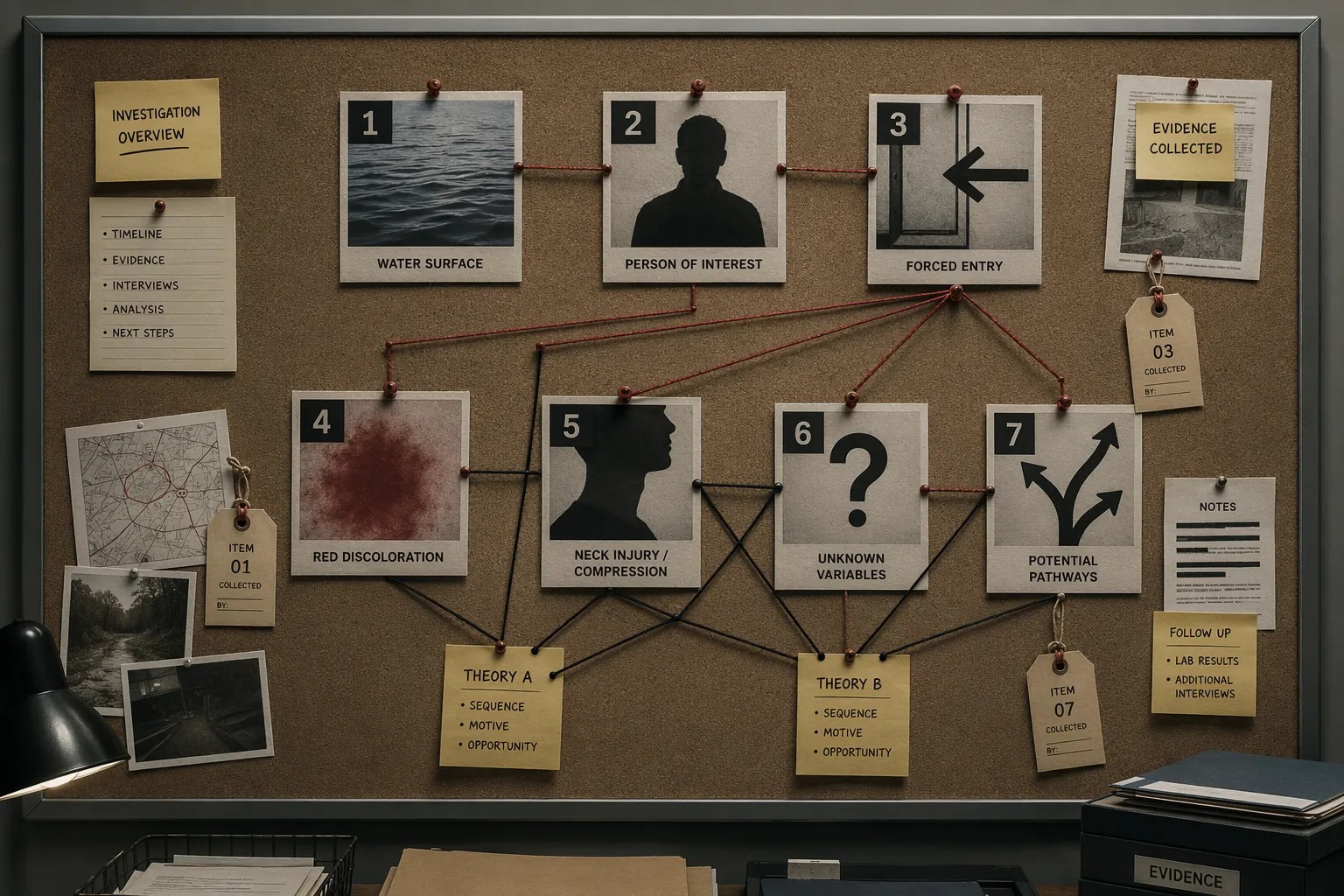
Mitchell’s report, as summarized in public reporting, identified unresolved questions that are not merely medical details. They determine which legal theory can be responsibly argued and which burden of proof that theory may or may not survive. The current posture adds one more caveat attorneys cannot ignore: the state’s final autopsy and toxicology findings remain unreleased.
| Unresolved forensic or evidentiary issue | Why it matters legally |
|---|---|
| Whether Wells was conscious before entering the water | A conscious entry may support one set of accidental or voluntary-entry theories; unconsciousness before water entry raises different causation questions. |
| Whether entry into the water was forced or unforced | Forced entry points toward possible assaultive conduct; unforced entry may move attention toward accident, impairment, or other surrounding circumstances. |
| Whether red discoloration reflected blunt force or decomposition | Blunt force could become evidence of injury before death; decomposition could weaken that inference. |
| Whether a person contributed to the death | This is the bridge from pathology uncertainty to homicide, manslaughter, negligent homicide, or civil fault theories. |
| Whether an object contributed to the death | An object may shift the inquiry toward environmental hazard, negligent maintenance, or an accidental mechanism. |
| Whether neck injury could be assessed adequately | If the relevant structures are unavailable to the independent pathologist, later arguments about neck trauma face an evidentiary gap. |
| Whether final state autopsy and toxicology findings change the record | A later official cause or manner finding could strengthen, narrow, or undermine arguments built from the independent autopsy. |
Among the reported questions are whether Wells was conscious or unconscious before entering the water, whether entry was forced or unforced, whether red discoloration reflected blunt force or decomposition, and whether any person or object contributed to his death.[1] Each question changes the route a lawyer would have to take. None supplies the destination by itself.
The Same Autopsy Can Mean Different Things Under Different Burdens
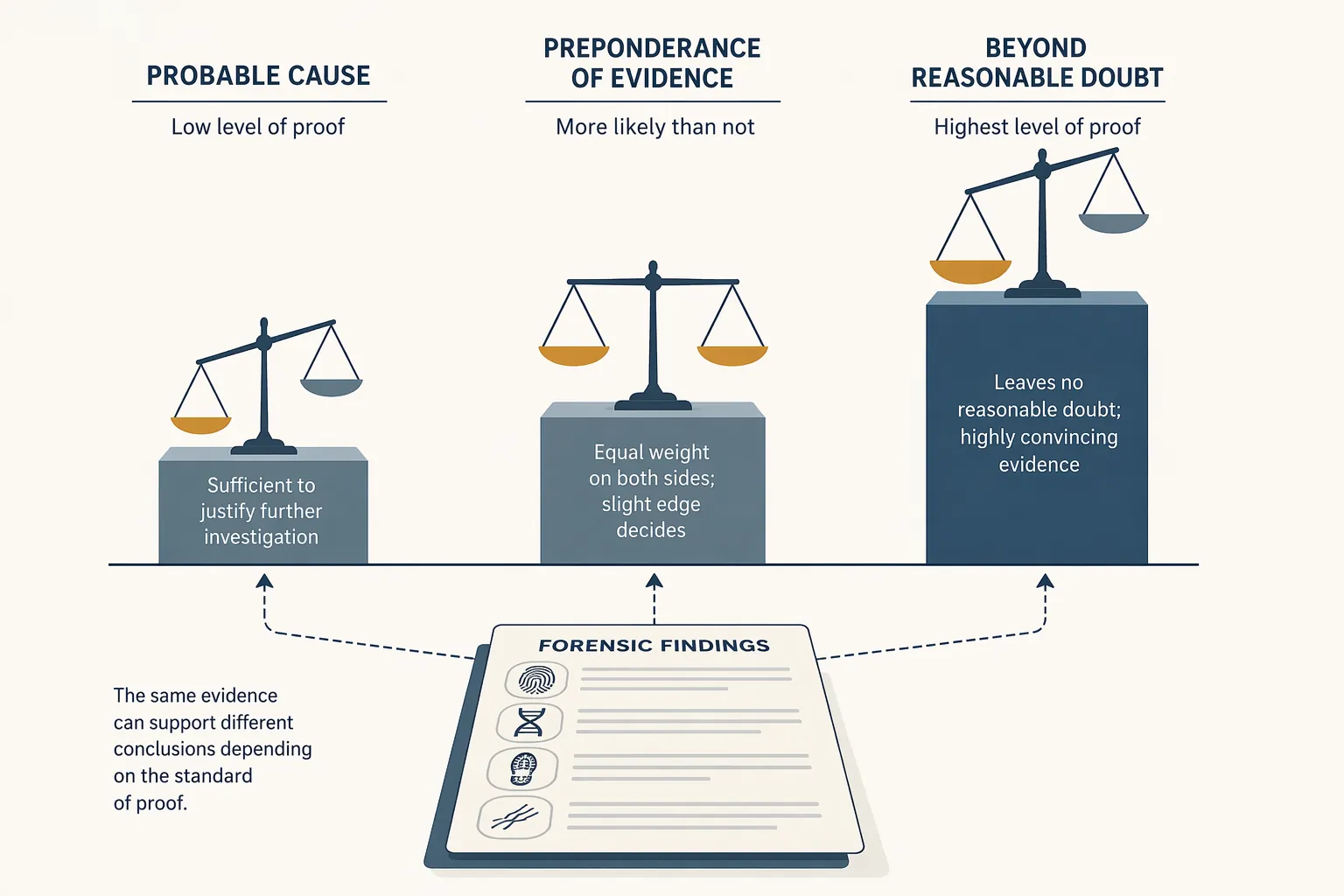
The legal mistake is to ask whether “undetermined” is good or bad for a case in the abstract. It depends on what decision-maker is being asked to do.
Probable Cause
At the probable-cause stage, the question is not whether the medical examiner can certify homicide. The question is whether there is credible evidence that a crime may have occurred and that further legal process is justified. Mitchell’s “cannot rule out” language would not, standing alone, establish probable cause for a specific charge. But it also would not bar one if other facts point toward forced entry, prior injury, witness involvement, concealment, inconsistent accounts, or another non-accidental mechanism.
This is where the phrase “non-accidental factors” becomes working legal material. It keeps open theories that depend on human conduct. A prosecutor or grand jury would still need facts outside the autopsy to move from possibility to probable cause, but an undetermined forensic classification does not close the file by itself.
Preponderance Of The Evidence
In a civil wrongful death or related claim, the inquiry changes. A plaintiff does not have to prove guilt beyond a reasonable doubt. The plaintiff has to show that the claimed theory is more likely than not. An undetermined autopsy can sometimes fit that burden if the surrounding evidence supplies the missing weight.
For example, if non-medical evidence supported a forced entry theory, the inability to assign a definitive manner of death would not automatically defeat civil causation. The autopsy might be used to show that a non-accidental contribution remains medically possible, while other proof supplies why that possibility is more likely than its alternatives. If the surrounding facts are equally balanced, however, “undetermined” may leave the plaintiff short. The classification preserves a route; it does not build the whole road.
Beyond A Reasonable Doubt
At a criminal trial, the same ambiguity becomes more powerful for the defense. If the medical evidence cannot distinguish accident from intentional or otherwise non-accidental conduct, a defense lawyer can argue that the state has not excluded reasonable alternative mechanisms. That argument becomes stronger where the unresolved issues go to the core act: whether Wells was conscious, whether he was forced into water, whether apparent injury was real injury, and whether another person contributed to death.
That does not mean an undetermined autopsy prevents conviction in every case. Criminal cases can be proved through circumstantial evidence. But where the pathologist cannot supply a definitive cause or manner, the prosecution must make up that distance elsewhere. A defense lawyer will make the jury look at every inch of it.
Red Discoloration Is A Small Phrase With Large Consequences
The red discoloration issue shows how quickly a medical uncertainty becomes trial terrain. CNN reported expert commentary from Dr. Kendall Von Crowns describing the finding as potentially reflecting “decompositional changes or blunt force injury.”[3] Those are very different legal facts.
If the discoloration is decomposition, it may have little value as evidence of assault. If it is blunt force injury, it can support an argument that something happened before water entry or death. A jury can hear competing expert opinions on that kind of ambiguity, but the burden of proof decides what the ambiguity does. In civil court, the question may be whether the injury explanation is more probable. In criminal court, the defense may argue that the decomposition explanation remains a reasonable doubt.
The point is not that red discoloration proves violence. It is that the record, as presently described, does not allow lawyers to ignore it or overstate it. It has to be matched with scene evidence, witness evidence, timing, toxicology when available, and any additional forensic findings.
The Neck-Structure Limitation Is Procedural, Not Cosmetic
One of the most consequential details in Mitchell’s report concerns what he could not examine. Public reporting described his limitation in evaluating neck injury because the state retained the anterior neck structures during the initial autopsy as part of its standard practice.[1] The Mississippi Department of Public Safety’s medical examiner materials describe autopsy practice in terms of examination and retention of materials for later testing, which is routine in death investigations.[4] Routine, however, does not mean legally neutral in every later dispute.
For the family’s lawyers, that limitation may explain why the independent autopsy could not answer a question the family wanted answered. For the state, it may reflect ordinary preservation of evidence. For a defense lawyer, it can become a caution against letting an independent examiner speculate beyond what was available. The same procedural fact can be used three ways because it affects the evidentiary record before anyone knows which future question will matter most.
That is why early autopsy procedure can matter so much in death litigation. Attorneys often do not know, at the beginning, whether the decisive issue will be drowning, neck trauma, blunt force, intoxication, timing, or scene reconstruction. Once certain tissue, structures, or observations are unavailable to a later examiner, the litigation inherits that absence.
What Attorneys Can Responsibly Do With This Record
The useful legal move is not to translate “undetermined” into a preferred conclusion. It is to identify which unresolved facts must be proved by other evidence.
- For a civil rights or wrongful death lawyer, the autopsy supports investigation into non-accidental contribution, but causation still needs corroboration from witnesses, scene evidence, timing, records, or expert reconstruction.
- For a prosecutor, the classification does not foreclose homicide theories, but it increases dependence on non-pathology evidence to show criminal agency.
- For a criminal defense lawyer, the unresolved cause and manner issues preserve arguments that the state cannot exclude accident, decomposition, or an unproven mechanism.
- For any lawyer evaluating the file, the unreleased state autopsy and toxicology results are not housekeeping details; they may change the medical foundation of every theory.
The most careful reading of Mitchell’s report is therefore neither “this proves homicide” nor “this proves nothing happened.” It is that the medical record, as currently public, keeps several theories alive while refusing to certify any one of them. That is often frustrating for families and inconvenient for lawyers, but it is not evasive. It is the evidentiary condition the case is presently in.
Where The Wells Autopsy Leaves The Legal Questions
As of July 23, 2026, the final state autopsy and toxicology results remain the obvious caveat. If they assign a cause or manner, confirm or contradict a key observation, or add toxicological findings, the legal analysis changes. Until then, the independent autopsy should be read for what it actually says.
In the Wells matter, “undetermined” preserves multiple legal possibilities. It can coexist with probable cause if other credible facts support a crime. It can support or fail a civil preponderance showing depending on the surrounding evidence. It can give a criminal defense substantial room to argue reasonable doubt. The classification is not the answer to the Nolan Wells family autopsy legal questions. It is the place where those questions become legally exact.
References
- What to know about the Nolan Wells independent autopsy results, PBS NewsHour, July 22, 2026.
- NAME guidelines framework for undetermined classification, Journal of Forensic Sciences, 2015.
- Nolan Wells preliminary autopsy results, CNN, July 22, 2026.
- FAQ, Mississippi Department of Public Safety.
Chronological incident history
No sanction cases have named this tool in the tracked record set to date. This does not imply the tool is safe — see Risk Digest for ongoing monitoring.
← Compare peer toolsReport a correction or tip
Spotted an outdated figure, a misstated fact, or a ruling this tool profile should reflect? Public comments are disabled for this content given the professional cost of a misreported case outcome, penalty amount, or rule text — use the structured correction channel instead.
Report a correction or tip for this record →