
How Nvidia-OpenAI deal reshapes securities fraud claims
The Nvidia-OpenAI circular-financing deal has already spawned two securities class actions and created a litigation template based on material omissions about off-balance-sheet data-center commitments and GPU depreciation mismatches. This article explains the structure and its implications for D&O exposure.
- Tool
- generic-chatbot
- Benchmark source
- Quinn Emanuel client alert
- Hallucination rate
- Not measured / undisclosed
- Test methodology
- Review of securities complaints
- Test date
- Jul 27, 2026
The securities-fraud story around AI infrastructure no longer depends on whether the reported Nvidia-OpenAI financing deal closes. The complaint template is already on file. In January 2026, plaintiffs sued Oracle in the Southern District of New York and CoreWeave in the District of Nevada, using different facts but a recognizably similar theory: investors were allegedly left without a clear view of the financing obligations, collateral assumptions, or economic exposure sitting behind AI data-center growth.
That is the useful starting point for assessing the legal implications of the reported Nvidia-OpenAI financing deal. The live legal risk is not simply that AI companies are spending heavily, or that chip suppliers, cloud platforms, and model developers are entering circular commercial arrangements. The sharper risk is that certain structures produce pleading-ready disclosure gaps: off-balance-sheet commitments, special-purpose-vehicle obligations, residual-value guarantees, take-or-pay exposure, GPU-backed debt, and depreciation schedules that can be compared against a deteriorating collateral market.
The Oracle and CoreWeave suits do not prove that plaintiffs will survive motions to dismiss. They do show that securities plaintiffs have moved from market commentary to filed 10b-5 theories. That difference matters to the people who have to sign the next risk factor, price the next D&O tower, or decide whether an AI infrastructure footnote is adequate.
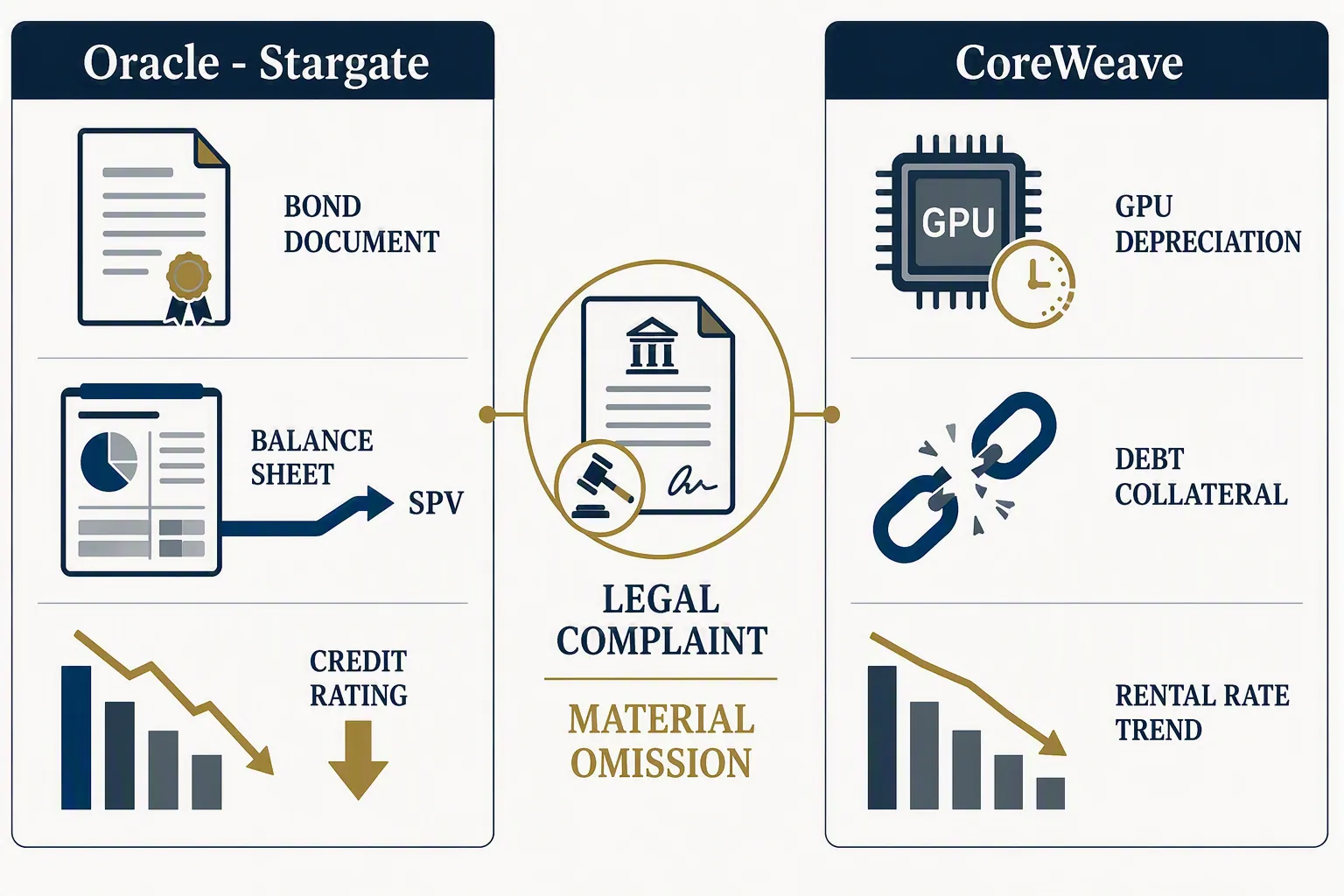
Two complaints, one emerging template
Oracle and CoreWeave are not interchangeable defendants. Oracle’s alleged problem is centered on Stargate-related financing, bond-market disclosure, and a large lease-commitment profile. CoreWeave’s alleged problem is centered on GPU-collateralized debt, depreciation accounting, and a collateral market that plaintiffs say moved faster than the company’s useful-life assumptions. Put together, they mark the two main routes by which AI infrastructure financing can become securities litigation: undisclosed obligation exposure and overstated collateral durability.
The Oracle complaint, Ohio Carpenters' Pension Plan v. Oracle, was filed on Jan. 14, 2026, in the Southern District of New York. The allegations described in the Quinn Emanuel client alert focus on Oracle’s $18 billion bond issuance and alleged material omissions about the Stargate financing structure, including the effect of new lease commitments and credit-market reaction. The same alert reports $248 billion in new lease commitments and says Oracle’s five-year CDS spread rose about 310% to a 16-year high, while citing S&P and Moody’s negative-watch activity in January 2026.[1]
Those figures are not just large. They are the kind of figures plaintiffs can put to work. A bond issuance gives the pleading a transaction point. Lease commitments give the pleading an obligation set. A sharp CDS move gives plaintiffs a market signal they can try to connect to materiality and loss causation. Ratings pressure gives the complaint a third-party credit lens, even if it does not, by itself, establish securities fraud.
CoreWeave’s complaint, Masaitis v. CoreWeave, was filed two days earlier, on Jan. 12, 2026, in the District of Nevada. The Quinn Emanuel alert describes the theory as turning on a GPU-collateralized debt facility, with plaintiffs pointing to six-year depreciation accounting against an alleged two-to-four-year actual useful life. The same alert, citing CNBC and the Center for Public Enterprise’s Bubble or Nothing report, states that GPU rental rates had fallen 70% to 90% since 2023.[1]
CoreWeave’s version of the template is more accounting-and-collateral driven. If the debt is supported by GPUs, the useful life of those GPUs becomes more than an accounting estimate. It bears on collateral coverage, future impairment arguments, financing capacity, and the credibility of growth projections. Plaintiffs do not need to show that every GPU lost value at the same pace. They need a plausible mismatch between disclosed assumptions and market facts that a reasonable investor would have wanted to know.
| Defendant | Filed case | Disclosure pressure point | Why plaintiffs can reuse it |
|---|---|---|---|
| Oracle | Ohio Carpenters' Pension Plan v. Oracle, SDNY, Jan. 14, 2026 | Alleged omissions about Stargate financing structure, bond issuance, lease commitments, and credit-market reaction | Turns off-balance-sheet or lease-heavy AI data-center exposure into a materiality and omission theory |
| CoreWeave | Masaitis v. CoreWeave, D. Nev., Jan. 12, 2026 | GPU-collateralized debt, depreciation assumptions, alleged useful-life mismatch, and falling GPU rental rates | Turns AI compute assets into a collateral-quality and accounting-disclosure theory |
Why off-balance-sheet AI financing is plaintiff-friendly
Securities complaints favor structures that can be translated into verbs. The company “relied on” SPVs. It “shifted” spending. It “guaranteed” residual values. It “entered” lease commitments. It “failed to disclose” a take-or-pay obligation. Those verbs are easier to plead than a generalized claim that AI enthusiasm got ahead of fundamentals.
The Moody’s AI leases report supplies the broader context. It says off-balance-sheet SPVs moved more than $120 billion in data-center spending off technology-company balance sheets over an 18-month period, and warns that “disclosures may not show the full picture.”[2] That is not a finding that every such structure is misleading. It is a warning that the legal significance may sit in the gap between economic exposure and disclosure location.
For a 10b-5 plaintiff, that gap matters because materiality is rarely about formal balance-sheet classification alone. If an issuer has meaningful economic exposure through lease commitments, guarantees, purchase obligations, or SPV-linked support, the question becomes whether the disclosed picture allowed investors to understand the risk they were actually underwriting. A footnote can be adequate. It can also become the exhibit plaintiffs cite to argue that the company knew the exposure was significant enough to mention but not clearly enough to price.
Meta’s Hyperion structure illustrates the point without needing to become another case study. Moody’s reported that the Hyperion SPV shifted $30 billion off balance sheet through a residual value guarantee of up to $28 billion that appeared only in footnotes.[2] The legal issue is not that a footnote is inherently defective. The issue is whether a large residual-value backstop, if material to the economics of the arrangement, is presented where and how investors would reasonably expect to find it.
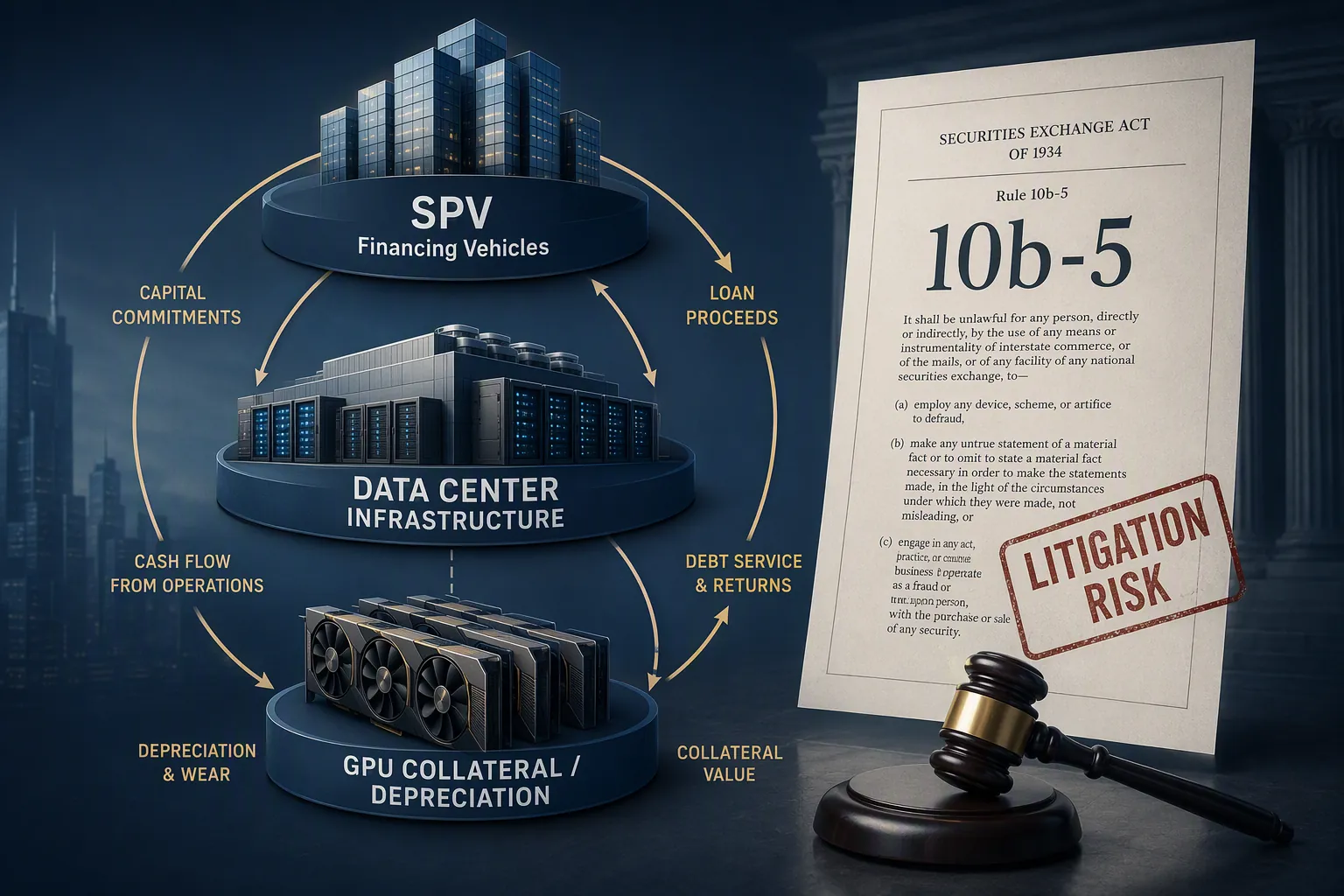
The AI filing surge makes portability the issue
The template matters because it is portable. Alston & Bird reported 18 AI-related securities filings in the first half of 2026, with 236 projected, and said the Second and Ninth Circuits accounted for 68% of those filings, citing NERA data.[3] Those numbers do not show that AI infrastructure cases are meritorious. They do show that plaintiffs’ firms are already sorting AI disclosures into securities theories at scale.
Oracle and CoreWeave give those filings more specific drafting pathways. A plaintiff looking at an AI infrastructure issuer can now ask a short sequence of questions: Where is the data-center spending sitting? Who is obligated if the SPV economics deteriorate? Are there lease commitments or take-or-pay compute obligations that affect liquidity? Is GPU collateral being depreciated over a period that still makes sense? Are residual-value assumptions visible to investors or buried in a way that requires reconstruction?
That sequence maps cleanly onto familiar 10b-5 elements. Materiality comes from scale, credit sensitivity, and investor relevance. An omission theory comes from the distance between the economic exposure and the disclosure actually made. Scienter will be harder; plaintiffs still need particularized facts supporting a strong inference that defendants knew, or were reckless in not knowing, that the disclosures were misleading. Loss causation will also need work, particularly if stock drops are tangled with sector-wide AI repricing rather than a company-specific corrective disclosure.
That is why the filed complaints should be read as templates, not verdicts. Their value for D&O risk teams is diagnostic. They identify which parts of AI infrastructure financing are likely to be recast as investor-facing omissions when the market turns: debt supported by fast-depreciating assets, long-dated lease commitments, guarantees that sit outside the main balance sheet presentation, and circular revenue or purchase arrangements that make demand look more independent than it may be.
Where Nvidia and OpenAI fit, and where they do not yet fit
The reported Nvidia-OpenAI financing terms are legally important because they sit near the center of the same ecosystem. But the status of those terms has to be kept straight. As of July 27, 2026, Axios described the Nvidia-OpenAI financing deal as still under negotiation, not finalized. The reported $250 billion backstop and $350 billion chip-purchase figures were terms under discussion, not executed obligations.[4]
That distinction limits what can responsibly be said about direct liability. The two filed class actions name Oracle and CoreWeave, not Nvidia or OpenAI. The chain of liability that would connect a reported circular-financing structure directly to 10b-5 exposure for Nvidia or OpenAI remains untested. A market participant can identify exposure signals; a complaint still needs a defendant-specific misstatement or omission, a duty to disclose, scienter, reliance, and loss causation.
The more immediate implication is upstream and downstream disclosure pressure. If a chip supplier finances, backstops, or otherwise supports demand for its own products, plaintiffs will look for statements that characterize revenue quality, customer demand, backlog, concentration risk, related financing support, and collectability. If a model developer commits to large compute purchases through structures that rely on third-party financing, plaintiffs will look for liquidity disclosure, dependency risk, and contingent obligations. If a cloud or data-center operator intermediates the arrangement, plaintiffs will look for lease commitments, SPV support, utilization assumptions, and collateral value.
None of that means the reported Nvidia-OpenAI structure is fraudulent. It means the structure contains the same legal raw material that has already appeared in complaints against adjacent issuers. The doctrinal bridge still has to be built case by case.
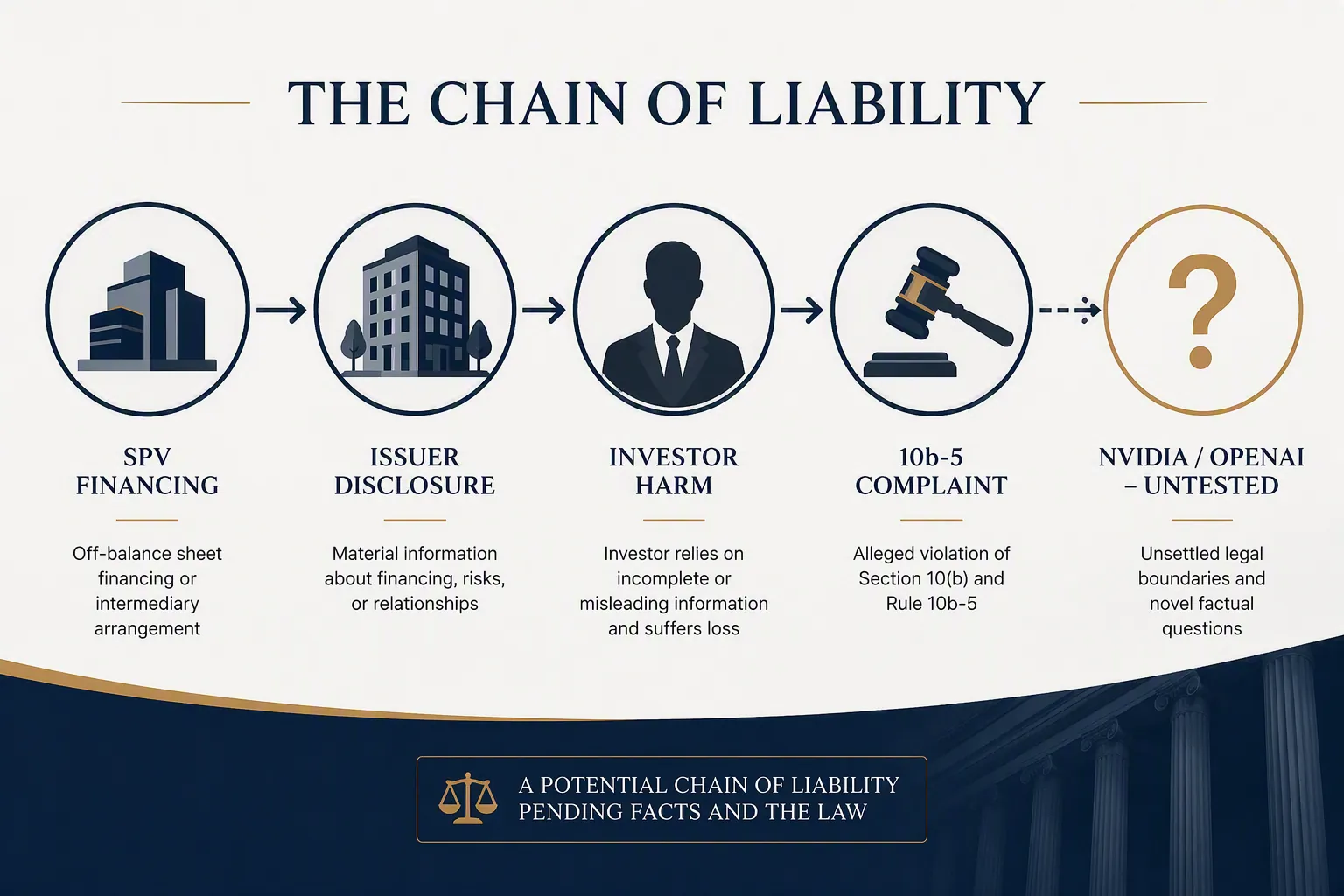
What disclosure teams should treat as litigation-sensitive
The highest-risk disclosures are not necessarily the longest ones. A dense footnote that technically identifies an SPV, lease, or guarantee may still leave investors without a practical view of the company’s exposure. Conversely, a concise disclosure can be defensible if it plainly states who bears which obligation, under what conditions, and why the amount matters to liquidity, margins, collateral coverage, or revenue quality.
- SPV exposure: whether the issuer has guarantees, support obligations, purchase commitments, residual-value risk, or economic dependence that is not obvious from balance-sheet presentation.
- Lease and take-or-pay commitments: whether future payment obligations are described only as operating arrangements when they materially affect liquidity or capacity planning.
- GPU collateral assumptions: whether depreciation schedules, useful-life estimates, and impairment analysis reflect observable changes in rental rates or secondary-market economics.
- Circular demand signals: whether revenue, backlog, or customer demand depends on financing supplied or backstopped by counterparties within the same commercial chain.
- Credit-market developments: whether rating actions, CDS movement, or refinancing constraints create facts that make prior liquidity or obligation disclosures vulnerable in hindsight.
For D&O underwriters, these are underwriting questions as much as legal questions. A company with AI infrastructure exposure may be a very different risk depending on whether its data-center growth is funded through ordinary capex, long-term leases, SPVs with residual-value guarantees, GPU-secured debt, customer financing, or a chain that combines several of those features. The litigation risk rises when the public disclosure does not let an investor distinguish among them.
For audit committees and counsel, the useful exercise is not to guess whether AI valuations are overheated. It is to trace the obligation chain until the disclosure verbs become accurate: who pays, who guarantees, who depreciates, who absorbs underutilization, who refinances, and who is left exposed if GPU economics or compute demand changes. The Oracle and CoreWeave complaints show how plaintiffs will perform that tracing after a stock drop. Companies with similar structures have an opportunity to do it before one.
AI infrastructure financing has become a D&O disclosure risk category. Oracle and CoreWeave supply the first working complaint models. Nvidia and OpenAI remain the unresolved test of how far plaintiffs can push the chain from circular financing mechanics to issuer-specific securities liability.
References
- Emerging Litigation Risks in Financing AI Data Centers Boom, Quinn Emanuel, Jan. 2026.
- AI Leases, Moody’s, Feb. 2026.
- Securities Class Action Filings Surge in the First Half of 2026, Alston & Bird, July 2026.
- Nvidia-OpenAI financing deal report, Axios, July 27, 2026.
Chronological incident history
No sanction cases have named this tool in the tracked record set to date. This does not imply the tool is safe — see Risk Digest for ongoing monitoring.
← Compare peer toolsReport a correction or tip
Spotted an outdated figure, a misstated fact, or a ruling this tool profile should reflect? Public comments are disabled for this content given the professional cost of a misreported case outcome, penalty amount, or rule text — use the structured correction channel instead.
Report a correction or tip for this record →