
Does OCBC HELIOS Have Real Compliance Evidence?
OCBC's HELIOS private-banking platform is strong on compliance control design but discloses no error rate, hallucination benchmark, or third-party audit. This evaluation maps the five-agent architecture against that evidence gap for procurement teams benchmarking agentic-AI vendors.
- Tool
- OCBC HELIOS
- Benchmark source
- No independent benchmark disclosed; public record review
- Hallucination rate
- Not measured / undisclosed
- Test methodology
- Qualitative review of OCBC disclosures and press reports; no accuracy benchmark conducted
- Test date
- Jul 31, 2026
| Record field | Current entry |
|---|---|
| Tool | HELIOS — Holistic wEalth Lifecycle Insights & Ongoing Surveillance [1] |
| Operator and deployment | OCBC; deployed at Bank of Singapore for private-banking onboarding and review workflows [1][2] |
| Jurisdictions named in public materials | Used by Bank of Singapore relationship managers across Singapore, Hong Kong, and Dubai [1][2] |
| Status | Live; rollout completion targeted for Q3 2026; planned extension to OCBC Premier Private Client by end-2026 [1] |
| Do not confuse with | OCBC’s earlier employee generative-AI chatbot built on Azure OpenAI and described in 2023–2024 productivity coverage [3] |
| Last verified | 2026-07-31 |
HELIOS is a stronger disclosure than the usual bank AI announcement. OCBC has named the workflow, the business unit, the rollout path, the accountable humans, and—through reporting on the system design—the presence of an independent checking agent. That is useful evidence for procurement teams benchmarking agentic AI in regulated work. It is not, however, accuracy evidence. The public record reviewed here contains no disclosed error rate, hallucination benchmark, false-negative rate, sampling protocol, or third-party audit.
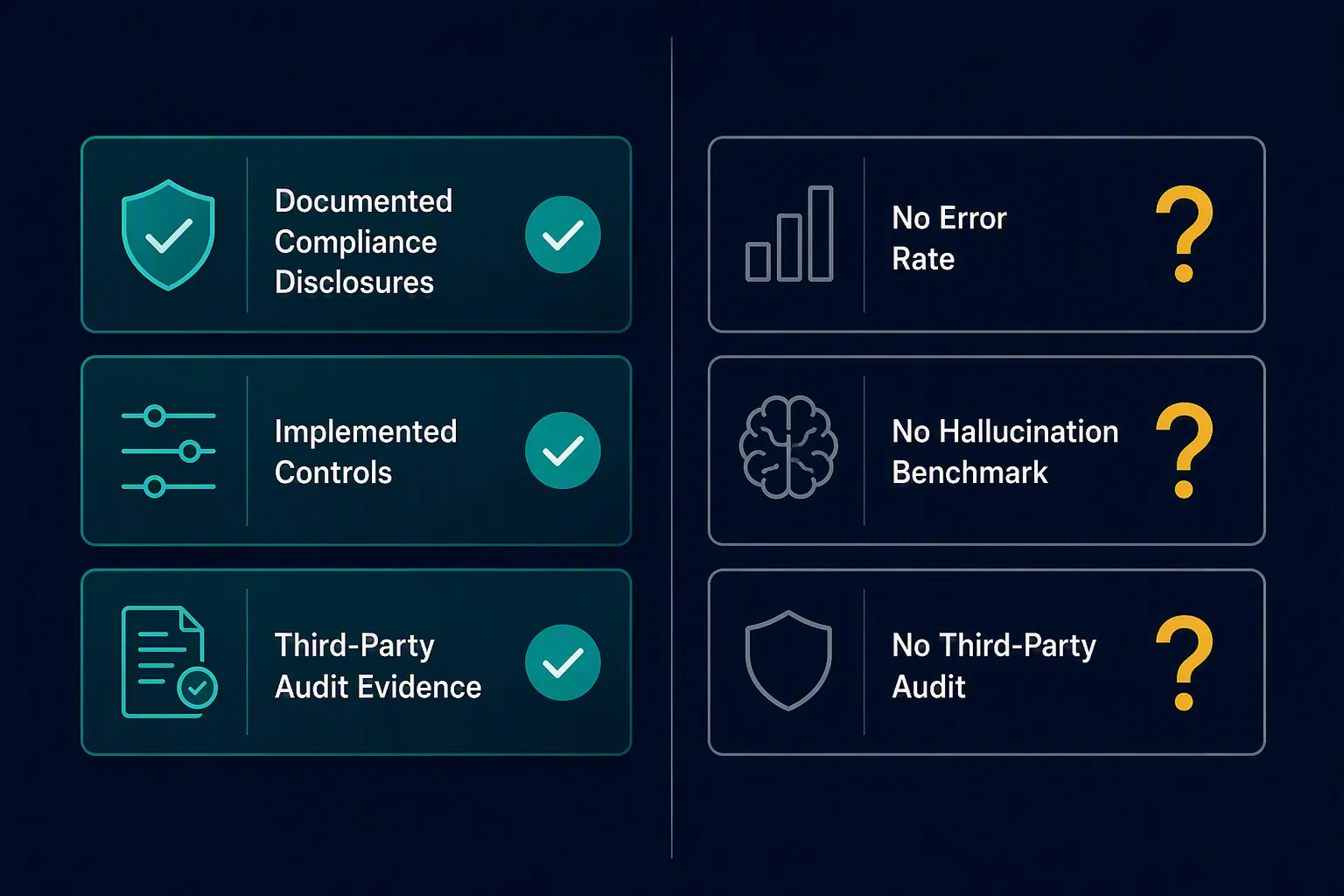
| What is disclosed | What still cannot be verified from public materials |
|---|---|
| HELIOS is live at Bank of Singapore and is being used by relationship managers in Singapore, Hong Kong, and Dubai [1][2]. | No public independent validation shows how often the system is correct, incomplete, or confidently wrong. |
| The platform is reported to use five agents, including an independent agent that checks the other four for accuracy; most information is verified by the checking agent, with the remainder verified by a human [4]. | No public benchmark describes the checking agent’s precision, recall, escalation rate, or miss rate. |
| OCBC states that relationship managers and internal review teams maintain ultimate accountability for review, judgment, and decision-making [1]. | No public material shows the audit trail quality, reviewer override rate, or how often human reviewers catch AI-generated defects. |
| OCBC says more than 100 relationship managers, about 25% of the relevant group, used HELIOS over five months, and about 50 clients had been fully onboarded using it [1][2]. | Adoption and client counts show operational use, not reliability. |
| Reported onboarding targets include cutting average onboarding from more than 30 days to 15 business days, with straightforward cases potentially completed within a day [4][5]. | Speed does not show whether source-of-wealth analysis, document review, or compliance judgment became more accurate. |
| OCBC has described a planned extension to OCBC Premier Private Client by end-2026 [1]. | No public source reviewed here discloses whether reliability thresholds must be met before that extension proceeds. |
Why the architecture is worth taking seriously
The most important HELIOS disclosure is not the onboarding-time claim. It is the control architecture. Business Times reporting describes HELIOS as a five-agent system in which an independent accuracy-checking agent reviews the work of the other four agents; the same report says most information is verified by that checking agent, while the remainder is verified by a human [4]. OCBC’s own release does not enumerate all five agents, so the five-agent detail should be attributed to that reporting rather than treated as a line item from the bank’s announcement.
That distinction matters because agentic-AI disclosures often blur the difference between “the system does several things” and “the system has a control layer.” HELIOS, as reported, has both. A task agent can gather, summarize, compare, or draft. A checking agent has a different job: it exists to challenge the output before the file moves forward. In a private-banking onboarding workflow, that placement is more meaningful than a general promise that someone somewhere can review the AI’s answer later.
OCBC also places accountability in named human roles. Its release states that relationship managers and internal review teams “maintain ultimate accountability on review, judgment and decision making” [1]. Business Times separately quoted OCBC’s Jason Moo saying the platform was built by the compliance unit so compliance standards are encoded in the system [4]. Those are better facts than a generic “human in the loop” claim. They identify who remains exposed when the workflow accelerates: the relationship manager preparing the client file, and the internal reviewer who must be able to defend the decision.
For legal-tech and compliance buyers, this is the part worth borrowing. If a vendor says its AI agent can prepare due-diligence material, summarize client evidence, or route risk judgments, the useful question is not whether a human can theoretically intervene. It is whether the control is built into the workflow before the decision point, whether the checker is independent from the drafting process, and whether a named accountable role receives an auditable file rather than a polished answer with no provenance.
The measurement gap is still the controlling risk signal
The public figures around HELIOS are commercially significant. OCBC says more than 100 Bank of Singapore relationship managers—about a quarter of the relevant group—used the platform over a five-month period, and about 50 clients had been fully onboarded through it [1][2]. Business Times reported that OCBC aims to cut onboarding to 15 business days, compared with its previous average of more than 30 days, and that simple cases could be completed within a day [4]. Computer Weekly also reported the 15-business-day target and the possibility of straightforward cases being handled in one day [5].
Those are not minor gains. In wealth onboarding, a file that waits for weeks can mean a client who cools, a relationship manager who has to chase documents again, and a compliance team that inherits backlog pressure. Reducing a process from more than 30 days to 15 business days would be operationally meaningful even if it did nothing to improve accuracy. A simple case completed in one day would change the commercial rhythm of onboarding.
But none of those figures answers the reliability question. They do not show how many AI-generated checks were wrong. They do not show how many files were escalated because the checking agent was uncertain. They do not show whether human reviewers found fewer defects, more defects, or different defects after HELIOS entered the workflow. They do not show whether the system performs differently across jurisdictions, document types, wealth sources, languages, or client complexity.
That absence is not evidence of a failure. No public material reviewed here shows that HELIOS has produced a compliance error, missed a source-of-wealth issue, or misled a reviewer. The narrower and more defensible finding is that OCBC has disclosed process and adoption metrics, while reliability metrics remain undisclosed.
What would count as reliability evidence
For a procurement review, the missing evidence is not exotic. A bank or vendor could disclose a tested error rate on a defined sample, the percentage of outputs escalated to humans, the types of defects caught by the independent checking layer, the reviewer override rate, or the rate at which the system misses material information later identified by human review. Stronger still would be an external audit or a benchmark run against realistic onboarding files with documented ground truth.
The point is not that every metric must be public in full. Banks have confidentiality, security, and model-risk reasons not to publish their whole test harness. But when a tool touches source-of-wealth review and onboarding judgment, a buyer evaluating similar technology should not accept time saved as a substitute for measured defect behavior.
SOWA is useful precedent, not proof of HELIOS accuracy
HELIOS did not appear out of nowhere. Bank of Singapore announced in October 2025 that it had deployed an agentic Source of Wealth Assistant, or SOWA, to automate preparation of source-of-wealth reports. The bank said SOWA reduced report-preparation time from 10 days to one hour and included plausibility validation against benchmark data on the bank’s private cloud [6].
That precursor is relevant because it shows OCBC’s private-banking group had already been applying agentic AI to source-of-wealth work before HELIOS. It also shows the bank was not merely using a general chatbot at the edge of a regulated workflow. Still, the SOWA claim has the same evidentiary limit: time saved and functional design do not establish the error rate of HELIOS. A plausibility-validation feature in one system is not a public accuracy benchmark for another.
The DBS contrast: another large bank is slowing the handoff
DBS provides a useful counterweight because its public posture is more cautious. In a July 2026 Computer Weekly interview, DBS said it was holding off on allowing AI agents to run on their own because controls were lagging capability. The bank described capability innovation advancing at roughly five times the rate of governance and control tooling, and said agents “optimise for efficiency, not compliance” [7].
That does not make DBS right and OCBC wrong. The systems are not the same, and the public records do not allow a head-to-head performance comparison. The contrast is useful because it separates two questions that vendor demos often merge. A bank can build agents that move faster than a manual workflow. A bank still has to show that its control tooling can keep pace with the errors those agents may introduce.
The DBS example is especially relevant for buyers because the same report described human interrogation remaining in a credit-memo chain involving about 70 to 80 agents [7]. That is the procurement issue in miniature. Agent count is not a safety metric. The meaningful questions are where the human interrogation occurs, what evidence the human sees, and whether the control system has been tested against the kinds of failures the workflow can actually produce.
MAS context makes the control questions harder to avoid
The regulatory backdrop in Singapore is moving in the same direction as the control questions raised by HELIOS. MAS issued Consultation Paper P017-2025 on proposed Guidelines on AI Risk Management on November 13, 2025, expressly covering generative AI and AI agents; comments closed on January 31, 2026 [8][9]. The consultation materials describe expectations across board and senior-management oversight, AI inventories, risk materiality assessment, and lifecycle controls including human oversight, evaluation and testing, and monitoring [8][9].
MAS’s Project MindForge also matters here because Phase 1 concluded on November 13, 2025, and Phase 2 broadened the work to agentic AI and an AI Risk Management Toolkit [10]. The primary sources reviewed for this record do not verify the final status of MAS’s AI Risk Management Guidelines as of Q3 2026, so the consultation should not be treated here as a finalized rulebook. It is still useful context: the direction of travel is toward inventories, testing, monitoring, accountable oversight, and lifecycle governance—not toward accepting productivity claims on their own.
Procurement questions HELIOS usefully puts on the table
HELIOS is credible architecture, not verified accuracy. That is enough to make it useful as a benchmark for evaluating other agentic-AI vendors, including legal-AI vendors that claim to draft, check, route, or summarize regulated work.
- Is there an independent checking layer, or does the same model family that generates the answer also mark its own homework?
- Where does the check occur: before the file reaches the accountable reviewer, after submission, or only if someone asks?
- Who remains accountable by role name when the AI output is wrong?
- Was compliance, legal, or risk part of system design, or only part of post-launch approval?
- What defect metrics are measured: error rate, escalation rate, hallucination rate, reviewer override rate, missed-material-fact rate, or some other tested failure category?
- Has any testing been performed by an independent team, internal audit, external audit, regulator, or other party not responsible for selling or promoting the system?
- Can the buyer inspect a sample audit trail showing source documents, AI transformations, checking-agent flags, human overrides, and final decision ownership?
The safest procurement stance is to give OCBC credit for the disclosed control design while refusing to let bank prestige, adoption counts, or faster onboarding stand in for reliability evidence. Buyers building their own evaluation files can pair this record with AI tool-selection criteria, lawyer ethics and human-oversight duties, and the same evidence-gap method used in the Alphabet AI legal-tech risk evaluation. This is a tool reliability evaluation, not a product review, legal advice, or investment analysis.
References
- OCBC harnesses agentic AI to sharpen and quicken onboarding of wealthy customers, OCBC, July 29, 2026
- OCBC seeks to accelerate wealth client onboarding with agentic AI, Reuters, July 29, 2026
- OCBC’s new generative AI chatbot is boosting the bank’s productivity across departments and locations, Microsoft Source Asia
- OCBC to cut wealth onboarding to 15 business days with agentic AI; simple cases in one day, The Business Times
- OCBC taps agentic AI to cut private banking onboarding time, Computer Weekly
- Bank of Singapore deploys Agentic AI tool to automate writing of Source of Wealth reports, Bank of Singapore, October 10, 2025
- DBS holds off on letting AI agents run on their own as controls lag capability, Computer Weekly, July 28, 2026
- MAS Guidelines for Artificial Intelligence Risk Management, Monetary Authority of Singapore, November 13, 2025
- Consultation Paper on Guidelines on Artificial Intelligence Risk Management, Monetary Authority of Singapore
- Project MindForge, Monetary Authority of Singapore
Chronological incident history
No sanction cases have named this tool in the tracked record set to date. This does not imply the tool is safe — see Risk Digest for ongoing monitoring.
← Compare peer toolsReport a correction or tip
Spotted an outdated figure, a misstated fact, or a ruling this tool profile should reflect? Public comments are disabled for this content given the professional cost of a misreported case outcome, penalty amount, or rule text — use the structured correction channel instead.
Report a correction or tip for this record →