
Onyx Security $113M Series B: What It Means for Law Firms
An evaluation of Onyx Security's AI agent control plane in light of its $113M Series B, assessing whether the platform addresses law firms' primary AI risk—hallucinated legal citations—or leaves that gap for a separate verification layer. The analysis grounds Onyx's general-enterprise capabilities against documented sanction cases from the Risk Digest.
- Tool
- Onyx Security
- Benchmark source
- Onyx Security product materials and legal sanction records
- Hallucination rate
- Not measured / undisclosed
- Test methodology
- Synthesis of Onyx general-enterprise materials against documented legal sanction patterns
- Test date
- Jul 31, 2026
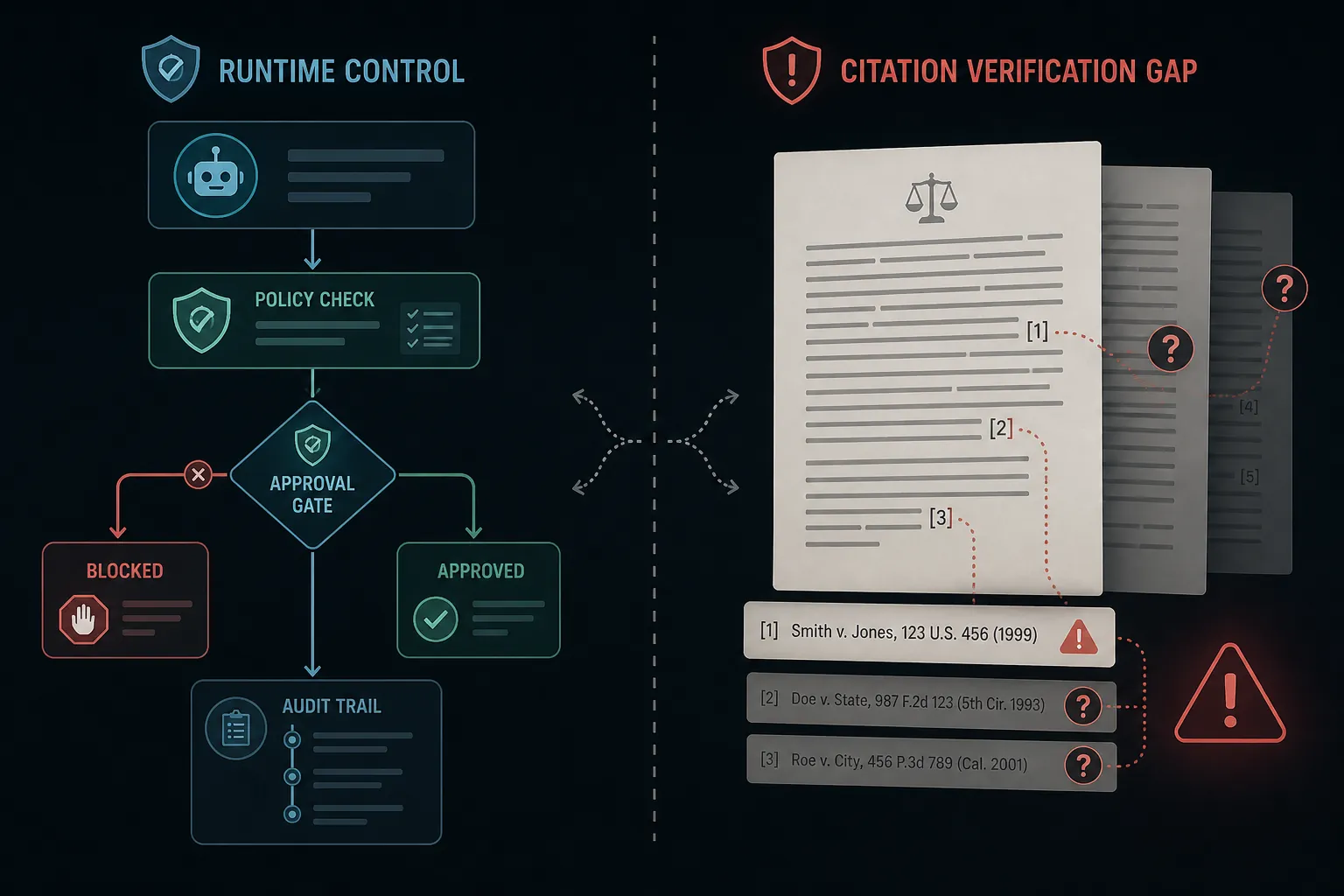
A law firm seeing the Onyx Security $113 million Series B headline should start with a narrower procurement question: does Onyx Security provide the missing control layer between authorized AI experimentation and filing-ready legal work? The answer is partly yes, but not in the way a sanction-conscious firm may hope. Onyx Security is building a runtime control plane for AI agents. It is not a legal citation checker, and it should not be evaluated as one.
Several housekeeping points matter before the funding number does. This article concerns Onyx Security, the enterprise AI agent security company, not Onyx AI at onyx.app, the open-source enterprise search company. The reported $640 million valuation comes from CTech/Calcalistech coverage, not from Onyx Security’s own announcement. Onyx’s usage counters are vendor-published and unaudited. And the law-firm assessment here is a synthesis of Onyx’s general-enterprise materials against documented legal sanction patterns, not a law-firm-specific benchmark commissioned by Onyx or by a court.
That distinction is not pedantic. A platform can be very useful for controlling what AI agents are allowed to do and still leave untouched the question that gets lawyers sanctioned: did anyone verify that the cases in the brief actually exist?
Why the $113M Round Matters, and Why It Is Not the Proof Point
Onyx Security announced a $113 million Series B led by Bessemer on July 29, 2026, bringing total funding to $153 million. The company said the round arrived four months after it emerged from stealth on March 12, 2026.[1][2] CTech/Calcalistech reported a $640 million valuation, a figure the company did not confirm in its own announcement.[3]
The round is meaningful because capital is arriving quickly around a specific category: tools that sit between enterprise users, SaaS systems, and increasingly autonomous AI agents. In the same short window, Hush Security raised a $30 million Series A on July 28, 2026, and Willow raised a $7 million seed round in June 2026, according to CTech’s category coverage.[3] That is category formation, not legal-risk validation.
For a law firm, the useful inference is not “large round, therefore safe.” It is “enough money is moving into AI agent control planes that firms should understand what this layer does before partners create their own informal one through policy memos, access restrictions, and hallway warnings.”
What Onyx Actually Controls
Onyx describes its product as a Secure AI Control Plane. Its platform materials identify five major functions: discovery, Guardian Agent, governance, posture management, and investigations. Discovery is aimed at shadow AI detection across more than 60 SaaS integrations. Guardian Agent is the runtime component: it can block, approve, or redirect AI agent actions before execution. Governance supports natural-language policy creation and EU AI Act compliance templates. Posture management tracks configuration and risk state. Investigations preserve audit trails for later review.[4][5]

For legal operations, those functions map cleanly to real governance headaches. A firm may not know which associates have connected unofficial AI tools to document repositories. A practice group may permit an approved research assistant but not permit it to email a client, alter a calendar entry, or pull files from a restricted matter workspace. A risk committee may need evidence showing which agent acted, which policy applied, what data was accessed, and who approved an exception.
Onyx’s own published counters say it has secured 1.1 million agents, inspected more than 66 million AI sessions, and covered 1.8 million employees. Those numbers are useful as vendor-supplied scale indicators, not as independently audited effectiveness evidence.[1]
| Onyx layer | What it can help a law firm see or control | What it does not prove |
|---|---|---|
| Discovery | Where AI tools and agents are appearing across connected SaaS systems | Whether the output from those tools is legally correct |
| Guardian Agent | Whether an agent action should be blocked, approved, or redirected before execution | Whether a cited case, quotation, or procedural rule is real |
| Governance | Which natural-language policies apply to AI use and compliance templates | Whether users complied with professional verification duties |
| Posture management | Whether the firm’s AI environment is configured consistently with policy | Whether a generated memorandum is reliable enough to file |
| Investigations | What happened, when, through which system, and under which approval path | Whether the legal authorities in the document were independently checked |
That is a serious control surface. It is also a different surface from legal truth. If an agent tries to export privileged material to an unapproved destination, runtime intervention is exactly where a firm wants the stop sign. If the same agent drafts a motion containing a fabricated appellate citation inside an otherwise permitted drafting workflow, the control plane may have no reason to object unless a separate verification rule or tool has been connected to that moment.
The Legal Sanction Pattern Is Mostly a Content Failure
The legal profession’s most visible AI failures have not generally involved an autonomous agent exfiltrating data or exceeding a SaaS permission. They have involved lawyers filing AI-generated work product that contained hallucinated cases, false citations, fabricated quotations, or unsupported propositions. Risk Digest records identify more than 1,490 documented hallucination or sanction matters globally, including more than 1,000 in the United States, with U.S. sanctions in Q1 2026 alone exceeding $145,000.[6]
That fact changes the procurement test. The firm should not ask only whether a vendor can prove that an AI system stayed inside approved applications. It should ask whether the tool would have changed the outcome in the actual cases producing discipline, monetary sanctions, or judicial orders. In a hallucinated-citation filing, the decisive missed step is usually primary-source verification before submission. Someone needed to match each cited authority against a trusted legal database, court docket, or official source. A runtime control plane can document the workflow around that step; it does not automatically perform the step.
This is where AI governance language gets too loose. “Keep humans in control” is a useful enterprise-security ambition. In a law firm, however, human control is not satisfied by approval alone. A partner can approve a brief full of nonexistent cases. An associate can follow the approved tool policy and still fail to Shepardize or otherwise verify the authorities. A docketing or filing team can preserve the wrong document perfectly.
Where Guardian Agent Would Help
Guardian Agent is the part of Onyx’s architecture that should draw the most attention from a law-firm risk committee. Onyx says it can intervene in real time by blocking, approving, or redirecting an agent action before the action executes.[4] That is more concrete than a policy document telling lawyers not to paste confidential facts into public tools. It is closer to a checkpoint in the workstream.
In a firm environment, the obvious use cases are not speculative. A research agent should not read documents from a matter wall unless the user has the right permissions. A drafting agent should not send a client-ready document to an external recipient without an approval path. A litigation support agent should not move material from one client workspace into another. A business-development assistant should not combine confidential client information with a public model just because a lawyer asks for a pitch paragraph.
Those are governance failures worth preventing. They are also the kinds of failures that traditional legal knowledge-management processes handle poorly. A memo can say “do not use unapproved AI,” but it will not discover all unsanctioned tools across the firm. A training deck can describe privilege risk, but it will not create an audit trail when an agent attempts a restricted action at 11:47 p.m. Discovery across SaaS integrations and before-execution enforcement are more reliable than folklore.
The investigations module matters for the same reason. After an incident, the question is rarely just whether the firm had a policy. The harder question is whether the firm can reconstruct what happened: which agent was involved, which data source it touched, which user authorized the action, which policy applied, and whether an exception was granted. Auditability is not a substitute for correctness, but it is often the difference between a manageable incident review and a vague internal search for someone to blame.
Where It Would Not Be Enough
Now place that workflow beside a hallucinated-citation case. Assume, hypothetically, that an associate uses an approved AI drafting assistant inside an approved SaaS environment. The assistant has permission to read the relevant memo folder. The associate asks for a draft argument section. The agent produces plausible citations. The associate lightly edits the text. The partner approves the filing. The document goes to court.
A runtime control plane may see an approved user, an approved tool, an approved data path, and an approved filing workflow. Nothing in that sequence necessarily tells the control plane that one cited case does not exist or that a quoted passage is not in the opinion. The failure sits inside the content.
That does not make runtime governance irrelevant. Onyx could still help a firm prove that the document came from an approved system, that no restricted data source was accessed, and that the review chain occurred. It could support an investigation after the court identifies the problem. It could enforce a policy requiring certain AI-generated materials to route through a verification workflow before filing if the firm has built or integrated that workflow. But the primary-source check itself remains a separate function.
This is the pencil mark in the margin. Onyx’s public materials describe agent discovery, policy enforcement, runtime intervention, posture management, and audit trails. They do not describe a legal citation-verification function that checks generated authorities against primary legal sources before court submission.[4][5]
The Enterprise Urgency Is Real
The broader market data explains why a control-plane vendor can raise this much this quickly. Gartner predicted that 40% of enterprise applications would include task-specific AI agents by 2026.[7] Gartner also predicted that guardian agent technologies would capture 10% to 15% of the agentic AI market by 2030, and separately warned that more than 40% of agentic AI projects would be canceled by the end of 2027 because of inadequate risk controls, among other issues.[8][9] Kiteworks reported in a 2026 vendor-published survey that 65% of organizations had experienced an AI-agent-caused security incident.[10]
Those figures support urgency around agent governance. They do not establish that any particular platform prevents legal hallucinations. The Kiteworks number is a vendor survey, not independent telemetry. Gartner’s forecasts are category-level predictions. They are relevant to budget timing and architecture planning, not to whether a court will accept a lawyer’s explanation for fabricated authorities.
AppSec Santa’s 2026 Onyx review is useful as a third-party technical assessment of the platform, but it is still a single-source review rather than legal-industry validation.[11] A law-firm buyer can use it to sharpen security questions. It should not be treated as evidence that Onyx solves the sanction fact pattern.
A Better Procurement Question
The better question is not whether Onyx is “for law firms.” Onyx is built for enterprises, and law firms are enterprises with unusually unforgiving professional obligations. The better question is where the platform belongs in a legal AI risk stack.
On the runtime side, a firm evaluating Onyx should ask for demonstrations tied to actual legal workflows: lateral-hire document access, matter-wall restrictions, litigation hold materials, client-data boundaries, external email actions, filing workflow approvals, and audit reconstruction after an AI incident. Sales decks should not be allowed to stay at the level of “policy enforcement.” The firm needs to see the moment of enforcement.
On the content side, the firm should ask a different set of questions, likely of a different tool or integration. Can every case citation be matched to a primary or trusted legal source? Can quotations be compared against the cited opinion? Can the workflow distinguish a real but miscited case from a fabricated one? Can the verification record be preserved with the final filing package? Can the system force unresolved authorities back to the lawyer before submission?
A useful architecture would let those layers talk to each other. The control plane could require verification before an AI-assisted brief moves into a filing workflow. The verification layer could return pass, fail, or exception status. The audit trail could preserve both the runtime decision and the source-check result. That is different from asking one product to do everything, and it is much safer than pretending “AI governance” has a single meaning.
The Practical Judgment
Onyx Security’s $113 million Series B is a strong signal that the AI agent control plane category is being capitalized quickly. Its platform addresses real law-firm problems: shadow AI, unauthorized data access, policy enforcement before execution, posture management, and auditability. Those problems are not minor, and firms that wait for informal AI use to stabilize itself are likely to inherit a mess.
But the most documented court-sanction exposure from legal AI has come from content failures: hallucinated citations, fabricated case law, and unverified AI output filed as if it had been checked. Onyx’s public materials do not show a primary-source citation-verification layer. That does not disqualify it as infrastructure. It defines its lane.
For a law firm, the clean procurement architecture is layered: a runtime control plane to govern what AI agents may do, plus a legal verification layer to prove that authorities and quotations are real before work product reaches a court. Onyx Security may be credible in the first role. It should not be marketed, bought, or comfortingly described as a substitute for the second.
References
- Onyx Raises $113M Series B to Keep Humans in Control as AI Becomes Smarter, Onyx Security, July 29, 2026
- Onyx Raises $113M Series B to Keep Humans in Control as AI Becomes Smarter, BusinessWire, July 29, 2026
- Onyx Security raises $113 million Series B at $640 million valuation, CTech by Calcalistech
- Platform, Onyx Security
- Introducing Onyx Security: The Secure AI Control Plane for Enterprises, Onyx Security
- Risk Digest hallucination and sanction records, Risk Digest
- Gartner Predicts 40% of Enterprise Applications Will Feature Task-Specific AI Agents by 2026, Gartner, August 26, 2025
- Gartner Says Guardian Agent Technologies Will Capture 10% to 15% of Agentic AI Market by 2030, Gartner, June 11, 2025
- Gartner Predicts Over 40% of Agentic AI Projects Will Be Canceled by End of 2027, Gartner, June 25, 2025
- AI Agent Security Incidents 2026, Kiteworks, 2026
- Onyx Security Review 2026, AppSec Santa, 2026
Chronological incident history
No sanction cases have named this tool in the tracked record set to date. This does not imply the tool is safe — see Risk Digest for ongoing monitoring.
← Compare peer toolsReport a correction or tip
Spotted an outdated figure, a misstated fact, or a ruling this tool profile should reflect? Public comments are disabled for this content given the professional cost of a misreported case outcome, penalty amount, or rule text — use the structured correction channel instead.
Report a correction or tip for this record →