
What Palantir's 2025 Earnings Tell Us About Legal AI Reliability
Palantir's record $4.48B revenue in 2025 signals a massive acceleration in enterprise AI adoption, but for legal professionals, that speed creates a verification gap that existing procurement cycles cannot close. This analysis examines what the earnings data means for law firms evaluating Palantir's production AI platforms.
- Tool
- Palantir AIP
- Benchmark source
- Palantir Q4 2025 Earnings Release
- Hallucination rate
- Not measured / undisclosed
- Test methodology
- Secondary analysis of financial and adoption metrics
- Test date
- Feb 2, 2026
For legal-technology teams reading Palantir’s 2025 AI earnings story as a diligence question, the earnings record gives a clear answer and a misleading one. Palantir’s FY2025 release reported $4.48 billion in full-year revenue, up 56% year over year; Q4 revenue grew 70% year over year; and U.S. commercial revenue grew 137% year over year in Q4.[1] Those numbers do not show that a Palantir-based legal AI workflow cites correctly, preserves privilege, or knows when to refuse an answer. They do show that enterprise AI has moved out of the controlled pilot room and into production budgets.
The quarterly pattern matters more than the headline. Overall revenue growth accelerated from 39% in Q1 to 48% in Q2, 63% in Q3, and 70% in Q4; U.S. commercial growth moved from 55% to 93%, then 121%, then 137% across the same period.[1][2] For legal buyers, that is not a product-quality benchmark. It is adoption velocity, and adoption velocity changes what “reasonable verification” has to mean.
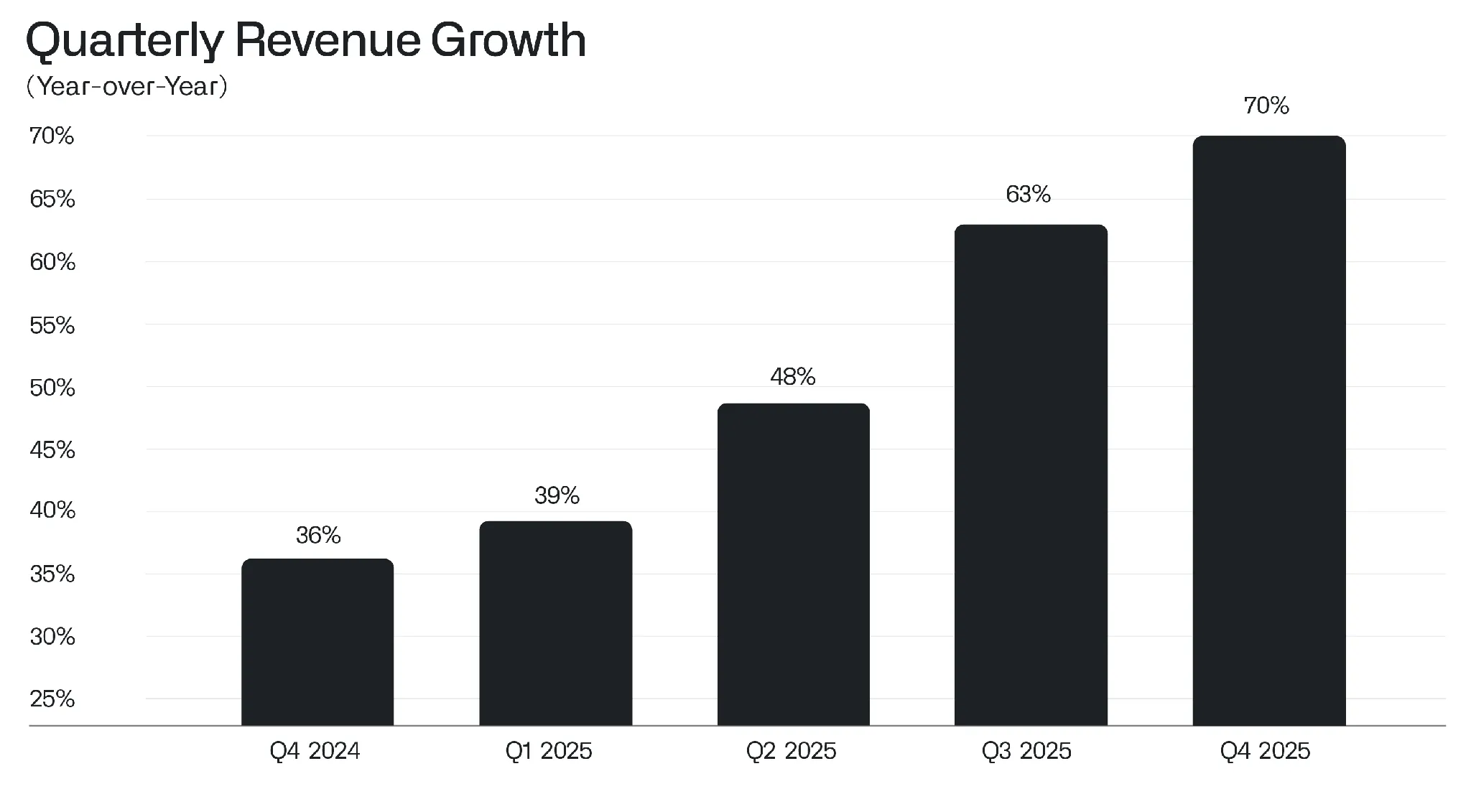
The earnings signal is velocity, not legal accuracy
| Palantir 2025 metric | What the record says | What legal buyers can infer |
|---|---|---|
| Full-year revenue | $4.48 billion, up 56% year over year.[1] | Large-scale enterprise adoption is no longer speculative. |
| Q4 revenue growth | 70% year over year.[1] | The adoption curve was still accelerating at year-end. |
| U.S. commercial growth | 55% in Q1, 93% in Q2, 121% in Q3, and 137% in Q4 year over year.[1][2] | The segment most relevant to private-sector legal buyers moved fastest. |
| Rule of 40 score | 127% for FY2025.[1] | The business case is unusually strong; reliability still has to be tested separately. |
This is where stock-market and valuation language can become sloppy. CNBC’s earnings coverage is useful for understanding why PLTR drew market attention after Q4 results, but a share-price reaction does not test a deposition-summary workflow, a regulatory-update product, or a fund-formation drafting system.[3] The same discipline applies to Palantir’s government-contract momentum. A reported $10 billion U.S. Army enterprise agreement is evidence of institutional scale; it is not evidence that a legal AI output is safe to file, send to a client, or rely on without review.[4]
That distinction is not anti-Palantir. It is the basic separation legal procurement has to preserve. Earnings tell a buyer that the vendor is commercially powerful, operationally embedded, and likely to keep expanding. Reliability work asks a different set of questions: what data entered the system, what sources were retrieved, what answer was generated, who reviewed it, what changed before delivery, and whether the firm can reconstruct that chain when a partner, client, regulator, or court asks.
Five days of deployment pressure meets months of legal diligence
Palantir’s AIP Bootcamp model is the mechanism that turns the earnings story into a governance problem. Secondary market reporting describes AIP Bootcamp as a five-day deployment sprint and cites an approximately 75% conversion rate attributed to Palantir internal quarterly data.[5] Octagon AI’s Q1 2026 customer-data coverage points in the same directional context, but the conversion figure should be treated carefully: it is not an SEC-filed metric and it is not an independently verified reliability result.[6]
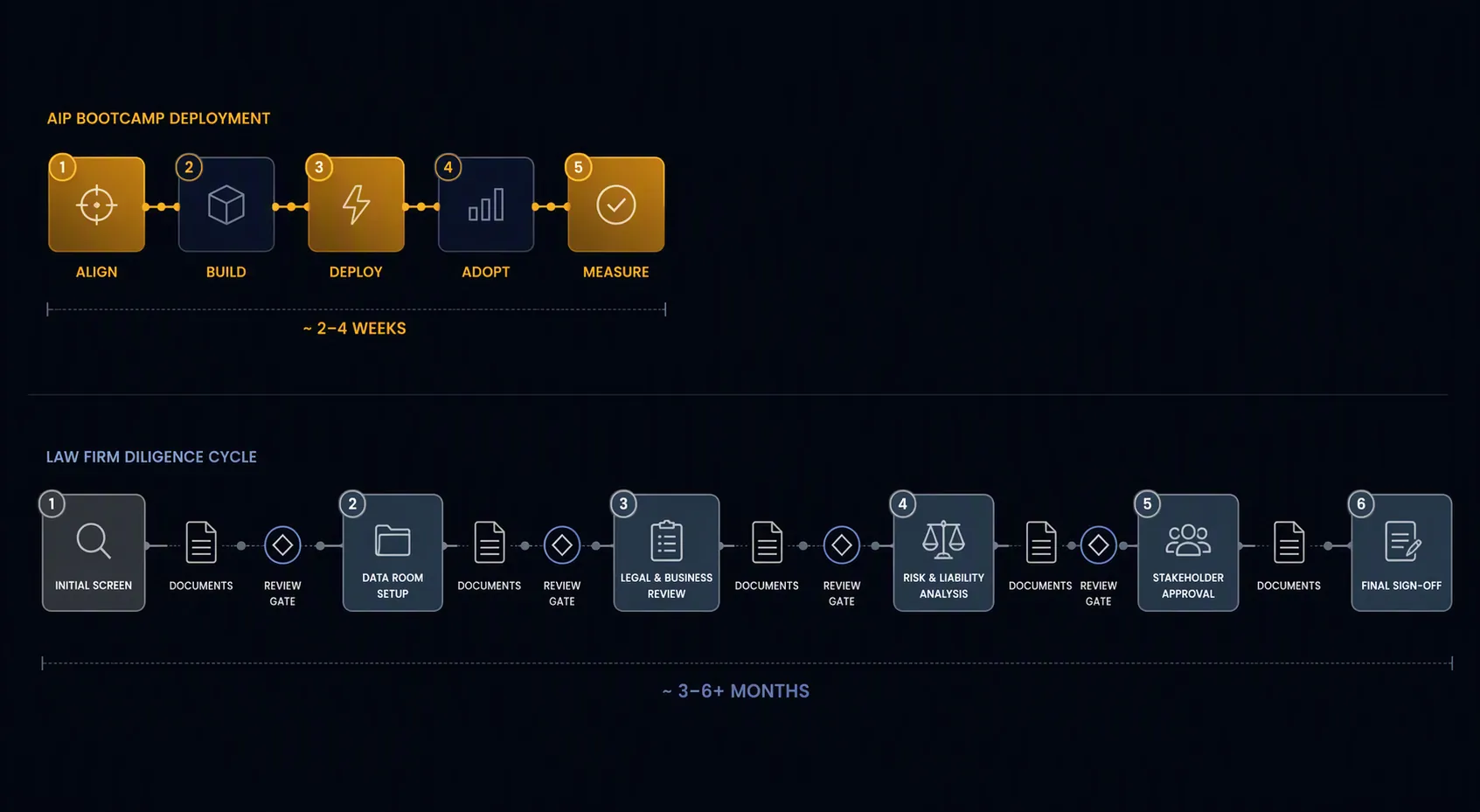
The mismatch is procedural. A five-day sprint can produce a working use case before the law firm has finished the slower work that usually makes a technology approval meaningful. Security review, data-retention terms, privilege analysis, records-management mapping, client-consent questions, procurement negotiation, and supervising-attorney signoff do not naturally compress just because the software can.
Many law-firm technology committees still operate on diligence cycles closer to 8 to 16 weeks than to one week. That calendar is not bureaucratic decoration. It is the period in which risk and knowledge-management staff try to find out whether a tool will touch client files, whether prompts and outputs are logged, whether the vendor can access confidential data, whether model behavior can be tested against firm-specific examples, and whether someone will own post-launch monitoring after the excitement of approval has passed.
When deployment moves faster than that review, the failure is rarely dramatic at first. The problem is more ordinary: a team builds a useful workflow, lawyers start depending on it, and only later does someone ask whether the firm has a defensible record of what the system did. By then, the question is no longer whether to pilot AI. The question is whether a production workflow has been operating without the controls the firm would have required if the same system had arrived through a slower procurement channel.
What the verification layer has to cover
A production legal AI verification layer has to be built around the work product, not the platform brochure. At minimum, the firm needs to know which matter materials are connected, which users can see them, whether the system retrieves authority or merely generates language, whether it preserves source links, and whether it records enough activity to support later review.
- Procurement review should identify data flows, retention settings, subcontractor exposure, audit rights, confidentiality terms, and client-specific restrictions before the workflow becomes ordinary practice.
- Workflow validation should test the actual use case: regulatory update, due-diligence extraction, fund-formation drafting, litigation research, contract comparison, or matter-intake triage. A generic chatbot test is not enough for a connected enterprise system.
- Citation and source checks should document whether the system used current law, retrieved the correct document, preserved quotation context, and distinguished binding authority from background material.
- Privilege review should address not only whether privileged documents enter the system, but whether generated outputs can reveal privileged strategy, client facts, or internal legal analysis to the wrong users.
- Output logging should capture the prompt or task, retrieved sources, model or workflow version, generated output, human reviewer, edits made before use, and final signoff.
- Post-deployment monitoring should re-test the workflow after template changes, connector changes, model updates, new practice-area use, or expansion from a small team to a broader lawyer population.
The uncomfortable point is that these controls are slower than the deployment story. They are supposed to be. In legal work, the evidence of reliability is not that a workflow can be stood up quickly; it is that the firm can explain, repeat, audit, and correct the workflow when the answer matters.
Palantir is already showing up in proprietary legal workflows
The legal-sector record should be kept narrow. Akin Gump and Palantir announced RegSpot as a legal digital-service platform built through their collaboration.[7] That announcement is meaningful because it places Palantir technology inside a law-firm-facing legal workflow, rather than in a generic enterprise AI narrative. It does not, by itself, establish that every RegSpot output is complete, current, or safe for unreviewed reliance.
Kirkland & Ellis is the more recent example. Artificial Lawyer reported on June 4, 2026, that Kirkland and Palantir partnered on a private-equity platform, and Law.com Legaltech News later analyzed the deal as part of an AI arms race in private equity.[8][9] The date matters. This development post-dates Palantir’s FY2025 earnings period, so it should not be used to explain the 2025 revenue results. It is directional evidence of where the platform is moving in 2026, and it has no long-term public reliability record yet.
Those examples are still important. They show that the buyer is no longer evaluating AI only as a research assistant sitting beside a lawyer. The buyer may be evaluating AI embedded in matter workflows, client-facing services, private-equity processes, regulatory products, or internal knowledge systems. Once that happens, hallucination and citation problems stop being only individual-lawyer misuse stories. They become system-design questions.
Why sanction cases now belong in platform procurement
The legal industry has already seen enough sanction cases and hallucinated-authority incidents to retire the idea that AI reliability is a theoretical ethics issue. The older lesson was simple: lawyers cannot file or rely on AI-generated legal material without verification. The production-platform lesson is harder. If the AI system is connected to firm data, embedded in a repeatable workflow, and marketed as operational infrastructure, the verification obligation moves upstream.
A supervising attorney can review one memo. A procurement team has to ask whether the workflow will generate hundreds of similar memos, who will review them, whether the review is documented, and whether errors can be found after the fact. A KM team has to decide whether a system’s answers will quietly become precedent within the firm. A risk team has to ask whether a false citation, a stale regulatory interpretation, or a privileged fact leakage will be traceable to a user, a data connector, a model update, or an approval process that never caught up.
This is also why benchmark failures in legal AI tools should not be dismissed as problems for smaller vendors or consumer chatbots. A production enterprise platform may have stronger integration, better access controls, and more sophisticated deployment support. It may also multiply the consequence of a weak validation process. The relevant question is not whether the model can sound competent in a demo. It is whether the firm has tested the workflow against the legal tasks it will actually perform.
What should change in 2026 procurement
The first change is timing. If a platform can move from workshop to working deployment in days, the diligence package has to be prepared before the workshop, not after the partner demo. The firm should know in advance which categories of client data may be used, which use cases are off limits, which practice groups can participate, and what evidence will be required before any workflow moves beyond a controlled test.
The second change is evidence. “Approved for use” should not mean that no one objected. For a Palantir-based legal AI workflow, approval should attach to a specific configuration, data environment, use case, reviewer role, and logging standard. If any of those change, the approval should not automatically travel with the brand name.
The third change is ownership. Someone has to be responsible for the system after deployment: not in the abstract, and not only at the vendor-management level. A production workflow needs a business owner, a legal-risk owner, a technical owner, and a review path for lawyers who find an error. Without that structure, the system can become too useful to interrupt and too poorly documented to defend.
None of this requires a law firm to reject Palantir. The earnings record gives the opposite warning: platforms with this much momentum will keep appearing in serious enterprise conversations. The procurement mistake would be to treat a production AI platform as though it were still a contained pilot, then discover after launch that the firm never built the verification layer that production use requires.
For legal-tech buyers, Palantir’s 2025 earnings are not a buy signal, an avoid signal, or a prediction about PLTR stock. They are a reliability signal of a different kind: adoption is now moving fast enough that legal verification has to be designed for operational deployment from the start. Any law firm evaluating Palantir-based legal AI in 2026 needs a production verification framework, not a pilot-era checklist dressed up for a platform that has already moved on.
References
- Palantir Q4 2025 Earnings Release. SEC Exhibit 99.1. Feb 2, 2026.
- Palantir Reports Q2 2025 U.S. Comm Revenue Growth of 93% Y/Y and Revenue Growth of 48% Y/Y, Guides Q3 Revenue to 50% Y/Y, Raises FY 2025 Revenue Guidance to 45% Y/Y and U.S. Comm Revenue Guidance to 85% Y/Y, Crushing Consensus Expectations. investors.palantir.com.
- Palantir PLTR Q4 2025 earnings. CNBC. Feb 2, 2026.
- Palantir Federal. FedSavvy Strategies.
- Palantir Shares Surge as AIP Bootcamp Strategy Cementing Dominance in Enterprise AI. MarketMinute / Chronicle Journal. Mar 6, 2026.
- Palantir Total Customers in Q1 2026. Octagon AI.
- Palantir and Akin Gump Collaborate on Legal Digital Service Platform. Palantir Newsroom.
- Kirkland, Palantir Partner for PE Platform. Artificial Lawyer. Jun 4, 2026.
- The AI Arms Race in Private Equity: What the Kirkland-Palantir Deal Means for the Rest of the Market. Law.com Legaltech News. Jul 22, 2026.
Chronological incident history
No sanction cases have named this tool in the tracked record set to date. This does not imply the tool is safe — see Risk Digest for ongoing monitoring.
← Compare peer toolsReport a correction or tip
Spotted an outdated figure, a misstated fact, or a ruling this tool profile should reflect? Public comments are disabled for this content given the professional cost of a misreported case outcome, penalty amount, or rule text — use the structured correction channel instead.
Report a correction or tip for this record →