
Palantir CEO Karp's AI Warning Signals New Vendor Risk for Law Firms
Alex Karp's warnings that AI nationalization is likely within two years, combined with bipartisan legislative proposals and government infrastructure investments, create a new vendor-risk dimension for law firms. This article examines how those signals translate into procurement obligations under ABA Model Rules 1.1 and 1.6.
- Tool
- Palantir
- Benchmark source
- Yahoo Finance
- Hallucination rate
- Not measured / undisclosed
- Test methodology
- News reporting and legislative analysis
- Test date
- Jun 1, 2026
For a law-firm buyer, the practical issue in Karp’s AI regulation warning is not whether Alex Karp moved a ticker for a day. It is whether an AI vendor being approved this quarter could face a material change in ownership, government influence, access terms, or continuity before the firm has finished embedding the tool into legal work. Karp’s warning is a signal, not a forecast. Sen. Bernie Sanders’s bill is introduced, not enacted. President Trump’s public-ownership discussions are reported political signals, not procurement instructions. And any live Palantir stock figure should be verified at publication rather than treated as a stable fact.

That caveating matters because law firms do not need to believe in imminent AI nationalization to have a diligence problem. They only need to accept that political exposure has become material enough to ask about before client data, work product, and attorney workflows are routed through a vendor stack.
The regulatory signal is broader than one CEO’s warning
At Palantir’s AIPCon 10 in June 2026, Karp said he had been privately warning AI leaders for six months that full nationalization could arrive within two years. He also characterized Sanders’s proposed 50% stock tax on large AI companies as “moderate,” a description that is politically useful but too neat for a procurement memo unless it is treated as Karp’s judgment, not as a neutral measurement of policy probability.[1][2]
The Sanders proposal gives the warning a concrete legislative anchor. On June 18, 2026, Sanders announced the American AI Sovereign Wealth Fund Act, framed around a one-time 50% tax on the stock of large AI companies including OpenAI, Anthropic, and xAI, with the stated goal of funding a $7 trillion sovereign wealth fund.[3] The bill’s existence does not mean law firms should assume passage. It does mean a buyer cannot honestly describe public ownership of frontier AI value as a fringe thought experiment.
The signal is not confined to the left. Trump has separately discussed government ownership stakes in AI companies, according to Fox Business reporting on Karp’s comments about U.S. AI regulation.[4] Those discussions differ sharply from Sanders’s proposed tax mechanism, but for procurement purposes the shared point is narrower and more useful: both parties are now producing versions of government participation in AI company economics or governance.
Infrastructure data points in the same direction. TNW, citing Center for a New American Security analysis, reported that Nvidia supplies GPUs for 52% of tracked sovereign AI infrastructure projects.[2] That statistic should be verified against the underlying methodology before it is used as a hard benchmark, but it is still relevant because it shows governments are not merely writing speeches about sovereign AI. They are participating in the infrastructure layer on which private tools may depend.
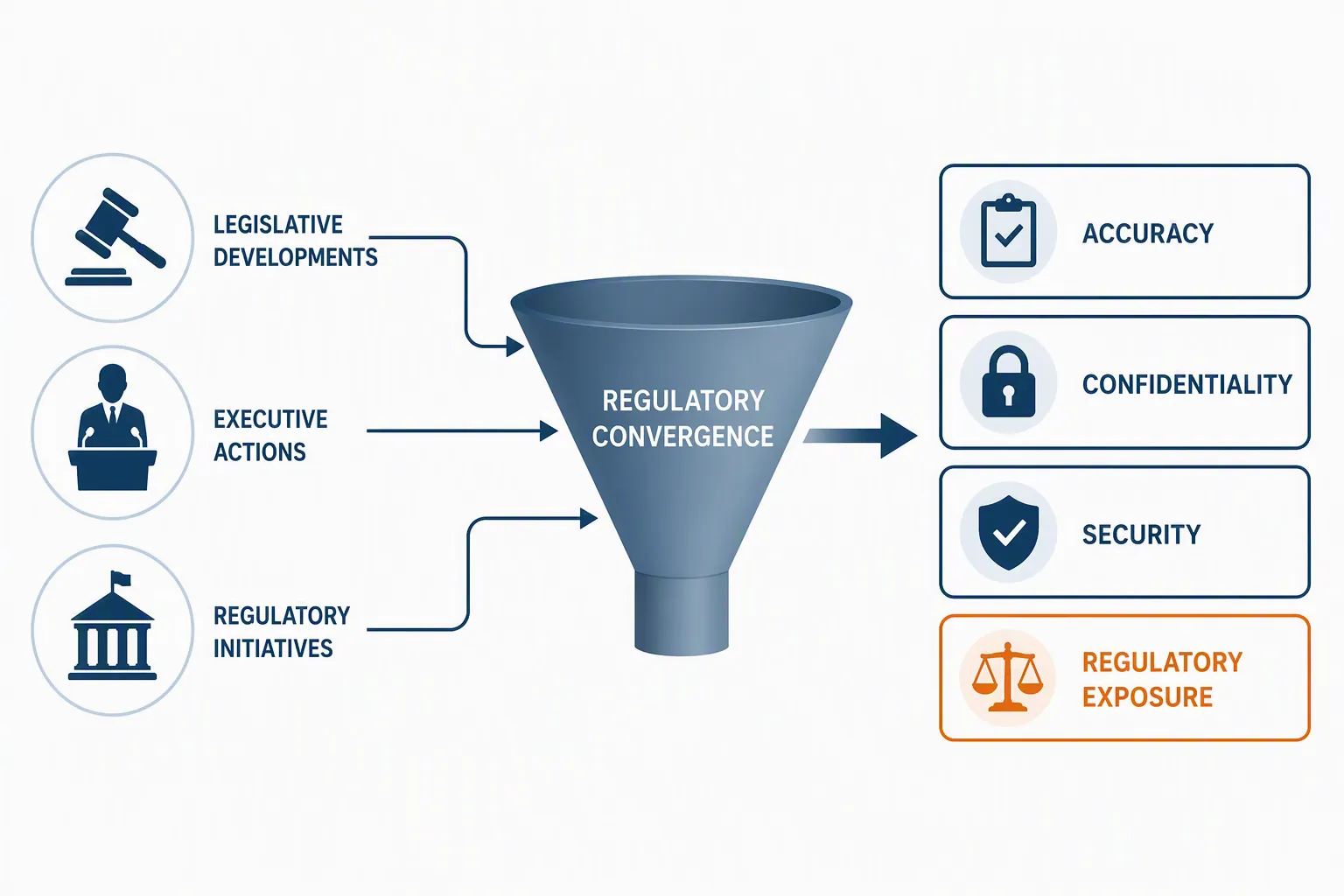
A law-firm risk manager should therefore resist two opposite mistakes. One is to dismiss the entire episode as stock-market theater. The other is to convert a CEO’s warning, a proposed bill, and reported political discussions into a prediction that nationalization will happen on Karp’s timetable. The usable conclusion is narrower: AI vendor exposure to political ownership, control, or access pressure has become a diligence category in its own right.
Where this changes legal AI procurement
Most legal AI questionnaires already ask some version of the familiar questions: how the model handles confidential data, whether user inputs are retained, whether outputs are grounded, whether training uses client material, whether the vendor has security certifications, and what happens if the tool hallucinates. Those questions remain necessary. They are no longer sufficient for higher-risk deployments.
The additional issue is control. If a vendor’s capital structure, public ownership exposure, government dependency, or regulatory commitments change after the firm signs, the risk is not limited to valuation. It can affect service availability, product roadmap, data localization, disclosure obligations, government access procedures, subcontractor selection, model replacement, and exit rights. Those are procurement consequences, not market commentary.
| Procurement question | Why it now belongs in the AI review |
|---|---|
| Could the vendor face forced ownership, equity-transfer, tax, or public-stake pressure? | The firm needs to know whether a material governance change could alter contractual performance or control over the product. |
| What happens if a regulator or public stakeholder influences model access, pricing, deployment scope, or customer eligibility? | A tool approved for litigation, transactions, or internal knowledge work may become less available or subject to different terms. |
| Does the contract address service discontinuation, model substitution, or degraded access following legal or ownership changes? | Continuity risk is different from ordinary downtime when the disruption is driven by public policy or ownership intervention. |
| Can the vendor describe government-access procedures under changed regulatory conditions? | Confidentiality review should cover not only current retention terms but also escalation paths if legal demands or public-control obligations change. |
| Is the vendor dependent on sovereign AI infrastructure, government contracts, or politically sensitive compute supply? | Dependency can be a resilience issue even when the vendor’s current security documentation is strong. |
This is where the ethics frame becomes useful, with an important caveat. ABA Model Rule 1.1 requires competent representation, and Comment 8 links competence to keeping abreast of relevant changes in technology.[5] ABA Model Rule 1.6 addresses confidentiality of information relating to client representation.[6] Neither rule says, in these words, that a law firm must analyze AI nationalization risk before buying software. The connection is an applied procurement judgment: if lawyers rely on AI systems in client work, competence and confidentiality review should account for material limitations and changed conditions that could affect the tool’s safe use.
That judgment is easiest to see in tools that touch client data or shape legal analysis. A general administrative assistant used for scheduling raises a different level of concern from an AI research, drafting, document-review, or matter-intelligence system connected to firm knowledge stores. The more a system is integrated into privileged workflows, the less persuasive it is to say that vendor political exposure belongs only to investment analysts.
Competence means understanding material tool limitations
Competence in legal AI procurement is often reduced to whether the tool produces reliable answers. Accuracy matters, but it is only one limitation. A system can be technically strong and still be a poor fit for a firm if the vendor cannot explain how regulatory intervention would affect access, model continuity, or contractual commitments. A partner who signs off on using a tool in client work should not have to reconstruct those answers during an incident.
The practical step is not to ask vendors to predict federal policy. It is to ask them to describe governance resilience. Who controls the product if ownership changes? Which obligations survive a change in control? How much notice will customers receive before a model is replaced or retired? Are there export, public-sector, defense, or sovereign-infrastructure dependencies that could affect commercial access? Does the vendor maintain a customer exit plan that preserves data portability and work continuity?
A firm does not need perfect answers to every question. It does need a record showing that the procurement team recognized the risk and made a reasoned decision. That record is especially important when the tool is approved for uses that lawyers cannot easily unwind, such as firmwide knowledge retrieval, automated document review workflows, or drafting support embedded into matter teams.
Confidentiality review cannot stop at today’s retention language
Model Rule 1.6 analysis tends to focus on the present-tense vendor answer: whether user inputs are stored, whether client data is used for training, whether encryption is in place, and whether the firm can delete submitted material. Those are still the first questions. The Karp-Sanders-Trump signal set adds a second layer: what happens to those controls if the vendor’s legal obligations, public ownership status, or government-facing commitments change?
For example, a vendor may have acceptable commercial confidentiality terms today but weak language on compelled disclosure, government requests, or notice to enterprise customers. Another may rely on infrastructure relationships that create jurisdictional or access questions the firm has not mapped. The point is not that government participation automatically compromises client confidentiality. The point is that confidentiality diligence should test whether existing controls remain meaningful under changed regulatory conditions.
The strongest procurement files will separate legal commitments from marketing assurances. A statement that enterprise data is “protected” is not the same as a contractual process for notice, challenge, minimization, segregation, audit, deletion, and customer exit. If the vendor cannot explain those mechanics, the firm should treat that gap as a risk finding rather than an aesthetic defect in the questionnaire.
The commercial-interest problem cannot be ignored
Karp is not a disinterested academic observer of frontier AI. Palantir sells its own AI platform narrative, including Ontology, and competes for enterprise adoption against the frontier labs he criticizes. Fortune’s July 7, 2026 critique argued that Karp’s framing serves Palantir’s commercial interest and challenged the idea that companies such as Anthropic and OpenAI are broadly “stealing” enterprise intellectual property in the way his remarks suggested.[7]
That counterargument should narrow the claim, not be waved away. Karp may be directionally alert to institutional risk while also describing competitors in a way that strengthens Palantir’s sales position. Those can both be true. A legal procurement team should not import his accusations into its risk file unless it can support them independently.
His broader comments fit a consistent enterprise-sovereignty narrative. In a CNBC interview on June 10, 2026, Karp said businesses are “unhappy” with frontier AI labs.[8] Fox Business also reported his warning that the United States should not copy Europe’s AI regulatory approach.[4] Those comments are useful context for understanding Palantir’s positioning. They do not prove that frontier labs are unsafe, that nationalization is imminent, or that a Palantir product is the safer answer for a law firm.
This distinction matters in vendor selection. If a firm responds to Karp’s warning by simply favoring the vendor that issued it, the diligence process has failed. The better response is to ask the same political-exposure questions of every AI provider: frontier lab, application-layer legal-tech vendor, cloud platform, data provider, and system integrator. Palantir itself should be evaluated under the same standard, including government dependency, public-sector exposure, contractual continuity, and the viability signals discussed in the earlier Palantir financial analysis, “Can Palantir’s AI Growth Validate Its Stock Price for Legal Procurement?”
Stock impact is a signal, not the procurement answer
Palantir stock data can be relevant to procurement, but only in a limited way. A sharp price movement may signal investor expectations, perceived regulatory advantage, or concern about business concentration. A valuation premium may raise questions about execution pressure. A selloff may raise continuity questions if it affects hiring, financing, or product investment. None of that tells a firm whether the vendor’s confidentiality controls are adequate or whether its contracts protect the firm if regulatory conditions change.
For Q3 2026 diligence, live market figures should be pulled at the time of review and documented separately from legal-risk analysis. The procurement file should not rely on stale closing prices or 52-week ranges as if they answer vendor-risk questions. Market data belongs in the financial-viability section. Political and regulatory exposure needs its own line of inquiry.
A defensible AI vendor memo now needs one more category
A law firm evaluating AI tools in Q3 2026 should be able to show that it considered at least five risk families: accuracy, confidentiality, security, financial viability, and political or regulatory exposure. The fifth category should not be buried inside a generic “legal compliance” box. It asks different questions and produces different consequences.
- Identify whether the vendor, parent company, model provider, or infrastructure provider is exposed to public-ownership proposals, sovereign AI programs, government-contract dependency, or politically sensitive compute supply.
- Ask what contractual rights the firm has if ownership, control, access obligations, model availability, or service terms materially change.
- Require a confidentiality explanation that covers changed legal conditions, not only ordinary commercial data retention.
- Document why the approved use case remains appropriate if the vendor’s risk profile changes after deployment.
- Assign an owner for monitoring regulatory developments after contract signing, because this risk does not end at onboarding.
That is the useful procurement lesson from Karp’s warning. Law firms do not need to accept his two-year nationalization timetable. They also do not need to endorse Sanders’s proposal, Trump’s reported ownership discussions, or Palantir’s critique of frontier labs. They do need to recognize that AI vendor risk now includes political and regulatory exposure alongside the older questions of accuracy, confidentiality, security, and financial viability.
References
- Palantir CEO Alex Karp Says He's Been Warning AI Leaders For Months About Nationalization Risks — Yahoo Finance.
- Palantir's Karp says Sanders will regret only asking for 50% of AI companies. Full nationalization is coming. — TNW.
- NEWS: Sanders Introduces Legislation to Create $7 Trillion AI Sovereign Wealth Fund — Sanders Senate press office, June 18, 2026.
- Palantir CEO Alex Karp warned the US not to copy Europe's AI regulations — Fox Business.
- Rule 1.1: Competence — American Bar Association.
- Rule 1.6: Confidentiality of Information — American Bar Association.
- Palantir CEO Alex Karp is wrong about Anthropic and OpenAI — but he has reason to be worried — Fortune, July 7, 2026.
- Palantir CEO Karp says businesses are unhappy with frontier AI labs — CNBC, June 10, 2026.
Chronological incident history
No sanction cases have named this tool in the tracked record set to date. This does not imply the tool is safe — see Risk Digest for ongoing monitoring.
← Compare peer toolsReport a correction or tip
Spotted an outdated figure, a misstated fact, or a ruling this tool profile should reflect? Public comments are disabled for this content given the professional cost of a misreported case outcome, penalty amount, or rule text — use the structured correction channel instead.
Report a correction or tip for this record →