
Pixel 11 vs Galaxy S26 AI privacy for legal work
When reviewing confidential client materials on a smartphone in public, which flagship phone better protects attorney-client privilege? This comparison evaluates the Pixel 11 and Galaxy S26 Ultra against ABA Model Rule 1.6 obligations, finding the Galaxy's hardware privacy screen and Knox Vault offer a structural advantage, while both phones fall short of full compliance in common scenarios.
- Tool
- Pixel 11, Galaxy S26 Ultra
- Benchmark source
- TechRadar, Android Central, Samsung Mobile Press
- Hallucination rate
- Not measured / undisclosed
- Test methodology
- Qualitative feature comparison using publicly available specifications, press releases, and pre-release reports
- Test date
- Jul 30, 2026
A lawyer reading a client memo on a phone in a coffee shop is not usually thinking about chip packaging. She is thinking about whether the person behind her can see the settlement number, whether the table by the window turns the glass into a mirror, and whether the associate who just forwarded a privileged email also forwarded a risk no one will be able to explain cleanly later.
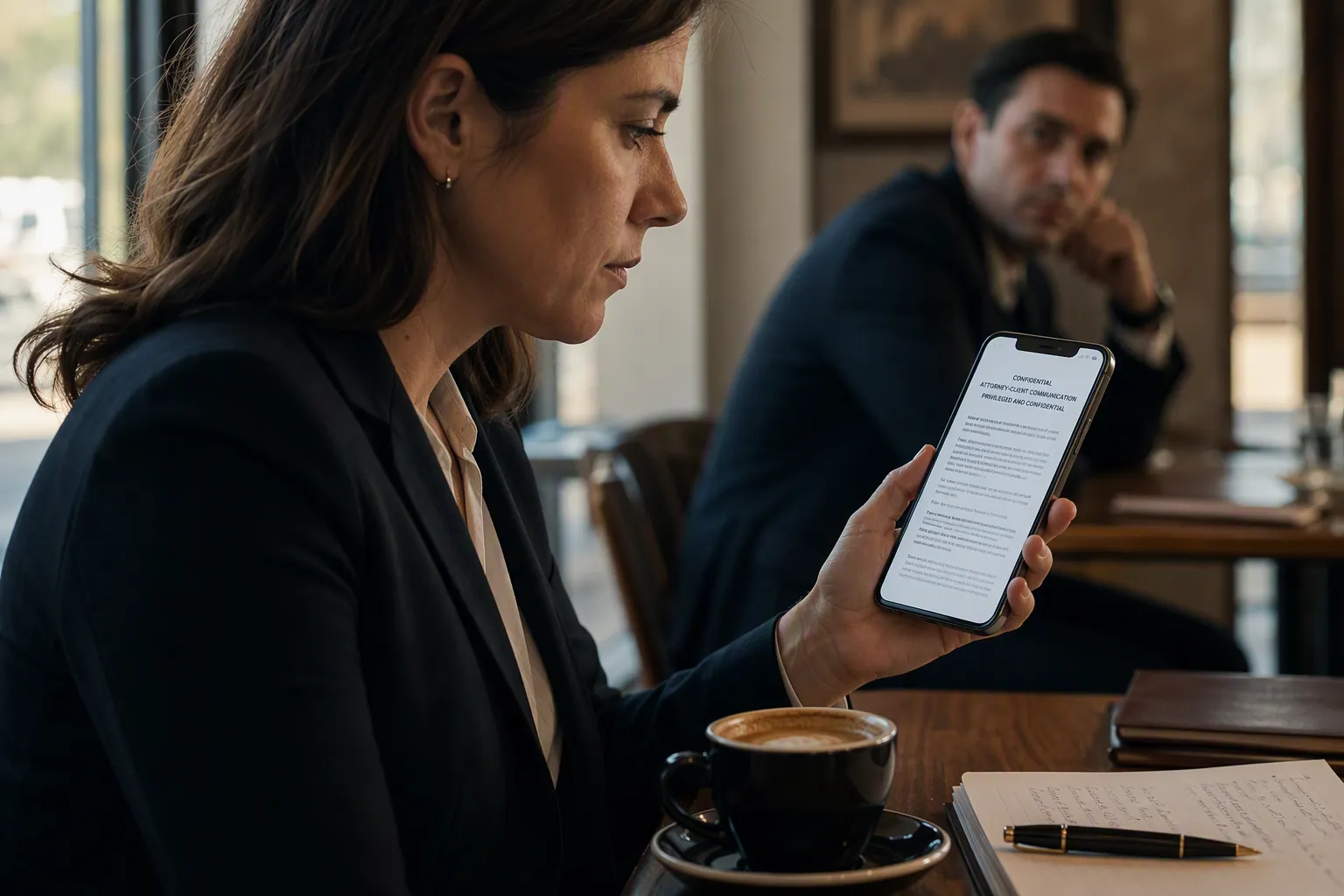
That is the right starting point for comparing the Pixel 11 and Galaxy S26 for legal work. The first confidentiality failure in public is often not exotic. It is not a compromised model, a broken enclave, or a cloud-routing mistake. It is a bright screen, held at the wrong angle, with client information visible to someone who has no business seeing it.
On the evidence available today, the Galaxy S26 Ultra has the stronger structural answer for public-space confidentiality. Samsung’s Privacy Display is described as a built-in, pixel-level privacy screen that obscures content from side angles, rather than a removable film or ordinary software dimming layer.[1][2] Knox Vault also gives Samsung a well-documented hardware isolation story for PINs, biometrics, and encryption keys.[3] The Pixel 11 may turn out to be a serious privacy phone, particularly if its reported Titan M3, Private AI Compute, federated analytics, and separated modem architecture perform as described, but those points remain less verified before Google’s August 12, 2026 event.[4][5][6]
That does not make the Galaxy S26 Ultra a compliance answer by itself. ABA Model Rule 1.6 asks for reasonable efforts to prevent inadvertent or unauthorized disclosure or access to information relating to representation. A phone can support those efforts. It cannot supply the judgment, policy, training, matter sensitivity review, or physical discipline that legal confidentiality still requires.
The public-screen problem is not a minor edge case
Confidential email review is the scenario that separates these devices most sharply. If a lawyer is standing in a courthouse hallway reading a client update, the question is not only whether the phone encrypts the message at rest. The question is whether a paralegal from another matter, a journalist, a client’s employee, or opposing counsel’s consultant can read the screen from the side while the attorney waits for an elevator.
The Galaxy S26 Ultra is designed for that physical setting in a way the Pixel 11, based on current reporting, is not. Samsung’s Privacy Display is positioned as a device-level visual privacy feature: content stays readable to the person facing the phone and becomes obscured from off-axis viewing positions.[1][2] For legal work, that matters because it reduces exposure before the user remembers to lower brightness, angle the phone inward, or step away from a crowd.
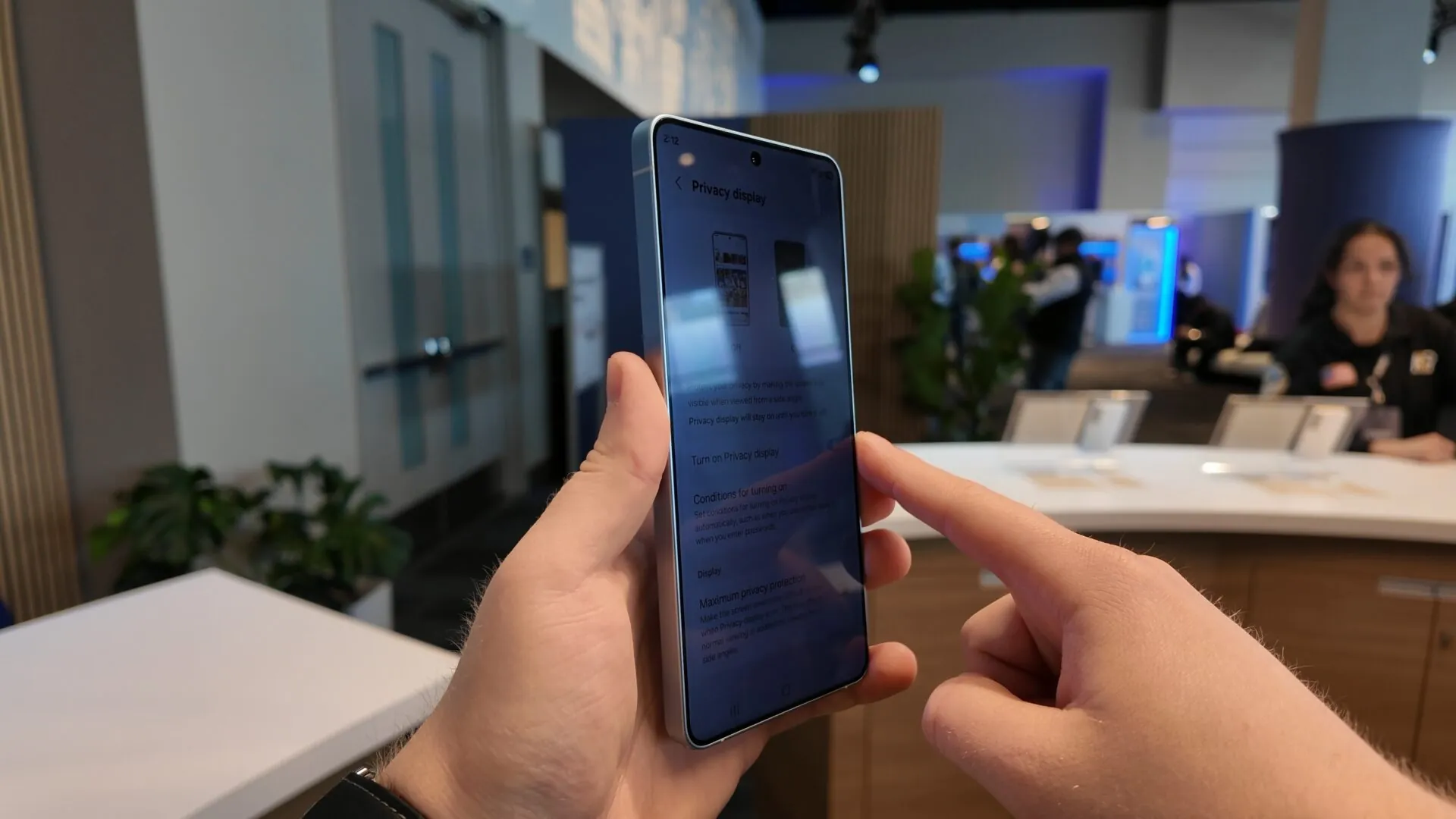
The caveat is important: the collected sources do not include independent viewing-angle testing, brightness-impact measurements, or a controlled comparison against third-party privacy films. So the correct claim is narrow. Samsung has the more directly relevant built-in feature for shoulder-surfing and side-angle exposure; the public evidence does not yet prove exactly how well it performs across lighting, font size, screen brightness, or awkward real-world posture.
That narrow claim is still meaningful. Risk controls do not have to be perfect to be useful. A built-in privacy layer is less likely to be forgotten than a removable screen protector, less dependent on individual attorney discipline than a training reminder, and more relevant to public legal work than a long list of assistant conveniences. The best confidentiality feature is often the one that prevents the ordinary mistake before it becomes a client incident.
Email, discovery, and settlement review
For confidential email, the Galaxy advantage is straightforward. Privileged email usually combines three risks at once: visible subject lines, readable message previews, and attachments that tempt a lawyer to zoom, rotate, or raise brightness. A hardware visual privacy layer directly reduces the most immediate public-space exposure. It does not decide whether the lawyer should open the email at all, but it changes the baseline risk when the email is opened.
Discovery and settlement-document review are harder. These are not quick glance workflows. A lawyer may scroll through PDFs, compare numbers, enlarge exhibit text, or keep a document open while answering a call. The longer the document remains visible, the more the surrounding room matters. A side-angle privacy feature helps, but it does not protect against someone directly behind the user, a screen reflected in glass, or an unlocked phone left face-up on a conference table.
Pixel 11’s reported privacy strengths do not solve that visible-screen problem. A Titan M3 coprocessor may improve device security, Private AI Compute may improve model isolation, and modem separation may reduce a narrower remote attack surface, but those controls operate behind the glass.[4][5][6] They do not stop a person two seats away from reading a damages analysis if the display itself is exposed.
| Legal workflow | Galaxy S26 Ultra risk posture | Pixel 11 risk posture | Practical judgment |
|---|---|---|---|
| Reviewing confidential email in a coffee shop or courthouse hallway | Stronger public-space posture because Privacy Display addresses side-angle viewing directly | Potentially strong device and AI security, but no reported built-in hardware privacy screen | Galaxy has the clearer advantage for ordinary shoulder-surfing risk |
| Reviewing discovery or settlement PDFs | Privacy Display helps with side exposure; user still must control reflections, brightness, and dwell time | Security architecture may protect stored and processed data; visible document exposure remains mostly behavioral | Galaxy is better supported, but neither phone makes public document review automatically reasonable |
| Scanning a signed settlement in a courthouse hallway | Samsung’s document-scanning workflow appears more polished in the available materials | Capable phone-based scanning is likely, but the brief does not support a stronger Pixel claim | The decisive issue is where the document and screen are visible during capture |
| Screen sharing in a shared workspace | Privacy Display may reduce casual side viewing when the phone remains in the lawyer’s hand | No equivalent built-in visual privacy feature is verified in current Pixel 11 materials | Galaxy better addresses nearby observers; shared-display behavior still requires policy |
What counts as a stronger security architecture
The physical screen is the most visible risk, but it is not the only one. A legal phone also has to protect credentials, biometrics, encryption keys, AI prompts, recordings, and files that may sit on the device for years. Here the comparison becomes less theatrical and more technical.
Samsung’s Knox Vault is the more mature, better-documented claim in the present evidence set. Samsung describes Knox Vault as using a physically isolated secure processor with dedicated memory, including separate DRAM and flash, to protect PINs, biometrics, and encryption keys.[3] For a legal-risk review, physically isolated memory matters because it makes certain cold-boot and side-channel scenarios harder than designs that keep secrets closer to the main system environment.
Pixel 11’s reported Titan M3 is also significant, but the certainty level is lower. Pre-release reporting describes Titan M3 as a dedicated security coprocessor rather than a general-purpose CPU core.[4][5] The available materials do not confirm that it uses physically separate memory in the same manner described for Knox Vault. The correct comparison is therefore not “Samsung secure, Google insecure.” It is that Samsung’s isolation model is more specifically documented for the Galaxy S26 Ultra today.
That distinction matters for procurement. A partner buying a phone may tolerate some uncertainty. A law-firm risk manager approving a fleet has to record why one architecture was treated as sufficient for privileged material, what claims were verified, and which claims came from leaks or pre-release reporting. The Galaxy file is easier to document right now.
AI notes are useful; they are not court transcripts
Meeting transcription is where both devices may be useful for lawyers, provided the use case is kept in its proper lane. A phone-generated transcript can help an attorney find a topic, draft a follow-up email, prepare a task list, or refresh recollection after a client intake call. It should not be described as a certified court transcript, and the research materials do not support any head-to-head Word Error Rate claim.
Google’s Recorder workflow is one of Pixel’s strongest privacy arguments. Google’s support materials describe recording and transcription features on Pixel devices, and the research brief identifies Pixel Recorder’s use of federated analytics to improve accuracy without sending raw audio to servers.[7] For privileged meetings, that kind of design is valuable because it distinguishes product improvement signals from the content of the client conversation.
Samsung’s Galaxy S26 privacy story is also credible for AI workflows because Samsung describes local processing options and per-feature control over whether AI features run on-device or in the cloud.[8] For a law firm, that explicit routing control is not a cosmetic setting. It gives IT and risk teams a policy lever: some matters can be restricted to local processing, while less sensitive workflows may permit cloud-assisted features if the firm’s review allows it.
The operational rule should be conservative. AI transcripts can be internal workflow aids when consent, confidentiality, and jurisdictional requirements are satisfied. They should not be treated as official records, and they should not be used where the recording itself would create a separate legal or ethical problem.
Cloud routing and AI controls
The phrase “on-device AI” is too blunt for legal review. It can mean that audio stays local, that a summary is generated locally, that model improvement is federated, that a request is routed to a protected cloud environment, or that only some features avoid external processing. Those distinctions matter when the input is a client name, a settlement position, a draft complaint, or a privileged strategy note.
Samsung’s advantage is not that every AI feature is necessarily local. It is that the available Galaxy S26 materials emphasize user and per-feature choice between local and cloud processing.[8] A law firm can build a mobile policy around visible switches more easily than around broad assurances. The policy still has to specify which features may be used for client material, who may change settings, and whether cloud-assisted functions are disabled by default on managed devices.
Pixel 11’s Private AI Compute may become one of its most important legal-work features, but the current evidentiary posture is different. The phone has not been officially released as of July 30, 2026, and the Made by Google event is reported for August 12, 2026.[6] Until Google confirms the implementation details, legal buyers should treat Pixel 11 AI-privacy claims as promising but not fully procurement-ready.
The remote attack surface still matters
It would be a mistake to treat visual privacy as the whole confidentiality analysis. Public-space exposure is common and concrete, but remote compromise can be more damaging. A phone used for legal work holds authentication tokens, client email, document access, messaging apps, voice recordings, and sometimes matter files that should never have lived on a personal device in the first place.
Pixel 11’s reported modem change deserves attention here. Android Central’s pre-release coverage says Google is expected to use a MediaTek M90 modem separated from the SoC, a shift that may reduce the attack surface associated with baseband-related exploits that have affected earlier Pixel generations using Samsung/Exynos modem components.[6] That is a narrower advantage than a built-in privacy display, but it is not trivial for legal IT teams that worry about hostile networks, travel, and long-lived credentials.
Samsung has its own longer-horizon security argument. Samsung says it has extended post-quantum cryptography to critical system processes, including software verification and firmware protection, and has added PQC-enabled end-to-end encryption for eSIM transfers through Knox Matrix.[9] For firms holding sensitive client information across multi-year retention periods, post-quantum planning belongs in the risk file, even if it is not what decides whether an attorney should open a memo on a crowded train.
How the comparison lands for legal procurement
For lawyers who frequently read client materials in public or semi-public spaces, the Galaxy S26 Ultra is the better-supported choice today. Its Privacy Display addresses the most ordinary confidentiality failure directly, and Knox Vault gives risk teams a more specific hardware-isolation record for secrets. Samsung’s local/cloud AI controls also give legal organizations a clearer way to turn privacy architecture into device policy.
The Pixel 11 remains interesting rather than dismissed. Titan M3, Private AI Compute, federated analytics, and modem separation all point in the right direction for legal work. The problem is timing and verification. Before Google’s launch and independent review, too much of the Pixel 11 privacy case depends on pre-release reporting and incomplete implementation detail.
The cleanest procurement language is conditional: Galaxy S26 Ultra is the stronger current candidate for legal professionals who often review confidential material in public; Pixel 11 should be revisited after release, official documentation, and independent security review; neither device should be approved as a stand-alone Model Rule 1.6 solution without mobile-device management, screen-use rules, transcription limits, training, incident response, and matter-specific judgment.
References
- Samsung Galaxy S26 AI experience support page, Samsung
- From Samsung Knox to Privacy Display: how the Samsung Galaxy S26 Ultra protects your privacy, TechRadar
- Your Privacy, Secured: How Galaxy AI Protects Privacy with Samsung Knox Vault, Samsung Mobile Press
- The Pixel 11 could be one of the most secure phones thanks to Titan M3, PhoneArena
- Google Pixel 11 Rumored Specs Leak: Tensor G6 Chip + Titan M3 Security Coprocessor, NokiaPowerUser
- Google Pixel 11: Everything we know so far, Android Central
- Save & share recordings & transcripts, Google Pixel Phone Help
- What you need to know about privacy and data protection on the Samsung Galaxy S26, Tom's Guide
- Samsung Introduces Future-Ready Mobile Security for Personalized AI Experiences, Samsung Mobile Press
Chronological incident history
No sanction cases have named this tool in the tracked record set to date. This does not imply the tool is safe — see Risk Digest for ongoing monitoring.
← Compare peer toolsReport a correction or tip
Spotted an outdated figure, a misstated fact, or a ruling this tool profile should reflect? Public comments are disabled for this content given the professional cost of a misreported case outcome, penalty amount, or rule text — use the structured correction channel instead.
Report a correction or tip for this record →