
Student Placement Legal Issues in Provo Canyon School Closure
When Provo Canyon School's dual campuses lost their licenses in July 2026, their ~195 students had to be placed elsewhere within weeks. This article examines the legal duties the facility owes, what the state can compel under Utah law, and the regulatory gaps exposed by a mass-transfer event with an interstate student population.
- Hallucination rate
- Not measured / undisclosed
The Enforcement Clock
Once the licenses fell, the question stopped being whether Provo Canyon School would keep operating and became who had to move roughly 195 students, on what clock, and under whose authority. The legal problem is not the revocation itself. It is the placement scramble that follows when one campus is ordered closed by Aug. 6 and the other by Aug. 16, after sanctions, lawsuits, and renewed conditional licensing moved through June and July.[1][2][3]
| Date | Action | Immediate effect | Source |
|---|---|---|---|
| May 14, 2026 | A 13-year-old student is injured; reporting described a fractured jaw and a possible brain bleed. | [1] | |
| May 29, 2026 | DHHS issues emergency sanctions. | [1] | |
| June 15, 2026 | Two civil lawsuits are filed. | [1] | |
| June 16, 2026 | The Disability Law Center files a complaint. | [1] | |
| June 17, 2026 | The facility's conditional license is renewed. | [1] | |
| July 6, 2026 | Springville's license is revoked. | Close by Aug. 6. | [1] |
| July 17, 2026 | Provo's license is revoked. | Close by Aug. 16. | [2] |
KSL's reporting also notes that UHS said it intended to appeal, which matters because appeal posture can prolong the limbo even when closure dates are already set.[1] Imprint's pre-shutdown enrollment figures put Springville at approximately 98 students and Provo at approximately 97, so the transfer problem is not abstract; it is a mass move of children whose placements cannot simply be held while the paperwork catches up.[3]
What Utah's Closure Rules Require
Utah Code 26B-2 et seq. gives the state a familiar closure toolkit: notice, cooperation with DHHS, and transfer or discharge planning when a facility loses its license.[4] The exact congregate-care provision needs to be confirmed against the operative text, but the shape of the duty is clear enough. The facility has to help move children out. The state can require compliance with the closure order. Neither of those rules creates a bed where none exists.
- Guardians and custodians need notice that lets them act before the deadline, not after the transport plan is already fixed.
- DHHS has to be brought into the placement process early enough to coordinate records, destinations, and transport.
- Medication lists, evaluations, and other handoff materials have to move with the child, or the receiving placement inherits the risk.
That framework works best when one resident is discharging from one placement. It gets much less certain when the shutdown has to move an entire census at once.
Why The Backup Campus Is Not A Backup
The hard part here is the staggered closure. Springville is on one deadline and Provo on another, but both campuses are under active revocation orders that bar new admissions.[1][2] That means the usual sibling-campus fallback is not available. A student cannot be moved from one closed campus into the other as overflow, because the other campus is not a clean receiving site; it is under the same enforcement regime.
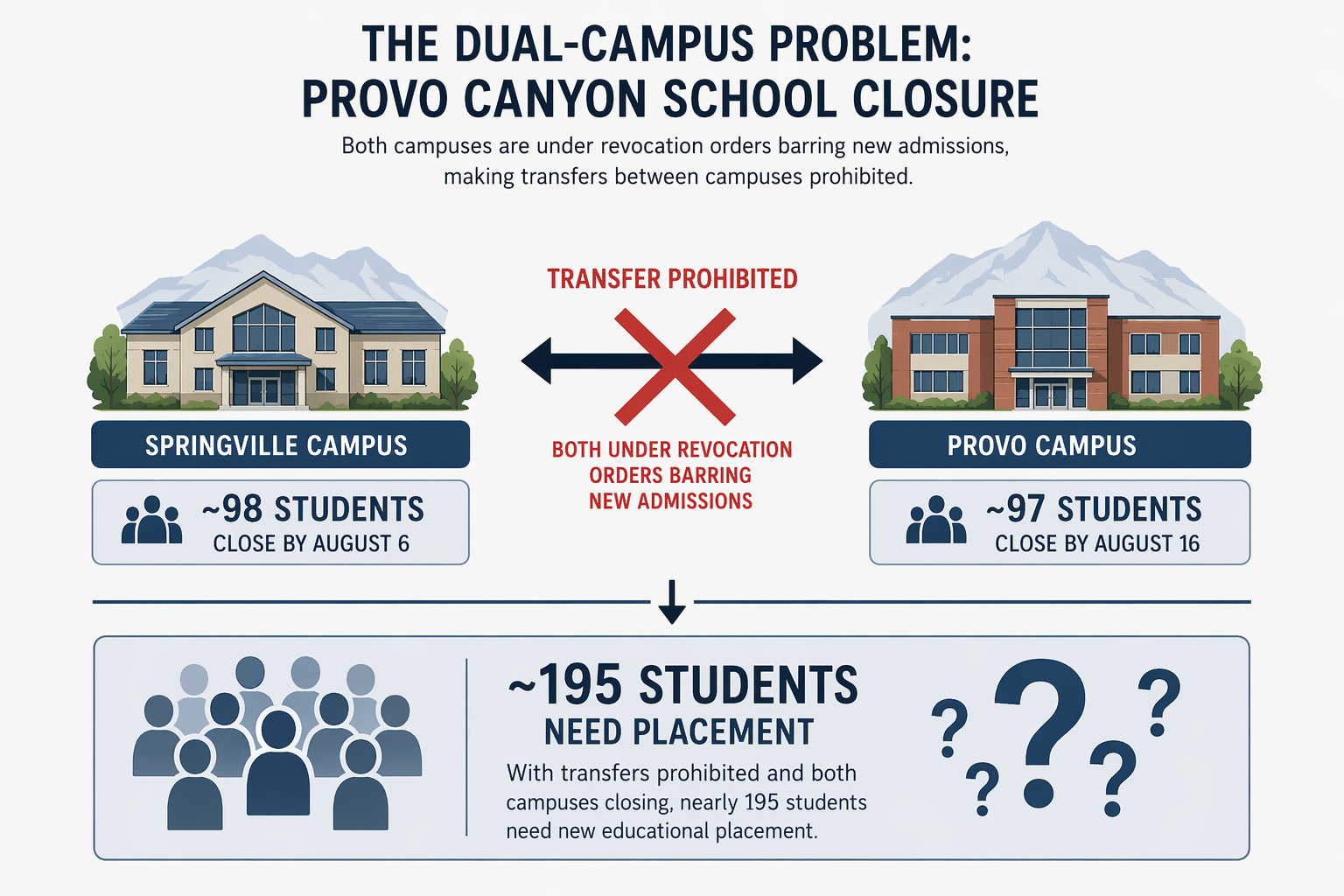
That single fact changes the legal load. The closure is not a routine discharge spread across a few cases; it is a coordinated relocation problem that has to account for child welfare placements, juvenile justice placements, and interstate coordination when a resident's case sits outside Utah. The system still has to decide who notifies whom, who can compel movement, and who absorbs the risk if a child is left without a lawful placement on the date the campus closes.
UHS's stated plan to appeal can lengthen that uncertainty, but it does not erase the closure schedule already running in parallel.[1] The legal question is not whether the company can keep arguing. It is what happens to the children while the argument continues.
What The Older Record Adds
The Senate Finance Committee's "Warehouses of Neglect" investigation found systemic discharge-planning failures in youth residential treatment facilities, including for-profit operators, which is why this shutdown should be read as a stress test of a known weak point rather than as a one-off compliance event.[5] A separate reporting package on Provo Canyon School's history described 341 investigations and 27 substantiated violations, which matters here only because it shows the placement problem sits on top of a long record of regulatory friction rather than a clean slate.[7]
For families who placed children voluntarily, the recourse picture is different again. Milonas v. Williams remains relevant because the Tenth Circuit treated Provo Canyon School as acting under color of state law, which preserves a possible Section 1983 path in the right case.[6] That does not solve placement, but it keeps the facility from being treated as a purely private actor once the closure starts forcing decisions that affect custody, transport, and access to records.

Utah's framework can describe the obligation to transfer, but this shutdown shows how little it says about the mechanics of a mass closure with no working fallback campus. It can order a facility to close, and it can require notice and cooperation, but it still leaves open the hardest questions: how to move about 195 children on staggered deadlines, how to manage out-of-state placements, and who is legally responsible when the ordinary discharge model breaks under scale.
References
- KSL.com, Utah revokes Springville's Provo Canyon School license
- ABC4, DHHS also revokes license of Provo Canyon School's Provo campus
- Imprint News, Utah Pulls Provo Canyon School's License After Yearslong Campaign by Youth Advocates and Celebrity Paris Hilton, a Former Resident
- Utah Legislature, SB0127 (2021)
- Senate Finance Committee, Wyden Investigation Exposes Systemic Taxpayer-Funded Child Abuse and Neglect in Youth Residential Treatment Facilities
- Justia, Milonas v. Williams, 691 F.2d 931 (10th Cir. 1982)
- Center for Health Journalism, Part 2: Provo Canyon School's history of abuse accusations spans decades, far beyond Paris Hilton's allegations
Chronological incident history
No sanction cases have named this tool in the tracked record set to date. This does not imply the tool is safe — see Risk Digest for ongoing monitoring.
← Compare peer toolsReport a correction or tip
Spotted an outdated figure, a misstated fact, or a ruling this tool profile should reflect? Public comments are disabled for this content given the professional cost of a misreported case outcome, penalty amount, or rule text — use the structured correction channel instead.
Report a correction or tip for this record →