
Regulatory risk divergence between Coinbase and Robinhood
SEC enforcement closures removed existential litigation risk from both Coinbase and Robinhood, but a divergence has opened: Coinbase carries broader global compliance obligations while Robinhood faces concentrated U.S. broker-dealer oversight. This article benchmarks the post-enforcement regulatory profiles to help institutional counterparties match their risk tolerance.
- Tool
- Coinbase, Robinhood
- Benchmark source
- SEC filings, company investor relations, Fortune, Reuters, CFO Brew
- Hallucination rate
- Not measured / undisclosed
- Test methodology
- Comparative regulatory risk analysis based on public enforcement records and financial disclosures
- Test date
- Jul 31, 2026
The useful starting point for a Coinbase-versus-Robinhood regulatory comparison is not the share-price chart. It is the enforcement docket. In early 2025, both companies moved out of the most blunt category of SEC risk: Robinhood Crypto said the SEC had closed its investigation with no action and no fine, while Coinbase said the SEC would dismiss its enforcement case.[1][2] That common relief matters because it removes the easiest answer. A platform is not automatically low-risk because one federal matter closed; it is only less burdened by that particular proceeding.
| Company | SEC posture after early 2025 | What changed for a risk register | What did not disappear |
|---|---|---|---|
| Robinhood | Robinhood Crypto investigation closed with no action and no fine | The prior SEC crypto investigation no longer anchors the counterparty review | Broker-dealer, FINRA, SEC disclosure, CFTC-linked event-contract, and tokenized-stock questions remain |
| Coinbase | SEC enforcement action dismissed after the company said the agency would drop the case | The highest-profile federal securities lawsuit no longer defines the entire file | Global licensing, state-level litigation, stablecoin exposure, and tokenized-equity approvals remain live |
For an institutional counterparty, the question after those closures is narrower and more practical: which remaining regulatory surface would be harder to explain if a client, regulator, bank partner, or investment committee asked why the venue was approved six months later?

The divergence starts after the SEC risk recedes
The Robinhood closure is unusually clean as a diligence fact. The company’s February 2025 release says the SEC’s Enforcement Division had closed its investigation into Robinhood Crypto and would not recommend enforcement action.[1] That does not immunize future products, but it gives a risk reviewer a short, citable answer on the specific closed investigation.
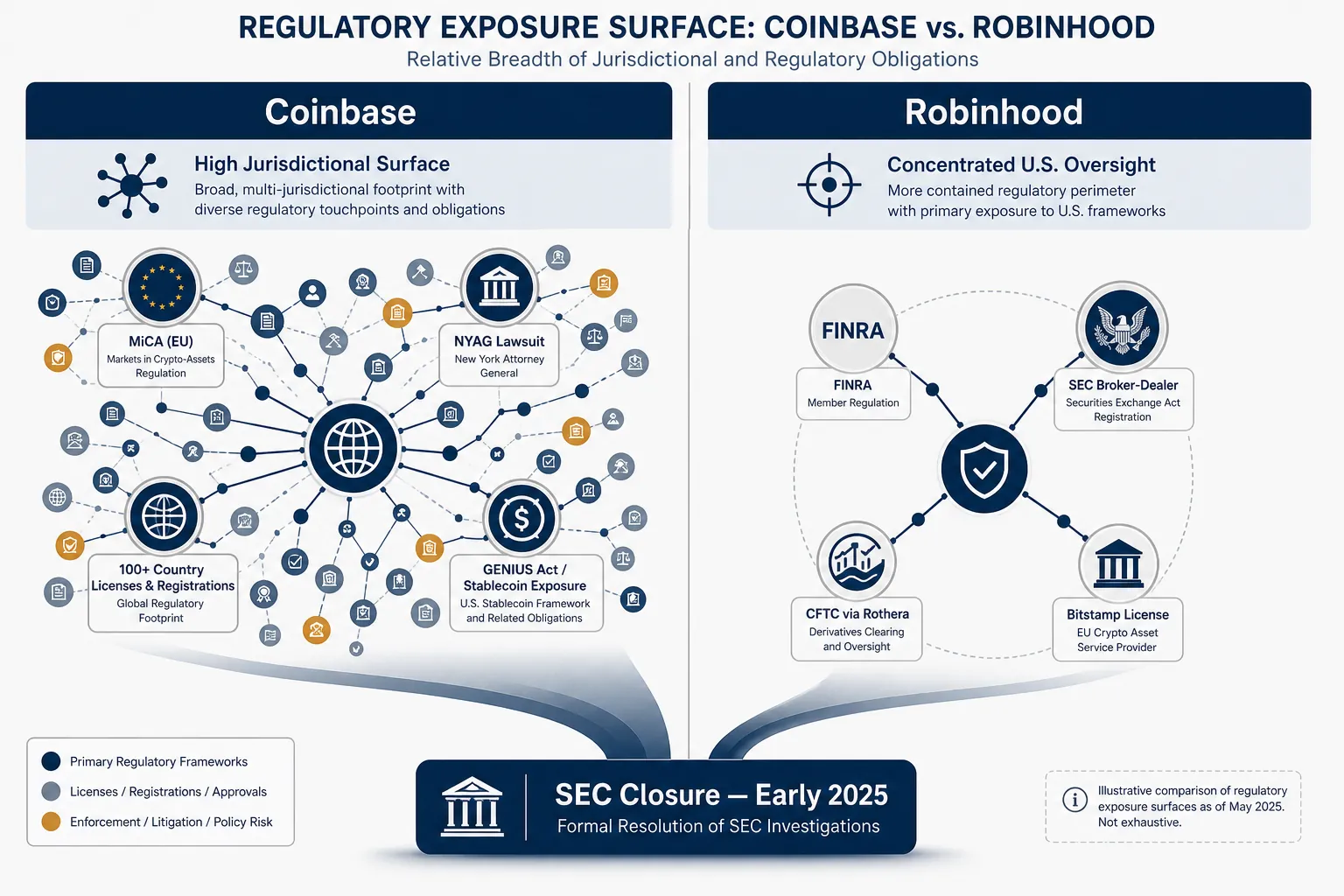
Coinbase’s relief is also material, but it is attached to a broader operating map. CFO Brew reported in February 2025 that the SEC was dropping investigations or cases involving Robinhood and Coinbase, and Coinbase’s own investor communications treated the dismissal as a major removal of overhang.[2] The difference is not that Coinbase remained under the same SEC case; it did not. The difference is that Coinbase’s regulatory perimeter after the dismissal is still spread across more jurisdictions, product categories, and counterparties.
That distinction is easy to lose in stock-rivalry coverage. Investors can debate which equity has the cleaner growth story. A vendor-risk memo has to identify who supervises the activity, where the assets or exposures sit, which product creates the legal question, and whether the company’s revenue mix gives it room to absorb a constraint.
Coinbase has the wider jurisdictional surface
Coinbase’s appeal to institutional users is also the source of its heavier review burden. It is not merely a brokerage app with a crypto tab. It has positioned itself as crypto infrastructure, with licensing and market access that span more than 100 countries and include European Union MiCA positioning identified in the available diligence record. That kind of footprint can be commercially attractive, but it is harder to reduce to a single supervisory relationship.
A broad footprint changes the diligence exercise. The reviewer is no longer asking only whether a U.S. federal enforcement matter has closed. The reviewer is asking which affiliate provides the service, which jurisdiction governs the activity, how local licensing affects the client’s use case, and whether a dispute in one market could change product availability or counterparty terms elsewhere.
The active state-level item matters for the same reason. The available record identifies a New York Attorney General lawsuit against Coinbase tied to prediction markets and gambling-law allegations. That is not the same risk as the dismissed SEC case, and it should not be scored as if it were. It is narrower than a federal securities enforcement action, but it is still a live state-level proceeding attached to a product category that many regulated firms will treat cautiously.
The stablecoin line adds another layer. The GENIUS Act was signed on July 18, 2025, creating a federal framework for payment stablecoins.[3] Coinbase’s USDC-related economics make that framework relevant to its revenue resilience and compliance posture; the research record identifies $355 million of Coinbase Q3 2025 revenue tied to USDC-related economics. Robinhood’s stablecoin exposure, by contrast, is described in the available record as de minimis. That does not make the GENIUS Act bad for Coinbase. It means stablecoin rulemaking is a more consequential diligence item for Coinbase than for Robinhood.
The financial picture should be handled with date discipline. Coinbase’s most recent final earnings in the available record are Q1 2026, not Q2 2026. Coinbase reported Q1 revenue of $1.41 billion, down 31% year over year, and said subscription and services revenue was 41% of total revenue.[4] As of July 31, 2026, the comparison should not quietly substitute analyst previews for final Q2 figures. If a memo needs current Coinbase revenue dependence, it should mark Q2 2026 as pending unless final company data has been separately verified.
Robinhood’s map is more bounded, but not simple
Robinhood’s regulatory profile is easier to diagram because the core U.S. brokerage stack is familiar: broker-dealer oversight, FINRA expectations, SEC disclosure obligations, and product-specific supervision. That concentrated map is useful for procurement because it identifies the likely reviewer, the likely rulebook, and the escalation channel more cleanly than a multi-jurisdiction crypto-infrastructure file.
Its Q2 2026 numbers also show why Robinhood can look more resilient to a crypto-specific regulatory shock. Robinhood reported crypto revenue of $100 million, down 38% year over year, while total revenue grew 32%; transaction-based lines included options revenue of $342 million, equities revenue of $129 million, and event contracts revenue of $156 million.[5] That mix does not eliminate crypto risk, but it means a crypto-specific constraint would not hit the company in the same way it might hit a more crypto-centered infrastructure provider.
Event contracts are the pressure point inside that diversification. Fortune’s coverage of Robinhood’s Q2 2026 results highlighted prediction markets as a growing business line, with event contracts contributing materially to the quarter.[6] Robinhood’s structure, as described in the available record, routes prediction markets through Rothera, a CFTC-licensed designated contract market joint venture with Susquehanna. That is a more defined regulatory path than an unlicensed side product would be, but it still leaves a counterparty with derivatives, event-contract, marketing, suitability, and disclosure questions to answer.
Bitstamp narrows one of Coinbase’s old advantages. The available record states that Robinhood’s $200 million Bitstamp acquisition closed in June 2025 and brought more than 50 global crypto licenses, including EU MiCA compliance. That gives Robinhood a more credible international crypto licensing story than it had before. It also complicates the once-neat distinction between a domestic brokerage app and a global crypto exchange. Still, Robinhood’s primary risk map remains more concentrated than Coinbase’s because the main counterparty questions cluster around U.S. brokerage, derivatives, disclosure, and selected international expansion rather than a full global crypto-infrastructure footprint.
Tokenized stocks are a forward-looking control test
Tokenized equities are where the stock-rivalry framing becomes most tempting and least sufficient. Robinhood has moved visibly into stock tokens outside the United States, with the available record identifying availability in more than 120 countries and a Robinhood Chain mainnet launch in July 2026 with more than $12 billion in DEX volume. Coinbase, meanwhile, has announced commission-free stock and ETF trading as a precursor and is seeking SEC approval for blockchain-based stock trading.
The SEC’s own posture is still developing. Fortune reported in September 2025 that SEC planning for blockchain-based stock trading could put Coinbase and Robinhood into a broader contest with Wall Street incumbents.[7] Reuters later reported in June 2026 that the SEC was poised to allow stock token trading through potential exemptive relief, describing a market-structure shift still awaiting regulatory terms.[8] A counterparty memo should therefore treat tokenized stocks as a conditional product line, not as a settled equivalence to conventional brokerage access.
The investor-protection gap is not a footnote. The available record states that tokenized stocks lack SIPC protection. That issue changes the client-facing explanation. If a user believes a tokenized equity position carries the same protection, recovery path, and intermediary obligations as a conventional brokerage-held security, the disclosure problem lands with anyone who recommended or approved the venue.
This is where Robinhood’s concentration cuts both ways. A focused U.S. broker-dealer identity is easier to understand, but a tokenized-stock expansion can create sharp product-specific risk precisely because users associate Robinhood with ordinary brokerage rails. Coinbase faces the inverse problem: its crypto-native infrastructure posture may make tokenization feel more strategically coherent, but approval, exemptive relief, custody, and investor-protection questions still have to be mapped before institutional use.
A counterparty-fit reading
A practical risk register would not label one platform green and the other red. It would separate the questions by type of exposure.
| Risk question | Coinbase | Robinhood |
|---|---|---|
| Closed SEC enforcement overhang | Dismissed early 2025 | Investigation closed with no action and no fine in February 2025 |
| Jurisdictional spread | Broader global footprint, including MiCA and more than 100 country licensing noted in the available record | More concentrated U.S. brokerage map, expanded by Bitstamp and selected international crypto licensing |
| Active proceeding noted in available record | NYAG prediction-market lawsuit alleging gambling-law violations | No comparable NYAG prediction-market case identified in the available record |
| Stablecoin exposure | Material because of USDC-related economics and the GENIUS Act framework | Described as de minimis in the available record |
| Revenue sensitivity | Q1 2026 final data only in the available record; Q2 2026 should be caveated as pending | Q2 2026 data shows total revenue growth despite lower crypto revenue |
| Tokenized-stock issue | Seeking approval while preparing stock and ETF trading access | Already more visibly extended internationally through stock tokens and Robinhood Chain |
For firms with low tolerance for multi-jurisdictional ambiguity, Robinhood’s more bounded oversight map may be easier to approve and monitor. The reviewer can focus on broker-dealer controls, FINRA and SEC obligations, event-contract governance, CFTC-linked routing through Rothera, tokenized-stock disclosures, and the added licensing brought by Bitstamp.
For firms that can support global crypto-infrastructure diligence, Coinbase can still be an acceptable counterparty after the SEC dismissal. The approval file just has to carry more weight: country-by-country licensing, MiCA posture, the NYAG prediction-market case, stablecoin economics under the GENIUS Act, and the absence of final Q2 2026 figures in the available record as of July 31, 2026.
That is the narrower answer the current record supports. Coinbase presents the higher jurisdictional-risk surface; Robinhood presents a more concentrated but still product-sensitive U.S. brokerage and derivatives/event-contract risk profile. The choice depends less on which stock looks safer after SEC relief and more on which unresolved regulatory map the approving institution is prepared to defend.
References
- SEC Closes Investigation into Robinhood Crypto with No Action, Robinhood Newsroom, February 2025.
- SEC to drop Robinhood, Coinbase investigations, companies say, CFO Brew, February 2025.
- S.394 - GENIUS Act of 2025, Congress.gov, July 18, 2025.
- Coinbase Q1 Financial Results Show Resilient Financial Performance Driven by New All-Time High Crypto Trading Volume Market Share, Coinbase Investor Relations, May 7, 2026.
- Robinhood Reports Second Quarter 2026 Results, Robinhood Investor Relations, July 29, 2026.
- Robinhood Q2 prediction markets, Fortune, July 29, 2026.
- SEC plan for blockchain-based stocks pits Coinbase and Robinhood against Wall Street giants, Fortune, September 2025.
- US SEC poised to allow stock token trading in potential market shakeup, Reuters, June 17, 2026.
Chronological incident history
No sanction cases have named this tool in the tracked record set to date. This does not imply the tool is safe — see Risk Digest for ongoing monitoring.
← Compare peer toolsReport a correction or tip
Spotted an outdated figure, a misstated fact, or a ruling this tool profile should reflect? Public comments are disabled for this content given the professional cost of a misreported case outcome, penalty amount, or rule text — use the structured correction channel instead.
Report a correction or tip for this record →