
Semiconductor Stock Crash Won't Ease AI Chip Supply for Legal Tools
The July 2026 semiconductor stock rout wiped $1.3 trillion from chip stocks, but the selloff is sentiment-driven and decoupled from physical chip availability. AI memory remains at its tightest point in years, with no near-term improvement in supply or cost for legal AI tools.
- Tool
- generic-chatbot
- Benchmark source
- CNBC, Fortune, Bloomberg, Tom's Hardware, Tech Insider
- Hallucination rate
- Not measured / undisclosed
- Test methodology
- Market and supply chain analysis using financial and semiconductor industry reporting
- Test date
- Jul 31, 2026
A legal AI buyer looking at the semiconductor tape in late July 2026 has a fair question: if the companies powering the AI boom just lost enormous market value, does that finally weaken the pricing power behind AI research, drafting, review, and knowledge tools?
As of CNBC’s July 29 reporting, the answer from the stock market looked dramatic. The PHLX Semiconductor Index had entered bear-market territory, down 20% from its June peak after a 105% rally. Roughly $1.3 trillion in market capitalization had been erased from chip stocks. Nvidia lost about $238 billion in a single day on July 29; over the referenced windows, Nvidia was down 16.8% for the week, AMD was down 25.2% month to date, Arm Holdings was down 23%, and ASML was down 28%.[1]

That is not noise. A rout of that size can change investor confidence, vendor financing conditions, and the tone of renewal calls. It may matter if a legal AI vendor depends on a fragile infrastructure partner or if a hyperscaler begins defending cash flow more aggressively. But it does not mean that the HBM-equipped data-center GPUs used to run legal AI workloads have suddenly become easier to obtain.
The distinction matters for procurement. Stock prices are repricing expectations about future AI returns. Chip allocation is governed by contracts, production capacity, memory packaging, and the queue position of the largest cloud platforms. Those systems can influence each other over time, but they do not move on the same clock.
The selloff is real, but analysts are not describing a demand collapse
The useful procurement reading of the July crash starts with what it is not. The available analyst commentary does not describe a broad cancellation of AI deployments or a sudden surplus of accelerator capacity. Fortune reported one Morningstar analyst calling the move “a sentiment-driven repricing rather than a fundamental demand collapse,” a Forrester analyst describing it as “momentum-trading unwinding, not a change in AI deployment reality,” and a D.A. Davidson analyst calling it “a mechanical and algorithmic selloff.”[2]
That language is easy to underweight because it sounds like market commentary rather than operating evidence. For a legal buyer, though, it is exactly the distinction to preserve. Sentiment-driven repricing can still be painful and rational. Investors can decide that AI capital expenditure is racing ahead of monetization. They can sell companies whose revenue remains strong because the next stage of growth looks more expensive, more crowded, or less certain. None of that automatically releases wafers, memory stacks, advanced packaging capacity, or cloud GPU reservations into the market.
Bloomberg’s July 17 reporting captured the same separation from another angle: Goldman Sachs noted Nvidia’s forward price-to-earnings multiple at 21.7, compared with a five-year average of 72.[3] That observation is about valuation compression. It says investors may be paying much less for a dollar of expected future earnings than they did during the most exuberant phase of the AI trade. It does not say that the physical supply chain has cleared.
This is where legal procurement teams should be careful with the phrase “buyer’s market.” In equity markets, buyers may get a lower entry price into a stock. In AI infrastructure, buyers need reserved compute, predictable latency, model availability, and a vendor that can absorb inference costs without quietly degrading service. A falling ticker does not answer those questions.
Why legal AI tools depend on the constrained part of the chip market
A brief hardware distinction is enough here. Legal AI products that summarize deposition transcripts, search large knowledge repositories, draft from precedent banks, or run complex reasoning workflows at scale are not mainly constrained by ordinary laptop-class chips. They depend on data-center systems built around AI accelerators, especially GPUs paired with high-bandwidth memory, or HBM.
HBM is not just “more memory.” It is memory designed to feed data to processors at the speed required by large AI workloads. When a vendor offers fast responses from a frontier model across many customer matters at once, the bottleneck is not only whether it has access to a model. It is whether the underlying cloud and model provider have enough accelerator capacity, memory bandwidth, and data-center power to serve that workload reliably.
A legal department does not usually contract directly for HBM. It buys a research platform, drafting assistant, contract review system, or enterprise AI workspace. But the tool’s performance still sits on that stack. If the vendor’s infrastructure partner is capacity-constrained, the legal team may experience it as throttled features, slower rollout of advanced models, higher enterprise pricing, stricter usage caps, or less room to negotiate volume commitments.
The memory data points in the opposite direction from the stock chart
The physical supply picture in July 2026 is still tight. Tom’s Hardware, citing IDC, reported that data centers would consume 70% of all memory chips made in 2026.[4] That is the opposite of spare capacity washing into the market. It suggests that memory production is being pulled toward cloud and AI infrastructure before downstream buyers ever get a chance to benefit from weakness in semiconductor equities.
Tech Insider reported in July 2026 that Samsung, SK Hynix, and Micron had shifted 93% of production capacity to HBM for AI workloads.[5] That figure is current but should be treated as a July 2026 supply-chain snapshot, not a permanent law of the industry. Still, the procurement implication is plain enough: manufacturers are already orienting production toward the highest-priority AI memory demand, and that demand is not primarily coming from mid-market legal software vendors.
Price behavior tells the same story. Bloomberg reported that DRAM spot prices had surged roughly 700% year over year, while Tech Insider reported that DRAM prices rose 90% in Q1 2026 alone.[6][5] Those are not direct legal AI subscription prices, and they should not be treated as a formula for what a vendor will charge. But they are hard to reconcile with the claim that the July stock selloff has already created cheap AI infrastructure.
| Procurement Question | What The July 2026 Materials Support | What They Do Not Support |
|---|---|---|
| Has investor confidence weakened? | Yes. The SOX drawdown and $1.3 trillion market-cap loss show a severe repricing. | They do not prove that accelerator inventory is suddenly available. |
| Has AI deployment demand collapsed? | The cited analysts characterize the move as sentiment-driven, mechanical, or momentum-related. | They do not describe a broad cancellation of AI infrastructure demand. |
| Has memory supply loosened? | No near-term loosening is evident in the cited memory data. | The data does not support cheaper HBM or easier access for downstream legal tools. |
| Can legal AI buyers assume lower tool prices? | They can raise cost questions in diligence and renewal discussions. | They should not assume a buyer’s market for compute. |
The more cautious reading is also the more useful one. The stock market is questioning future returns on AI infrastructure spending. The memory market is still allocating scarce production to buyers with the largest commitments.
Hyperscaler contracts sit between the crash and the legal buyer
Legal AI procurement often treats “the cloud” as if it were an elastic utility. For ordinary software workloads, that shorthand is sometimes harmless. For generative AI, it hides the main queue. Hyperscalers are not buying chips one quarter at a time for whatever demand appears next month. They are signing long-term supply agreements and building data-center plans around them.
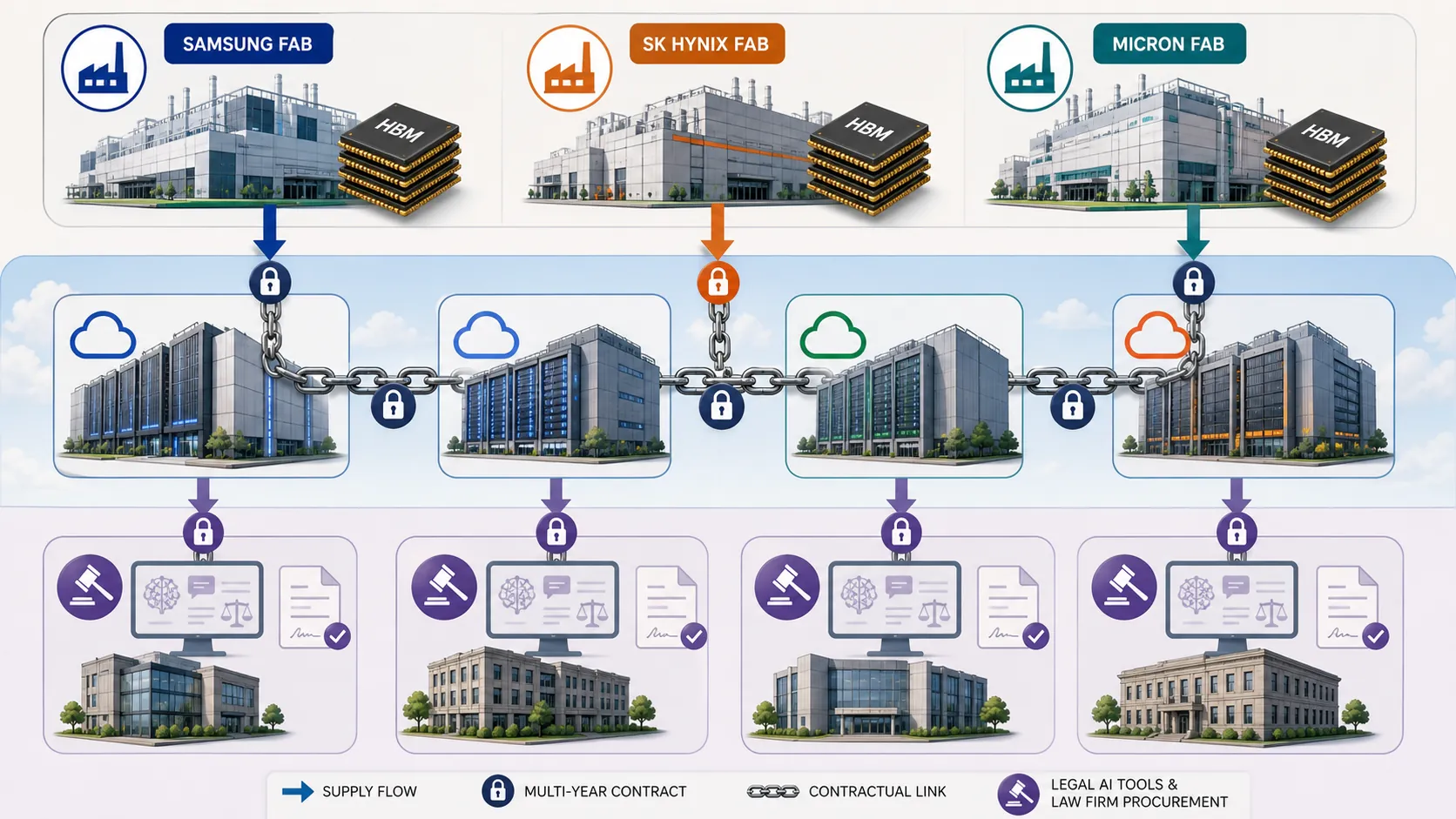
Google and Meta have signed five-year agreements with memory manufacturers, and Alphabet raised its 2026 capital expenditure plan to $195 billion to $205 billion, up from $91 billion in 2025. The same July 2026 reporting cited cloud revenue growth of 82%.[7] Those commitments are the bridge between semiconductor news and legal AI pricing. They show that the largest infrastructure buyers are still reserving capacity in advance, even while public-market investors debate whether the spending will earn acceptable returns.
A legal research company, contract AI vendor, or litigation analytics platform sits downstream from those commitments. It may contract with a hyperscaler, with a model provider that contracts with a hyperscaler, or with both. By the time the legal buyer negotiates a renewal, much of the relevant chip supply has already been allocated through cloud infrastructure plans that were made far above the legal-tech layer.
This is why the July crash can be important without being negotiable leverage. If a hyperscaler’s stock falls, the legal buyer should watch for financial-health and reliability consequences. If the hyperscaler has already committed to multi-year memory supply and raised capex, however, the buyer should not assume that a vendor can suddenly obtain the same compute at a discount.
There is also a timing problem. Typical fab construction timelines run four to five years. Even if a manufacturer decided today to add capacity because pricing remained attractive, that decision would not solve an enterprise legal AI renewal this quarter. Procurement leverage tends to appear when suppliers have unsold capacity, not merely when investors have lost patience.
The “3-to-1 rule” is useful only if it stays in its lane
One of the more memorable explanations in the July coverage is the so-called “3-to-1 rule”: the idea that each AI chip deployed in a data center destroys capacity for three PC or laptop chips because fabrication lines at TSMC and Samsung must be reallocated. Tech Insider presented this as analyst framing, not as an industry-standard metric.[5]
Used carefully, the framing helps a non-specialist audience understand why AI demand can crowd out other chip categories. It turns an abstract manufacturing constraint into a visual procurement problem: the same fabrication ecosystem cannot maximize every product line at once. Used carelessly, it becomes fake precision. A legal team should not put “3-to-1” into a board memo as settled semiconductor math.
The safer point is narrower and better supported. AI infrastructure demand is pulling scarce manufacturing and memory resources toward data centers. That allocation pressure can coexist with a falling semiconductor index because one is a production constraint and the other is a financial-market price.
Shortage timelines still extend beyond the current renewal cycle
The available executive comments do not point to quick relief. Tech Insider reported that SK Hynix’s CEO warned the memory chip shortage may persist “beyond 2030.”[5] CNBC reported in January 2026 that Synopsys’s CEO expected the shortage to last through 2027.[8] Forbes reported in July 2026 that Intel’s CEO projected “no relief before 2028.”[9]
Those statements come from market participants, not from a neutral law of supply and demand. They should be read as informed signals rather than guarantees. Even so, they line up with the reported memory consumption, HBM allocation, DRAM pricing, hyperscaler contracts, and fab-timeline constraints. Taken together, the evidence supports a tight-supply view more strongly than a crash-equals-discount view.
For legal AI buyers, the practical consequence is not that every vendor price must rise. Vendor pricing includes margin strategy, contract term, usage design, model routing, customer segment, and competitive pressure. The point is more limited: the July 2026 semiconductor selloff does not, by itself, create evidence that the underlying compute cost stack has improved.
How this should change a legal AI evaluation
The semiconductor stock crash belongs in legal AI diligence, but not as a demand for an automatic discount. It is a risk signal. It should push procurement and legal operations teams to ask better questions about infrastructure dependence, not to assume that vendors have cheaper compute available.
- Ask whether the product’s core AI features run on reserved capacity, best-efforts cloud capacity, or a model provider’s shared pool.
- Separate subscription pricing from usage economics: a flat enterprise fee may still hide stricter limits, slower premium-model access, or narrower feature availability.
- Request notice obligations for material changes in model routing, latency thresholds, usage caps, or degradation of advanced AI features.
- Review whether the vendor depends heavily on one hyperscaler or model provider, especially if that dependency is not disclosed in ordinary security documentation.
- Treat market-cap losses as financial-health context, not as proof of operational slack.
This is also where the issue connects to the companion procurement risk covered in What Alphabet’s Negative Free Cash Flow Means for Legal AI. The present question is whether the semiconductor crash loosens AI chip supply. The answer, on the current July 2026 materials, is no. The companion question is different: whether hyperscaler financial strain can still affect tool reliability, roadmap timing, and vendor exposure even when physical supply remains tight.
A legal team can hold both points at once. The selloff is relevant because it may expose stress in the AI infrastructure business model. It is not evidence that a legal AI vendor can now buy more HBM-backed compute, sooner, at a lower cost. Until allocation, memory pricing, and hyperscaler commitments move, the procurement condition has not become a buyer’s market.
References
- Chip stocks shed $1 trillion as selloff hits companies powering AI boom, CNBC, July 29, 2026
- A lot of panic around the AI investment, Fortune, July 28, 2026
- Chips Stocks Sink Into Bear Market, Bloomberg, July 17, 2026
- IDC: Data centers will consume 70% of all memory chips made in 2026, Tom’s Hardware / IDC, July 2026
- AI memory shortage and HBM production shift, Tech Insider, July 2026
- DRAM spot prices surge amid AI memory demand, Bloomberg, July 2026
- Alphabet raises 2026 capex as cloud revenue grows, Yahoo Finance / Fortune, July 2026
- Synopsys CEO says chip shortage will last through 2027, CNBC, January 2026
- Intel CEO projects no chip supply relief before 2028, Forbes, July 2026
Chronological incident history
No sanction cases have named this tool in the tracked record set to date. This does not imply the tool is safe — see Risk Digest for ongoing monitoring.
← Compare peer toolsReport a correction or tip
Spotted an outdated figure, a misstated fact, or a ruling this tool profile should reflect? Public comments are disabled for this content given the professional cost of a misreported case outcome, penalty amount, or rule text — use the structured correction channel instead.
Report a correction or tip for this record →