
How Soccer's SAOT Validation Exposes Legal AI Benchmark Gaps
This article compares FIFA's SAOT certification framework — component-level testing, independent test events, and published accuracy tolerances — against leading legal AI benchmarks, identifying specific gaps procurement teams can use to demand better validation from legal AI vendors.
- Tool
- harvey-ai
- Benchmark source
- Vals AI VLAIR report
- Hallucination rate
- Not measured / undisclosed
- Test methodology
- Task-specific evaluation across seven legal tasks
- Test date
- Feb 27, 2025
The useful lesson from soccer's semi-automated offside technology is not that football has found a magic accuracy number. It is that FIFA made the validation problem inspectable. Semi-automated offside technology, or SAOT, is not certified as one blended promise that “the system is accurate.” FIFA’s Quality Programme breaks it into parts: virtual offside line accuracy, ball tracking, skeletal tracking, and the automated alert system. Each part is tested against its own criteria at FIFA test events and through offline provider trials.[1]
That distinction matters before anyone starts borrowing soccer analogies for legal AI. A legal research assistant is not measuring a striker’s shoulder against a defender’s heel. It is retrieving authorities, interpreting user requests, applying jurisdictional constraints, deciding what to cite, and presenting an answer that may later sit near a filing workflow. The error landscape is different. The validation burden is not lighter because the task is harder; if anything, it is less forgiving of theatrical benchmark summaries.
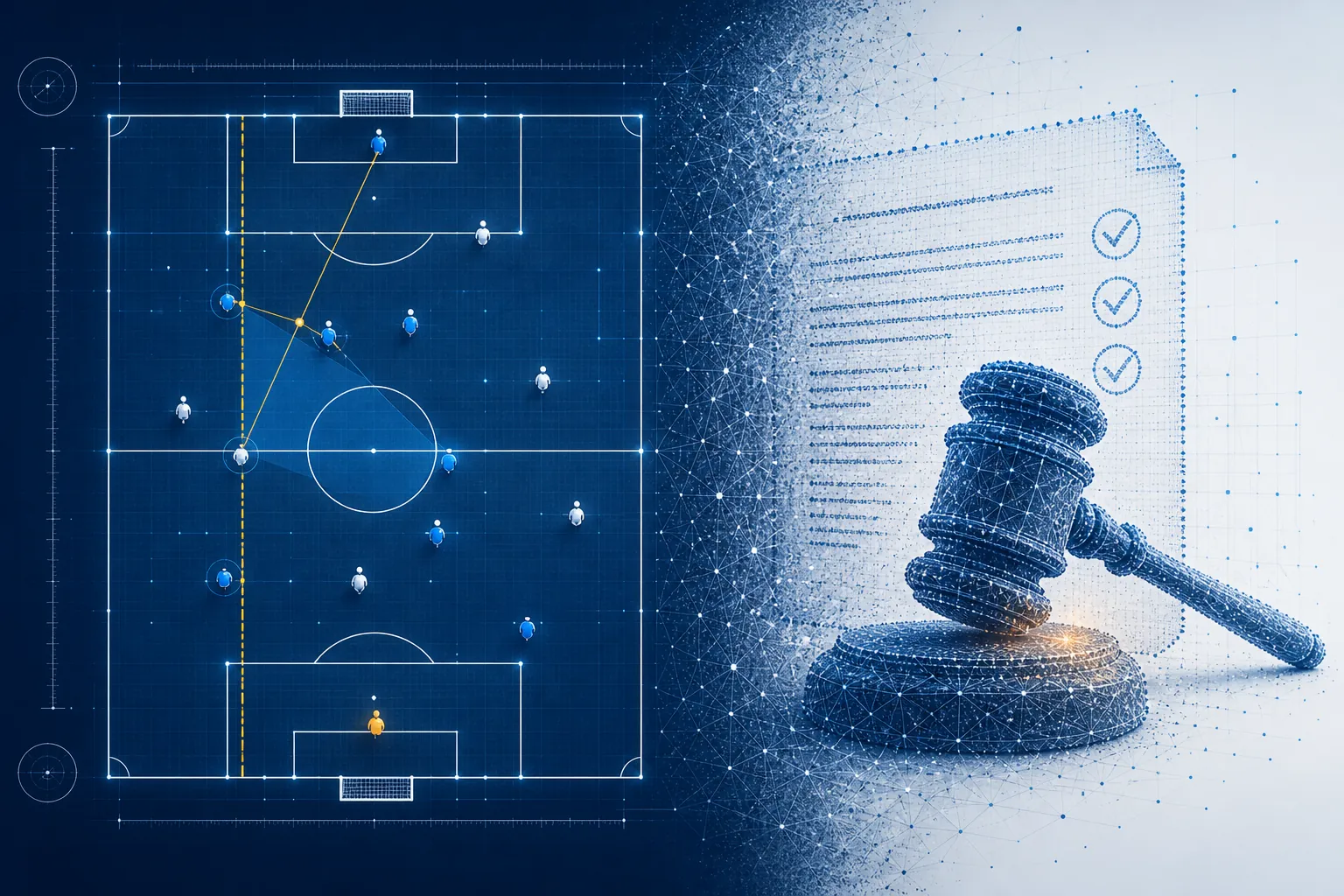
What FIFA Actually Certifies
FIFA’s SAOT framework is useful because it does something procurement teams routinely ask for and rarely receive in clean form: it separates the system into testable subsystems. The virtual offside line is tested for line-placement accuracy. Ball tracking is evaluated as its own component, with FIFA’s criteria describing tracking at 500Hz. Skeletal tracking is evaluated separately, with 29 body points and a minimum 50 frames per second. The automated alert system is another component, not a footnote inside an overall system score.[1]
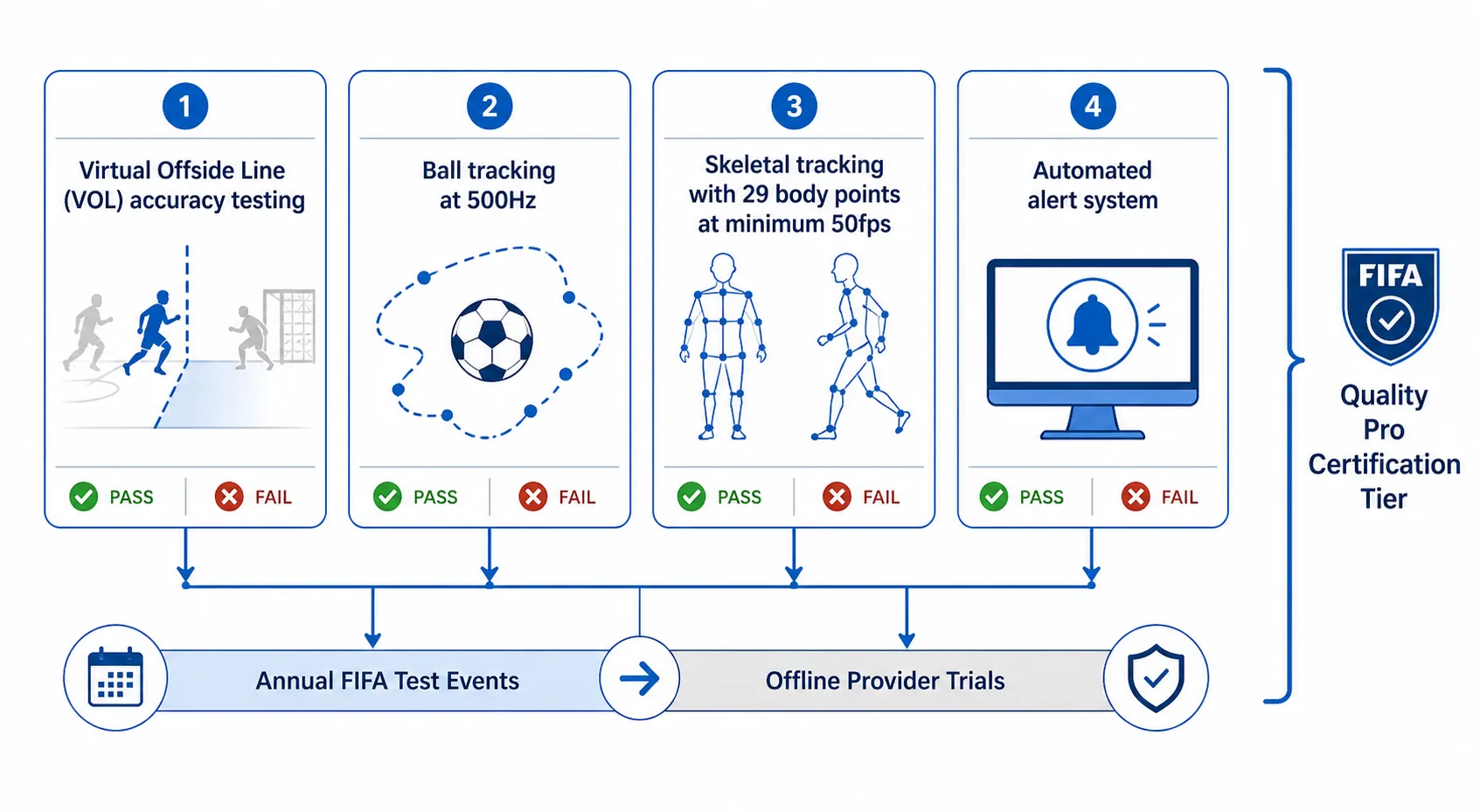
The certification tier also matters. FIFA Quality Pro is the highest mark, and it is not awarded because a vendor can show a persuasive demo reel. Systems must pass the required component tests, including the annual FIFA test event structure described in the Quality Programme materials.[1][2]
| SAOT Component | What Is Being Isolated | Why a Buyer Should Care |
|---|---|---|
| Virtual offside line | Whether the line can be placed within the required tolerance | A line-placement failure is different from a tracking failure and should be diagnosed separately |
| Ball tracking | Whether the ball is tracked at the required frequency | The moment of the pass cannot be validated by body tracking alone |
| Skeletal tracking | Whether player body points are captured at the required frame rate | The system needs to know which body part creates the offside position |
| Automated alert system | Whether the system correctly flags potential offside situations for review | A detection failure changes the human review queue, not merely the measurement layer |
The public technical literature adds a second procurement-grade feature: tolerances. A 2026 Scientific Reports paper describes SAOT system specifications as achieving greater than 98% offside-specific accuracy with less than 3cm spatial tolerance through multi-camera triangulation using 12 to 29 cameras.[3] That figure should not be inflated into a single FIFA-published master metric for all SAOT deployments. It is better read as a system-specification discussion from the paper, not as a universal public warranty. Even with that caveat, it gives buyers something rare: a stated tolerance they can question, test around, and compare against the operational consequence.
That is the procurement value of the SAOT structure. It does not merely say “accurate.” It says which part was tested, at what performance level, and through what certification process. If a system fails, the buyer can ask whether the problem sits in camera calibration, line placement, skeletal capture, ball timing, or alert generation. That is a much better conversation than arguing over a single percentage in a sales deck.
The Premier League Example Is Useful, If Kept Small
The Premier League’s experience is worth mentioning precisely because it should not be overclaimed. After the league introduced semi-automated offside technology in April 2025, the reported result was 100% correct offside calls and an approximately 31-second reduction in review time per decision.[4] That does not prove SAOT solved every VAR controversy. It says something narrower and more useful: for the offside decisions in that implementation window, the technology was reported to improve correctness and reduce review time.
That kind of scoped claim is exactly what legal AI evaluations need more often. A vendor saying a research tool performs well “on legal tasks” is not comparable to a claim about a defined category of offside review after a specific implementation date. The narrower claim is easier to audit. It also gives the buyer less room to misunderstand what has not been proven.
Legal AI Benchmarks Are Serious, But They Are Not Certification Regimes
The point is not that legal AI lacks benchmarks. It has several that deserve attention. LegalBench created task-specific evaluations for legal language model performance. Vals AI’s VLAIR report evaluated legal AI tools across seven legal tasks and four tools in February 2025. Stanford RegLab has evaluated language models on statutory survey tasks.[5][6][7]
Those efforts are materially better than model-name comparison shopping. They put legal tasks in front of systems and measure outputs. They help expose differences that a generic benchmark cannot show. They also create a public vocabulary for discussing legal AI performance beyond anecdote.
But they do not yet function like SAOT certification. The gap is procedural. Current legal AI benchmarks generally test end-task outcomes rather than certifying the separate components that produce those outcomes: retrieval, authority ranking, citation validation, jurisdictional filtering, reasoning, confidence calibration, and answer presentation. A buyer may learn that one tool outperformed another on a benchmark task. The buyer often still cannot tell whether the advantage came from better retrieval, better synthesis, more conservative citation behavior, a friendlier test set, or output formatting that made graders more likely to award credit.
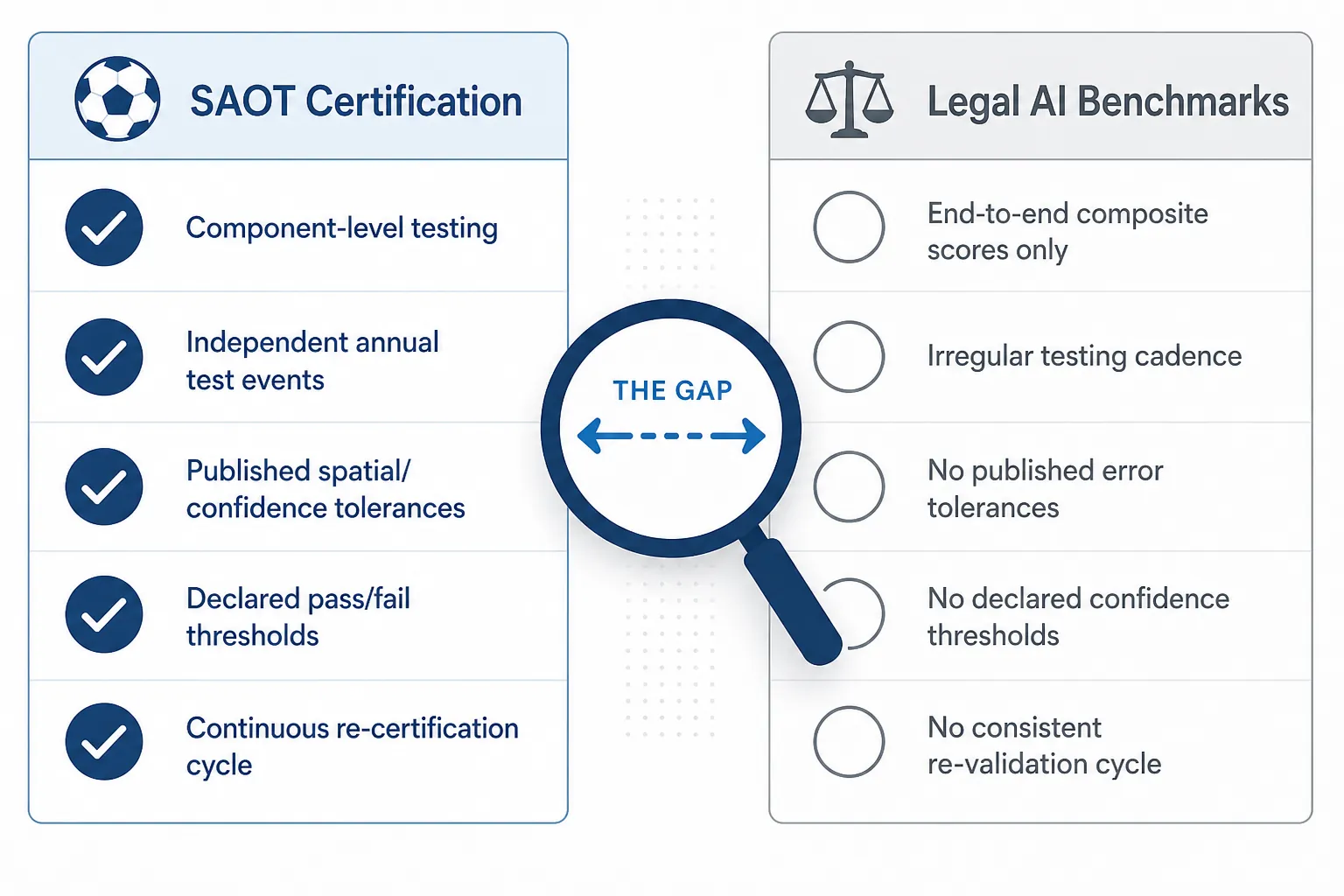
This is where aggregate accuracy becomes procurement theater. A score may be directionally informative and still be unusable as acceptance evidence. If a legal AI tool misses a controlling authority, fabricates a citation, or gives a confident answer outside the user’s jurisdiction, the remediation path depends on which component failed. End-task scoring can tell the buyer something went wrong. Component validation tells the buyer where to look before renewal, deployment expansion, or incident review.
The Missing Component Map
A procurement-grade legal AI validation package would not stop at “92% on benchmark X” or “top performer on task Y.” It would separate the work into components that can fail independently. At minimum, buyers should expect evidence for these layers:
- Retrieval: whether the system finds the relevant authorities and excludes irrelevant materials.
- Citation validation: whether cited cases, statutes, quotations, and pincites exist and support the proposition stated.
- Jurisdictional coverage: whether the tool knows the boundaries of the legal corpus it is using.
- Reasoning and synthesis: whether the answer applies authorities in a legally coherent way.
- Confidence calibration: whether the system signals uncertainty when the materials are thin, conflicting, or outside scope.
- Output presentation: whether the answer makes verification easy for the lawyer who remains responsible for the work product.
Those are not interchangeable risks. A tool with strong retrieval and weak citation validation creates a different control problem from a tool with cautious citations but poor jurisdictional filtering. A tool that answers beautifully while hiding uncertainty is especially dangerous in a workflow where junior lawyers or business users may treat fluency as reliability.
The Missing Test-Event Discipline
FIFA’s model also creates a cadence. Annual test events and offline provider trials give certification a time stamp.[1] That matters because systems change. Cameras are recalibrated. Software is updated. Providers improve, regress, or alter behavior in ways that a buyer cannot infer from last year’s deck.
Legal AI changes faster. Models are swapped, retrieval indexes are refreshed, system instructions are rewritten, guardrails are adjusted, and user interfaces alter what lawyers see. A benchmark result from a prior version may be interesting history rather than current evidence. Yet legal AI procurement materials often treat benchmark participation as a static credential instead of asking when the tested version last matched the deployed version.
A proper validation file should therefore answer basic version-control questions: what model was tested, what retrieval corpus was live, what system instructions were used, what date the test occurred, whether the evaluation was independent, and what product version customers are actually buying. Without that chain, a benchmark score is closer to a marketing artifact than a certification record.
The Missing Tolerance Standard
SAOT can publish spatial tolerances because it measures a physical event. Legal AI cannot copy that metric. There is no legal equivalent of less than 3cm for a motion-to-dismiss answer. But legal AI can still declare tolerances. It can state acceptable false-positive rates for citation existence. It can state maximum tolerated unsupported proposition rates. It can define confidence thresholds for sending an answer to a lawyer, blocking an answer, or requiring additional verification.
The absence of a spatial metric should not become an excuse for having no threshold at all. If a vendor cannot say what error rate is unacceptable for a citation checker, then the buyer is being asked to accept an undefined risk. If a vendor cannot explain how confidence is calibrated, then “high confidence” is just interface copy.
Cost Transparency Is Part of the Validation Conversation
The Scientific Reports discussion places SAOT implementation costs at roughly $2 million to $4 million per stadium.[3] That number is not directly portable to legal AI, but its transparency is instructive. Buyers can see that the validation and deployment of a high-stakes adjudication technology carries real infrastructure cost.
Legal AI validation costs are usually far less visible. A firm may pay license fees, devote knowledge-management time to testing, ask partners to review outputs, and absorb risk through malpractice, sanctions, or client-confidence exposure if a tool performs poorly. If the vendor has not invested in independent validation, that cost does not disappear. It moves to the buyer after deployment.
Scale adds the same lesson without needing much sports detail. Reporting on 2026 World Cup offside technology describes 1,248 players scanned before the tournament at sub-centimeter accuracy and more than 150 million tracking data points per match across 16 cameras per stadium.[8] The useful point is not spectacle. It is that high-volume automated assistance requires known inputs, calibration, and repeatable measurement. Legal AI buyers should want the same discipline around corpora, matter types, jurisdictions, and user workflows.
Governance Questions Do Not Disappear Because a System Is Certified
SAOT has also drawn legal and governance commentary in sport. Law-firm analyses have noted that automated decision-support in elite sport can raise issues around responsibility, transparency, implementation, and disputes over technology-assisted outcomes.[9][10] Those are advisory perspectives, not empirical proof of systemic failure. They are still a useful reminder: certification narrows uncertainty; it does not eliminate accountability.
The same is true in legal AI. A benchmark result does not decide who signs the filing, who supervises the junior lawyer, who reviews citations, or who explains an error to a court or client. Validation is not a substitute for governance. It is the evidence base governance needs before assigning responsibility.
The Comparison Is an Analogy, Not a Study
No head-to-head academic study compares FIFA’s SAOT certification framework with LegalBench, VLAIR, or Stanford RegLab evaluations. The comparison here is an analytical procurement analogy built from separate source sets. That limitation should be explicit because it is exactly the kind of boundary vendors should be expected to state when they present their own evidence.
The analogy is procedural. Soccer and legal AI do not share the same consequences, data structure, or tolerance for ambiguity. But both ask buyers and institutions to trust AI-assisted systems in consequential workflows. In both settings, a serious validation regime should tell the evaluator what was tested, how it was tested, who tested it, what passed, what failed, and when the evidence expires.
What Legal AI Buyers Should Ask For
The practical standard is not “make legal AI exactly like SAOT.” That would be lazy and technically wrong. The standard is to stop treating opaque benchmark summaries as procurement-grade evidence. A vendor that wants deployment in legal work should be able to answer questions that look more like certification questions than sales questions.
- Show component-level validation, not only end-task scores: retrieval, citation checking, jurisdictional filtering, reasoning, confidence calibration, and output presentation.
- Identify the independent evaluator, test date, tested product version, model version, corpus scope, and benchmark methodology.
- Declare error tolerances for high-risk functions, especially fabricated citations, unsupported propositions, missed controlling authority, and out-of-jurisdiction answers.
- Explain confidence thresholds: when the system answers, when it warns, when it refuses, and when it routes work to human review.
- Provide re-validation cadence after model changes, retrieval updates, instruction changes, corpus expansions, or interface changes.
- Link to benchmark methodology and disclose whether results are vendor-run, independently run, or independently certified.
A buyer does not need to reject every tool that lacks a mature answer on day one. Some legal AI benchmarking work is still developing, and serious vendors may be building toward better validation. But the burden should move. The buyer should not have to reverse-engineer reliability from a leaderboard, a demo, and a paragraph of accuracy claims.
If soccer can require component tests, independent events, published tolerances, certification tiers, and re-testing before trusting AI-assisted officiating, legal AI buyers can ask for the same category of evidence before allowing a tool to influence legal work product. Not the same metric. The same discipline.
References
- Semi-automated offside technology testing criteria, FIFA.
- Semi-automated offside technology, FIFA.
- Scientific Reports article on semi-automated offside technology, Nature Scientific Reports, 2026.
- Premier League may introduce semi-automated offside tech before end of season, Sport Resolutions.
- What Legal AI Benchmarks Reveal That Model Names Don’t, Artificial Lawyer, June 22, 2026.
- Building Legal AI Benchmarks That Matter: From Theory to Implementation, Colin S. Levy.
- VLAIR 2/27/25, Vals AI, February 27, 2025.
- World Cup Offside AI Technology, Label Your Data.
- The Legal Implications of Semi-Automated Offside Technology in Professional Football, O’Connors.
- AI in elite sport: key legal considerations around performance enhancing technology, Brabners.
Chronological incident history
No sanction cases have named this tool in the tracked record set to date. This does not imply the tool is safe — see Risk Digest for ongoing monitoring.
← Compare peer toolsReport a correction or tip
Spotted an outdated figure, a misstated fact, or a ruling this tool profile should reflect? Public comments are disabled for this content given the professional cost of a misreported case outcome, penalty amount, or rule text — use the structured correction channel instead.
Report a correction or tip for this record →