
St. Lawrence River 30 mph Zone Law Applied in 157 mph Boating Case
A 157 mph boat in the St. Lawrence River 30 mph zone on July 18, 2026, triggered charges under New York Navigation Law. This article explains the legal basis for the speed zone, the penalties, and why the organized-race exception did not apply.
- Hallucination rate
- Not measured / undisclosed
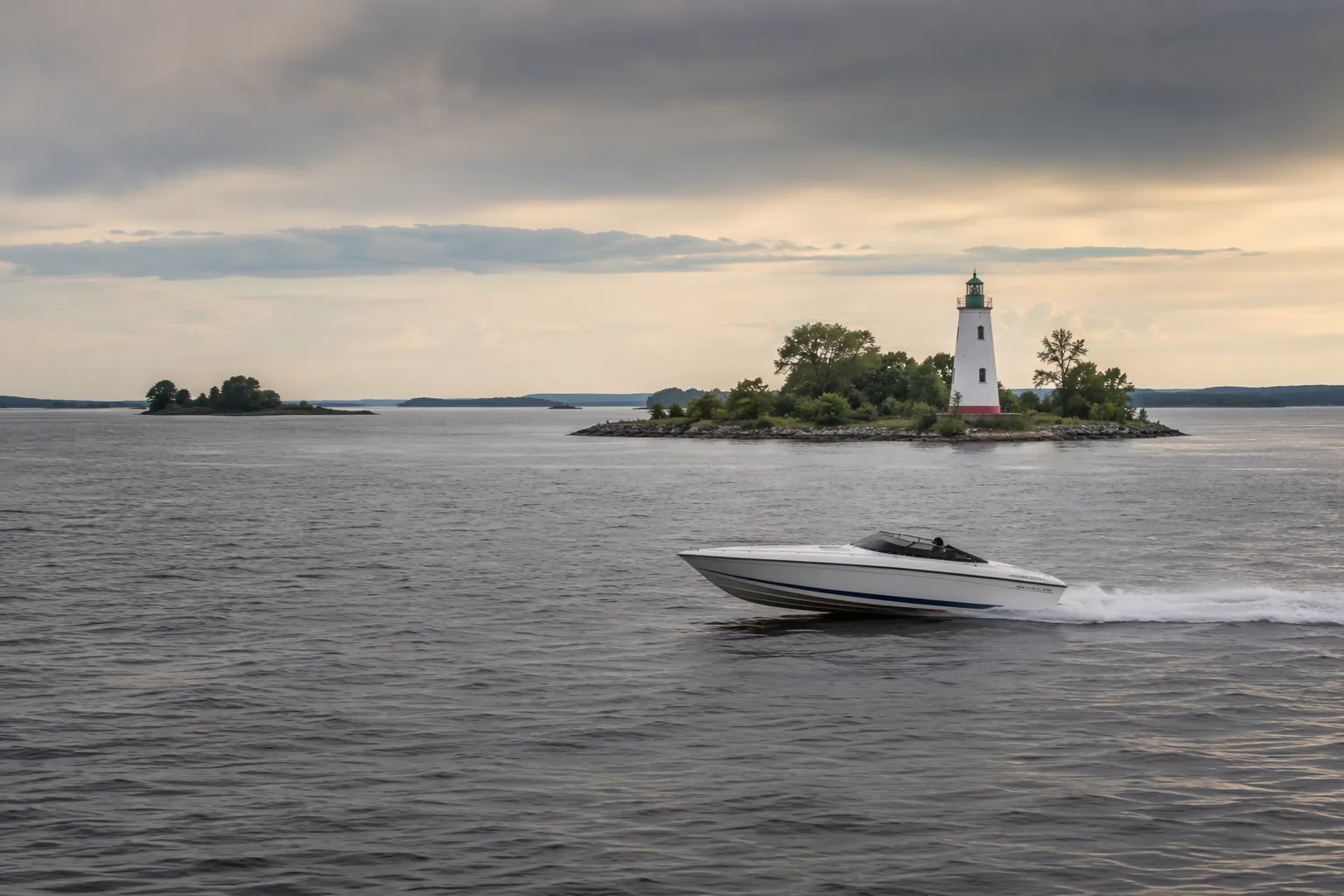
A 42-foot turbine-powered catamaran, valued in reports at about $700,000, was allegedly clocked at 157 mph on July 18, 2026, in the American Narrows 30 mph zone of the St. Lawrence River during the 1000 Islands Charity Poker Run.[1] The reported charge list is not just a speeding ticket dressed up by a dramatic number. It includes New York Navigation Law §102.4, Speed in American Narrows; Navigation Law §45.1(a), reckless operation of a vessel; insufficient navigation lights; insufficient anchor or line; unregistered vessel; and failure to display registration numbers.[2]
Those are charges, not findings. The difference matters. But the charging pattern is still useful because it shows how New York can treat a single run through a narrow, regulated stretch of river as more than one legal problem: first, whether the boat exceeded a place-specific speed limit; second, whether the operation of the vessel independently met the statutory standard for reckless operation.
The St. Lawrence River 30 mph Zone Is a Statutory Place, Not a Vague Local Custom
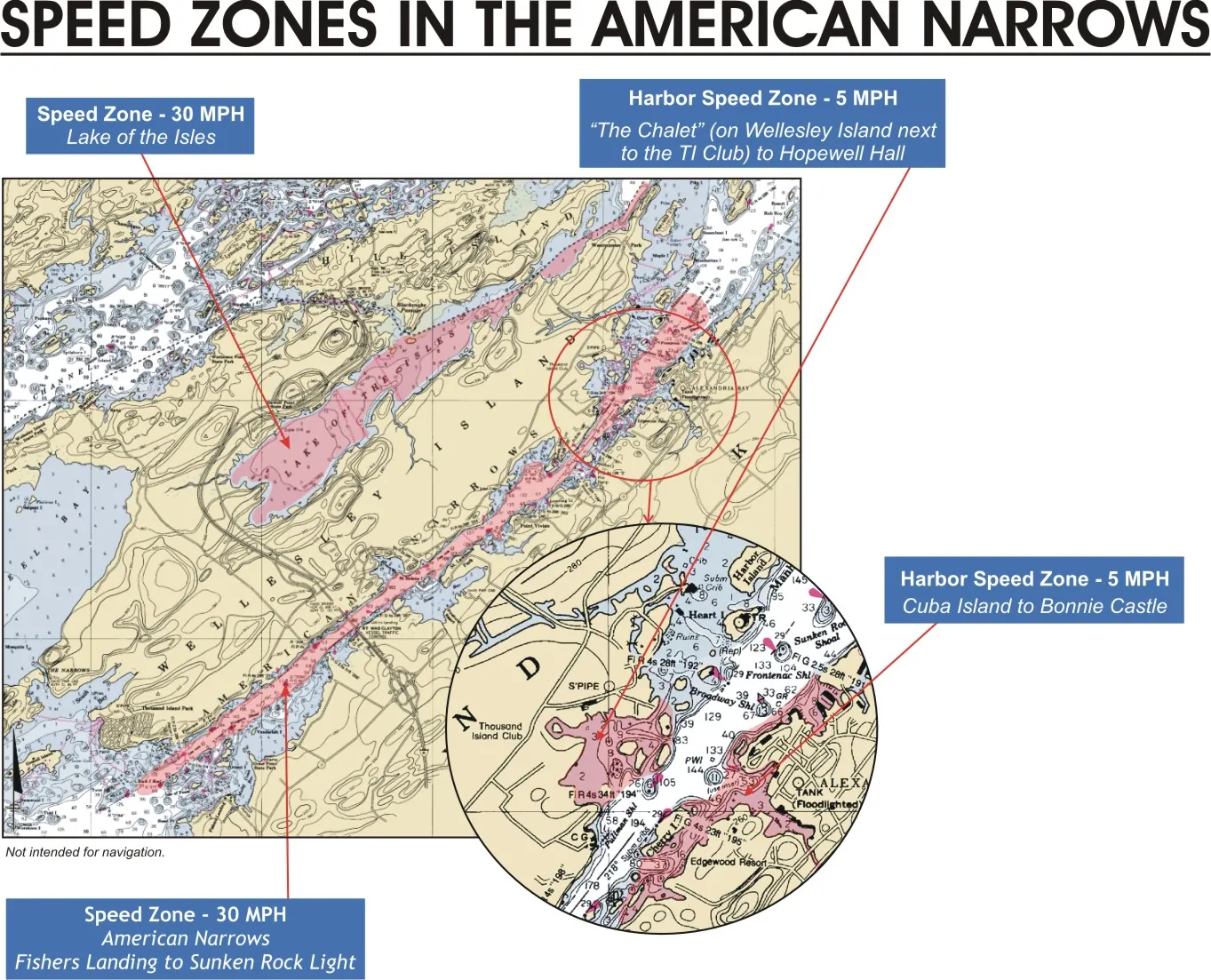
The operative speed rule is in New York Navigation Law §102.4. It applies on the St. Lawrence River “between Rock Island Light House in the town of Orleans, Jefferson county and Sunken Rock Lighthouse in the town of Alexandria, Jefferson county,” the American Narrows, a stretch described in the research materials as approximately six statute miles.[3]
During the day, the statute sets a 30 mph limit. At night, it sets a 15 mph limit. The daytime period is defined as one-half hour before sunrise to one-half hour after sunset; the nighttime period is the reverse.[3] That is why the location and time of day matter before anyone gets to adjectives like dangerous, outrageous, or reckless.
The last sentence of §102.4 is also doing work: “Where different speed limits are prescribed by this section, the more restrictive provision shall govern.”[3] That sentence keeps the American Narrows rule from being treated as a loose default whenever another speed condition can be invoked. If two limits under the section point in different directions, the tighter one controls.
| Statutory feature | What it does |
|---|---|
| Geographic boundary | St. Lawrence River between Rock Island Light House and Sunken Rock Lighthouse |
| Daytime limit | 30 mph from one-half hour before sunrise to one-half hour after sunset |
| Nighttime limit | 15 mph from one-half hour after sunset to one-half hour before sunrise |
| Conflict rule | The more restrictive speed provision governs |
| Race exclusion | Excludes boats actually competing in qualifying organized races |
Why a Speed-Zone Charge and Reckless Operation Can Sit Side by Side
The §102.4 count and the §45.1(a) count answer different questions. The American Narrows count asks whether the vessel exceeded the statutory speed limit in that specific stretch of the St. Lawrence River. The reckless-operation count asks whether the vessel was operated “in a reckless manner” so as to endanger life, limb, or property, using the separate language of Navigation Law §45.[4]
That distinction is not academic. A vessel could violate a posted or statutory speed limit without every fact necessary to prove reckless operation. Conversely, reckless operation may depend on the surrounding conduct, traffic, visibility, wake, proximity to shore, event control measures, and other circumstances, not merely on the existence of a numbered speed cap. The 157 mph allegation is relevant to both theories, but it does not make the two charges identical.
This is the part of the case where the casual setting can mislead. A charity poker run is social, organized, and often full of spectators who expect to see high-performance boats. None of that erases the statute. If the state proves the vessel was in the American Narrows zone during the statutory daytime period, the §102.4 question is narrow. If the state also proves operation meeting §45.1(a), the reckless-operation exposure is a separate matter.
The Organized-Race Exception Does Not Fit the Poker Run Materials
Section 102.4 contains an exclusion for boats “actually competing in a race held under the auspices of a racing association, chamber of commerce or duly incorporated yacht club.”[3] The words “actually competing” are hard to treat as surplus. They point to a race, not merely a gathering of fast boats, and not every sanctioned boating event becomes a race because speed is part of the culture around it.
The 1000 Islands Charity Poker Run’s own safety plan cuts against the exception. It states that the event is not a race and requires participants to follow pace boats through all designated slow zones.[5] The same materials state that the operator was not present at the mandatory rules meeting.[5] Those facts do not decide guilt, but they make the race-exception argument a poor fit on the documents available now.
There is a practical reason for reading the exception closely. Slow zones only work if event organizers, patrol officers, and other boaters can rely on them during the event. If a poker run silently carried a racing exemption through the American Narrows, the safety plan’s pace-boat requirement would have little legal or operational bite.
Penalties: Violation Exposure, Misdemeanor Exposure, and Vessel Privileges
The penalty structure explains why prosecutors or police would not have to choose between §102.4 and §45. For a first offense under §102.4, Navigation Law §73-C classifies the violation with a fine range of $100 to $250, imprisonment of up to seven days, or both.[6] Reckless operation under §45 is treated under §73-B as a misdemeanor, with a first-offense fine range of $250 to $500, imprisonment of up to 30 days, or both.[6]
Section 45 also carries a separate vessel-privilege consequence. Upon conviction for reckless operation, the court may suspend the person’s privilege to operate a vessel for a period of three to 12 months.[4] That possible suspension is attached to the reckless-operation conviction, not to the mere fact that a boat was alleged to be over the American Narrows speed limit.
The other reported counts—navigation lights, anchor or line, registration, and display of registration numbers—belong in the enforcement record, but they do not carry the legal center of this incident. They matter because equipment and registration rules are part of vessel regulation, not because they explain why the 157 mph allegation triggered the most serious public attention.
Why This Zone Has a Local Enforcement History
The American Narrows speed zone did not appear in a vacuum. Historical materials from the Thousand Islands Safe Boating Association describe a multi-year campaign that led to 30 mph zone signage in 2004, involving TISBA and former U.S. Attorney Daniel J. French, who had threatened private nuisance lawsuits against violators.[7]
That history should not be overstated. It does not prove the facts of the July 18 incident, and it does not substitute for the statutory elements of a charge. It does explain why a narrow, lighthouse-to-lighthouse stretch of the river is treated as a rule-bound shared space rather than an open straightaway.
Some local summaries also refer to other speed regimes in the Thousand Islands area, including 5 mph limits near shore or in harbor zones and a separate upriver/downriver restriction for vessels over 39 feet. The 5 mph near-shore rule appears in Navigation Law §45(2), and harbor-zone provisions appear in §102.1, but the vessels-over-39-feet summary in the research materials was not independently verified against the New York Codes, Rules and Regulations. It should not be used to enlarge the July 18 charging theory beyond the cited statutes.
What the Available Record Can and Cannot Support
The most secure legal ground is the statutory text: §102.4 defines the American Narrows speed zone; §45 supplies the reckless-operation offense; §§73-B and 73-C supply the first-offense penalty ranges; and §45(7) supplies the possible vessel-privilege suspension upon conviction.[3][4][6]
The enforcement details are less pristine as source material. The full charge list comes through a repost of a New York State Park Police release, and local reporting separately covered the 157 mph allegation and the July 18 poker-run setting.[1][2] That is enough to discuss the reported enforcement action, but not enough to treat every allegation as adjudicated fact.
On the reported facts, the case illustrates a narrow but important point in New York boating law: an alleged American Narrows speed-zone violation and an alleged reckless operation of a vessel can create separate legal exposures, and a charity poker run is not transformed into a statutory race merely because high-performance boats are participating.
References
- 157 mph boating incident coverage, WWNY / Gray Media, 2026-07-21/22
- NYS Park Police news release repost on July 18, 2026 boating charges, Newzjunky / Facebook, 2026-07-21 to 2026-07-22
- N.Y. Navigation Law Section 102, public.law
- New York Navigation Law § 45, ypdcrime.com
- N.Y. Navigation Law Sections 73-B and 73-C, public.law
- 1000 Islands Charity Poker Run Safety Plan, 1000 Islands Charity Poker Run
- TISBA articles page, Thousand Islands Safe Boating Association
Chronological incident history
No sanction cases have named this tool in the tracked record set to date. This does not imply the tool is safe — see Risk Digest for ongoing monitoring.
← Compare peer toolsReport a correction or tip
Spotted an outdated figure, a misstated fact, or a ruling this tool profile should reflect? Public comments are disabled for this content given the professional cost of a misreported case outcome, penalty amount, or rule text — use the structured correction channel instead.
Report a correction or tip for this record →