
TB-500 FDA Compounding List Decision: A Procedural Risk Case Study
This article examines the TB-500 FDA compounding list decision process as a case study in regulatory procedural risk, showing how deviations from statutory notice-and-comment requirements create legal vulnerability and prolonged uncertainty for downstream stakeholders.
- Tool
- TB-500
- Benchmark source
- FDA staff recommendation; PCAC advisory vote
- Hallucination rate
- Not measured / undisclosed
- Test methodology
- Procedural defect analysis; APA challenge; settlement; advisory committee review
- Test date
- Jul 24, 2026
There Was No Clean 2025 TB-500 FDA Compounding Decision
The safest way to read the phrase “TB-500 FDA compounding list decision 2025” is to correct it before relying on it. The current record does not show a clean, substantive FDA decision in calendar year 2025 that finally resolved whether TB-500 may be used in 503A compounding. The 2025 reference appears to point instead to the docket-and-comment posture around FDA-2025-N-6895, not to a final rule or a completed agency reversal.
As of July 24, 2026, the controlling picture is procedural rather than final: TB-500 was placed in Category 2 in 2023; Evexias Medical Systems challenged that placement under the Administrative Procedure Act; FDA settled in 2024 by agreeing to send the contested peptides through Pharmacy Compounding Advisory Committee review; public and political attention intensified in 2026; FDA staff recommended against listing TB-500; and the PCAC proceedings on July 23-24, 2026 produced an advisory recommendation that still must move through notice-and-comment rulemaking before it becomes legally operative.
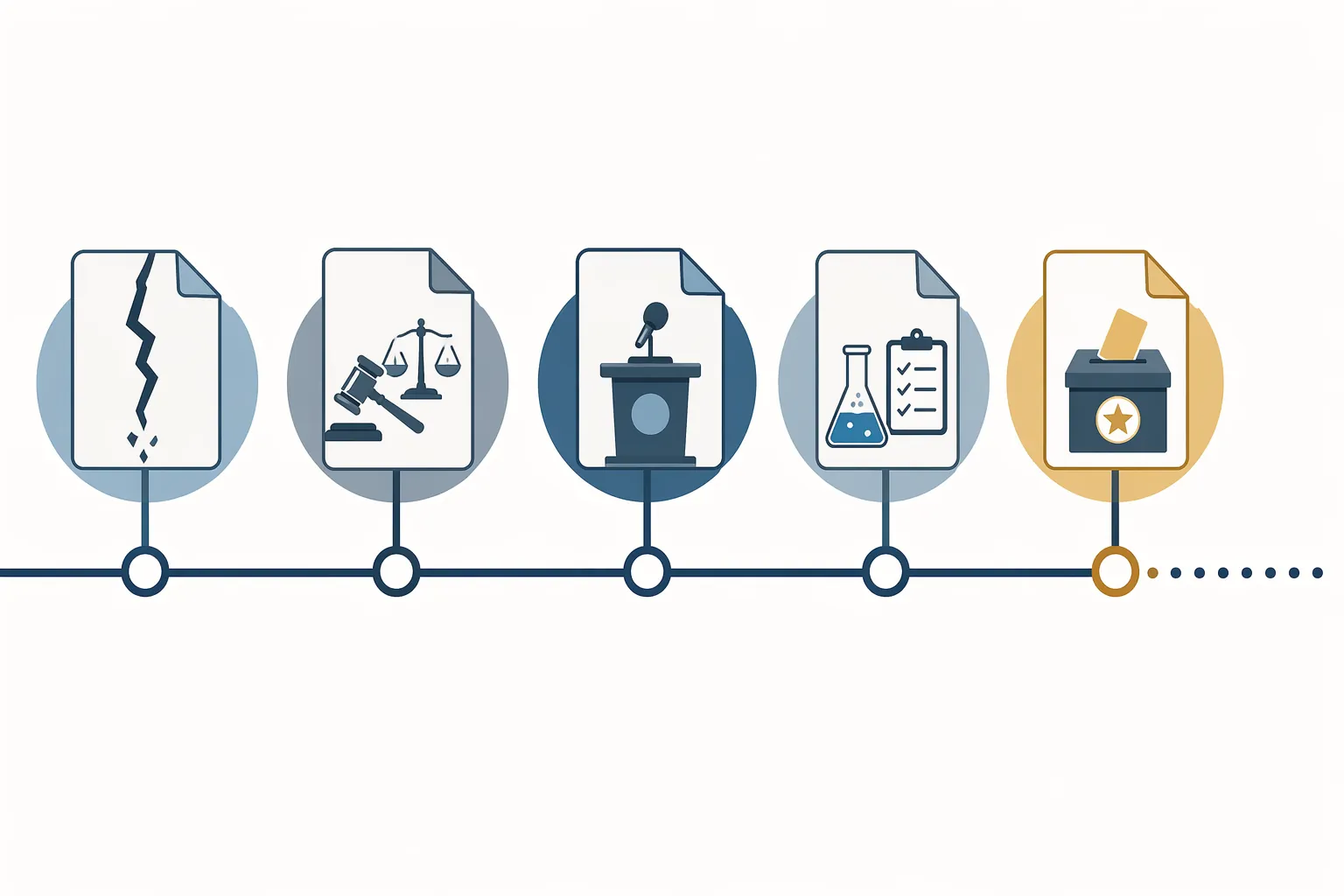
That distinction matters because a recommendation, a settlement, a docket, and a binding rule do different legal work. Treating them as interchangeable is how downstream parties end up making operational decisions on a record that has not yet finished becoming law.
- September 2023: FDA placed TB-500 in Category 2, a status used for bulk drug substances that may present significant safety risks when used in compounding. [1][2]
- 2024: Evexias Medical Systems sued FDA in federal court, alleging the Category 2 placement violated the APA; the September 2024 settlement required FDA to submit seven contested peptides for PCAC review. [3][4]
- 2025: the relevant marker appears to be docket and comment activity, not a final FDA merits decision on TB-500 compounding. [5]
- April 2026: HHS Secretary Robert F. Kennedy Jr. publicly called for relisting the peptides, giving the review an unusual political profile. [6]
- June 2026: FDA staff materials recommended against adding TB-500 to the 503A Bulks List, citing the absence of human clinical studies for wound healing and TB-500’s presence on the World Anti-Doping Agency prohibited list. [7]
- July 23-24, 2026: PCAC met to consider the peptides; Reuters and The Hill reported an 8-6-1 vote to recommend TB-500 for the 503A Bulks List, while coverage was still developing during the meeting window. [3][6]
The Legal Weak Point Was the 2023 Process
The key procedural event is not the 2026 vote. It is the 2023 Category 2 placement. Under the 503A framework, the advisory-committee consultation step is not a decorative courtesy; it is part of the statutory path for evaluating whether a bulk drug substance may be used in compounding. When TB-500 was placed in Category 2 without PCAC consultation, the record acquired a defect that could not be cured by simply insisting later that FDA scientists had safety concerns.
Category 2 is not the same thing as a final Bulks List exclusion after full rulemaking. FDA describes Category 2 as covering substances that may present significant safety risks in compounding, and the practical effect is that the substance is treated as restricted while the agency process remains unresolved. [1]
That is why the Evexias lawsuit was important even if it did not decide whether TB-500 is clinically appropriate. The litigation attacked the procedural foundation of the Category 2 placement. The 2024 settlement did not announce that TB-500 belonged on the 503A Bulks List; it forced FDA to run the omitted PCAC step for seven contested peptides. [3][4]
For compliance teams, that is the transferable point. A procedural violation can be narrower than a merits reversal and still be operationally disruptive. It can invalidate the confidence stakeholders place in an agency posture, trigger litigation, reopen records, invite political scrutiny, and leave the regulated market asking which version of the agency’s position governs today.
Staff Opposition Was Part of the Risk Signal
It would be too easy to describe the case as a clean story of process corrected and access restored. FDA’s staff review complicates that reading. Staff recommended against listing TB-500, and the cited concerns went to the quality of the clinical record and external safety signals: no human clinical studies for wound healing and inclusion on the WADA prohibited list. [7]
Those facts do not prove that FDA’s 2023 procedural route was lawful. They do explain why the advisory process mattered. A skipped consultation step is especially vulnerable when the underlying scientific record is contested, because the omitted process is where competing evidence, expert disagreement, and public comment are supposed to be organized into an administrative record capable of carrying legal weight.
The distinction is small but decisive. The staff recommendation is not a final rule. The PCAC vote is not a final rule. Both become part of the record that FDA must eventually use if it proceeds through notice-and-comment rulemaking.
The July 2026 Vote Was Advisory, Split, and Still Moving
Reuters and The Hill reported that PCAC voted 8-6-1 on July 23, 2026 to recommend placing TB-500 on the 503A Bulks List, despite FDA staff’s recommendation against listing. [3][6]
That tally should be read with date discipline. The July 23-24 meeting is current as of today, July 24, 2026, and some contemporaneous coverage was still being updated while the committee was working through the peptides. RAPS, for example, reported on the advisory committee backing two controversial peptides while noting that discussion of TB-500 was still underway at publication time. [4]
Even if the reported TB-500 recommendation stands exactly as described, it does not itself authorize compounding. PCAC advises FDA. FDA still must decide what to propose, receive and evaluate comments, and complete the legally effective rulemaking process. RAPS and FDA Law Blog coverage both emphasized that the recommendation is not binding and that the formal process could extend well beyond the meeting. [4][5]
For pharmacies, prescribers, suppliers, investors, and counsel, that means the operative risk did not disappear at the vote. The record improved in one respect: the consultation step the lawsuit targeted has now occurred. But the vote was close, the staff record remained adverse, and the legally binding step still had not been completed.
Political and Roster Concerns Made Finality Harder to Claim
The April 2026 political intervention did not prove that politics caused the committee’s recommendation. The available record does not support that causal claim. It does show that the proceeding no longer looked like a routine technical correction after settlement. The Hill reported that RFK Jr. publicly called for relisting the peptides in a podcast appearance and on X before the July advisory process. [6]
Coverage also raised concerns about the committee roster and potential conflicts around newly added PCAC members, followed by FDA’s addition of temporary voting members shortly before the meeting. Those details should not be stretched into a finding that the vote was tainted. Their significance is narrower: when a procedurally vulnerable action returns to the agency under litigation pressure, later questions about committee composition, recusals, temporary members, and political attention make it harder for downstream actors to treat the new recommendation as a clean endpoint.
This is a familiar pattern in regulatory-risk work. The original defect may be procedural. The remedial process then attracts scrutiny from parties who see advantage in reopening the record, defending the staff view, challenging the committee’s legitimacy, or accelerating access. By the time the agency reaches the point everyone calls a “decision,” there may be several different records competing for practical authority.
How to Read This Kind of Agency Record
The TB-500 timeline is useful outside FDA compounding because it gives compliance teams a way to test regulatory reliability before treating an agency position as settled. The same discipline applies in pharmaceutical regulation, financial supervision, procurement, privacy enforcement, and legal-AI governance: identify the act that binds, identify the procedure required before that act, and check whether the record shows the required step actually occurred.
| Question | Why it matters in the TB-500 record |
|---|---|
| What is the legally operative act? | The PCAC vote is advisory; the binding posture depends on FDA rulemaking and the current Category 2 status. |
| Was a required consultation step skipped? | The 2023 Category 2 placement was challenged because PCAC consultation had not occurred before the placement. |
| Did litigation change the merits or the process? | The 2024 settlement required committee review; it did not itself decide that TB-500 must be listed. |
| Does the expert record support a clean agency reversal? | FDA staff opposed listing TB-500, so the July 2026 recommendation sits against an adverse staff review. |
| Are later political or ethics disputes causal, contextual, or merely atmospheric? | The current materials support procedural caution, not a claim that political pressure caused the vote. |
| Can downstream parties identify the rule that governs today? | If not, the operational issue is not only legal compliance but timing, inventory, contracting, disclosure, and enforcement exposure. |
The practical consequence of a skipped statutory step is not limited to the agency losing a lawsuit. The more durable consequence is a period in which every actor downstream must price uncertainty: whether to continue sourcing, whether to pause compounding, whether to revise patient communications, whether to disclose regulatory risk, whether to rely on an advisory vote, and whether fresh coverage has changed the posture without changing the law.
That is why the TB-500 record should not be filed away as a peptide-access story. It is a procedural-risk case study. A 2023 defect produced a 2024 APA settlement, a 2026 advisory proceeding, staff opposition, political attention, a split reported vote, and continuing uncertainty over final rulemaking. The lesson is not that FDA will ultimately list or reject TB-500. The lesson is that when the record stops carrying its own procedural weight, the regulated market inherits the delay.
References
- Certain Bulk Drug Substances for Use in Compounding That May Present Significant Safety Risks, FDA
- FDA considers adding a dozen peptides to its bulk drug compounding list, RAPS
- FDA advisory panel votes to place popular peptide TB-500 on compounding list, Reuters, July 23, 2026
- FDA advisory committee backs two controversial peptides, RAPS, July 23, 2026
- FDA’s Pep(tide) Rally! What Compounders and Industry Need to Know, The FDA Law Blog, April 2026
- FDA panel votes to add peptides to permitted compounding list despite opposition from agency scientists, The Hill, July 23, 2026
- FDA Panel to Evaluate 7 Popular Peptides for Compounding Substances List, Drug Topics
Chronological incident history
No sanction cases have named this tool in the tracked record set to date. This does not imply the tool is safe — see Risk Digest for ongoing monitoring.
← Compare peer toolsReport a correction or tip
Spotted an outdated figure, a misstated fact, or a ruling this tool profile should reflect? Public comments are disabled for this content given the professional cost of a misreported case outcome, penalty amount, or rule text — use the structured correction channel instead.
Report a correction or tip for this record →